The Magi, like a multitude of ancient nations, worshipped fire, above all the other elements and powers of nature. In India, the Ganges and the Indus were worshipped, and the Sun was the Great Divinity. They worshipped the Moon also, and kept up the sacred fire. In Ceylon, the Sun, Moon, and other planets were worshipped: in Sumatra, the Sun, called Iri, and the Moon, called Handa. And the Chinese built Temples to Heaven, the Earth, and genii of the air, of the water, of the mountains, and of the stars, to the sea-dragon, and to the planet Mars.
The celebrated Labyrinth was built in honor of the Sun; and its twelve palaces, like the twelve superb columns of the Temple at Hieropolis, covered with symbols relating to the twelve signs and the occult qualities of the elements, were consecrated to the twelve gods or tutelary genii of the signs of the Zodiac. The
p. 460
figure of the pyramid and that of the obelisk, resembling the shape of a flame, caused these monuments to be consecrated to the Sun and to Fire. And Timæus of Locria says: “The equilateral triangle enters into the composition of the pyramid, which has four equal faces and equal angles, and which in this is like fire, the most subtle and mobile of the elements.” They and the obelisks were erected in honor of the Sun, termed in an inscription upon one of the latter, translated by the Egyptian Hermapion, and to be found in Ammianus Marcellinus, “Apollo the strong, Son of God, He who made the world, true Lord of the diadems, who possesses Egypt and fills it with His glory.”
The two most famous divisions of the Heavens, by seven, which is that of the planets, and by twelve, which is that of the signs, are found on the religious monuments of all the people of the ancient world. The twelve Great Gods of Egypt are met with everywhere. They were adopted by the Greeks and Romans; and the latter assigned one of them to each sign of the Zodiac. Their images were seen at Athens, where an altar was erected to each; and they were painted on the porticos. The People of the North had their twelve Azes, or Senate of twelve great gods, of whom Odin was chief. The Japanese had the same number, and like the Egyptians divided them into classes, seven, who were the most ancient, and five, afterward added: both of which numbers are well known and consecrated in Masonry.
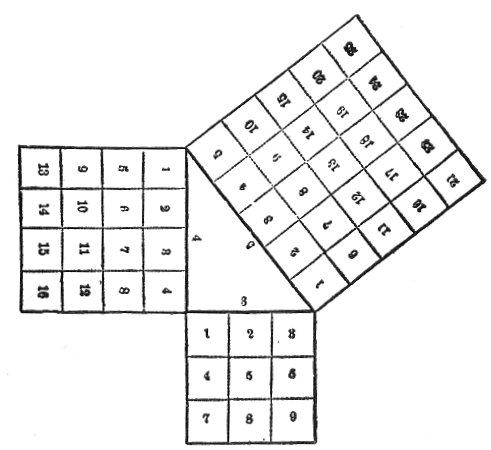
There is no more striking proof of the universal adoration paid the stars and constellations, than the arrangement of the Hebrew camp in the Desert, and the allegory in regard to the twelve Tribes of Israel, ascribed in the Hebrew legends to Jacob. The Hebrew camp was a quadrilateral, in sixteen divisions, of which the central four were occupied by images of the four elements. The four divisions at the four angles of the quadrilateral exhibited the four signs that the astrologers called fixed, and which they regard as subject to the influence of the four great Royal Stars, Regulus in Leo, Aldebarán in Taurus, Antares in Scorpio, and Fomalhaut in the mouth of Pisces, on which falls the water poured out by Aquarius; of which constellations the Scorpion was represented in the Hebrew blazonry by the Celestial Vulture or Eagle, that rises at the same time with it and is its paranatellon. The other signs were arranged on the four faces of the quadrilateral, and in the parallel and interior divisions.
p. 461
There is an astonishing coincidence between the characteristics assigned by Jacob to his sons, and those of the signs of the Zodiac, or the planets that have their domicile in those signs.
Reuben is compared to running water, unstable, and that cannot excel; and he answers to Aquarius, his ensign being a man. The water poured out by Aquarius flows toward the South Pole, and it is the first of the four Royal Signs, ascending from the Winter Solstice.
The Lion (Leo) is the device of Judah; and Jacob compares him to that animal, whose constellation in the Heavens is the domicile of the Sun; the Lion of the Tribe of Judah; by whose grip, when that of apprentice and that of fellow-craft,–of Aquarius at the Winter Solstice and of Cancer at the Vernal Equinox,–had not succeeded in raising him, Khu_ru_m was lifted out of the grave.
Moe is the founder of GnosticWarrior.com. He is a father, husband, author, martial arts black belt, and an expert in Gnosticism, the occult, and esotericism.