by Moe | Aug 31, 2011 | Ecclesiastical History of England
AFTER this, Cuthbert, as he grew in goodness and intensity of devotion, attained also to a hermit’s life of contemplation in silence and solitude, as we have mentioned. But forasmuch as many years ago we wrote enough concerning his life and virtues, both in heroic verse and prose,it may suffice at present only to mention this, that when he was about to go to the island, he declared to the brothers, “If by the grace of God it shall be granted to me, that I may live in that place by the labour of my hands, I will willingly abide there; but if not, God willing, I will very soon return to you.” The place was quite destitute of water, corn, and trees; and being infested by evil spirits, was very ill suited for human habitation; but it became in all respects habitable, at the desire of the man of God; for at his coming the wicked spirits departed. When, after expelling the enemy, he had, with the help of the brethren, built himself a narrow dwelling, with a mound about it, and the necessary cells in it, to wit, an oratory and a common living room, he ordered the brothers to dig a pit in the floor of the room, although the ground was hard and stony, and no hopes appeared of any spring. When they had done this relying upon the faith and prayers of the servant of God, the next day it was found to be full of water, and to this day affords abundance of its heavenly bounty to all that resort thither. He also desired that instruments for husbandry might be brought him, and some wheat; but having prepared the ground and sown the wheat at the proper season, no sign of a blade, not to speak of ears, had sprouted from it by the summer. Hereupon, when the brethren visited him according to custom, he ordered barley to be brought him, if haply it were either the nature of the soil, or the will of God, the Giver of all things, that such grain rather should grow there. He sowed it in the same field, when it was brought him, after the proper time of sowing, and therefore without any likelihood of its bearing fruit; but a plentiful crop immediately sprang up, and afforded the man of God the means which he had desired of supporting himself by his own labour.
When he had here served God in solitude many years, the mound which encompassed his dwelling being so high, that he could see nothing from it but heaven, which he thirsted to enter, it happened that a great synod was assembled in the presence of King Egfrid, near the river Alne, at a place called Adtuifyrdi, which signifies “at the two fords,” in which Archbishop Theodore, of blessed memory, presided, and there Cuthbert was, with one mind and consent of all, chosen bishop of the church of Lindisfarne. They could not, however, draw him from his hermitage, though many messengers and letters were sent to him. At last the aforesaid king himself, with the most holy Bishop and other religious and powerful men, sailed to the island; many also of the brothers from the isle of Lindisfarne itself, assembled together for the same purpose: they all knelt, and conjured him by the Lord, with tears and entreaties, till they drew him, also in tears, from his beloved retreat, and forced him to go to the synod. When he arrived there, he was very reluctantly overcome by the unanimous resolution of all present, and compelled to take upon himself the duties of the episcopate; being chiefly prevailed upon by the words of Boisil, the servant of God, who, when he had prophetically foretold all things that were to befall him, had also predicted that he should be a bishop. Nevertheless, the consecration was not appointed immediately; but when the winter, which was then at hand, was over, it was carried out at Easter, in the city of York, and in the presence of the aforesaid King Egfrid; seven bishops coming together for his consecration, among whom, Theodore, of blessed memory, was Primate. He was first elected bishop of the church of Hagustald, in the place of Tunbert,who had been deposed from the episcopate; but because he chose rather to be placed over the church of Lindisfarne, in which he had lived, it was thought fit that Eata should return to the see of the church of Hagustald, to which he had been first ordained, and that Cuthbert should take upon him the government of the church of Lindisfarne.
Moe is the founder of GnosticWarrior.com. He is a father, husband, author, martial arts black belt, and an expert in Gnosticism, the occult, and esotericism.
by Moe | Aug 31, 2011 | Ecclesiastical History of England
HAVING spent two years in his bishopric, he returned to his island and hermitage,being warned of God that the day of his death, or rather of his entrance into that life which alone can be called life, was drawing near; as he, at that time, with his wonted candour, signified to certain persons, though in words which were somewhat obscure, but which were nevertheless afterwards plainly understood; while to others he declared the same openly.
There was a certain priest, called Herebert, a man of holy life, who had long been united with the man of God, Cuthbert, in the bonds of spiritual friendship. This man leading a solitary life in the island of that great lake from which the river Derwent flows at its beginning, was wont to visit him every year, and to receive from him the teaching of everlasting salvation. Hearing that Bishop Cuthbert was come to the city of Lugubalia, he went thither to him, according to his custom, seeking to be more and more inflamed in heavenly desires through his wholesome admonitions. Whilst they alternately entertained one another with draughts of the celestial life, the bishop, among other things, said, “Brother Herebert, remember at this time to ask me and speak to me concerning all whereof you have need to ask and speak; for, when we part, we shall never again see one another with bodily eyesight in this world. For I know of a surety that the time of my departure is at hand, and that shortly I must put off this my tabernacle.” Hearing these words, Herebert fell down at his feet, with tears and lamentations, and said, “I beseech you, by the Lord, not to forsake me; but to remember your most faithful companion, and entreat the mercy of God that, as we have served Him together upon earth, so we may depart together to behold His grace in Heaven. For you know that I have always endeavoured to live according to the words of your lips, and likewise whatsoever faults I have committed, either through ignorance or frailty, I, have instantly sought to amend according to the judgement of your will.” The bishop applied himself to prayer, and having presently had intimation in the spirit that he had obtained what he asked of the Lord, he said, “Rise, brother, and do not weep, but rejoice greatly because the mercy of Heaven has granted what we desired.”
The event established the truth of this promise and prophecy, for after their parting, they never again saw one another in the flesh; but their spirits quitting their bodies on one and the same day, to wit, the 20th of March,were immediately united in fellowship in the blessed vision, and together translated to the heavenly kingdom by the ministry of angels. But Herebert was first wasted by a long-continued infirmity, through the dispensation of the Lord’s mercy, as may be believed, to the end that if he was in any wise inferior in merit to the blessed Cuthbert, that which was lacking might be supplied by the chastening pain of a long sickness, that being thus made equal in grace to his intercessor, as he departed out of the body at one and the same time with him, so he might be accounted worthy to be received into the like abode of eternal bliss.
The most reverend father died in the isle of Fame, earnestly entreating the brothers that he might also be buried there, where he had served no small time under the Lord’s banner. But at length yielding to their entreaties, he consented to be carried back to the isle of Lindisfarne, and there buried in the church.This being done, the venerable Bishop Wilfrid held the episcopal see of that church one year, till such time as a bishop should be chosen to be ordained in the room of Cuthbert. Afterwards Eadbertwas ordained, a man renowned for his knowledge of the Holy Scriptures, as also for his observance of the heavenly precepts, and chiefly for almsgiving, so that, according to the law, he gave every year the tenth part, not only of four-footed beasts, but also of all corn and fruit, as also of his garments, to the poor.
Moe is the founder of GnosticWarrior.com. He is a father, husband, author, martial arts black belt, and an expert in Gnosticism, the occult, and esotericism.
by Moe | Aug 31, 2011 | Ecclesiastical History of England
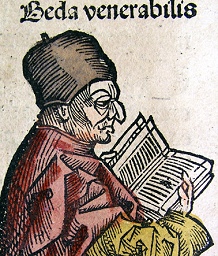
Bede’s Ecclesiastical History of England
ed. by A.M. Sellar
[1907]
Start Reading
Title Page
Preface
Introduction
Life of Bede
Book I
I. Of the Situation of Britain and Ireland, and of their ancient inhabitants
II. How Caius Julius Caesar was the first Roman that came into Britain. [54 AD]
III. How Claudius, the second of the Romans who came into Britain, brought the islands Orcades
IV. How Lucius, king of Britain, writing to Pope Eleutherus, desired to be made a Christian.
V. How the Emperor Severus divided from the rest by a rampart that part of Britain which had been recovered.
VI. Of the reign of Diocletian, and how he persecuted the Christians. [286 AD]
VII. How, when the persecution ceased, the Church in Britain enjoyed peace till the time of the
VIII. How during the reign of Gratian, Maximus, being created Emperor in Britain, returned into Gaul with a mighty army. [377 AD]
IX. How, in the reign of Arcadius, Pelagius, a Briton, insolently impugned the Grace of God. [395 AD]
X. How during the reign of Honorius, Gratian and Constantine were created tyrants in Britain; and soon after the former was slain in Britain, and the latter in Gaul. [407 A.D.]
XI. How the Britons, being ravaged by the Scots and Picts, sought succour from the Romans,
XII. How in the reign of Theodosius the younger, in whose time Palladius was sent to the Scots that believed in Christ, the Britons begging assistance of Aetius, the consul, could not obtain it. [446 A.D.]
XIII. How the Britons, compelled by the great famine, drove the barbarians out of their territories
XIV. How the Angles, being invited into Britain, at first drove off the enemy; but not long after, making a league with them, turned their weapons against their allies.
XV. How the Britons obtained their first victory over the Angles, under the command of
XVI. How Germanus the Bishop, sailing into Britain with Lupus, first quelled the tempest of the
XVII. How the same holy man gave sight to the blind daughter of a tribune, and then coming to St. Alban, there received of his relics, and left other relics of the blessed Apostles and other martyrs. [429 A.D.]
XVIII. How the same holy man, being detained there by sickness, by his prayers quenched a fire [429 A.D.]
XIX. How the same Bishops brought help from Heaven to the Britons in a battle, and then returned home.
XX. How, when the Pelagian heresy began to spring up afresh, Germanus, returning to Britain
XXI. How the Britons, being for a time at rest from foreign invasions, wore themselves out by civil
XXII. How the holy Pope Gregory sent Augustine, with other monks, to preach to the English
XXIII. How he wrote to the bishop of Arles to entertain them. [596 A.D.]
XXIV. How Augustine, coming into Britain, first preached in the Isle of Thanet to the King of Kent, and having obtained licence from him, went into Kent, in order to preach therein. [597 A. D.]
XXV. How St. Augustine in Kent followed the doctrine and manner of life of the primitive Church,
XXVI. How St. Augustine, being made a bishop, sent to acquaint Pope Gregory with what had
XXVII. How Pope Gregory wrote to the bishop of Aries to help Augustine in the work of God. [601 A.D.]
XXVIII. How the same Pope sent to Augustine the Pall and a letter, along with several ministers of the Word. [601 A.D.]
XXIX. A copy of the letter which Pope Gregory sent to the Abbot Mellitus, then going into Britain. [601 A.D.]
XXX. How Pope Gregory, by letter, exhorted Augustine not to glory in his miracles. [601 A.D.]
XXXI. How Pope Gregory sent letters and gifts to King Ethelbert. [601 A.D.]
XXXII. How Augustine repaired the church of our Saviour, and built the monastery of the blessed
XXXIII. How Ethelfrid, king of the Northumbrians, having vanquished the nations of the Scots,
Book II
I. Of the death of the blessed Pope Gregory. [604 A.D.]
II. How Augustine admonished the bishops of the Britons on behalf of Catholic peace, and to that end wrought a heavenly miracle in their presence; and of the vengeance that pursued them for their contempt. [Circ. 603 A.D.]
Moe is the founder of GnosticWarrior.com. He is a father, husband, author, martial arts black belt, and an expert in Gnosticism, the occult, and esotericism.
by Moe | Aug 30, 2011 | Ecclesiastical History of England
IN the beginning of Aldfrid’s reign, Bishop Eata died, and was succeeded in the bishopric of the church of Hagustald by the holy man John, of whom those that knew him well are wont to tell many miracles, and more particularly Berthun, a man worthy of all reverence and of undoubted truthfulness, and once his deacon, now abbot of the monastery called Inderauuda, that is, “In the wood of the Deiri”: some of which miracles we have thought fit to hand on to posterity. There is a certain remote dwelling enclosed by a mound, among scattered trees, not far from the church of Hagustald, being about a mile and a half distant and separated from it by the river Tyne, having an oratory dedicated to St. Michael the Archangel, where the man of God used frequently, as occasion offered, and specially in Lent, to abide with a few companions and in quiet give himself to prayer and study. Having come hither once at the beginning of Lent to stay, he bade his followers find out some poor man labouring under any grievous infirmity, or want, whom they might keep with them during those days, to receive alms, for so he was always used to do.
There was in a township not far off, a certain youth who was dumb, known to the bishop, for he often used to come into his presence to receive alms. He had never been able to speak one word; besides, he had so much scurf and scab on his head, that no hair could ever grow on the top of it, but only some rough hairs stood on end round about it. The bishop caused this young man to be brought, and a little hut to be made for him within the enclosure of the dwelling, in which he might abide, and receive alms from him every day. When one week of Lent was over, the next Sunday he bade the poor man come to him, and when he had come, he bade him put his tongue out of his mouth and show it him; then taking him by the chin, he made the sign of the Holy Cross on his tongue, directing him to draw it back so signed into his mouth and to speak. “Pronounce some word,” said he; “say ‘gae,’ ” which, in the language of the English, is the word of affirming and consenting, that is, yes. The youth’s tongue was immediately loosed, and he spoke as he was bidden. The bishop then added the names of the letters: “Say A.” He said A. “Say B;” he said B also. When he had repeated all the letters after the bishop, the latter proceeded to put syllables and words to him, and when he had repeated them all rightly he bade him utter whole sentences, and he did it. Nor did he cease all that day and the next night, as long as he could keep awake, as those who were present relate, to say something, and to express his private thoughts and wishes to others, which he could never do before; after the manner of the man long lame, who, when he was healed by the Apostles Peter and John, leaping up, stood and walked, and entered with them into the temple, walking, and leaping, and praising the Lord, rejoicing to have the use of his feet, which he had so long lacked. The bishop, rejoicing with him at his cure, caused the physician to take in hand the healing of the sores of his head. He did as he was bidden, and with the help of the bishop’s blessing and prayers, a goodly head of hair grew as the skin was healed. Thus the youth became fair of countenance, ready of speech, with hair curling in comely fashion, whereas before he had been ill-favoured, miserable, and dumb. Thus filled with joy at his recovered health, notwithstanding that the bishop offered to keep him in his own household, he chose rather to return home.
Next: How he healed a sick maiden by his prayers. [705 A.D.]
Index
Moe is the founder of GnosticWarrior.com. He is a father, husband, author, martial arts black belt, and an expert in Gnosticism, the occult, and esotericism.
by Moe | Aug 30, 2011 | Ecclesiastical History of England
THE same Berthun told another miracle concerning the said bishop. When the most reverend Wilfrid, after a long banishment, was admitted to the bishopric of the church of Hagustald, and the aforesaid John, upon the death of Bosa, a man of great sanctity and humility, was, in his place, appointed bishop of York, he himself came, once upon a time, to the monastery of nuns, at the place called Wetadun, where the Abbess Heriburg then presided. “When we were come thither,” said he, “and had been received with great and universal joy, the abbess told us, that one of the nuns, who was her own daughter after the flesh, laboured under a grievous sickness, for she had been lately let blood in the arm, and whilst she was under treatment, was seized with an attack of sudden pain, which speedily increased, while the wounded arm became worse, and so much swollen, that it could scarce be compassed with both hands; and she lay in bed like to die through excess of pain. Wherefore the abbess entreated the bishop that he would vouchsafe to go in and give her his blessing; for she believed that she would soon be better if he blessed her or laid his hands upon her. He asked when the maiden had been let blood, and being told that it was on the fourth day of the moon, said, ‘You did very indiscreetly and unskilfully to let blood on the fourth day of the moon; for I remember that Archbishop Theodore, of blessed memory, said, that blood-letting at that time was very dangerous, when the light of the moon is waxing and the tide of the ocean is rising. And what can I do for the maiden if she is like to die?’
“But the abbess still earnestly entreated for her daughter, whom she dearly loved, and designed to make abbess in her stead, and at last prevailed with him to go in and visit the sick maiden. Wherefore he went in, taking me with him to the maid, who lay, as I said, in sore anguish, and her arm swelling so greatly that it could not be bent at all at the elbow; and he stood and said a prayer over her, and having given his blessing, went out. Afterwards, as we were sitting at table, at the usual hour, some one came in and called me out, saying, ‘Quoenburg’ (that was the maid’s name) ‘desires that you should immediately go back to her.’ This I did, and entering the chamber, I found her of more cheerful countenance, and like one in good health. And while I was sitting beside her, she said, “Shall we call for something to drink? ‘—‘ Yes,’ said I, ‘and right glad am I, if you can.’ When the cup was brought, and we had both drunk, she said, ‘As soon as the bishop had said the prayer for me and given me his blessing and had gone out, I immediately began to mend; and though I have not yet recovered my former strength, yet all the pain is quite gone both from my arm, where it was most burning, and from all my body, as if the bishop had carried it away with him; notwithstanding the swelling of the arm still seems to remain.’ But when we departed thence, the cure of the pain in her limbs was followed by the assuaging of the grievous swelling; and the maiden being thus delivered from pains and death, returned praise to our Lord and Saviour, in company with His other servants who were there.
Next: How he healed a thegn’s wife that was sick, with holy water.
Index
Moe is the founder of GnosticWarrior.com. He is a father, husband, author, martial arts black belt, and an expert in Gnosticism, the occult, and esotericism.