In a free country, human speech must needs be free; and the State must listen to the maunderings of folly, and the screechings of its geese, and the brayings of its asses, as well as to the golden oracles of its wise and great men. Even the despotic old kings allowed their wise fools to say what they liked. The true alchemist will extract the lessons of wisdom from the babblings of folly. He will hear what a man has to say on any given subject, even if the speaker end only in proving himself prince of fools. Even a fool will sometimes hit the mark. There is some truth in all men who are not compelled to suppress their souls and speak other men’s thoughts. The finger even of the idiot may point to the great highway.
A people, as well as the sages, must learn to forget. If it neither learns the new nor forgets the old, it is fated, even if it has been royal for thirty generations. To unlearn is to learn; and also it is sometimes needful to learn again the forgotten. The antics of fools make the current follies more palpable, as fashions are shown to be absurd by caricatures, which so lead to their extirpation. The buffoon and the zany are useful in their places. The ingenious artificer and craftsman, like Solomon, searches the earth for his materials, and transforms the misshapen matter into glorious workmanship. The world is conquered by the head even more than by the hands. Nor will any assembly talk forever. After a time, when it has listened long enough, it quietly puts the silly, the shallow, and the superficial to one side,–it thinks, and sets to work.
The human thought, especially in popular assemblies, runs in the most singularly crooked channels, harder to trace and follow than the blind currents of the ocean. No notion is so absurd that it may not find a place there. The master-workman must train
p. 57
these notions and vagaries with his two-handed hammer. They twist out of the way of the sword-thrusts; and are invulnerable all over, even in the heel, against logic. The martel or mace, the battle-axe, the great double-edged two-handed sword must deal with follies; the rapier is no better against them than a wand, unless it be the rapier of ridicule.
The SWORD is also the symbol of war and of the soldier. Wars, like thunder-storms, are often necessary to purify the stagnant atmosphere. War is not a demon, without remorse or reward. It restores the brotherhood in letters of fire. When men are seated in their pleasant places, sunken in ease and indolence, with Pretence and Incapacity and Littleness usurping all the high places of State, war is the baptism of blood and fire, by which alone they can be renovated. It is the hurricane that brings the elemental equilibrium, the concord of Power and Wisdom. So long as these continue obstinately divorced, it will continue to chasten.
In the mutual appeal of nations to God, there is the acknowledgment of His might. It lights the beacons of Faith and Freedom, and heats the furnace through which the earnest and loyal pass to immortal glory. There is in war the doom of defeat, the quenchless sense of Duty, the stirring sense of Honor, the measureless solemn sacrifice of devotedness, and the incense of success. Even in the flame and smoke of battle, the Mason discovers his brother, and fulfills the sacred obligations of Fraternity.
Two, or the Duad, is the symbol of Antagonism; of Good and Evil, Light and Darkness. It is Cain and Abel, Eve and Lilith, Jachin and Boaz, Ormuzd and Ahriman, Osiris and Typhon.
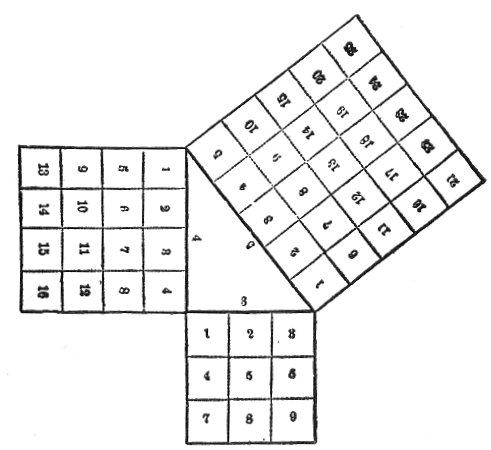
THREE, or the Triad, is most significantly expressed by the equilateral and the right-angled triangles. There are three principal colors or rays in the rainbow, which by intermixture make seven. The three are the blue, the yellow, and the red. The Trinity of the Deity, in one mode or other, has been an article in all creeds. He creates, preserves, and destroys. He is the generative power, the productive capacity, and the result. The immaterial man, according to the Kabalah, is composed of vitality, or life, the breath of life; of soul or mind, and spirit. Salt, sulphur, and mercury are the great symbols of the alchemists. To them man was body, soul, and spirit.
Moe is the founder of GnosticWarrior.com. He is a father, husband, author, martial arts black belt, and an expert in Gnosticism, the occult, and esotericism.