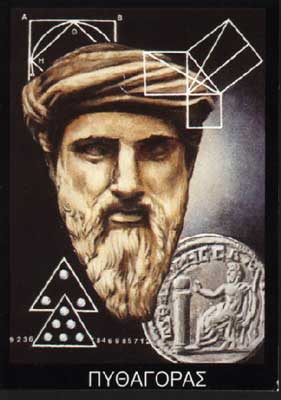
The therapeutic music of Pythagoras is described by Iamblichus thus: “And there are certain melodies devised as remedies against the passions of the soul, and also against despondency and lamentation, which Pythagoras invented as things that afford the greatest assistance in these maladies. And again, he employed other melodies against rage and anger, and against every aberration of the soul. There is also another kind of modulation invented as a remedy against desires.” (See The Life of Pythagoras.)
It is probable that the Pythagoreans recognized a connection between the seven Greek modes and the planets. As an example, Pliny declares that Saturn moves in the Dorian mode and Jupiter in the Phrygian mode. It is also apparent that the temperaments are keyed to the various modes, and the passions likewise. Thus, anger–which is a fiery passion–may be accentuated by a fiery mode or its power neutralized by a watery mode.
The far-reaching effect exercised by music upon the culture of the Greeks is thus summed up by Emil Nauman: “Plato depreciated the notion that music was intended solely to create cheerful and agreeable emotions, maintaining rather that it should inculcate a love of all that is noble, and hatred of all that is mean, and that nothing could more strongly influence man’s innermost feelings than melody and rhythm. Firmly convinced of this, he agreed with Damon of Athens, the musical instructor of Socrates, that the introduction of a new and presumably enervating scale would endanger the future of a whole nation, and that it was not possible to alter a key without shaking the very foundations of the State. Plato affirmed that music which ennobled the mind was of a far higher kind than that which merely appealed to the senses, and he strongly insisted that it was the paramount duty of the Legislature to suppress all music of an effeminate and lascivious character, and to encourage only s that which was pure and dignified; that bold and stirring melodies were for men, gentle and soothing ones for women. From this it is evident that music played a considerable part in the education of the Greek youth. The greatest care was also to be taken in the selection of instrumental music, because the absence of words rendered its signification doubtful, and it was difficult to foresee whether it would exercise upon the people a benign or baneful influence. Popular taste, being always tickled by sensuous and meretricious effects, was to be treated with deserved contempt. (See The History of Music.)
Even today martial music is used with telling effect in times of war, and religious music, while no longer developed in accordance with the ancient theory, still profoundly influences the emotions of the laity.
THE MUSIC OF THE SPHERES
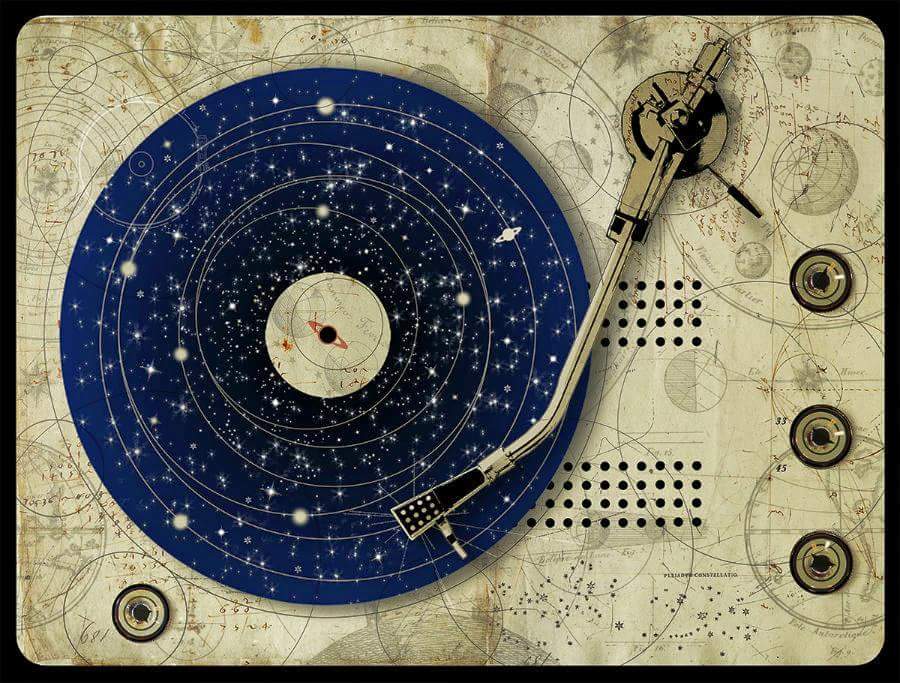
The most sublime but least known of all the Pythagorean speculations was that of sidereal harmonics. It was said that of all men only Pythagoras heard the music of the spheres. Apparently the Chaldeans were the first people to conceive of the heavenly bodies joining in a cosmic chant as they moved in stately manner across the sky. Job describes a time “when the stars of the morning sang together,” and in The Merchant of Venicethe author of the Shakesperian plays
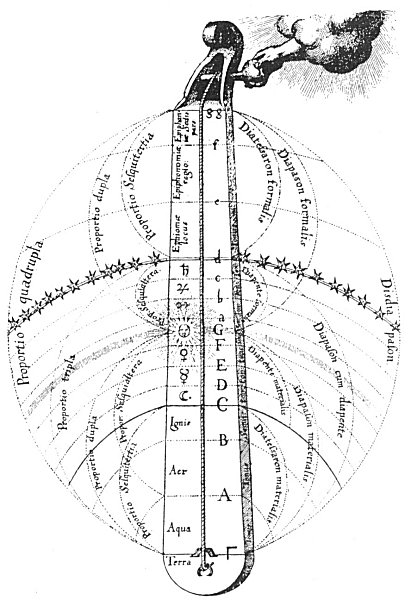
THE MUNDANE MONOCHORD WITH ITS PROPORTIONS AND INTERVALS.
From Fludd’s De Musica Mundana. In this chart is set forth a summary of Fludd’s theory of universal music. The interval between the element of earth and the highest heaven is considered as a double octave, thus showing the two extremes of existence to be in disdiapason harmony. It is signifies that the highest heaven, the sun, and the earth have the same time, the difference being in pitch. The sun is the lower octave of the highest heaven and the earth the lower octave of the sun. The lower octave (Γ to G) comprises that part of the universe in which substance predominate over energy. Its harmonies, therefore, are more gross than those of the higher octave (G to g) wherein energy predominates over substance. “If struck in the more spiritual part,” writes Fludd, “the monochord will give eternal life; if in the more material part, transitory life.” It will be noted that certain elements, planets, and celestial spheres sustain a harmonic ratio to each other, Fludd advanced this as a key to the sympathies and antipathies existing between the various departments of Nature.
Moe is the founder of GnosticWarrior.com. He is a father, husband, author, martial arts black belt, and an expert in Gnosticism, the occult, and esotericism.