Julius Caesar was known as “Divus Iulius” (Latin for “Julius is God”),and his son Augustus would be given the title of Divi Filius (Latin for the “Son of a God”). Later Augustus would be known as the Savior to the Romans, and over time, savior to much of the world.
“Jesus of Nazareth, the Grand Master of our order, appeared at a time when the world was in the utmost Disorder, and among a people who for ages had groaned under the yolk of Bondage. He taught them the lessons of reason. To be more effective, he took the aid of Religion–of opinions which were current–and in a very clever manner, he combined his secret doctrines with he popular religion, and with the customs which lay to his hand.
A brothers blood is spilled as another ages prophecy is fulfilled.
The name of the ancient priesthood that Augustus Caesar had restored, was the high priests of Jupiter-Amon (Flamen Dialis), or the Arval Brothers who were also connected originally with the Sabine,or Sabazian priesthood [Pike -from Saba-Zeus, an oriental name of this Deity] of Sodales Titii. 33rd degree freemason, Albert McKay says this about the Sabazians; “The Mysteries of Bacchus were known as the Sabazian, Orphic and Dionysiac festivals. They went back to the remotest antiquity among the Greeks.”
Octavian restored the college to its old rank and gained also the additional advantage that the people were impressed with the moral righteousness of their cause against Antony and Cleopatra, and also with the fact that it was a foreign, _i.e._ an international war, and not a civil one, in which they were about to engage. The effect of Octavian’s restoration was a lasting one, for from this time on, this priesthood was held in high honour during the whole of the empire, and the emperors themselves were members of it.
Tacitus, a priest in the Brotherhood had said; “The reverence due to the gods was no longer exclusive. Augustus claimed equal worship. Temples were built and statues were erected to him; a mortal man was adored; and priests and pontiffs were appointed to pay him impious homage.”
as the cornerstone who binds the Jews with the Gentiles in one building, as two walls with two different directions mingled together. He said: “It happened in the day of His birth that the Jewish shepherds saw Him, while in the day of Epiphany, the Gentile wise men worshiped Him. Truly, He was born as a cornerstone for both.
Saint Bede, the Father of English History and Doctor of the Church had written in his Biographical Writings and Letters;“In the forty-second year of Augustus Caesar, in the twenty-seventh from the death of Antony and Cleopatra, when Egypt became a Roman Province, in the third year of the 193rd Olympiad, and in the 752nd from the building of the city, in the year when all the commotions of nations were stilled throughout the whole world, and by the appointment of God, Caesar had established real and durable tranquility,
Jesus Christ consecrated by his advent of the 6th age of the world.”
Moe is the founder of GnosticWarrior.com. He is a father, husband, author, martial arts black belt, and an expert in Gnosticism, the occult, and esotericism.
“The practice of magick – either white or black – depends upon the ability of the adept to control the universal life force – that which Eliphas Levi calls the great magical agent or astral light….in the arcanum of magic it is declared that ‘he controls the soul who controls the blood of another.”
True black magic is performed with the aid of a demoniacal spirit, who serves the sorcerer for the length of his earthly life, with the understanding that after death the magician shall become the servant of his own demon. For this reason a black magician will go to inconceivable ends to prolong his physical life, since there is nothing for him beyond the grave. – Manly P. Hall
(Source: Many P. Hall Secret Teachings of All Ages) – CEREMONIAL magic is the ancient art of invoking and controlling spirits by a scientific application of certain formulae. A magician, enveloped in sanctified vestments and carrying a wand inscribed with hieroglyphic figures, could by the power vested in certain words and symbols control the invisible inhabitants of the elements and of the astral world. While the elaborate ceremonial magic of antiquity was not necessarily evil, there arose from its perversion several false schools of sorcery, or black magic.
Egypt, a great center of learning and the birthplace of many arts and sciences, furnished an ideal environment for Transcendental experimentation. Here the black magicians of Atlantis continued to exercise their superhuman powers until they had completely undermined and corrupted the morals of the primitive Mysteries. By establishing a sacerdotal caste they usurped the position formerly occupied by the initiates, and seized the reins of spiritual government.
Thus black magic dictated the state religion and paralyzed the intellectual and spiritual activities of the individual by demanding his complete and unhesitating acquiescence in the dogma formulated by the priestcraft. The Pharaoh became a puppet in the hands of the Scarlet Council — a committee of archsorcerers elevated to power by the priesthood.
These sorcerers then began the systematic destruction of all keys to the ancient wisdom, so that none might have access to the knowledge necessary to reach adeptship without first becoming one of their order. They mutilated the rituals of the Mysteries while professing to preserve them, so that even though the neophyte passed through the degrees he could not secure the knowledge to which he was entitled. Idolatry was introduced by encouraging the worship of the images which in the beginning the wise had erected solely as symbols for study and meditation.
False interpretations were given to the emblems and figures of the Mysteries, and elaborate theologies were created to confuse the minds of their devotees. The masses, deprived of their birthright of understanding and groveling in ignorance, eventually became the abject slaves of the spiritual impostors. Superstition universally prevailed and the black magicians completely dominated national affairs, with the result that humanity still suffers from the sophistries of the priestcrafts of Atlantis and Egypt.
Fully convinced that their Scriptures sanctioned it, numerous medieval Qabbalists devoted their lives to the practice of ceremonial magic. The transcendentalism of the Qabbalists is founded upon the ancient and magical formula of King Solomon, who has long been considered by the Jews as the prince of ceremonial magicians.
Among the Qabbalists of the Middle Ages were a great number of black magicians who strayed from the noble concepts of the Sepher Yetzirah and became enmeshed in demonism and witchcraft. They sought to substitute magic mirrors, consecrated daggers, and circles spread around posts of coffin nails, for the living of that virtuous life which, without the assistance of complicated rituals or submundane creatures, unfailingly brings man to the state of true individual completion.
Those who sought to control elemental spirits through ceremonial magic did so largely with the hope of securing from the invisible worlds either rare knowledge or supernatural power. The little red daemon of Napolean Bonaparte and the infamous oracular heads of de Medici are examples of the disastrous results of permitting elemental beings to dictate the course of human procedure.
While the learned and godlike daemon of Socrates seems to have been an exception, this really proves that the intellectual and moral status of the magician has much to do with the type of elemental he is capable of invoking. But even the daemon of Socrates deserted the philosopher when the sentence of death was passed.
Transcendentalism and all forms of phenomenalistic magic are but blind alleys — outgrowths of Atlantean sorcery; and those who forsake the straight path of philosophy to wander therein almost invariably fall victims to their imprudence. Man, incapable of controlling his own appetites, is not equal to the task of governing the fiery and tempestuous elemental spirits.
Many a magician has lost his life as the result of opening a way whereby submundane creatures could become active participants in his affairs. When Eliphas Levi invoked the spirit of Apollonius of Tyana, what did he hope to accomplish? Is the gratification of curiosity a motive sufficient to warrant the devotion of an entire lifetime to a dangerous and unprofitable pursuit? If the living Apollonius refused to divulge his secrets to the profane, is there any probability that after death he would disclose them to the curious-minded?
Levi himself did not dare to assert that the specter which appeared to him was actually the great philosopher, for Levi realized only too well the proclivity of elementals to impersonate those who have passed on. The majority of modern mediumistic apparitions are but elemental creatures masquerading through bodies composed of thought substance supplied by the very persons desiring to behold these wraiths of decarnate beings.
The Theory and Practice of Black Magic
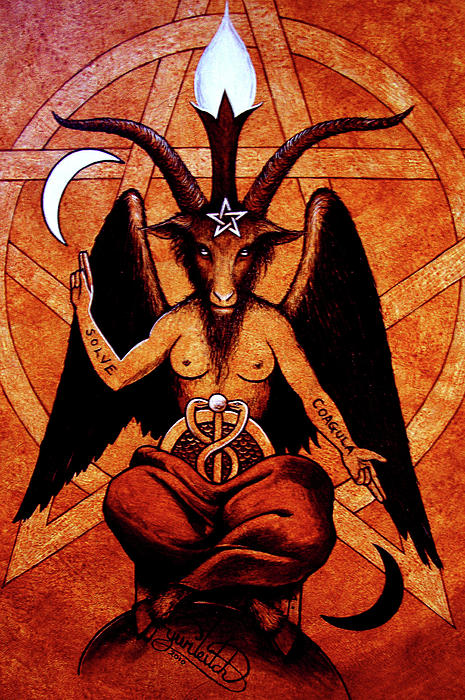
Baphomet: The Goat of Mendes
The practice of magick – either white or black – depends upon the ability of the adept to control the universal life force – that which Eliphas Levi calls the great magical agent or astral light.
By the manipulation of this fluidic essence, the phenomena of transcendentalism are produced.
The famous hermaphroditic Goat of Mendes was a composite creature formulated to symbolize this astral light. It is identical with Baphomet, the mystic pantheos of those disciples of ceremonial magic, the Templars, who probably obtained it from the Arabians.
Some understanding of the intricate theory and practice of ceremonial magic may be derived from a brief consideration of its underlying premises.
First. The visible universe has an invisible counterpart, the higher planes of which are peopled by good and beautiful spirits; the lower planes, dark and foreboding, are the habitation of evil spirits and demons under the leadership of the Fallen Angel and his ten Princes.
Second. By means of the secret processes of ceremonial magic it is possible to contact these invisible creatures and gain their help in some human undertaking. Good spirits willingly lend their assistance to any worthy enterprise, but the evil spirits serve only those who live to pervert and destroy.
Third. It is possible to make contracts with spirits whereby the magician becomes for a stipulated time the master of an elemental being.
Fourth. True black magic is performed with the aid of a demoniacal spirit, who serves the sorcerer for the length of his earthly life, with the understanding that after death the magician shall become the servant of his own demon. For this reason a black magician will go to inconceivable ends to prolong his physical life, since there is nothing for him beyond the grave.
The most dangerous form of black magic is the scientific perversion of occult power for the gratification of personal desire. Its less complex and more universal form is human selfishness, for selfishness is the fundamental cause of all worldly evil. A man will barter his eternal soul for temporal power, and down through the ages a mysterious process has been evolved which actually enables him to make this exchange.
In its various branches the black art includes nearly all forms of ceremonial magic, necromancy, witchcraft, sorcery, and vampirism. Under the same general heading are also included mesmerism and hypnotism, except when used solely for medical purposes, and even then there is an element of risk for all concerned.
Though the demonism of the Middle Ages seems to have disappeared, there is abundant evidence that in many forms of modern thought — especially the so-called “prosperity” philosophy, “will-power building” metaphysics, and systems of “high-pressure” salesmanship — black magic has merely passed through a metamorphosis, and although its name be changed its nature remains the same.
A well-known magician of the Middle Ages was Dr. Johannes Faustus, more commonly known as Dr. Faust. By a study of magical writings he was enabled to bind to his service an elemental who served him for many years in various capacities. Strange legends are told concerning the magical powers possessed by Dr. Faust. Upon one occasion the philosopher, being apparently in a playful mood, threw his mantle over a number of eggs in a market-woman’s basket, causing them to hatch instantly. At another time, having fallen overboard from a small boat, he was picked up and returned to the craft with his clothes still dry.
But, like nearly all other magicians, Dr. Faust came at length to disaster; he was found one morning with a knife in his back, and it was commonly believed that his familiar spirit had murdered him. Although Goethe’s Dr. Faust is generally regarded as merely a fictional character, this old magician actually lived during the sixteenth century. Dr. Faust wrote a book describing his experiences with spirits, a section of which is reprinted below. (Dr. Faust must not be confused with Johann Fust, the printer.)
“While the black magician at the time of signing his pact with the elemental demon may be fully convinced that he is strong enough to control indefinitely the powers placed at his disposal, he is speedily undeceived. Before many years elapse he must turn all his energies to the problem of self-preservation. A world of horrors to which he has attuned himself by his own covetousness looms nearer every day, until he exists upon the edge of a seething maelstrom, expecting momentarily to to be sucked down into its turbid depths.
Afraid to die — because he will become the servant of his own demon — the magician commits crime after crime to prolong his wretched earthly existence. Realizing that life is maintained by the aid of a mysterious universal life force which is the common property of all creatures, the black magician often becomes an occult vampire, stealing this energy from others. According to mediaeval superstition, black magicians turned themselves into werewolves and roamed the earth at night, attacking defenseless victims for the life force contained in their blood.”
Extract From the Book of Dr. Faust, Wittenberg, 1524 (An abridged translation from the original German of a book ordered destroyed.)
“From my youth I followed art and science and was tireless in my reading of books. Among those which came to my hand was a volume containing all kinds of invocations and magical formulae. In this book I discovered information to the effect that a spirit, whether he be of the fire, the water, the earth or the air, can be compelled to do the will of a magician capable of controlling him. I also discovered that according as one spirit has more power than another, each is adapted for a different operation and each is capable of producing certain supernatural effects.
“After reading this wonderful book, I made several experiments, desiring to test the accuracy of the statements made therein. At first I had little faith that what was promised would take place. But at the very first invocation which I attempted a mighty spirit manifested to me, desiring to know why I had manifested him. His coming so amazed me that I scarcely knew what to say, but finally asked him if he would serve me in my magical investigations. He replied that if certain conditions were agreed upon he would. The conditions were that I should make a pact with him. This I did not desire to do, but as in my ignorance I had not protected myself with a circle and was actually at the mercy of the spirit, I did not dare to refuse his request and resigned myself to the inevitable, considering it wisest to to turn my mantle according to the wind.
“I then told him that if he would be serviceable to my desires and requests and needs for a certain length of time, I would sign myself over to him. After the pact had been arranged, this mighty spirit, whose name was Ashteroth, [“Ashtar” -B:.B:.] introduced me to another spirit by the name of Marbuel, who was appointed to be my servant. I questioned Marbuel as to his suitability for my needs. I asked him how quick he was, and he answered, ‘As swift as the winds.’ This did not satisfy me, so I replied, ‘You cannot become my servant. Go again whence you have come.’ Soon another spirit manifested itself, whose name was Aniguel.
Upon asking him the same question, he answered that he was swift as a bird in the air. I said, ‘You are still too slow for me. Go whence you came.’ In the same moment another spirit by the name of Aciel manifested himself. For the third time I asked my question and he answered, ‘I am as swift as human thought.’ ‘You shall serve me,’ I replied. This spirit was faithful for a long time, but to tell you how he served me is not possible in a document of this length and I will here only indicate how spirits are to be invoked and how the circles for protection are to be prepared. There are many kinds of spirits which will permit themselves to be invoked by man and become his servant.
Moe is the founder of GnosticWarrior.com. He is a father, husband, author, martial arts black belt, and an expert in Gnosticism, the occult, and esotericism.
Was Jane Mansfield cursed by Anton LaVey? Was Sammy Davis Jr. a member of the Church of Satan? Bob Larson interviews the Church of Satan with the daughter of Anton Lavey, Zeena Lavey and Nikolas Schreck.
Moe is the founder of GnosticWarrior.com. He is a father, husband, author, martial arts black belt, and an expert in Gnosticism, the occult, and esotericism.
In this video interview, Beyonce admits she has an alter ego named Sasha. Is she possessed by a demon whom she relinquishes control too on stage, or is this just normal stage acting?
Let me please remind you, that Pope Francis had come out recently saying that demons and the devil are real…
Moe is the founder of GnosticWarrior.com. He is a father, husband, author, martial arts black belt, and an expert in Gnosticism, the occult, and esotericism.
The diocese of the Goths was established during the reign of Constantine the Great. The Gotones, (aka) the Goths, were a tribe who came from Northern Europe, originating in Scandinavia. The Goths afterwards became so famous under the name of Goths, who, a few centuries later, crowned their kings in Rome.
In 332, Constantine helped the Sarmatians to settle on the north banks of the Danube to defend against the Goths’ attacks and thereby enforce the Roman Empire’s border. Around 100,000 Goths were reportedly killed in battle, and Ariaricus, son of the King of the Goths, was captured. In 334, Constantine evacuated approximately 300,000 Sarmatians from the north bank of the Danube after a revolt of the Sarmatians’ slaves. From 335 to 336, Constantine, continuing his Danube campaign, defeated many Gothic tribes. Both the Greuthungi and Thervingi became heavily Romanized during the 4th century. This came about through trade with the Romans, as well as through Gothic membership of a military covenant, which was based in Byzantium and involved pledges of military assistance. Reportedly, 40,000 Goths were brought by Constantine to defend Constantinople in his later reign, and the Palace Guard was mostly composed of Germans, as the quality and quantity of the native Romans troops kept declining. The Goths were converted to Arianism by Ulfila during this time.
Moe is the founder of GnosticWarrior.com. He is a father, husband, author, martial arts black belt, and an expert in Gnosticism, the occult, and esotericism.