by Moe | Aug 21, 2011 | Secret Teachings of All Ages
p. 181
ONE of the most interesting legends concerning the cross is that preserved in Aurea Legenda, by Jacobus de Vorgaine. The Story is to the effect that Adam, feeling the end of his life was near, entreated his son Seth to make a pilgrimage to the Garden of Eden and secure from the angel on guard at the entrance the Oil of Mercy which God had promised mankind. Seth did not know the way; but his father told him it was in an eastward direction, and the path would be easy to follow, for when Adam and Eve were banished from the Garden of the Lord, upon the path which their feet had trod the grass had never grown.
Seth, following the directions of his father, discovered the Garden of Eden without difficulty. The angel who guarded the gate permitted him to enter, and in the midst of the garden Seth beheld a great tree, the branches of which reached up to heaven. The tree was in the form of a cross, and stood on the brink of a precipice which led downward into the depths of hell. Among the roots of the tree he saw the body of his brother Cain, held prisoner by the entwining limbs. The angel refused to give Seth the Oil of Mercy, but presented him instead with three seeds from the Tree of Life (some say the Tree of Knowledge). With these Seth returned to his father, who was so overjoyed that he did not desire to live longer. Three days later he died, and the three seeds were buried in his mouth, as the angel had instructed. The seeds became a sapling with three trunks in one, which absorbed into itself the blood of Adam, so that the life of Adam was in the tree. Noah dug up this tree by the roots and took it with him into the Ark. After the waters subsided, he buried the skull of Adam under Mount Calvary, and planted the tree on the summit of Mount Lebanon.
Moses beheld a visionary being in the midst of this tree (the burning bush) and from it cut the magical rod with which he was able to bring water out of a stone. But because he failed to call upon the Lord the second time he struck the rock, he was not permitted to carry the sacred staff into the Promised Land; so he planted it in the hills of Moab. After much searching, King David discovered the tree; and his son, Solomon, tried to use it for a pillar in his Temple, but his carpenters could not cut it so that it would fit; it was always either too long or too short. At last, disgusted, they cast it aside and used it for a bridge to connect Jerusalem with the surrounding hills. When the Queen of Sheba came to visit King Solomon she was expected to walk across this bridge. Instead, when she beheld the tree, she refused to put her foot upon it, but, after kneeling and praying, removed her sandals and forded the stream. This so impressed King Solomon that he ordered the log to be overlaid with golden places and placed above the door of his Temple. There it remained until his covetous grandson stole the gold, and buried the tree so that the crime would not be discovered.
From the ground where the tree was buried there immediately bubbled forth a spring of water, which became known as Bethesda. To it the sick from all Syria came to be healed. The angel of the pool became the guardian of the tree, and it remained undisturbed for many years. Eventually the log floated to the surface and was used as a bridge again, this time between Calvary and Jerusalem; and over it Jesus passed to be crucified. There was no wood on Calvary; so the tree was cut into two parts to serve as the cross upon which the Son of Man was crucified. The cross was set up at the very spot where the skull of Adam had been buried. Later, when the cross was discovered by the Empress Helena, the wood was found to be of four different varieties contained in one tree (representing the elements), and thereafter the cross continued to heal all the sick who were permitted to touch it.
Moe is the founder of GnosticWarrior.com. He is a father, husband, author, martial arts black belt, and an expert in Gnosticism, the occult, and esotericism.
by Moe | Aug 21, 2011 | Secret Teachings of All Ages
p. 189
REPRESENTATIVE of the attitude of Christendom toward Islam, till recent years at least, is Alexander Ross’s postscript to the Anglicized version, published in 1649, of Sieur Du Ryer’s French translation of the Koran. The author of the postscript directs the following invective against Mohammed and the Koran:
“Good Reader, the great Arabian Impostor now at last after a thousand years, is by the way of France arrived in England, and his Alcoran, or gallimaufry of errors, (a brat as deformed as the parent, and as full of heresies as his scald head was of scurvy) hath learned to speak English. * * * If you will take a brief view of the Alcoran, you shall find it a hodgepodge made up of these four ingredients: 1. Of Contradictions. 2. Of Blasphemy. 3. Of ridiculous Fables. 4. Of Lies.”
The accusation of blasphemy is emphasized against Mohammed because he affirmed that God, being unmarried, was incapable of having a Son! The fallacious argument, however, is apparent from the Prophet’s own views of the nature of God as contained in the second sura of the Koran:
“To Allah [God] belongeth the east and the west; therefore, whithersoever ye turn yourselves to pray, there is the face of Allah; for Allah is omnipresent and omniscient. They say, Allah hath begotten children: Allah forbid! To him belongeth whatever is in heaven, and on earth; all is possessed by him, the Creator of heaven and earth; and when he decreeth a thing, he only saith unto it, Be, and it is.” In other words, the God of Islam has but to desire and the object of that desire at once comes into being, whereas the God of Alexander Ross must proceed in accord with the laws of human generation!
Mohammed, Prophet of Islam, “the desired of all nations,” was born in Mecca, A.D. 570 (?) and died in Medina, A.D. 632, or in the eleventh ),ear after the Hegira. Washington Irving thus describes the signs and wonders accompanying the birth of the Prophet:
“His mother suffered none of the pangs of travail. At the moment of his coming into the world a celestial light illumined the surrounding country, and the new born child, raising his eyes to heaven, exclaimed: ‘God is great! There is no God bur God, and I am his prophet!’ Heaven and earth, we are assured, were agitated at his advent. The Lake Sawa shrank back to its secret springs, leaving its borders dry; while the Tigris, bursting its bounds, overflowed the neighboring lands. The palace of Khosru the king of Persia shook t on its foundations, and several of its towers were toppled to the earth. * * * In the same eventful night the sacred fire of Zoroaster, which, guarded by the Magi, had burned without interruption for upward of a thousand years, was suddenly extinguished, and all the idols in the world fell down.” (See Mahomet and His Successors.)
While the Prophet was still but a toddling babe, the Angel Gabriel with seventy wings came to him, and cutting open the child, withdrew the heart. This Gabriel cleansed of the black drop of original sin which is in every human heart because of the perfidy of Adam and then returned the organ to its proper place in the Prophet’s body. (See footnote in E. H. Palmer’s translation of the Qur’an.)
In his youth Mohammed traveled with the Meccan caravans, on one occasion acted as armor-bearer for his uncle, and spent a considerable time among the Bedouins, from whom he learned many of the religious and philosophic traditions of ancient Arabia. While traveling with his uncle, Abu Taleb, Mohammed contacted the Nestorian Christians, having encamped on a certain night near one of their monasteries. Here the young Prophet-to-be secured much of his information concerning the origin and doctrines of the Christian faith.
With the passing years Mohammed attained marked success in business and when about twenty-six years old married one of his employers, a wealthy widow nearly fifteen years his senior. The widow, Khadijah by name, was apparently somewhat mercenary, for, finding her young business manager most efficient, she resolved to retain him in that capacity for life! Khadijah was a woman of exceptional mentality and to her integrity and devotion must be ascribed the early success of the Islamic cause. By his marriage Mohammed was elevated from a position of comparative poverty to one of great wealth and power, and so exemplary was his conduct that he became known throughout Mecca as “the faithful and true.”
Moe is the founder of GnosticWarrior.com. He is a father, husband, author, martial arts black belt, and an expert in Gnosticism, the occult, and esotericism.
by Moe | Aug 21, 2011 | Secret Teachings of All Ages
p. 193
THE North American Indian is by nature a symbolist, a mystic, and a philosopher. Like most: aboriginal peoples, his soul was en rapport with the cosmic agencies manifesting about him. Not only did his Manidos control creation from their exalted seats above the clouds, but they also descended into the world of men and mingled with their red children. The gray clouds hanging over the horizon were the smoke from the calumets of the gods, who could build fires of petrified wood and use a comet for a flame. The American Indian peopled the forests, rivers, and sky with myriads of superphysical and invisible beings. There are legends of entire tribes of Indians who lived in lake bottoms; of races who were never seen in the daytime but who, coming forth from their hidden caves, roamed the earth at night and waylaid unwary travelers; also of Bat Indians, with human bodies and batlike wings, who lived in gloomy forests and inaccessible cliffs and who slept hanging head downward from great branches and outcroppings of rock. The red man’s philosophy of elemental creatures is apparently the outcome of his intimate contact with Nature, whose inexplicable wonders become the generating cause of such metaphysical speculations.
In common with the early Scandinavians, the Indians of North America considered the earth (the Great Mother) to be an intermediate plane, bounded above by a heavenly sphere (the dwelling place of the Great Spirit) and below by a dark and terrifying subterranean world (the abode of shadows and of submundane powers). Like the Chaldeans, they divided the interval between the surface of earth and heaven into various strata, one consisting of clouds, another of the paths of the heavenly bodies, and so on. The underworld was similarly divided and like the Greek system represented to the initiated the House of the Lesser Mysteries. Those creatures capable of functioning in two or more elements were considered as messengers between the spirits of these various planes. The abode of the dead was presumed to be in a distant place: in the heavens above, the earth below, the distant corners of the world, or across wide seas. Sometimes a river flows between the world of the dead and that of the living, in this respect paralleling Egyptian, Greek, and Christian theology. To the Indian the number four has a peculiar sanctity, presumably because the Great Spirit created His universe in a square frame. This is suggestive of the veneration accorded the tetrad by the Pythagoreans, who held it to be a fitting symbol of the Creator. The legendary narratives of the strange adventures of intrepid heroes who while in the physical body penetrated the realms of the dead prove beyond question the presence of Mystery cults among the North American red men. Wherever the Mysteries were established they were recognized as the philosophic equivalents of death, for those passing through the rituals experienced all after-death conditions while still in the physical body. At the consummation of the ritual the initiate actually gained the ability to pass in and out of his physical body at will. This is the philosophic foundation for the allegories of adventures in the Indian Shadow Land, or World of Ghosts.
“From coast to coast,” writes Hartley Burr Alexander, “the sacred Calumet is the Indian’s altar, and its smoke is the proper offering to Heaven.” (See Mythology of All Paces.) In the Notes on the same work is given the following description of the pipe ceremony:
“The master of ceremonies, again rising to his feet, filled and lighted the pipe of peace from his own fire. Drawing three whiffs, one after the other, he blew the first towards the zenith, the second towards the ground, and the third towards the Sun. By the first act he returned thanks to the Great Spirit for the preservation of his life during the past year, and for being permitted to be present at this council. By the second, he returned thanks to his Mother, the Earth, for her various productions which had ministered to his sustenance. And by the third, he returned thanks to the Sun for his never-failing light, ever shining upon all.”
Moe is the founder of GnosticWarrior.com. He is a father, husband, author, martial arts black belt, and an expert in Gnosticism, the occult, and esotericism.
by Moe | Aug 21, 2011 | Secret Teachings of All Ages
p. 197
DID that divine knowledge which constituted the supreme possession of the pagan priestcrafts survive the destruction of their temples? Is it yet accessible to mankind, or does it lie buried beneath the rubbish of ages, entombed within the very sanctuaries that were once illuminated by its splendor? “In Egypt,” writes Origen, “the philosophers have a sublime and secret knowledge respecting the nature of God. What did Julian imply when he spoke of the secret initiations into the sacred Mysteries of the Seven-Rayed God who lifted souls to salvation through His own nature? Who were the blessed theurgists who understood them profundities concerning which Julian dared not speak? If this inner doctrine were always concealed from the masses, for whom a simpler code had been devised, is it not highly probable that the exponents of every aspect of modern civilization–philosophic, ethical, religious, and scientific-are ignorant of the true meaning of the very theories and tenets on which their beliefs are founded? Do the arts and sciences that the race has inherited from older nations conceal beneath their fair exterior a mystery so great that only the most illumined intellect can grasp its import? Such is undoubtedly the case.
Albert Pike, who has gathered ample evidence of the excellence of the doctrines promulgated by the Mysteries, supports his assertions by quoting from the writings of Clement of Alexandria, Plato, Epictetus, Proclus, Aristophanes, and Cicero, all of whom unite in lauding the high ideals of these institutions. From the unqualified testimony of such reputable authorities no reasonable doubt can exist that the initiates of Greece, Egypt, and other ancient countries possessed the correct solution to those great cultural, intellectual, moral, and social problems which in an unsolved state confront the humanity of the twentieth century. The reader must not interpret this statement to mean that antiquity had foreseen and analyzed every complexity of this generation, but rather that the Mysteries had evolved a method whereby the mind was so trained in the fundamental verities of life that it was able to cope intelligently with any emergency which might arise. Thus the reasoning faculties were organized by a simple process of mental culture, for it was asserted that where reason reigns supreme, inconsistency cannot exist. Wisdom, it was maintained, lifts man to the condition of Godhood, a fact which explains the enigmatical statement that the Mysteries transformed “roaring beasts into divinities.”
The preeminence of any philosophical system can be determined only by the excellence of its products. The Mysteries have demonstrated the superiority of their culture by giving to the world minds of such overwhelming greatness, souls of such beatific vision, and lives of such outstanding impeccability that even after the lapse of ages the teachings of these individuals constitute the present spiritual, intellectual, and ethical standards of the race. The initiates of the various Mystery schools of past ages form a veritable golden chain of supermen and superwomen connecting heaven and earth. They are the links of that Homeric “golden chain” with which Zeus boasted he could bind the several parts of the universe to the pinnacle of Olympus. The sons and daughters of Isis are indeed an illustrious line–founders of sciences and philosophies, patrons of arts and crafts, supporting by the transcendency of their divinely given power the structures of world religions erected to do them homage. Founders of doctrines which have molded the lives of uncounted generations, these Initiate-Teachers bear witness to that spiritual culture which has always existed–and always will exist–as a divine institution in the world of men.
Those who represent an ideal beyond the comprehension of the masses must face the persecution of the unthinking multitude who are without that divine idealism which inspires progress and those rational faculties which unerringly sift truth from falsehood. The lot of the Initiate-Teacher is therefore almost invariably an unhappy one. Pythagoras, crucified and his university burned; Hypatia, torn from her chariot and rended limb from limb; Jacques de Molay, whose memory survives the consuming flame; Savonarola, burned in the square of Florence; Galileo, forced to recant upon bended knee; Giordano Bruno, burned by the Inquisition; Roger Bacon, compelled to carry on his experiments in the secrecy of his cell and leave his knowledge hidden under cipher; Dante Alighieri, dying in exile from his beloved city; Francis Bacon, patient. under the burden of persecution; Cagliostro, the most vilified man of modern times–all this illustrious line bear unending witness of man’s inhumanity to man. The world has ever been prone to heap plaudits upon its fools and calumny upon its thinkers. Here and there notable exceptions occur, as in the case of the Comte de St.-Germain, a philosopher who survived his inquisitors and through the sheer transcendency of his genius won a position of comparative immunity. But even the illustrious Comte–whose illumined intellect merited the homage of the world–could not escape being branded an impostor, a charlatan, and an adventurer. From this long fist of immortal men and women who have represented the Ancient Wisdom before the world, three have been chosen as outstanding examples for more detailed consideration: the first the most eminent woman philosopher of all ages; the second the most maligned and persecuted man since the beginning of Christian Era; the third the most brilliant and the most successful modern exponent of this Ancient Wisdom.
HYPATIA
Sitting in the chair of philosophy previously occupied by her father, Theon the mathematician, the immortal Hypatia was for many years the central figure in the Alexandrian School of Neo-Platonism. Famed alike for the depth of her learning and the charm of her person, beloved by the citizens of Alexandria, and frequently consulted by the magistrates of that city, this noble woman stands out from the
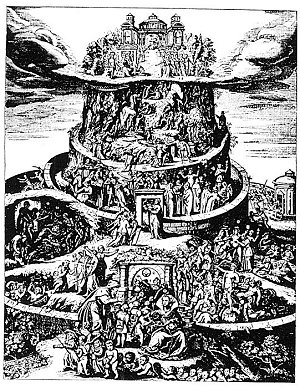
THE TABLE OF CEBES.
From Vænius’ Theatro Moral de la Vida Humana. There is legend to the effect that the Tablet of Cebes, a dialogue between Cebes and Gerundio, was based upon an ancient table set up in the Temple of Kronos at Athens or Thebes which depicted the entire progress of human life. The author of the Tablet of Cebes was a disciple of Socrates, and lived about 390 B.C. The world is represented as a great mountain. Out of the earth at the base of it come he myriads of human creatures who climb upward in search of truth and immortality. Above the clouds which conceal the summit of the mountain is the goal of human attainment–true happiness. The figures and groups are arranged as follows: (1) the door of the wall of life; (2) the Genius or Intelligence; (3) deceit (4) opinions, desires, and pleasures; (5) fortune; (6) the strong; (7) venery, insatiability, flattery; (8) sorrow; (9) sadness; (10) misery; (11) grief, (12) rage or despair; (13) the house of misfortune; (14) penitence; (15) true opinion; (16) false opinion; (17) false doctrine; (18) poets, orators, geometers, et. al.; (19) incontinence, sexual indulgence, and opinion; (20) the road of the true doctrine (21) continence and patience; (22) the true doctrine; (23) truth and persuasion; (24) science and the virtues; (25) happiness, (26) the highest (first) pleasure of the wise man; (27) the lazy and the strays.
Moe is the founder of GnosticWarrior.com. He is a father, husband, author, martial arts black belt, and an expert in Gnosticism, the occult, and esotericism.
by Moe | Aug 21, 2011 | Secret Teachings of All Ages
PHILIP, King of Macedon, ambitious to obtain the teacher who would be most capable of imparting the higher branches of learning to his fourteen-year-old son, Alexander, and wishing the prince to have for his mentor the most famous and learned of the great philosophers, decided to communicate with Aristotle. He dispatched the following letter to the Greek sage: “PHILIP TO ARISTOTLE, HEALTH: Know that I have a son. I render the gods many thanks; not so much for his birth, as that he was born in your time, for I hope that being educated and instructed by you, he will become worthy of us both and the kingdom which he shall inherit.” Accepting Philip’s invitation, Aristotle journeyed to Macedon in the fourth year of the 108th Olympiad, and remained for eight years as the tutor of Alexander. The young prince’s affection for his instructor became as great as that which he felt for his father. He said that his father had given him being, but that Aristotle had given him well-being.
The basic principles of the Ancient Wisdom were imparted to Alexander the Great by Aristotle, and at the philosopher’s feet the Macedonian youth came to realize the transcendency of Greek learning as it was personified in Plato’s immortal disciple. Elevated by his illumined teacher to the threshold of the philosophic sphere, he beheld the world of the sages–the world that fate and the limitations of his own soul decreed he should not conquer.
Aristotle in his leisure hours edited and annotated the Iliad of Horner and presented the finished volume to Alexander. This book the young conqueror so highly prized that he carried it with him on all his campaigns. At the time of his triumph over Darius, discovering among the spoils a magnificent, gem-studded casket of unguents, he dumped its contents upon the ground, declaring that at last he had found a case worthy of Aristotle’s edition of the Iliad!
While on his Asiatic campaign, Alexander learned that Aristotle had published one of his most prized discourses, an occurrence which deeply grieved the young king. So to Aristotle, Conqueror of the Unknown, Alexander, Conqueror of the Known, sent this reproachful and pathetic and admission of the insufficiency of worldly pomp and power: “ALEXANDER TO ARISTOTLE, HEALTH: You were wrong in publishing those branches of science hitherto not to be acquired except from oral instruction. In what shall I excel others if the more profound knowledge I gained from you be communicated to all? For my part I had rather surpass the majority of mankind in the sublimer branches of learning, than in extent of power and dominion. Farewell.” The receipt of this amazing letter caused no ripple in the placid life of Aristotle, who replied that although the discourse had been communicated to the multitudes, none who had not heard him deliver the lecture (who lacked spiritual comprehension) could understand its true import.
A few short years and Alexander the Great went the way of all flesh, and with his body crumbled the structure of empire erected upon his personality. One year later Aristotle also passed into that greater world concerning whose mysteries he had so often discoursed with his disciples in the Lyceum. But, as Aristotle excelled Alexander in life, so he excelled him in death; for though his body moldered in an obscure tomb, the great philosopher continued to live in his intellectual achievements. Age after age paid him grateful tribute, generation after generation pondered over his theorems until by the sheer transcendency of his rational faculties Aristotle–“the master of those who know,” as Dante has called him–became the actual conqueror of the very world which Alexander had sought to subdue with the sword.
Thus it is demonstrated that to capture a man it is not sufficient to enslave his body–it is necessary to enlist his reason; that to free a man it is not enough to strike the shackles from his limbs–his mind must be liberated from bondage to his own ignorance. Physical conquest must ever fail, for, generating hatred and dissension, it spurs the mind to the avenging of an outraged body; but all men are bound whether willingly or unwillingly to obey that intellect in which they recognize qualities and virtues superior to their own.
Moe is the founder of GnosticWarrior.com. He is a father, husband, author, martial arts black belt, and an expert in Gnosticism, the occult, and esotericism.