by Moe
The Apostle John (4 BC – 100 AD) is said to have been born in the city of Ephesus. There are mentioned to be actual records of 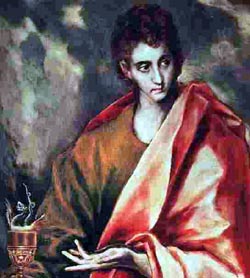 John being arrested by the Emperor Domitian (reigned 81 -96 AD), and then being sent to the small island of Patmos where he had written the Book of Revelation. He was eventually released late in his life of exile from his prison on Patmos, and then returned back to his birthplace of Ephesus where he would convert many Jews to Christianity before his death. Saint John was also buried at Ephesus. A place, that I believe the original city was located on the Holy Island of Crete in the Mediterranean Sea.
Today, the city of Ephesus is located in the Selçuk, İzmir Province, Turkey, but I have found that the original ancient city mentioned in the bible was actually on the island of Crete. It simply appears to me, that many of these very old cities were moved or were sister cities created, and that were models of the original ancient cities. This can be easily researched to connect the dots, by anyone who wishes to verify my words that I write in this article with the links to the sources that I provide.
in the early history of the Church, from St. John’s having been banished to it, and having there written his Apocalypse. The modem name is Patmo. 3. Liros lay to the southeast of Patmos. It was peopled from Miletus, and probably belonged to that city. Strabo gives its inhabitants a character for dishonesty. The modern name is Lero. 3. Calymna lay to the southeast of Leros. Ovid praises its honey. It is supposed to have belonged to the group which Homer calls Calydna. The modern name is Ctrfimno. 4. Cos, to the southeast, an island of some celebrity. It must have been inhabited at an early period, since Homer represents it as sending its warriors to the siege of Troy. It was subsequently colonized by a party of Dorians, and hence was always reckoned of Dorian origin, and obtained a place in the Triopian Pentapolis. Its chief city was also called Cos, without the walls of which was a celebrated temple of .Esculapius, containing two famous paintings of Apelles, the Antigonus and Venus Anadyomene. Augustus removed the latter to Rome, and remitted to the Coans, as a compensation for the loss, a tribute of one hundred talents. Cos was the birth-place not only of Apelles, but also of the celebrated physician Hippocrates. It was a very productive island, especially in wine, which vied with that of Lesbos and Chios. Cos was likewise celebrated for its purple dye, and for its manufacture of a species of transparent silk stuff, against the use of which by the Romans Juvenal so strongly inveighs. The modern name of the island is Stan-Co (A System of Ancient and Mediæval Geography for the Use of Schools and Colleges
By Charles Antho)
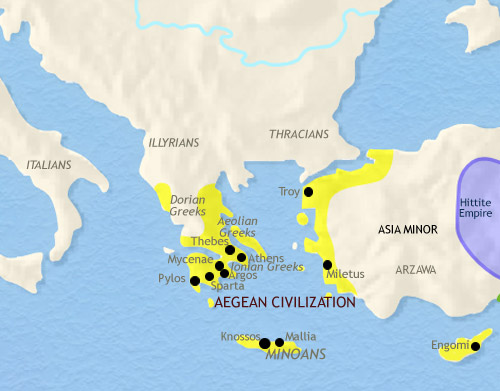 There are many connections and clues tying the City of Ephesus to being located on Crete.
Besides the city of Ephesus being the birthplace and burial site of Saint John, it was also world-famous for the Temple of Artemis (completed around 550 BC). In Greek mythology, Artemis, who was also called Letois was the daughter of the Father of the Gods, Zeus (Jupiter); her mother was the Titan, Leto who was the goddess of motherhood, and with her children, a protectress of the young. Her brother was the God of Healing, Apollo.
In Crete, at the city of Dreros, Spyridon Marinatos uncovered an eighth-century post-Minoan hearth house temple, in which there were found three unique figures of Apollo, Artemis and Leto made of brass sheeting hammered over a shaped core (sphyrelata).
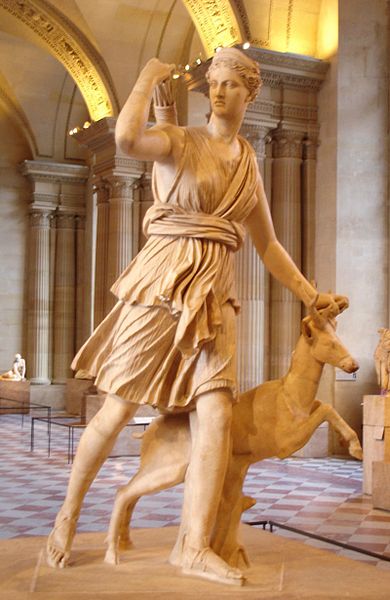 Homer refers to her as Artemis Agrotera, Potnia Theron: “Artemis of the wildland, Mistress of Animals.” The Arcadians believed she was the daughter of Demeter. She was also the protector and goddess of young men and or priesthood who were called the Curetes (Kuretes or Kouretes). The worship of Artemis had originated in Minoan Crete, where she was “goddess of mountains and hunting’, who was the “sweet maiden’ and “sweet virgin,” Britomartis (Βριτόμαρτις).
Strabo notes she was venerated as Diktynna, only in western Crete in the region of Cydonia, where there was a Diktynnaion , or temple of Diktynna. “Oupis [Artemis], O queen, fairfaced Bringer of Light, thee too the Kretans name after that Nymph,” Callimachus says. “She passed her time in the company of Artemis, this being the reason why some men think Diktynna and Artemis are one and the same goddess,” Diodorus Siculus (5.76.3) suggested.
By Hellenistic and Roman times, Britomartis was given a genealogical setting that fitted her into a Classical context: “Britomartis, who is also called Diktynna, the myths relate, was born at Kaino in Crete of Zeus and Karme,[8] the daughter of Euboulos who was the son of Demeter; she invented the nets [diktya] which are used in hunting.”
The reason I relate these stories to you, is for reference to Greek mythology and is because this all takes place on the island of Crete. In addition, one of the best authorities on the subject would be Strabo who was a native from Crete. Hence, it only makes sense, that if Zeus was born on Crete and the legend has it that he was hidden in a cave on Mount Ida on the same island where he would father other Gods and Goddesses such as Artemis and Apollo, that these temples and the main home for them would be on the same holy land. It was only after the Romans had taken over Crete and the religion of the Greek Jews, that they would then change many of the names of these goddesses and Gods; where Artemis then, became known as “Diana of Ephesus” and her Temple from then on was called, “The Temple of Diana.”
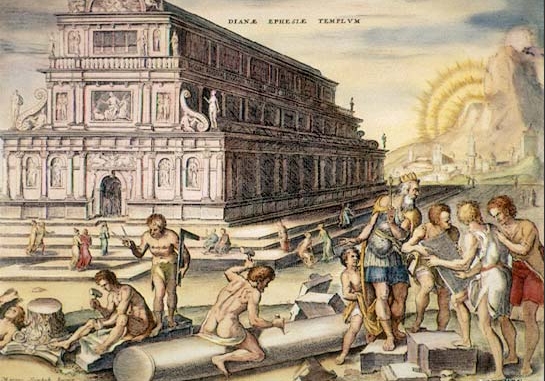 The Temple of Artemis (Diana) was one of the Seven Wonders of the Ancient World. In the 7th century BC, the old temple was destroyed by a flood. Its reconstruction began around 550 BC. under the Cretan architect Chersiphron and his son Metagenes, at the expense of Croesus of Lydia: the project took 10 years to complete, only to be destroyed in an act of arson by Herostratus. It was later rebuilt in 268 AD., and the Temple was destroyed or damaged yet again in a raid by the Goths. In Greek and Roman historical tradition, the temple’s destruction coincided with the birth of Alexander the Great (around 20/21 July 356 BC). Plutarch remarked, that Artemis was too preoccupied with Alexander’s delivery to save her burning temple. (Wikpedia)
Antipater of Sidon of Crete from around 140 BC, had named six of the seven sites on his list—leaving out the lighthouse—, but was primarily in praise of the Temple of Artemis at Ephesus:
I have gazed on the walls of impregnable Babylon along which chariots may race, and on the Zeus by the banks of the Alpheus, I have seen the hanging gardens, and the Colossus of the Helios, the great man-made mountains of the lofty pyramids, and the gigantic tomb of Mausolus; but when I saw the sacred house of Artemis that towers to the clouds, the others were placed in the shade, for the sun himself has never looked upon its equal outside Olympus.
— Greek Anthology IX.58
St. John had opposed a man in Ephesus named ‘Cerinthus,’ who was a Jewish Christian and the alleged Gnostic arch-heretic. Ephesus was one of the seven churches of Asia that are cited in the Book of Revelation. Hence, it was one of the most important religious centers of all the world at the time, and it would continue to be for many centuries, even after it was conquered by the Romans. The story of St. John, the Gnostic Cerinthus and his followers, I will write on in the near future.
Christianity in the city of Ephesus, was introduced in the 1st century AD by Paul the Apostle who visited Ephesus around 53 AD, where he spent three months teaching in a synagogue in an effort to bring the Greek Jews to accept union with the gentiles of Rome in Christianity, but he met with little success. For the next two years he stayed in Ephesus on Crete, where he appears to have made many converts.
One of his Gentile converts was actually a Roman Emperor by the name, Titus who would later become the companion of Paul 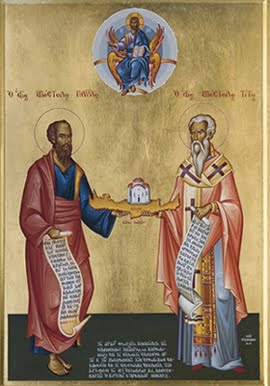 who had appointed him Bishop of Crete after the siege of the City of Jerusalem and the destruction of the Temple. Hence, the Roman Emperor Titus became master of the island of Crete after he had conquered the government and religion, where he then would be immortalized in the Catholic Church as Saint Titus forever thereafter.
Titus 1:5-9 – I (Paul) left you (Titus as minister) in Crete to set right matters which needed attention, and gave you instructions to appoint elders in every city. They were to be men of unquestioned integrity with only one wife, and with children brought up as Christians and not likely to be accused of loose living or law-breaking. To exercise spiritual oversight a man must be of unimpeachable virtue, for he is God’s agent in the affairs of his household. He must not be aggressive or hot-tempered or over-fond of wine; nor must he be violent or greedy for financial gain. On the contrary, he must be hospitable, a genuine lover of what is good, a man who is discreet, fair-minded, holy and self-controlled: a man who takes his stand on the orthodox faith, so that he can by sound teaching both stimulate faith and confute opposition.
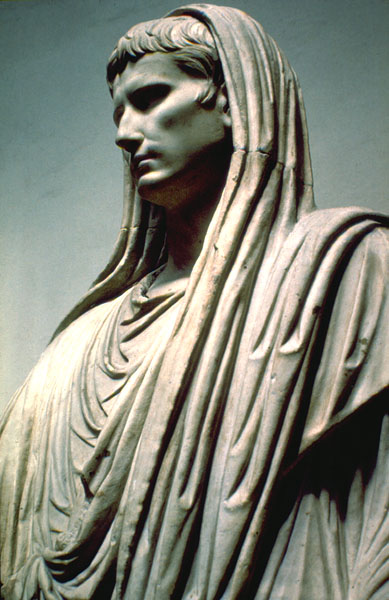 When Augustus Caesar became Roman Emperor in 27 BC, he made Ephesus the capital of proconsular Asia (which covered western Asia Minor) instead of Pergamum. He had built a city to his name nearby Ephesus called, Caesaria, which at the time of Paul was the seat of where, the then governor of Idaea or Judea (Tribe of Judah) had resided. The Cretans were called back then, the ‘Idaeans’ and according to Homer, one of their rulers was known as ‘Idomensus,’ the grandson of the ruler of Knossos. The children of Idomensus were, whom Homer had called the royal and warlike ‘Idomen,‘ and who we would know of today as the Judeans (Idaeans, Tribe of Judah). Ephesus then entered an era of prosperity, becoming both the seat of the governor and a major center of commerce.
According to Strabo, the city of Ephesus was second in importance and size only to Rome.
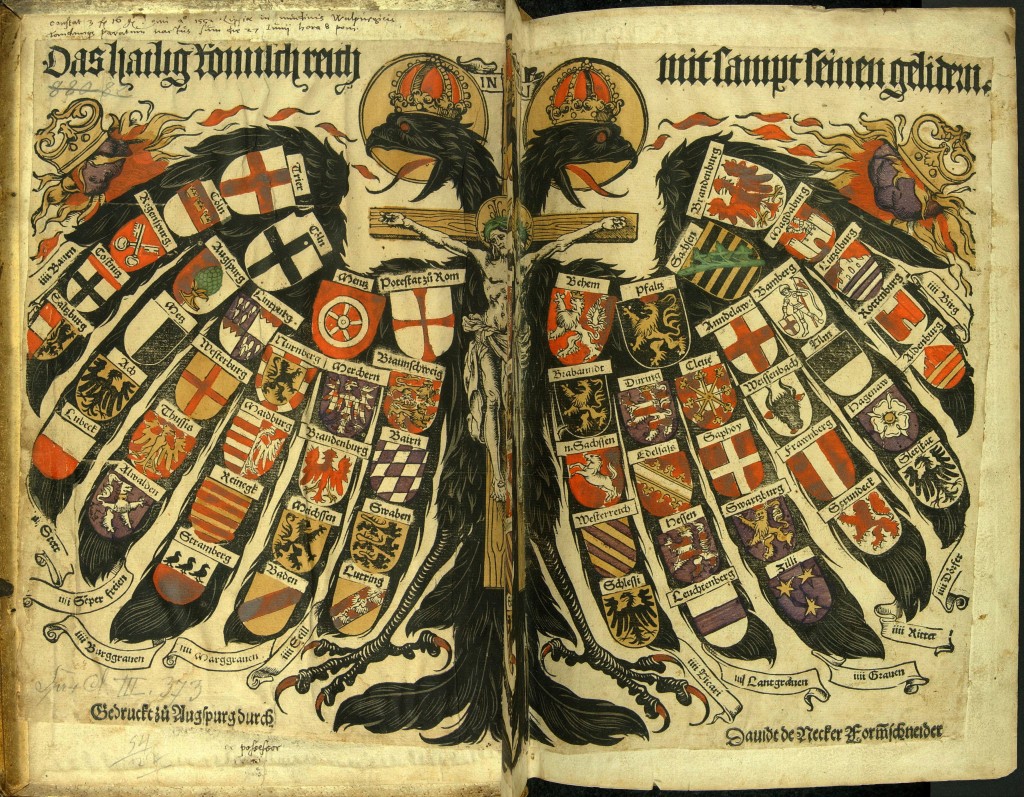
MORE FACTS CONNECTING SAINT JOHN AND THE CITY OF EPHESUS TO CRETE (Open Source)
Two decades later, the church at Ephesus was still important enough to be addressed by a letter written by Bishop Ignatius of Antioch to the Ephesians in the early 2nd century AD, that begins with, “Ignatius, who is also called Theophorus, to the Church which is at Ephesus, in Asia, deservedly most happy, being blessed in the greatness and fullness of God the Father, and predestinated before the beginning of time, that it should be always for an enduring and unchangeable glory” (Letter to the Ephesians). The church at Ephesus had given their support for Ignatius, who was taken to Rome for execution.
A legend, which was first mentioned by Epiphanius of Salamis in the 4th century AD, purported that Mary may have spent the last years of her life in Ephesus. The Ephesians derived the argument from John’s presence in the city, and Jesus’ instructions to John to take care of Mary after his death. Epiphanius, however, was keen to point out that, while the Bible says John was leaving for Asia, it specifically does not say that Mary went with him. He later stated that she was buried in Jerusalem.
In the 3rd century, the emperor Constantine I rebuilt much of the city of Ephesus, and erected a new public bath. Constantine the Great frequently traveled to Nicomedia in Crete near Ephesus and had made this city his place of residence. He later died near his home in the year 337.’ Ephesus remained the most important city of the Byzantine Empire in Asia after Constantinople in the 5th and 6th centuries.
Moe is the founder of GnosticWarrior.com. He is a father, husband, author, martial arts black belt, and an expert in Gnosticism, the occult, and esotericism.
by Moe
“The Great Dragon was cast out, that Archaic Ophis, called Diabolos and Satan, that deceiveth the whole world.” – HP Blavatsky
Just this past week, Pope Francis had given a sermon in which he had reminded Catholics that the Devil is real and we are called to spiritual warfare. Here is an excerpt and video of this sermon;
There are some priests who, when they read this Gospel passage, this and others say: ‘But, Jesus healed a person with a mental illness’. They do not read this, no? It is true that at that time, they could confuse epilepsy with demonic possession; but it is also true that there was the devil! And we do not have the right to simplify the matter, as if to say: ‘All of these (people) were not possessed; they were mentally ill’. No! The presence of the devil is on the first page of the Bible, and the Bible ends as well with the presence of the devil, with the victory of God over the devil.
Do not confuse the truth. Jesus fights the devil: first criterion. Second criterion: he who is not with Jesus, is against Jesus. There are no attitudes in the middle. Third criterion: vigilance over our hearts because the devil is astute. He is never cast out forever. It will only be so on the last day.
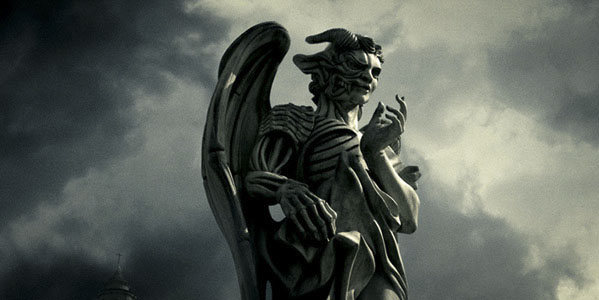 WHO IS THIS DEVIL AND ARE DEMONS REAL?
“Are they real, or are these papal claims just religious dogmas perpetuated in order to keep fear in the minds of the billion people who are members of the Catholic Church?”
The religious facts, are that the name of the devil has brought fear and mayhem into the minds of the people ever since it has been written and that this head prince of the demons had fallen when he turned his face away from God. To live, is to spell evil backwards and to be a devil, is to spell the word lived backwards. Hence, we live in a world that has been magically turned upside down, where there is a war for your soul here, and the never-ending spiritual warfare for our minds is a reality that many of us chained souls have come to know intimately.
To some people, the Devil is an invented character by the church, just like Jesus, who they say that his teachings were simply part of a secret Roman government plan that was hell-bent on subjugating the people they had conquered and their minds via religious dogmas. To other people who are more educated on these spiritual matters such as the early Church Fathers and some of the world’s best authorities on the occult, the devil and his legions of demons are as real as Jesus and the Pope.
In the Gospel of Luke, he explains who these demons are and who is their prince;
When Jesus had driven out a demon, some of the crowd said: “By the power of Beelzebul, the prince of demons, he drives out demons.” Others, to test him, asked him for a sign from heaven. But he knew their thoughts and said to them, “Every kingdom divided against itself will be laid waste and house will fall against house. And if Satan is divided against himself, how will his kingdom stand? For you say that it is by Beelzebul that I drive out demons. If I, then, drive out demons by Beelzebul, by whom do your own people drive them out? Therefore they will be your judges.
WHO WAS THE GREEK JEWISH DEMON BAALZEBUL THAT CATHOLICS CALL THE DEVIL OR SATAN?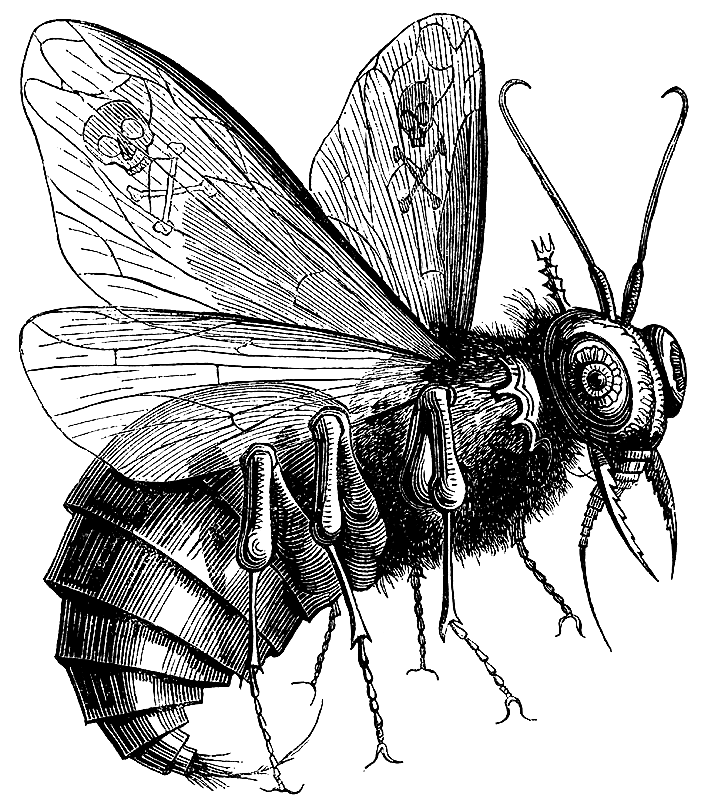
In the cult of Serapis, Beelzebul (Beelzeboul, Beelzebub, Beelsebab, Baalzebub or Ba’al) is prince of the Seraphim, just below Lucifer. The cult of Serapis had originated from the Greco-Egyptian priesthood under the Ptolemies. The testimony of Pausanias, says the temples of Serapis were the most famous at Alexandria, and the most ancient at Memphis. Tacitus, the Roman senator and historian had said that Serapis was worshipped as a type of universal deity that represented Jupiter, Osiris, Pluto, and sometimes Jupiter Ammon.
The name Beelzebul is a corruption of the Phoenician God ‘Ba’al’ (usually pronounced “bail”) and is mentioned in the Old Testament as the pagan idol of the Phoenicians, Ethiopians, Syrians and Greeks who had often worshiped Ba’al in conjunction with the fertility and war-goddess, Ashtaroth. The meaning of the term ‘Baal’, in both Gaelic and in Phoenician is – “the lord of heaven or lord of souls.” The plural of Baal is Baalim, or Baals (Judges 2:11, 10:10). Baalzebub or Beelzebul (bee-EL-ze-bull) is mentioned 2 Kings i, 2, and the name Beelzebul signifies the Lord of the Flies (which originally meant “Lord of everything that flies”), King of the Earth, and the Prince Daimon who is said to be the chief of spirits amongst the Jews.
Since only priests were allowed to utter his divine name, Hadad, Ba‛al was commonly used and few, if any Biblical uses of “Baʿal” refer to Hadad, the lord over the assembly of gods on the holy mount of Heaven. This is evident in the name Baal or Baalzebub becoming the corruption of Beelzebul, that is only found in the bible via the texts of the Acts of Pilate (also known as the Gospel of Nicodemus) and vary in whether they use Beelzebul or Beelzebub. The name is used by Hades as a secondary name for the Devil, but it may vary with each translation of the text; other versions give the name Beelzebub as Beelzebub, but separates him from the devil. The Gospel of Nicodemus is in two sections, with an appendix, Descensus ad Infernos—the Harrowing of Hell—that does not exist in the Greek texts, and is a later addition to the Latin versions. (Wikipedia)
In ancient Syria, the name, King Hadad was known as Adad, or Aden. The name Hadad is also spelled as Eldad, Bedad, Adad, Aden, Dudu, Dawd, Amnidad and Heldan. The meaning of Hadad is “on of Dod or David”, or Be-dad or Bon-dad, “the son of Dad,” and David, Daoud, or Dood means the beloved ; and as a mythical character the beloved one, the Lord’s anointed. The same is seen in the Kings of Edom, in Genesis in the names of ” Hadad,” Bedad ( = Bendad, son of Dod or David), Samlah, Shaul ( = Saul), and Benhanan. In the names Dod, Dad, Dan and David, we have a specific true meaning behind these other names. This true meaning would be “Father.” Hence, when we find these many different names written in literature, they are referring to one “Lord and Father.”
Many Bible scholars translate the name David as Beloved, but the Hebrew root  (dwd) that yields (dod), meaning beloved in general or uncle more specifically; King David’s most beloved son, Solomon. By the side of King Hadad, stood his son Ben-Hadad. In ancient Syrian, Hebrew and Arabic, Ben means son. It is the kings of Edom (Gen. xxxvi. 35) who were called “Hadad, the son of Bedad,” or Ben-[Ha]dad who are also known to us now as the Priests of Baal, serpents, dragons, wise ones, Giants, and the Nephilim who are the Sons of God that became the fallen ones.
Lucifer is another word for the Greek word, Phosphorus (Greek Φωσφόρος Phōsphoros), a name meaning “Light-Bringer” and the Morning Star. Baal, along with Lucifer and Leviathan, were the first three angels to fall, and Baal tempts men with pride and is opposed by St. Francis of Assisi. (Wikipedia) St. Francis was the founder of the Cordeliers and Franciscans. He was also known as the Seraphic Father and Seraphic Saint because of a vision he saw on Mount Alverna where he witnessed a crucified seraph who perforated his feet, hands, and right side. In the New Testament, Baal is identified as the Devil, “prince of the demons” and in Catholic demonology, is one of the seven princes of Hell according to Catholic views on Hell.(Wikipedia)
ARE DEMONS, SERPENTS AND DRAGONS EVIL?
The Greek word daimon does not carry the negative connotation as it does today with Catholics and Christians. This is explained by 33rd Degree Freemason, Master Rosicrucian and author, Manly P. Hall who had written in “The Secret Teachings of all Ages,” that the Christian Church had literally taken these elemental entities or angels and grouped them together under the title of demon, and that for to the average mind the word demon means an evil thing.
The Christian Church gathered all the elemental entities together under the title of demon. This is a misnomer with far-reaching consequences, for to the average mind the word demon means an evil thing, and the Nature spirits are essentially no more malevolent than are the minerals, plants, and animals. Many of the early Church Fathers asserted that they had met and debated with the elementals.
The Serpent was venerated for thousands of years in ancient Egypt, Phoenicia, Ethiopia, Greece and many other places around the world as an emblem of divinity, an oracle, and as a god. The Greeks called Apollo also by the name of Python, which is rendered the same as Ophis, Opis, Oupis, and Oub. Ophis represents divine Wisdom (Blavatsky). Apollo and Ophis were the sons of Zeus who is the god of light and the sun, truth and prophecy, healing, plague, music, poetry, and more. This Serpent-worship or what the church would call devil worship, had continued amongst the Samaritans in the West and in Europe, and with the Druids in Ireland, Scotland and Britain. The Masters of Wisdom, and all Initiates into the Sacred Mysteries are called Nagas, or Serpents of Wisdom . These Gnostic Serpent Priests of Wisdom from the East had went under various names such as the Ophites, and the Hivites who later became known as the Levites; all these names signify serpent. The Ophites were said to attribute all wisdom to the serpent, who was also the author of knowledge to men.
The biblical legend of the serpent is derived from Greek legends where one of the first Titans, Ophis; meaning serpent, and who ruled over Olympus with his queen; Eurynome was dethroned by the God of chaos and darkness, Cronus (Saturn or Satan) and the goddess of fertility and war, Rhea (Saturn’s Moon). In Greek mythology, Olympus was the home of the Twelve Olympian gods of the ancient Greek world. It formed itself after the gods defeated the Titans in the Titan War, and soon the palace was inhabited by the gods.
To the Phoenicians, Ethiopians, Syrians and Greeks who are the Jews of the Old Testament, Baal was their chief daimon (daemon or demon) or simply, their God. Ba’al would be the equivalent to Jesus in the New Testament, but Ba’al is the race or ancestor God of who we call today the Jewish people of the Old Testament and Jesus would be the new chosen son or messiah, Augustus Caesar with his blood to commemorate as the cornerstone of the newly built Roman Empire, and who under Roman and Cannon Law via the new law of the New Testament would abolish all old gods and teachings of the Old Testament.
From this point forward, Ba’al becomes the devil, their angels become evil ugly demons, and the people called the Phoenicians, Ethiopians, Syrians and Greeks, along with their religion become Jews. This spiritual event at the turn of the millenia marks the great dividing point between the Old Law under the Greek Ptolemy’s of the Old Testament and the New Law under the Caesars and Rome. Hence, Rome against the world and old spirit world via Vatican magic of the pen and backed by the sword of the Roman Army.
As I mentioned above, Baal is prince of the Seraphim just below Lucifer. The name ‘seraphim’ is the plural form of serpent and is also said to mean, “the burning ones.” Seraphs appear in the 2nd century BC Book of Enoch, where they are designated as drakones (δράκονες “serpents”) and are mentioned in conjunction with cherubs as the heavenly creatures standing nearest to the throne of God. Serapis is the Hellenized version of the Egyptian Osiris-Apis. The various spellings of the name Serapis are Sor-apis (Σέραπις, Attic/Ionian Greek), Sarapis (Σάραπις, Dorian Greek), Serapin (Greek Ὄφις), or in Hebrew Seraph.
Please also note that the great dragon, devil or diabolos is a drakones (δράκονες “serpent”), and is a heavenly creature standing nearest to the throne of God. All these names mean ‘serpent’ which is the symbol of wisdom, knowledge and Gnosis. Hence, the battle against the serpent or the Great Dragon is the battle of the Roman Church against knowledge and Gnosis.
It is the Old Serpent of the Genesis. Since the church was opposed to the serpent who brought this Gnosis and knowledge to men to make them wise, they had symbolically crucified the prince of the Seraphim, Jesus at Golgotha, the place of the skull, in order for the church to take the place of wisdom and the serpent and in which they would become the vicars of Christ. Therefor, Baal becomes Satan or the Old Serpent under Roman Catholic Church Law via the New Testament. A church that was simply against the religion and angels or Daimons (Demons) of the Ancient Greek Jews who had committed the sins of propagating wisdom and Gnosis, and for good reason.
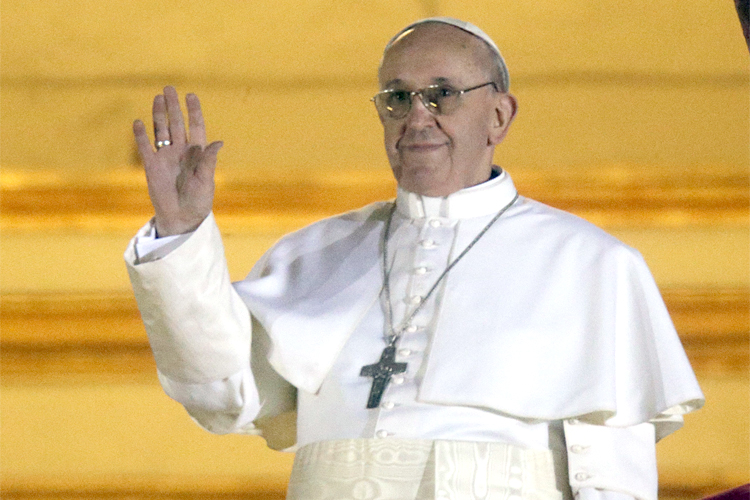 But as Pope Francis says, “the devil is astute. He is never cast out forever. It will only be so on the last day.”
Pope Francis and the Devil
“Vigilance, because his strategy is this: ‘You became Christian. Advance in your faith. I will leave you. I will leave you tranquil. But then when you are used to not being so watchful and you feel secure, I will come back’. The Gospel today begins with the devil being cast out and ends with the devil coming back! St. Peter would say: ‘It is like a fierce lion that circles us’. It is like that.”
‘But, Father, you are a little ancient. You are frightening us with these things’. No, not me! It is the Gospel! And these are not lies: it is the Word of the Lord! Let us ask the Lord for the grace to take these things seriously. He came to fight for our salvation. He won against the devil! Please, let us not do business with the devil! He seeks to return home, to take possession of us. Do not relativize; be vigilant! And always with Jesus!”
Moe is the founder of GnosticWarrior.com. He is a father, husband, author, martial arts black belt, and an expert in Gnosticism, the occult, and esotericism.