by Moe | Aug 21, 2011 | Secret Teachings of All Ages
CEREMONIAL magic is the ancient art of invoking and controlling spirits by a scientific application of certain formulæ. A magician, 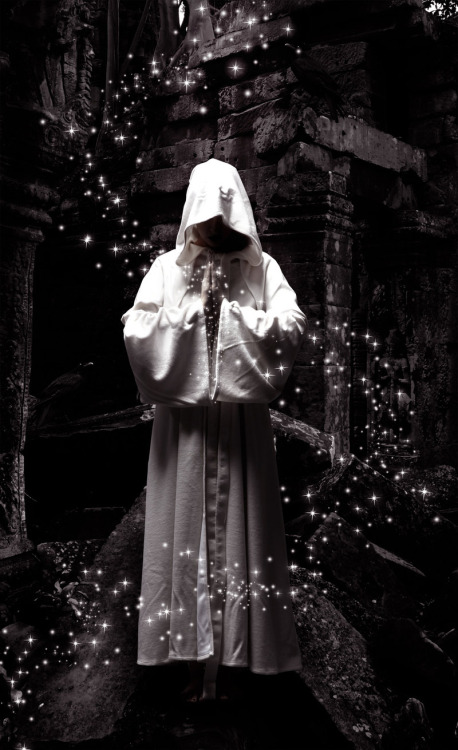 enveloped in sanctified vestments and carrying a wand inscribed with hieroglyphic figures, could by the power vested in certain words and symbols control the invisible inhabitants of the elements and of the astral world. While the elaborate ceremonial magic of antiquity was not necessarily evil, there arose from its perversion several false schools of sorcery, or black magic.
Egypt, a great center of learning and the birthplace of many arts and sciences, furnished an ideal environment for transcendental experimentation. Here the black magicians of Atlantis continued to exercise their superhuman powers until they had completely undermined and corrupted the morals of the primitive Mysteries. By establishing a sacerdotal caste they usurped the position formerly occupied by the initiates, and seized the reins of spiritual government.
Thus black magic dictated the state religion and paralyzed the intellectual and spiritual activities of the individual by demanding his complete and unhesitating acquiescence in the dogma formulated by the priestcraft. The Pharaoh became a puppet in the hands of the Scarlet Council–a committee of arch-sorcerers elevated to power by the priesthood.
These sorcerers then began the systematic destruction of all keys to the ancient wisdom, so that none might have access to the knowledge necessary to reach adeptship without first becoming one of their order. They mutilated the rituals of the Mysteries while professing to preserve them, so that even though the neophyte passed through the degrees he could not secure the knowledge to which he was entitled. Idolatry was introduced by encouraging the worship of the images which in the beginning the wise had erected solely as symbols for study and meditation. False interpretations were given to the emblems and figures of the Mysteries, and elaborate theologies were created to confuse the minds of their devotees. The masses, deprived of their birthright of understanding and groveling in ignorance, eventually became the abject slaves of the spiritual impostors. Superstition universally prevailed and the black magicians completely dominated national affairs, with the result that humanity still suffers from the sophistries of the priestcrafts of Atlantis and Egypt.
Fully convinced that their Scriptures sanctioned it, numerous mediæval Qabbalists devoted their lives to the practice of ceremonial magic. The transcendentalism of the Qabbalists is founded upon the ancient and magical formula of King Solomon, who has long been considered by the Jews as the prince of ceremonial magicians.
Among the Qabbalists of the Middle Ages were a great number of black magicians who strayed from the noble concepts of the Sepher Yetzirah and became enmeshed in demonism and witchcraft. They sought to substitute magic mirrors, consecrated daggers, and circles spread around posts of coffin nails, for the living of that virtuous life which, without the assistance of complicated rituals or submundane creatures, unfailingly brings man to the state of true individual completion.
Those who sought to control elemental spirits through ceremonial magic did so largely with the hope of securing from the invisible worlds either rare knowledge or supernatural power. The little red demon of Napoleon Bonaparte and the infamous oracular heads of de Medici are examples of the disastrous results of permitting elemental beings to dictate the course of human procedure. While the learned and godlike dæmon of Socrates seems to have been an exception, this really proves that the intellectual and moral status of the magician has much to do with the type of elemental he is capable of invoking. But even the dæmon of Socrates deserted the philosopher when the sentence of death was passed.
Transcendentalism and all forms of phenomenalistic magic are but blind alleys–outgrowths of Atlantean sorcery; and those who forsake the straight path of philosophy to wander therein almost invariably fall victims to their imprudence. Man, incapable of controlling his own appetites, is not equal to the task of governing the fiery and tempestuous elemental spirits.
Many a magician has lost his life as the result of opening a way whereby submundane creatures could become active participants in his affairs. When Eliphas Levi invoked the spirit of Apollonius of Tyana, what did he hope to accomplish? Is the gratification of curiosity a motive sufficient to warrant the devotion of an entire lifetime to a dangerous and unprofitable pursuit? If the living Apollonius refused to divulge his secrets to the profane, is there any probability that after death he would disclose them to the curious-minded?
Levi himself did not dare to assert that the specter which appeared to him was actually the great philosopher, for Levi realized only too well the proclivity of elementals to impersonate those who have passed on. The majority of modern mediumistic apparitions are but elemental creatures masquerading through bodies composed of thought substance supplied by the very persons desiring to behold these wraiths of decarnate beings.
THE THEORY AND PRACTICE OF BLACK MAGIC
Some understanding of the intricate theory and practice of ceremonial magic may be derived from a brief consideration of its underlying premises.
First. The visible universe has an invisible counterpart, the higher planes of which are peopled by good and beautiful spirits; the lower planes, dark and foreboding, are the habitation of evil spirits and demons under the leadership of the Fallen Angel and his ten Princes.
Second. By means of the secret processes of ceremonial magic it is possible to contact these invisible creatures and gain their help in some human undertaking. Good spirits willingly lend their assistance to any worthy enterprise, but the evil spirits serve only those who live to pervert and destroy.
Third. It is possible to make contracts with spirits whereby the magician becomes for a stipulated time the master of an elemental being.
Fourth. True black magic is performed with the aid of a demoniacal spirit, who serves the sorcerer for the length of his earthly life, with the understanding that after death the magician shall become the servant of his own demon. For this reason a black magician will go to inconceivable ends to prolong his physical life, since there is nothing for him beyond the grave.
The most dangerous form of black magic is the scientific perversion of occult power for the gratification of personal desire. Its less complex and more universal form is human selfishness, for selfishness is the fundamental cause of all worldly evil.
A man will barter his eternal soul for temporal power, and down through the ages a mysterious process has been evolved which actually enables him to make this exchange. In its various branches the black art includes nearly all forms of ceremonial magic, necromancy, witchcraft, sorcery, and vampirism. Under the same general heading are also included mesmerism and hypnotism, except when used solely for medical purposes, and even then there is an element of risk for all concerned.
Though the demonism of the Middle Ages seems to have disappeared, there is abundant evidence that in many forms of modern thought–especially the so-called “prosperity” psychology, “willpower-building” metaphysics, and systems of “high-pressure” salesmanship–
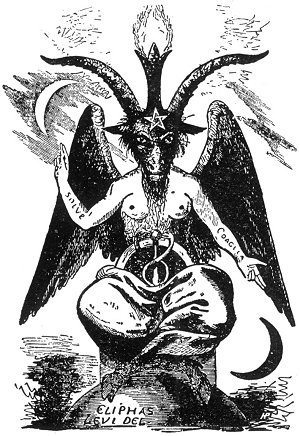
BAPHOMET, THE GOAT OF MENDES.
From Levi’s Transcendental Magic. The practice of magic–either white or black–depends upon the ability of the adept to control the universal life force–that which Eliphas Levi calls the great magical agent or the astral light. By the manipulation of this fluidic essence the phenomena of transcendentalism are produced. The famous hermaphroditic Goat of Mendes was a composite creature formulated to symbolize this astral light. It is identical with Baphomet the mystic pantheos of those disciples of ceremonial magic, the Templars, who probably obtained it from the Arabians.
p. 102
black magic has merely passed through a metamorphosis, and although its name be changed its nature remains the same.
A well-known magician of the Middle Ages was Dr. Johannes Faustus, more commonly known as Dr. Faust. By a study of magical writings he was enabled to bind to his service an elemental who served him for many years in various capacities. Strange legends are told concerning the magical powers possessed by Dr. Faust. Upon one occasion the philosopher, being apparently in a playful mood, threw his mantle over a number of eggs in a market-woman’s basket, causing them to hatch instantly. At another time, having fallen overboard from a small boat, he was picked up and returned to the craft with his clothes still dry. But, like nearly all other magicians, Dr. Faust came at length to disaster; he was found one morning with a knife in his back, and it was commonly believed that his familiar spirit had murdered him. Although Goethe’s Dr. Faust is generally regarded as merely a fictional character, this old magician actually lived during the sixteenth century. Dr. Faust wrote a book describing his experiences with spirits, a section of which is reprinted below. (Dr. Faust must not be confused with Johann Fust, the printer.)
EXTRACT FROM THE BOOK OF DR. FAUST, WITTENBERG, 1524
(An abridged translation from the original German of a book ordered destroyed.)
“From my youth I followed art and science and was tireless in my reading of books. Among those which came to my hand was a volume containing all kinds of invocations and magical formulæ. In this book I discovered information to the effect that a spirit, whether he be of the fire, the water, the earth or the air, can be compelled to do the will of a magician capable of controlling him. I also discovered that according as one spirit has more power than another, each is adapted for a different operation and each is capable of producing certain supernatural effects.
Moe is the founder of GnosticWarrior.com. He is a father, husband, author, martial arts black belt, and an expert in Gnosticism, the occult, and esotericism.
by Moe | Aug 21, 2011 | Secret Teachings of All Ages
p. 105
FOR the most comprehensive and lucid exposition of occult pneumatology (the branch of philosophy dealing with spiritual substances) extant, mankind is indebted to Philippus Aureolus Paracelsus (Theophrastus Bombastus von Hohenheim), prince of alchemists and Hermetic philosophers and true possessor of the Royal Secret (the Philosopher’s Stone and the Elixir of Life). Paracelsus believed that each of the four primary elements known to the ancients (earth, fire, air, and water) consisted of a subtle, vaporous principle and a gross corporeal substance.
Air is, therefore, twofold in nature-tangible atmosphere and an intangible, volatile substratum which may be termed spiritual air. Fire is visible and invisible, discernible and indiscernible–a spiritual, ethereal flame manifesting through a material, substantial flame. Carrying the analogy further, water consists of a dense fluid and a potential essence of a fluidic nature. Earth has likewise two essential parts–the lower being fixed, terreous, immobile; the higher, rarefied, mobile, and virtual. The general term elements has been applied to the lower, or physical, phases of these four primary principles, and the name elemental essences to their corresponding invisible, spiritual constitutions. Minerals, plants, animals, and men live in a world composed of the gross side of these four elements, and from various combinations of them construct their living organisms.
Henry Drummond, in Natural Law in the Spiritual World, describes this process as follows: “If we analyse this material point at which all life starts, we shall find it to consist of a clear structureless, jelly-like substance resembling albumen or white of egg. It is made of Carbon, Hydrogen, Oxygen and Nitrogen. Its name is protoplasm. And it is not only the structural unit with which all living bodies start in life, but with which they are subsequently built up. ‘Protoplasm,’ says Huxley, ‘simple or nucleated, is the formal basis of all life. It is the clay of the Potter.'”
The water element of the ancient philosophers has been metamorphosed into the hydrogen of modern science; the air has become oxygen; the fire, nitrogen; the earth, carbon.
Just as visible Nature is populated by an infinite number of living creatures, so, according to Paracelsus, the invisible, spiritual counterpart of visible Nature (composed of the tenuous principles of the visible elements) is inhabited by a host of peculiar beings, to whom he has given the name elementals, and which have later been termed the Nature spirits. Paracelsus divided these people of the elements into four distinct groups, which he called gnomes, undines, sylphs, and salamanders. He taught that they were really living entities, many resembling human beings in shape, and inhabiting worlds of their own, unknown to man because his undeveloped senses were incapable of functioning beyond the limitations of the grosser elements.
The civilizations of Greece, Rome, Egypt, China, and India believed implicitly in satyrs, sprites, and goblins. They peopled the sea with mermaids, the rivers and fountains with nymphs, the air with fairies, the fire with Lares and Penates, and the earth with fauns, dryads, and hamadryads. These Nature spirits were held in the highest esteem, and propitiatory offerings were made to them. Occasionally, as the result of atmospheric conditions or the peculiar sensitiveness of the devotee, they became visible. Many authors wrote concerning them in terms which signify that they had actually beheld these inhabitants of Nature’s finer realms. A number of authorities are of the opinion that many of the gods worshiped by the pagans were elementals, for some of these invisibles were believed to be of commanding stature and magnificent deportment.
The Greeks gave the name dæmon to some of these elementals, especially those of the higher orders, and worshiped them. Probably the most famous of these dæmons is the mysterious spirit which instructed Socrates, and of whom that great philosopher spoke in the highest terms. Those who have devoted much study to the invisible constitution of man realize that it is quite probable the dæmon of Socrates and the angel of Jakob Böhme were in reality not elementals, but the overshadowing divine natures of these philosophers themselves. In his notes to Apuleius on the God of Socrates, Thomas Taylor says:
“As the dæmon of Socrates, therefore, was doubtless one of the highest order, as may be inferred from the intellectual superiority of Socrates to most other men, Apuleius is justified in calling this dæmon a God. And that the dæmon of Socrates indeed was divine, is evident from the testimony of Socrates himself in the First Alcibiades: for in the course of that dialogue he clearly says, ‘I have long been of the opinion that the God did not as yet direct me to hold any conversation with you.’ And in the Apology he most unequivocally evinces that this dæmon is allotted a divine transcendency, considered as ranking in the order of dæmons.”
Moe is the founder of GnosticWarrior.com. He is a father, husband, author, martial arts black belt, and an expert in Gnosticism, the occult, and esotericism.
by Moe | Aug 21, 2011 | Secret Teachings of All Ages
p. 109
THE art of healing was originally one of the secret sciences of the priestcraft, and the mystery of its source is obscured by the same veil which hides the genesis of religious belief. All higher forms of knowledge were originally in the possession of the sacerdotal castes. The temple was the cradle of civilization. The priests, exercising their divine prerogative, made the laws and enforced them; appointed the rulers and controlled than; ministered to the needs of the living, and guided the destinies of the dead. All branches of learning were monopolized by the priesthood, who admitted into their ranks only those intellectually and morally qualified to perpetuate their arcanum. The following quotation from Plato’s Statesman is apropos of the subject: ” * * * in Egypt, the King himself is not allowed to reign, unless he have priestly powers; and if he should be one of another class, and have obtained the throne by violence, he must get enrolled in the priestcraft.”
Candidates aspiring to membership in the religious orders underwent severe tests to prove their worthiness. These ordeals were called initiations. Those who passed them successfully were welcomed as brothers by the priests and were instructed in the secret teachings. Among the ancients, philosophy, science, and religion were never considered as separate units: each was regarded as an integral part of the whole. Philosophy was scientific and religious; science was philosophic and religious I religion was philosophic and scientific. Perfect wisdom was considered unattainable save as the result of harmonizing all three of these expressions of mental and moral activity.
While modern physicians accredit Hippocrates with being the father of medicine, the ancient therapeutæ ascribed to the immortal Hermes the distinction of being the founder of the art of healing. Clemens Alexandrinus, in describing the books purported to be from the stylus of Hermes, divided the sacred writings into six general classifications, one of which, the Pastophorus, was devoted to the science of medicine. The Smaragdine, or Emerald Tablet found in the valley of Ebron and generally accredited to Hermes, is in reality a chemical formula of a high and secret order.
Hippocrates, the famous Greek physician, during the fifth century before Christ, dissociated the healing art from the other sciences of the temple and thereby established a precedent for separateness. One of the consequences is the present widespread crass scientific materialism. The ancients realized the interdependence of the sciences. The moderns do not; and as a result, incomplete systems of learning are attempting to maintain isolated individualism. The obstacles which confront present-day scientific research are largely the result of prejudicial limitations imposed by those who are unwilling to accept that which transcends the concrete perceptions of the five primary human senses.
THE PARACELSIAN SYSTEM OF MEDICAL PHILOSOPHY
During the Middle Ages the long-ignored axioms and formulæ of Hermetic wisdom were assembled once more, and chronicled, and systematic attempts were made to test their accuracy. To Theophrastus of Hohenheim, who called himself Paracelsus (a name meaning “greater than Celsus”), the world is indebted for much of the knowledge it now possesses of the ancient systems of medicine. Paracelsus devoted his entire life to the study and exposition of Hermetic philosophy. Every notion and theory was grist to his mill, and, while members of the medical fraternity belittle his memory now as they opposed his system then, the occult world knows that he will yet be recognized as the greatest physician of all times. While the heterodox and exotic temperament of Paracelsus has been held against him by his enemies, and his wanderlust has been called vagabondage, he was one of the few minds who intelligently sought to reconcile the art of healing with the philosophic and religious systems of paganism and Christianity.
In defending his right to seek knowledge in all parts of the earth, and among all classes of society, Paracelsus wrote: “Therefore I consider that it is for me a matter of praise, not of blame, that I have hitherto and worthily pursued my wanderings. For this will I bear witness respecting nature: he who will investigate her ways must travel her books with his feet. That which is written is investigated through its letters, but nature from land to land-as often a land so often a leaf. Thus is the Codex of Nature, thus must its leaves be turned.” (Paracelsus, by John Maxson Stillman.)
Moe is the founder of GnosticWarrior.com. He is a father, husband, author, martial arts black belt, and an expert in Gnosticism, the occult, and esotericism.
by Moe | Aug 21, 2011 | Secret Teachings of All Ages
p. 113
ALBERT PIKE, quoting from Transcendental Magic, thus sums up the importance of Qabbalism as a key to Masonic esotericism: “One is filled with admiration, on penetrating into the Sanctuary of the Kabalah, at seeing a doctrine so logical, so simple, and at the same time so absolute. The necessary union of ideas and signs, the consecration of the most fundamental realities by the primitive characters; the Trinity of Words, Letters, and Numbers; a philosophy simple as the alphabet, profound and infinite as the Word; theorems more complete and luminous than those of Pythagoras; a theology summed up by counting on one’s fingers; an Infinite which can be held in the hollow of an infant’s hand; ten ciphers and twenty-two letters, a triangle, a square, and a circle,–these are all the elements of the Kabalah. These are the elementary principles of the written Word, reflection of that spoken Word that created the world!” (Morals and Dogma.)
Hebrew theology was divided into three distinct parts. The first was the law, the second was the soul of the law, and the third was the soul of the soul of the law. The law was taught to all the children of Israel; the Mishna, or the soul of the law, was revealed to the Rabbins and teachers; but the Qabbalah, the soul of the soul of the law, was cunningly concealed, and only the highest initiates among the Jews were instructed in its secret principles.
According to certain Jewish mystics, Moses ascended Mount Sinai three times, remaining in the presence of God forty days each time. During the first forty days the tables of the written law were delivered to the prophet; during the second forty days he received the soul of the law; and during the last forty days God instructed him in the mysteries of the Qabbalah, the soul of the soul of the law. Moses concealed in the first four books of the Pentateuch the secret instructions that God had given him, and for centuries students of Qabbalism. have sought therein the secret doctrine of Israel. As the spiritual nature of man is concealed in his physical body, so the unwritten law–the Mishna and the Qabbalah–is concealed within the written teachings of the Mosaic code. Qabbalah means the secret or hidden tradition, the unwritten law, and according to an early Rabbi, it was delivered to man in order that through the aid of its abstruse principles he might learn to understand the mystery of both the universe about him and the universe within him.
The origin of Qabbalism is a legitimate subject for controversy. Early initiates of the Qabbalistic Mysteries believed that its principles were first taught by God to a school of His angels before the fall of man. The angels later communicated the secrets to Adam, so that through the knowledge gained from an understanding of its principles fallen humanity might regain its lost a estate. The Angel Raziel was dispatched from heaven to instruct Adam in the mysteries of the Qabbalah. Different angels were employed to initiate the succeeding patriarchs in this difficult science. Tophiel was the teacher of Shem, Raphael of Isaac, Metatron of Moses, and Michael of David. (See Faiths of the World.)
Christian D. Ginsburg has written: “From Adam it passed over to Noah, and then to Abraham, the friend of God, who emigrated with it to Egypt, where the patriarch allowed a portion of this mysterious doctrine to ooze out. It was in this way that the Egyptians obtained some knowledge of it, and the other Eastern nations could introduce it into their philosophical systems. Moses, who was learned in all the wisdom of Egypt, was first initiated into it in the land of his birth, but became most proficient in it during his wanderings in the wilderness, when he not only devoted to it the leisure hours of the whole forty years, but received lessons in it from one of the angels. * * * Moses also initiated the seventy Elders into the secrets of this doctrine and they again transmitted them from hand to hand. Of all who formed the unbroken line of tradition, David and Solomon were most initiated into the Kabbalah.” (See The Kabbalah.)
Moe is the founder of GnosticWarrior.com. He is a father, husband, author, martial arts black belt, and an expert in Gnosticism, the occult, and esotericism.
by Moe | Aug 21, 2011 | Secret Teachings of All Ages
p. 117
THE Qabbalists conceive of the Supreme Deity as an Incomprehensible Principle to be discovered only through the process of eliminating, in order, all its cognizable attributes. That which remains–when every knowable thing has been removed–is AIN SOPH, the eternal state of Being. Although indefinable, the Absolute permeates all space. Abstract to the degree of inconceivability, AIN SOPH is the unconditioned state of all things. Substances, essences, and intelligences are manifested out of the inscrutability of AIN SOPH, but the Absolute itself is without substance, essence, or intelligence. AIN SOPH may be likened to a great field of rich earth out of which rises a myriad of plants, each different in color, formation, and fragrance, yet each with its roots in the same dark loam–which, however, is unlike any of the forms nurtured by it. The “plants” are universes, gods, and man, all nourished by AIN SOPH and all with their source in one definitionless essence; all with their spirits, souls, and bodies fashioned from this essence, and doomed, like the plant, to return to the black ground–AIN SOPH, the only Immortal–whence they came.
AIN SOPH was referred to by the Qabbalists as The Most Ancient of all the Ancients. It was always considered as sexless. Its symbol was a closed eye. While it may be truly said of AIN SOPH that to define It is to defile It, the Rabbis postulated certain theories regarding the manner in which AIN SOPH projected creations out of Itself, and they also assigned to this Absolute Not-Being certain symbols as being descriptive, in part at least, of Its powers. The nature of AIN SOPH they symbolize by a circle, itself emblematic of eternity. This hypothetical circle encloses a dimensionless area of incomprehensible life, and the circular boundary of this life is abstract and measureless infinity.
According to this concept, God is not only a Center but also Area. Centralization is the first step towards limitation. Therefore, centers which form in the substances of AIN SOPH are finite because they are predestined to dissolution back into the Cause of themselves, while AIN SOPH Itself is infinite because It is the ultimate condition of all things. The circular shape given to AIN SOPH signifies that space is hypothetically enclosed within a great crystal-like globe, outside of which there is nothing, not even a vacuum. Within this globe–symbolic of AIN SOPH–creation and dissolution take place. Every element and principle that will ever be used in the eternities of Kosmic birth, growth, and decay is within the transparent substances of this intangible sphere. It is the Kosmic Egg which is not broken till the great day “Be With Us,” which is the end of the Cycle of Necessity, when all things return to their ultimate cause.
In the process of creation the diffused life of AIN SOPH retires from the circumference to the center of the circle and establishes a point, which is the first manifesting One–the primitive limitation of the all-pervading O. When the Divine Essence thus retires from the circular boundary to the center, It leaves behind the Abyss, or, as the Qabbalists term it, the Great Privation. Thus, in AIN SOPH is established a twofold condition where previously had existed but one. The first condition is the central point–the primitive objectified radiance of the eternal, subjectified life. About this radiance is darkness caused by the deprivation of the life which is drawn to the center to create the first point, or universal germ. The universal AIN SOPH, therefore, no longer shines through space, but rather upon space from an established first point. Isaac Myer describes this process as follows: “The Ain Soph at first was filling All and then made an absolute concentration into Itself which produced the Abyss, Deep, or Space, the Aveer Qadmon or Primitive Air, the Azoth; but this is not considered in the Qabbalah as a perfect void or vacuum, a perfectly empty Space, but is thought of as the Waters or Crystalline Chaotic Sea, in which was a certain degree of Light inferior to that by which all the created [worlds and hierarchies] were made.” (See The Qabbalah.)
In the secret teachings of the Qabbalah it is taught that man’s body is enveloped in an ovoid of bubble-like iridescence, which is called the Auric Egg. This is the causal sphere of man. It bears the same relationship to man’s physical body that the globe of AIN SOPH bears to Its created universes. In fact, this Auric Egg is the AIN SOPH sphere of the entity called man. In reality, therefore, the supreme consciousness of man is in this aura, which extends in all directions and completely encircles his lower bodies. As the consciousness in the Kosmic Egg is withdrawn into a central point, which is then called God–the Supreme One–so the consciousness in the Auric Egg of man is concentrated, thereby causing the establishment of a point of consciousness called the Ego. As the universes in Nature are formed from powers latent in the Kosmic Egg, so everything used by man in all his incarnations throughout the kingdoms of Nature is drawn from the latent powers within his Auric Egg. Man never passes from this egg; it remains even after death. His births, deaths, and rebirths all take place within it, and it cannot be broken until the lesser day “Be With Us,” when mankind–like the universe–is liberated from the Wheel of Necessity.
THE QABBALISTIC SYSTEM OF WORLDS
On the accompanying circular chart, the concentric rings represent diagrammatically the forty rates of vibration (called by the Qabbalists Spheres) which emanate from AIN SOPH. The circle X 1 is the outer boundary of space. It circumscribes the area of AIN SOPH. The nature of AIN SOPH Itself is divided into three parts, represented by the spaces respectively between X 1 and X 2, X 2 and X 3, X 3 and A 1; thus:
| X 1 to X 2, |
אין,
|
AIN, the vacuum of pure spirit. |
| X 2 to X 3, |
אין סוף,
|
AIN SOPH, the Limitless and Boundless. |
| X 3 to A 1, |
אין סוף אור,
|
AIN SOPH AUR, the Limitless Light. |
It should be borne in mind that in the beginning the Supreme Substance, AIN, alone permeated the area of the circle; the inner rings had not yet come into manifestation. As the Divine Essence concentrated Itself, the rings X 2 and X 3 became apprehensible, for AIN SOPH is a limitation of AIN, and AIN SOPH AUR, or Light, is a still greater limitation. Thus the nature of the Supreme One is considered to be threefold, and from this threefold nature the powers and elements of creation were reflected into the Abyss left by the motion of AIN SOPH towards the center of Itself. The continual motion of AIN SOPH towards the center of Itself resulted in the establishment of the dot in the circle. The dot was called God, as being the supreme individualization of the Universal Essence. Concerning this the Zohar says:
Moe is the founder of GnosticWarrior.com. He is a father, husband, author, martial arts black belt, and an expert in Gnosticism, the occult, and esotericism.