The Pythia Priesthood of the Delphic Oracles
Outside their Temple carved in stone were the ancient Gnostic maxims, “Know Thyself” and “Nothing in Excess”. For more than 1,100 years, they were some of the most powerful people to have ever rule the globe from what was once known as the center, naval, and soul of the world on the Holy Island of Crete.
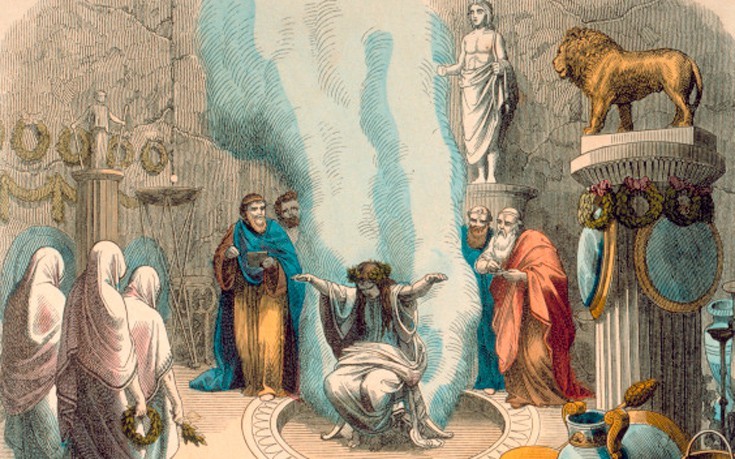
It was here where the High Priestess of Pythia would speak mysterious prophecies as she sat atop the tripod with her legs spread and no undergarments as the vapors creeped into her mouth, nostrils, and vagina from the pit below. The name Pythia is derived from Pytho, which is derived from púthein – meaning “to rot”, and is said refers to the sickly smell of the decomposition of the body of the monstrous Python after she was slain by Apollo.

Upon the altar in the Temple burned sweet incense to hide the pungent smell of the misty smoke and the walls and roof were covered all over with laurel garlands. Intoxicating fumes would rise from deep within a small cavern in the ground at the center of the temple where there stood a high tripod, on which the High Priestess – Pythia, took her seat whenever the oracle was to be consulted.
The tripod was perforated with holes that allowed the vapors to completely envelop the Pythia. As she straddled herself over the tripod with her legs spread wide allowing the spirits of the vapors to enter into her bodily orifices, which caused her body to enlarge, her hair stand on end, her complexion changed, her heart panted, her bosom swelled and her voice became seemingly more than human.
These mysterious vapors would completely change the Priestess into another being that they believed could prophesy and tell the future. This smoke rising from the pit affected her body and brain in such a manner that she fell into a state of what can possibly be described today as “religious ecstasy” or “speaking in tongues.”
Here is an ancient depiction from a scene of the Delphic Oracle which shows the Pythia Priestess enveloped in serpents alongside Athena and Pylades and Erinyes (330 BCE). In Greek mythology, the Erinyes, also known as Furies, were female deities of vengeance who were sometimes referred to as “infernal goddesses.”

These were the first prophets (prophētai,προφῆται”, singular prophētēs) – meaning “one who speaks on behalf of another person” and I believe from these virgin women, the Lord and his Apostles were born.
Speaking of the rotting carcass of Pytho, Pausanias relates a text where she is called “the great and terrible monster, the nurse of Typhon, who devastated the land”, which I speculate could have been in reference to the previous religion and or cult of the Cretans being centered upon the Great Mother and nature who represented the earth but after her death, she represented death and war, for now, the vapors from her rotting carcass of a religion encompass the whole earth in a dark mist.
Pausanias writes in the first person how Apollo slew Pytho;
“Here,” says Apollo, “ will I build a splendid temple to be an oracle for men ; they shall bring hecatombs from the Peloponnesus, from Europe, and from the isles, and I will make revelations unto mortals in my sanctu~ my.” Having thus spoken, Phoebus Apollo laid the foundations, and upon them Tropho~ nice and Agamedes, sons of Erginus, placed the stone threshold, aided by countless tribes of men, and raised the temple with polished blocks of stone.
And hard by there was a spring of pure water, guarded by a she-dragon, a great and terrible monster, the nurse of Typhon, who devastated the land ; and the Lord Apollo slew her with his sharp arrows, and, having slain her, he mocked her and said: “ There lie and rot upon the ground.
No longer shalt thou be a scourge to my worshippers. Neither Typhoeus nor the dread Chimaera shall save thee from death, but here shall the black earth and the sun god Hyperion cause thee to rot.” So he spake exalting, and darkness covered her eyes, and the sun caused her body to rot, whence the place is now called Pytho, and the Lord Apollo the Pythian.
In The Travels of Lycurgus, it speaks of his arrival at Delphos to consult the oracle of Apollo, who he states is worshipped there under the name of Pythian, from the serpent Python, which he killed. It is written;
“Over the vent of the cavity a tripod is placed, which the Pythia, or priestess, mounts, when consulted, and from which she gives the oracle. The priestess was a long time preparing by sacrifices and purifications a fast of three days and other ceremonies before she ascended the tripod. I presented my offering: the Pythia mounted the sacred tripod, and the god denoted his approach by the agitation of a laurel that stands before the gate of the temple, which shook to its very foundations.
No sooner had the divine vapour, like a penetrating fire, diffused itself through the veins of the priestess, than her hair stood erect, and her looks grew wild and furious; she foamed at the mouth; a sudden and violent tremor convulsed her whole frame, and all the symptoms of distraction and frenzy were marked upon her countenance. She eyed me with fixed attention, and exclaimed:
“A friend of the gods, and rather a god than a man!” Here she ceased: her lips trembled, and she appeared agonized with the divine spirit that inflamed her soul. At length she again burst out into this exclamation:
“O Spartan! O favored of the gods! thy country shall flourish as long as the laws, which thou art about to establish, shall flourish: it shall become the most glorious and potent”
He concludes, “The words here died upon her lips; she gasped for breath and was led, pale and trembling, to her cell. I departed, satisfied with the answer that I had received.”
In my opinion, these mysterious vapors that were said to be from the rotting body of the serpent relate to fungi/molds that resided in these pits of which, “I will say no more.”
The 1st century BC Cretan historian, Diodorus Siculus tells of the mythology of the Oracle of Delphi that it was founded by a goat herder named Coretas who fed his flocks on Mount Parnassus. As the animals wandered here and there in pursuit of food, they “happened to approach a deep and long chasm in the rock.
From this chasm, a vapor issued, and the goats had no sooner inhaled a portion of the vapor than they began to play and frisk about with singular agility. The goatherder observing this, and curious to discover the cause, held his head over the chasm and in a short time the fumes having ascended to his brain, he threw himself into a variety of strange attitudes and uttered words which were supposed to have a prophetic meaning.
A temple was then erected on the spot, and dedicated to Apollo which is known as the Oracle of Delphi.
The word oracle comes from the Latin verb ōrāre, “to speak” and properly refers to the priest or priestess of Pythia uttering the prophecy containing the revelations of the God Apollo which were written down and interpreted by the priests who afterward communicated to the persons who had come to consult the oracle.
How the word delphi is connected to the dolphin and Apollo is described in an old Delphian or Pythian oracle. “It is open to students to regard the dolphin as only one of the many animals whose earlier worship is concentrated in Apollo, or to take the creature for the symbol of spring when seafaring becomes easier to mortals, or to interpret the dolphin as the result of a volks-etymologic (popular derivation), in which the name Delphi (meaning originally a hollow in the hills) was connected with delphis, the dolphin.” — Lang, Myth, Ritual, etc., 2,197.
The Science of the Vapors Which Produce Prophecy
It appears that the vapors arising from the pit are the source or cause of the action of prophecy for the priests and priestesses but the science as to how this occurred is still being debated. The early Christian Church Fathers said the purpose of the oracles were for demons which allowed to assist them to spread idolatry; so that the need for a savior would be more evident.
Other researchers had speculated that the vapors and subsequent oracles were the results of some type of narcotic or sulphuric compound such as gas emissions from a geologic chasm in the earth. Some researchers suggest the possibility that it might be ethylene gas, methane, CO2, or H2S.
A new theory is based on oleander, most commonly known as nerium. Apparently, a researcher has put forth erroneous claims that it causes symptoms similar to those of the Pythia and similar to those of epilepsy, the “sacred disease.” In my opinion, this explanation is false because nerium does not produce the same effects and this has been proven by science.
Ingestion of this plant does poison humans producing toxic effects such as nausea, vomiting, excess salivation, abdominal pain, diarrhea, irregular heart rate, drowsiness, tremors or shaking of the muscles, seizures, collapse, and even coma that can lead to death. But the facts are that it does not make you hallucinate and only one human death from oleander/nerium has ever been recorded.
The most commonly accepted explanation is the one made by Plutarch who said that the vapors from the Kerna spring waters that flowed under the temple. In my opinion, Plutarch’s official “public explanation” would have been purposely misleading due to the fact that he was a High Priest who would also know the secret operations, ingredients and even the science of the Delphic Oracle which he would have been under an oath of secrecy not to divulge.
What I have found in my research is that the leaves of the oleander/nerium plant’s are prone to fungus/mold infections.
I believe that the vapors were the result of a process of rotting flesh which contained various organisms such as fungi/molds that we know today have the ability to take over other organisms and also produce hallucinating and delirious effects. An example would be the fungus ergot which contains lysergic acid as well as its precursor, ergotamine – the ingredients for the famous hallucinogenic drug- LSD. I will expand more on this theory in a future article.
It was reported that the Pythia of the Oracle of Delphi was always a “native of Delphi” or of the native land in which the oracles were consulted. I believe they did this because these people would have always been considered as representing the earth or “earthborn” as some of the oldest inhabitants on earth so in their minds, these natives would have DNA coming from the same said lands so they would naturally be closer to the source of our origins which came from within the earth.
This is why we find in almost all ancient secret initiation rituals were conducted inside caves such as one of the most famous in antiquity is the cave of Zeus at Mt. Ida on Crete. The same cave where Epimenides Gnosis would awaken from a 57-year slumber to go to purify Athens to then become the founder of the Orphic (Ophite/Levite) Religion and later Pythagoras would spend three days alone as part of his initiation rites of Knossos to become a leading Gnostic of the Pythagoreans.
In the early stages of the development of their religion, young virgin girls who were never allowed to marry were utilized as oracles. Diodorus explains how the Pythia was always a clad young virgin with great emphasis on the girl’s chastity and purity to be reserved for union with the god Apollo but after one priestess had been seduced by Echecrates the Thessalian, the Delphians made a law that in future no one should be elected who had not attained the age of fifty years. He writes;
“Echecrates the Thessalian, having arrived at the shrine and beheld the virgin who uttered the oracle, became enamoured of her because of her beauty, carried her away and violated her; and that the Delphians because of this deplorable occurrence passed a law that in the future a virgin should no longer prophesy but that an elderly woman of fifty would declare the Oracles and that she would be dressed in the costume of a virgin, as a sort of reminder of the prophetess of olden times.”
One of the most famous Greek writers and philosopher, Plutarch was actually a High Priest of Apollo at Delphi during the late first century and early second century CE. He would have been in charge of overseeing the Cult, the priestesses, interpretations of the prophecies, conduct sacrifices at other festivals of Apollo, collect money for the Temple treasury and would have been an official of the Pythian games.

Plutarch said that the Pythia’s life was shortened through the service of Apollo. Apparently, being a Pythia was a very dangerous job because it was said to be common that the Pythia would go crazy after the ceremony as she often leaped from the tripod in mad convulsions (epileptic seizures?) and then would die soon after.
As the cult developed and the priests became more learned more about the dangers associated with divination, the priestesses were then chosen from poor families in the empire and there were always two Pythias, who took their seat on the tripod alternately, and a third alternate was kept ready in case one of the others went mad or died.
More on the Delphic Oracle Connection to Crete
The Oracle of Delphi may be connected to the more Ancient Cult of Rhea (Mother Earth/Cybelle/Rhea/Gaia/Magna Mater) on Crete which was based on honoring and serving God, nature and the earth. For example, one of the most important rites was the doctrine of purification, which had its roots in Crete.
Thus the Delphic oracle was essentially Cretan Cult in character which I will prove below.
To the Ancient Cretans (Phoenicians), Greeks and in all countries around the Mediterranean, no religious institution in all of antiquity had obtained such a paramount influence, as the Oracle of Delphi. Delphi was the most famous place for this secret religion of the oracles of Zeus (Jupiter) which could also be found at Boetia, the Siwa Oasis, Dodona, and at Olympia.
In researching the origins of this religion, it appears to have originated on the Holy Islands of Crete and Delos which was said to have been the birthplace of Appollo who was the son of the God Zeus who was also born on Crete and hid in the mountain of the Hellenistic Jews – Mount Ida.
In the Delphi Complete Works of Diodorus Siculus, he had written that Apollo has been called Delian and Lycian and Pythian, and Artemis has been called Ephesian and Cretan and Tauropolian and Persian, although both of them were born in Crete.
Siculus said Apollo was the discoverer of the lyre and of the music which is got from it; that he introduced the knowledge of healing, which is brought about through the faculty of prophecy, whereby it was the practice in ancient times that the sick were healed; and as the discoverer of the bow he taught the people of the land all about the use of the bow, this being the reason why the art of archery is especially cultivated by the Cretans and the bow is called “Cretan.”
He further stated, “To Apollo and Coronis was born Asclepius, who learned from his father many matters which pertain to the healing art, and then went on to discover the art of surgery and the preparations of drugs and the strength to be found in roots, and, speaking generally, he introduced such advances into the healing art that he is honored as if he were its source and founder.”
A paean is a song, poem or hymn which expressed triumph or thanksgiving was sung during the religious ceremonies. In the Mycenaean Linear B tablets found on Crete, the word pa-ja-wo-ne is used as a name for a healer god which was later associated with Apollo and his son Asclepius.
Further connections to Crete can be found in the Homer’s Iliad in the Hymn to Apollo, in which Apollo himself is introduced conducting a band of Cretans (Phoenicians), who came from the city of Gnosis – Knossus, Krissa (Krisa/CreUSA). Apollo chose his first priests, whom he selected in their “swift ship” were “Cretans from Minos’ city of Knossos (Gnosis)” who were voyaging to sandy Pylos.
In the form of a dolphin (delphys”, gen. “delphinos), Apollo leapt into the ship and revealed himself to the terrified Cretans, and bade them follow him up to the “place where you will have rich offerings”. The Cretans “danced in time and followed, singing Iē Paiēon, like the paeans of the Cretans in whose breasts the divine Muse has placed “honey-voiced singing”.
These were Apollos Cretan priests of Pytho who we find as the head musician playing the lyre, and the Cretans follow beating drums and singing “paeans such as the Cretans sing to whom the divine muse has given the gift of sweet song.”
Historian, Professor G.L. Huxley had said, “If the hymn to (Delphic) Apollo conveys a historical message, it is above all that there were once Cretan priests at Delphi.”
These songs and dances I believe were for healing Thaletas was able to heal with his songs; Epimenides Gnosis was the magically gifted purifier and lawgiver who saved the Athenians and who after his death the Spartans held as a God. These paean hymns were also associated with the war and dances of the priesthood of the Curetes in Crete in honor of Zeus whom they were assigned as protectors. The Homeric Hymn expressly states that the Cretan priests sang paeans at their advent at Delphi, and were of a distinctly Cretan character.
While these myths seem fantastical to the casual researcher, these facts can also easily be backed by science because we know today that the Holy Island of Crete is known as the birthplace of Western Civilization and the ancient Cretans (Phoenicians) were very skilled in magic, religion, writing, war, music, and dancing which was “how the West was truly won.”
Historical evidence also states that the invention of the “paeonic meter” was consistently attributed to Crete” and its introduction into Greece was assigned to the Cretan Thaletas.” The poems of Archilochus (7th century BC) and ancient scholars mention it such as Alcman (7th century BC) and other poets who wrote in Sparta.
Later in the 5th century BC, Pindar also mentions the paeans and he was said to be especially fond of the Pythian Apollo of Delphi. The ancient Greek poet, Euripides speaks of the Delian women singing the paean in honor of Apollo and swaying in beautiful dance before the doors of the temple.
In the later days of Cicero and Plutarch, the Delphic Oracle began to lose its influence but was still continued to be consulted down to the times of the Roman Emperor Julian, until at last it was altogether banned by Roman Emperor Theodosius I who was the last emperor to rule over both the eastern and the western halves of the Roman Empire.

Moe is the founder of GnosticWarrior.com. He is a father, husband, author, martial arts black belt, and an expert in Gnosticism, the occult, and esotericism.