by Moe | Nov 11, 2013 | History of the Brotherhood, Meaning of Symbols
“Red star, that from his flaming hair. Shakes down diseases, pestilence and war.”- Homer 
In ancient history, the sign of a comet was an evil omen, and a sign of death. It often meant the death of a king or Pope, such as in 858 A.D. when there was a comet seen before the death of Pope Benedict III; or in 859 a comet announced the death of Lotharius the Younger; and in 875, another for Louis II. There was “Charlemagne’s Comet “; in which a torch-shaped comet was seen above Germany in 814 A.D., foretelling the king of the Franks death.
Also, the infamous Halley’s Comet that would blaze in the European heavens once a century; foretelling the death of a king like that of Richard I, “the Lion Heart,” and another with that of James II, King of Scotland, in 1460.(1) Also, in 1910 it was widely anticipated and coincided with the death of King Edward VII of England (Burnham, 2000).
Let us not forget “Caesar’s Comet” of 44 B.C., during the reign of Augustus, that instead of being a sign of death, it was a sign of Caesar’s soul ascending to heaven after his death. The Comet was part of the political propaganda that changed the mythology of the comet being an omen that had meant death of a king, to meaning the assencison of the soul of the king. As part of this tool, his son Augustus in the year 42 B.C. had built “The Temple of Divus Iulius (Temple of the Deified Julius or Temple of the Comet Star) and was dedicated in 29 B.C. by Augustus for the “cult of the comet”. In the temple there was a large image of Julius Caesar, who according to Ovid, had a flaming comet affixed to its forehead:
To make that soul a star that burns forever
Above the Forum and the gates of Rome.(Wikipedia)
A comet was visible for 40 days and 40 nights at the time of the Emperor Constantine’s birth in 904 A.D., and another upon his death in 959. In 1208 A.D., the Jews thought the comet seen that year was a sign of the coming of their long-expected Messiah. (1)
Homer had written almost 3,000 years ago about comets and death in the Iliad; Warm’ din the brain the smoking weapon lift- The purple death comet floating over his eye.
Ironically, just like Homer had described the purple death comet floating over his eye, today, the purple comet known as Ison is currently located just inside the orbit of Jupiter. A planet that has as a massive eye, and a planet known as the King of the Gods…
Link to Space.com
WARS AND COMETS
Homer had further written in the Iliad; “As when high Jove (Jupiter) denouncing future woe, Over the dark clouds extend his purple bow; And as the purple bow Jove (Jupiter) bends at mortals, when of war he will the signal show – (In sign of tempests from the troubled air, Or from the rage of man, destructive war)
According to the Roman Stoic philosopher Seneca, shortly before the war of Achaia, B.C. 146, there was a comet as large as the sun, and dissipated the darkness of the nights: its disk was red and fiery. In 83 B.C., a comet signaled the war between Caesar and Pompey. Three Comets appeared before the War between Ludo- 841 and his Sons, that arose about the division of the Kingdom. In 1043, the War in Hungary succeeded a Comet. In 1472, two Comets appeared, which were succeeded by several Wars and violent Plague; at this time Charles Duke of Burgundy made War upon his Neighbours, which War lasted many years, and was ended by his death. Two Comets were seen, the one in the East, the other in the West, after which the Turks invaded Armenia. The appearance of Donati’s comet, in 1858, was quickly followed by the Italian war of 1859.(2)
The 17th century English poet, Milton said this in regards to comets, Satan, and war in his day; “Satan stood and like a comet burned, That fires the length of Ophiuchus huge In the arctic sky, and from his horrid hair Shakes pestilence and war.”(3)
Does this have any relation to Wormwood?
Revelation 8:11- the name of the star is Wormwood. A third of the waters turned bitter, and many people died from the waters that had become bitter.
DISCLAIMER:
This content relates to ancient mythology and the events of today. It is a form of Conspiritainment, that may or may not apply to prophecy, the Apocalypse, or life in general. User discretion is advised.
SOURCES:
1. Knowledge…: A Monthly Record of Science, Volume 5; Volume 31
2. The petitioning-comet: or, A brief chronology of all the famous comets By Democritus (pseud.)
3. Presbyterian Banner, Volume 96
4. Wikipedia and other open source material
Moe is the founder of GnosticWarrior.com. He is a father, husband, author, martial arts black belt, and an expert in Gnosticism, the occult, and esotericism.
by Moe | Nov 4, 2013 | Gnosis, History of the Brotherhood
The word Kohen, or Cohen (Kohain; Hebrew: כֹּהֵן, “priest”, pl. כֹּהֲנִים Kohanim or the English Koan) is the name of a priesthood that is one of the oldest still alive today. They are the ancient priests who had worshiped the God Asclepius; the God of wisdom, medicine, healing, rejuvenation and physicians, with his serpent-entwined Tau staff. The Kohens (Koans) of the House of Asklepios (iEsculapius) come from the Island of Kos just 7 miles off the coast of Crete, where the secret mysteries of their religion is not only passed from father to son, it is also contained in their blood.
A person who comes from the island Kos (Coos) is called a Koan in English, and a Cohen or Kohen (or Kohain; Hebrew: כֹּהֵן, “priest”, pl. כֹּהֲנִים Kohanim) which is simply the Hebrew word for priest. Hence, your last name does not have to be “Kohen or Cohen” to be a member of this biblical family. This is a common misconception that many modern Jews have today. The people and families of the original Kohens (Koans) were simply from the island of Kos located just 7 miles offshore Crete, and that were specifically trained in medicine, healing and arts. Hence, this is why the family of the Kohen were consecrated to serve in the Sanctuary of the Temple as the High Priests of Ancient Israel up to the destruction of the Second Temple in 70 CE. We also find that the Apostle Paul had visited this island of Kos (Coos) as described in Acts 21: “And it came to pass, that after we were gotten from them, and had launched, we came with a straight course unto Coos, and the day following unto Rhodes, and from thence unto Patara.”
 This small island of Kos has a deep history, that many people are simply unaware of. The people of Kos are mentioned in the time of Alexander the Great where they are also referred to as some of the most powerful Jewish bankers of their time, with strong connections to Egypt, the Ptolemies, Cleopatra and Herod; as described in early 20th century in The Jewish Encyclopedia:
Jews are mentioned among the population of Kos; and under Alexander the Great and the Egyptian Ptolemies (from 836 13.6.) the town developed into one of the great Jewish centers in the A’Jgean. Josephus (“ Ant.” xiv. 7, § 2) quotes Strabo to the effect that Mithridates were sent to Kos to fetch the gold deposited there by Queen Cleopatra and “800 talents belonging to the Jews.”
Jews of Kos are mentioned at the time of Antiochus VII., Sidetes, Kos being one of the islands to which the rescript of the Roman consul Lucius was sent (139 12.0.; I Mace. xv. 23). It appears probable that in course of time the Jews became the chief bankers in the island, and that they took charge, at a certain rate of interest, of the large sums of money owned by the temples. In the sacrificial tablet of the Temple of Adrasteia and N emesis, they are mentioned (lines 17, 18) as mivrrg‘ ierb ‘r[uv rpa]1rsCur£w 6 67.2.1»; (Herzog, “Critische Forschungen,” p. 35). This inscription is of the first century 11c. Rayet (“ Mémoire sur l’Ile de Kos,” p. 80) thinks that the 800 talents ($960,000) deposited by Cleopatra were held by these Jewish rpamfirat; but of this there is no evidence (Paton and Hicks, “Inscriptions of Cos,” p. xxxviii.). In 49 3.0. the Koans are reminded by the consul Cains Fannius to obey the decree of the Roman Senate and to allow safe passage to Jewish pilgrims traveling to Jerusalem (Josephus, Le. xiv. 10, § 15). Herod is said to have provided an annual stipend for the benefit of prizewinners in the athletic games (Josephus, “B. J.” i. 21, § 11); a statue was erected there to his son Herod the ‘l‘etrarch (“ C. I. G.” 2502). The epigrammatist Melenger, who was living at Kos about 95 13.0., complains of having been abandoned by his mistress for a Jew (Epigram No. 83, in “Anthologia Graeea,” v. 160).
The island of Kos (Dia) is where the Father of Medicine, Hippocrates (Greek: Ἱπποκράτης; Hippokrátēs; c. 460 BC – c. 370 BC) was born, and also where he had operated his world-famous school of medicine. Soranus said that Hippocrates learned medicine from his father and grandfather, and studied other subjects with Democritus and Gorgias. (Wikipedia) This learning from grandfather to father, and father to son would follow in the ancient Kohen family tradition. Pliny had written; Hippocrates learned medicine by writing down the successful cures that had been recorded by patients on the walls of Asklepios’s Kohen (Koan) temple.
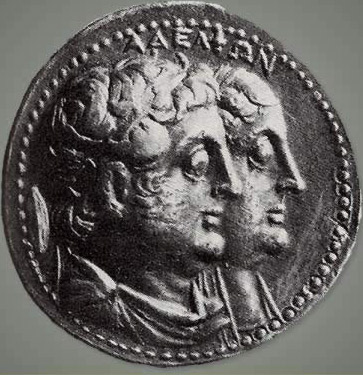 The Ptolemies of the Greco Egyptian period had continued the ancient tradition of the high priests of Ptah from Egypt and were connected to the islands of Kos and Crete, which was part of the Ptolemaic Kingdom that had stretched from Egypt and spread along the Eastern Mediterranean from Cyprus, Crete, to almost all islands of the Aegean and even Thrace. Some members of the Ptolemy family were born on Kos, such as Ptolemy II in 308 B.c.e. In the time of Ptolemy Philadelphos, who was the son of Cleoptatra; Kos enjoyed great relations with the Alexandrian court, and is where some of the greatest literary men of the time from Alexandria would often want to escape the busy atmosphere of the city and travel to Kos for a spiritual and health retreat. Some of them would also attend the Hippocrates’ School of Medicine, which would have been the finest in all the world from the 5th century, down to the time of the destruction of the temple.
Herodas (Greek: Ἡρώδας) was a Greek poet who was also a Kohen (Koan) from the island of Kos. An account of Kos, down to, and during the time of Herodas is given in the book, The Mimes of Herodas by Herodas;
Next to Rhodes, Kos is the largest of the Dorian Sporades. Its Geocircumference is given by Strabo as 550 stades, by Pliny the elder as 100 Roman miles. The island falls into three divisions (i)the eastern district, bounded on the south by a high range of mountains; upon these mountains are the healing springs, which are still famous; (2) a plateau furrowed by watercourses, and for the most part desolate and barren; (3) the mountainous western district, with a distinct range of its own.
Most of the island is remarkably fertile, and noted for its wines. Kos is badly supplied with harbours. Its people were of a sober, steadfast character, as befitted their Doric origin. The youths of Kos were famous for their beauty1. They adhered faithfully to ancient ritual, especially in regard to the worship of Asklepios, which came to them from the mainland of Greece*. In the fifth century the Koan school of medicine, which continued famous for a considerable period, was founded by Hippokrates; he based his observations on the votive models in the temple of Asklepios, which constituted a kind of anatomical and pathological museum.
The history of the settlements on the island is as follows. In the Early Homeric catalogue we find Kos, with its dependent islands (Nisyros, J^yj? Krapathos, Kasos, and the Kalydnian group), sending a contingent island, of thirty ships to help the Greek cause. The contingent is led by Pheidippos and Antiphos, the sons of Thessalos, a Herakleid. In the Iliad we also hear twice6 of Herakles having been carried to Kos by contrary winds through the anger of Hera, on his way from the sack of Troy. He is attacked by the natives of Kos, according to the fuller form of the legend, and slays the king of the island, Eurypylos, marries his daughter Chalkiope, and begets a son, Thessalos. This legend is now seen to be referred to by Herodas *.
Thus, even before the Dorian migration and the colonization of Ionia there was a Dorian settlement in Kos. It is thought probable that these Dorians came from Argolis. Herodotos1 tells us that Kos and the adjacent islands were colonized from Epidauros, and in this way the old Dorian element was strengthened. The sterner features of the Dorian character were, however, mollified in Kos. The discipline (dyaryi;) of Sparta and Crete is not found there, though the population of the island was purely Dorian, and was divided into the three Dorian tribes, the Dymanes, Hylleis, and Pamphyli. Six of the cities in this region formed a religious league, the Doric Hexapolis. They were, besides Kos, Lindos, Ialysos, Kamiros, Knidos, and Halikarnassos. These states met at the temple of Apollo on the Triopian promontory, to take part in the worship of the god and also in games. Later on Halikarnassos was expelled, and the Hexapolis became a Pentapolis.
The dwellings of the earliest inhabitants of Kos were on the northeast coast, near the present town of Kos. The fountain Burinna*, which is alluded to by Theokritos *, and still remains, is situated in this region. The Dorian settlers saw the advantage of this side of the island, which brought them closer to the mainland; they did not, however, confine themselves to the east coast, but spread over the island Koto. In the sixth century the Lydo-Persian wars forced them to change the capital of the island to the opposite side, where they built ‘Acmm-dXaia, which served as the capital until the fourth century.
It was on Crete and Kos where the royal family of the Ptolemies had intermarried with various princesses of the ancient priesthood blood of the island, that which played a prominent role in the building of the Ptolemaic court that was a powerful religious and banking dynasty. Author, Theodore Arthur Buenger explains more of this connection between Crete and Egypt in his book, “Crete in Greek Tradition.” He relates the story of the Egyptian God Ammon fleeing to Crete that was originally told by the 1st Century B.C. Greek historian, Diodorus Siculus who was also from the same Holy Island of Crete, or quite possibly a Kohen from Kos;
An odd story is told by Diodorus about Rhea and Ammon. Rhea quarreled with the other Titans, went away from them, and married Ammon in Egypt. After a time she deserted him and married Cronus, who then waged war against the Egyptian god. Ammon, fleeing from Cronus, went to Crete and married Crete, the daughter of one of the Curetes. If this story really represents an old tradition, it must be rated rather high, for it is practically the only one which links Crete and Egypt.
Hippocrates and Ptolemy II would have been of the priesthood of the original Kohen who trace their patrilineal descent from the Biblical Aaron. This is one of the methods, in which we can verify that there is a relationship in history between Crete, the Isle of Kos and Egypt, and that also ties in with the Kohen Priesthood.
This history above connects the Island of Kos to the ancient priesthood of the Kohens (Koans) and also home to one of the most powerful cities and people of their time. A people, priesthood, medicine men, bankers and kings who were also once aligned with the most powerful governments of Egypt and Athens. It was during the Peloponnesian War, when they were considered an ally of Athens, and later part of the Delian League. The island Kos or Cos is named after Ceus, the son of Titan, and has been known by various names such as Zia, Cia, Cea, Ceos, Coo, Coos, Cous, Delos, Merope, Lemnos, Letos, Staunchio and Patmos.
Today the island of Kos is simply known as Dia. A barren wasteland, that was once the fertile home to the Kohens (Koans) and one of the world’s best schools of medicine. A history and true origins of a people, that someone or some entity had wished to erase from the memories of their ancestors, their original home, and from the face of the earth.
SOURCES:
1. Creation Records Discovered in Egypt: (studies in The Book of the Dead) By George St. Clair page 72
2. All other sources are linked to in yellow or can be easily researched via Google and Open Source material
Moe is the founder of GnosticWarrior.com. He is a father, husband, author, martial arts black belt, and an expert in Gnosticism, the occult, and esotericism.
by Moe | Oct 28, 2013 | History of the Brotherhood, Mystical Christianity
At one time, the religion of Christianity had a different cross as their symbol, than the one used today and over the last 1500-1800 years. The original true cross that the Fathers of the Church had considered a symbol of our Saviour’s cross was the letter Tau, who St. Jerome had declared that the ancient Hebrews before Esdias formed the Tau like a cross, and who Saint Bede had said was “the sign of salvation and of the cross.” The Tau is the 19th letter of the Greek alphabet which is modeled after the Phoenicians who had represented the Tau with the Phoenician letter taw ‘X.’ (more…)
Moe is the founder of GnosticWarrior.com. He is a father, husband, author, martial arts black belt, and an expert in Gnosticism, the occult, and esotericism.
by Moe | Oct 24, 2013 | Apocalypse, History of the Brotherhood
On July 11, 2013; Pope Francis had issued one of the most important Apostolic Letters of our time on the jurisdiction of  Judicial Authorities of Vatican City State in Criminal Matters. This letter was addressed to all the public officials of the Roman Curia around the world, and not just those who reside in the Vatican City State. Pope Francis had ended the letter with, “I establish that this Apostolic Letter issued Motu Proprio will be promulgated by its publication in L’Osservatore Romano, entering into force on 1 September 2013.”
What this basically means, is that all public officials that are under Roman Curia rule of law will have to comply with this letter. Hence, they will have to simply resign or be fired by the date of September 1st, or they may face international criminal prosecution.
Shortly before and after this letter was released, news about an unprecedented amount of resignations, firings and early retirements in the United States, from some of the most powerful positions in government had started to hit the media like no other time in recent history. The conspiracy news blogs and Youtube videos were the first to start making allegations, that this letter from the Pope and these events in the US are connected.
“Could all these various resignations and firings indicate that the US is under Roman Curia Law, or are these mass resignations and firings just a peculiar coincidence?
Here is a small list of “some of these US public officials” who have resigned, or have been fired around or since the time of this letter on July 11, 2013; (Disclaimer – This list does NOT indicate guilt, but just facts that coincide with Pope’s letter.)
- On the same day of the letter from the Pope dated July 11, 2013, the Federal Reserve Governor, the New York Times announced that Elizabeth Duke would step down effective September 1, 2013.
- News on July 12, 2013 stated that Janet Napolitano, head of Homeland Security will resign effective September 1, 2013.
- Since July 2013, nine senior commanding generals have been fired by Obama, such as the two-star general overseeing the U.S. arsenal of intercontinental missiles that was fired on October 11, 2013
Yes, lot’s of the numbers 11 and 1 here. In the occult, the number 11 is the destruction, judgment and the death of man. It is the first number after 10 at which point the number 11 signifies a new starting point of counting.
WHERE DOES THE POPE GET HIS LEGAL AUTHORITY OVER THE PUBLIC OFFICIALS OF THE WORLD?
The Pope governs the Catholic Church through the Roman Curia. The Roman Curia consists of a complex of offices that administer church affairs at the highest level, including the Secretariat of State, nine Congregations, three Tribunals, eleven Pontifical Councils, and seven Pontifical Commissions.
Curia in medieval and later Latin usage means “court” in the sense of “royal court” rather than “court of law”. The Roman Curia, then, sometimes anglicized as the Court of Rome, as in the 1534 Act of Parliament that forbade appeals to it from England, is the Papal Court, and assists the Pope in carrying out his functions.(Wikipedia)
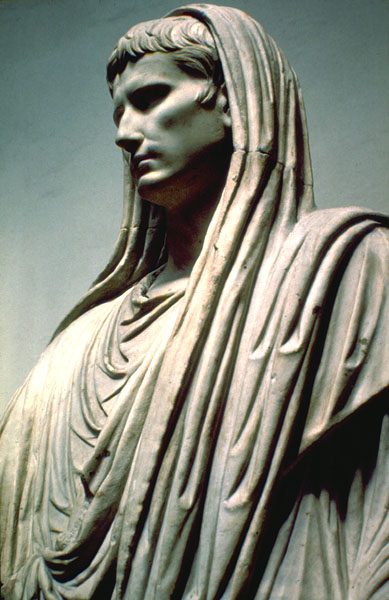 The first high priest of this Age and the first official Roman Pontifex Maximus, or who we would today call the first official Pope of this age, was Augustus Caesar. It was King Lucius who clearly had said, “superior papal authority and dominion is derived from the law of the Caesars.” From the reign of Augustus, all laws made by the Roman Curia at the time ,and all subsequent laws would be incorporated into not only the decisions of the church, but also the countries in which their Catholic Kings and bishops had ruled. Today it is no different from what it was in the time of Augustus; the Pope rules from the top down, and when an edict on law and criminal matters is issued from the Pontifex Maximus, you better believe that all the various entities under the rule of Church will have to simply comply or face criminal prosecution.
COPY OF APOSTOLIC LETTER ISSUED MOTU PROPRIO
OF THE SUPREME PONTIFF FRANCIS
ON THE JURISDICTION OF JUDICIAL AUTHORITIES OF VATICAN CITY STATE IN CRIMINAL MATTERS
In our times, the common good is increasingly threatened by transnational organized crime, the improper use of the markets and of the economy, as well as by terrorism.
It is therefore necessary for the international community to adopt adequate legal instruments to prevent and counter criminal activities, by promoting international judicial cooperation on criminal matters.
In ratifying numerous international conventions in these areas, and acting also on behalf of Vatican City State, the Holy See has constantly maintained that such agreements are effective means to prevent criminal activities that threaten human dignity, the common good and peace.
With a view to renewing the Apostolic See’s commitment to cooperate to these ends, by means of this Apostolic Letter issued Motu Proprio, I establish that:
1. The competent Judicial Authorities of Vatican City State shall also exercise penal jurisdiction over:
a) crimes committed against the security, the fundamental interests or the patrimony of the Holy See;
b) crimes referred to:
– in Vatican City State Law No. VIII, of 11 July 2013, containing Supplementary Norms on Criminal Law Matters;
– in Vatican City State Law No. IX, of 11 July 2013, containing Amendments to the Criminal Code and the Criminal Procedure Code;
when such crimes are committed by the persons referred to in paragraph 3 below, in the exercise of their functions;
c) any other crime whose prosecution is required by an international agreement ratified by the Holy See, if the perpetrator is physically present in the territory of Vatican City State and has not been extradited.
2. The crimes referred to in paragraph 1 are to be judged pursuant to the criminal law in force in Vatican City State at the time of their commission, without prejudice to the general principles of the legal system on the temporal application of criminal laws.
3. For the purposes of Vatican criminal law, the following persons are deemed “public officials”:
a) members, officials and personnel of the various organs of the Roman Curia and of the Institutions connected to it.
b) papal legates and diplomatic personnel of the Holy See.
c) those persons who serve as representatives, managers or directors, as well as persons who even de facto manage or exercise control over the entities directly dependent on the Holy See and listed in the registry of canonical juridical persons kept by the Governorate of Vatican City State;
d) any other person holding an administrative or judicial mandate in the Holy See, permanent or temporary, paid or unpaid, irrespective of that person’s seniority.
4. The jurisdiction referred to in paragraph 1 comprises also the administrative liability of juridical persons arising from crimes, as regulated by Vatican City State laws.
5. When the same matters are prosecuted in other States, the provisions in force in Vatican City State on concurrent jurisdiction shall apply.
6. The content of article 23 of Law No. CXIX of 21 November 1987, which approves the Judicial Order of Vatican City State remains in force.
This I decide and establish, anything to the contrary notwithstanding.
I establish that this Apostolic Letter issued Motu Proprio will be promulgated by its publication in L’Osservatore Romano, entering into force on 1 September 2013.
Given in Rome, at the Apostolic Palace, on 11 July 2013, the first of my Pontificate.
FRANCISCUS
Moe is the founder of GnosticWarrior.com. He is a father, husband, author, martial arts black belt, and an expert in Gnosticism, the occult, and esotericism.
by Moe | Oct 22, 2013 | History of the Brotherhood, Irish History, Meaning of Symbols
The power of the serpent of Egypt was broken on the cross – Justin Martyr
Let it be said, that long before the Romans had given us the images and idols of the Lord and Savior of Jesus crucified upon the cross, the serpent or snake was the chosen image by the ancient wise people of the not so distant past as their savior. In fact, the ancient Romans had used to carry forth the serpent in war, and one of their standards was the serpent on a pole. St. Augustine tells us, that the image of Christ and his Cross was the new ensign of Christian Warfare that the Romans had carried before them; being the Ensign or Profession of their Warfare. Hence as Jesus had said, “I come not to bring peace, but to bring a sword” (Matthew 10:34)
 The ancient serpent-god of the Gnostics from the East was Serapis. The various spellings of the name Serapis are, Sor-apis (Σέραπις, Attic/Ionian Greek), Sarapis (Σάραπις, Dorian Greek), Serapin (Greek Ὄφις), or in Hebrew, Seraph. All these names mean ‘serpent.’ The name ‘seraphim’, is the plural form of serpent and is also said to mean, “the burning ones.” Serapis is the Hellenized version of the Egyptian Osiris-Apis.
“Be ye wise as serpents”
Serapis is the serpent on the cross that was also the precursor to the Christian Christ, who would take the serpents place upon the cross in this Sixth Age under the religion of Christianity. Before the Christian era, the most ancient worship of the serpent was practiced in many areas of the world. The serpent on the cross was still worshiped up to the 7th century in England under the Druids. Tacitus, the Roman senator and historian had said, that Serapis was worshipped as a type of universal deity that represented Jupiter, Osiris, Pluto, and sometimes Jupiter Ammon. The cult of Serapis had originated from the Greco-Egyptian priesthood under the Ptolemies, and the testimony of Pausanias says the temples of Serapis were the most famous at Alexandria, and the most ancient at Memphis.
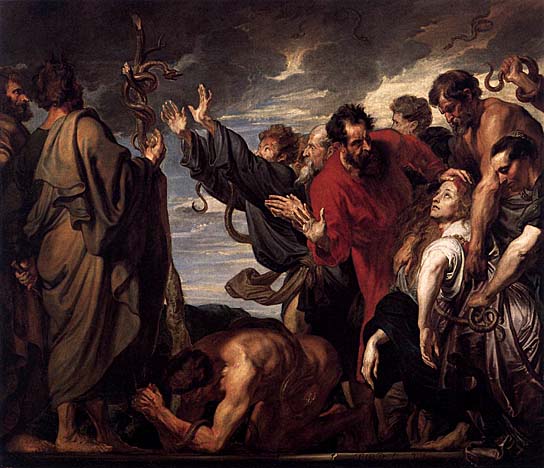
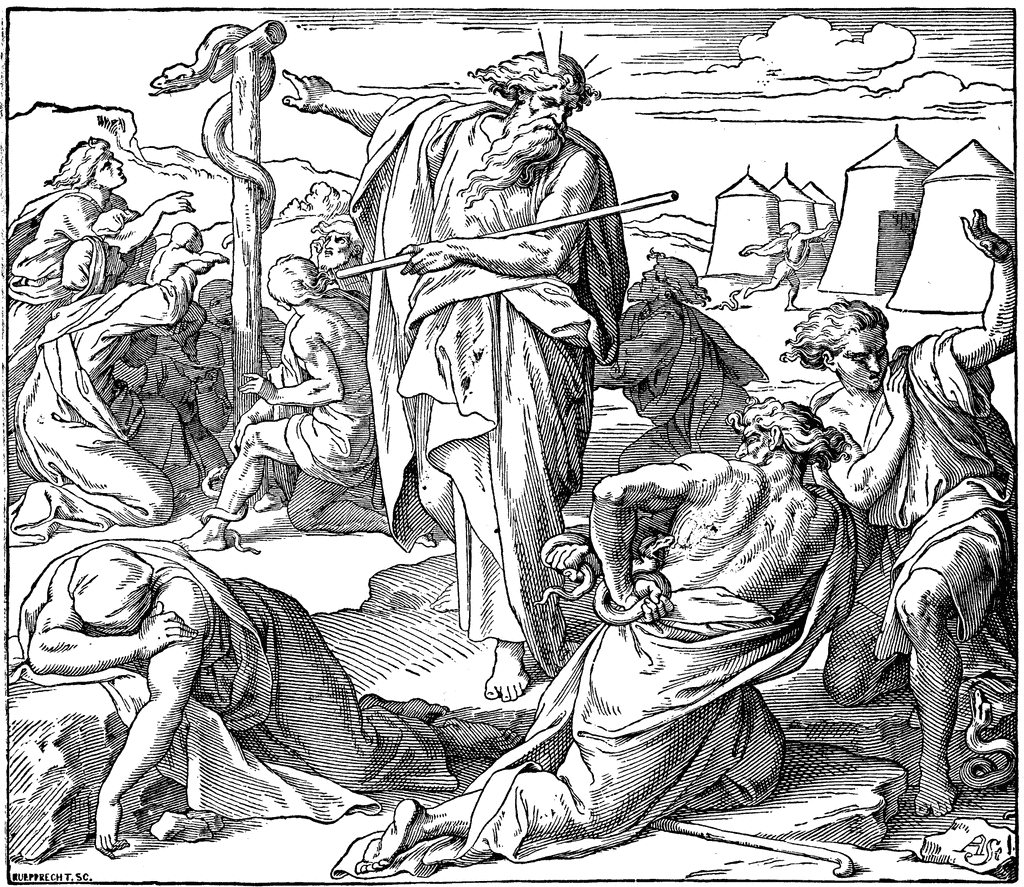 With the symbol of Jesus, St Mark informs us, “With the form of a serpent, He kills the serpent, for the serpent made out of the rod swallowed up the other serpents.” This symbolic event is further explained in St Augustine’s sixth sermon where he said, ” the serpent signifies death, and that Moses’ rod was changed into the serpent because our Lord took upon himself death for us.”
Prior to the 15th century A.D., most people were unlearned and they could neither read or write. The main educated class were usually those fortunate souls who were born into current ruling royal stock. This is why symbols and picture were often the preferred method in which the priesthood and government would educate the people about their religion, gods and history. The Father of English History and Doctor of the Church, Saint Bede who had lived during the 7th century and at the time of this transition from the Old Testament serpent on the cross, to New Testament Jesus on the cross; calls these images, “executed with wonderful art and wisdom.
Some bishops of the church had disagreed with this symbolic method of idolatry type education, such as when the Bishop of Marseilles; Serenus had broken these idols. In the book, “An English-Saxon Homily on the Birth-day of St. Gregory,” By Aelfric (Abbot of Eynsham), he relates the story of Gregory the Great who had declared in his Epistle to Serenus, speaking of those Images which that Bishop had broken;
who know not Letters , may at least be able to read, by looking upon the Walls, what they are not capable of reading in Books. Wherefore, your Brotherhood you’d both preserve them, and hinder the People from adoring them. That sa f1 those who cannot read, may have, from whence to gather some Knowledge of History: And the people be, by no means, permitted to Sin, by the Adoration of a Picture.
Bede had further explained, “A Cross of Silver, and the Image of our Saviour in a Picture. ‘In this manner, Augustine and his Followers are described by Bede, to have come into the Presence of King Æthelbert. They bore a Cross for their Banner, Pro Vexillo: hon pro Adoratione, not for Adoration.” A Latin phrase meaning, “As standards: no honors for Adoration.” Hence, there was no homage or worship given to it, but only as St Augustine had said, “his Cross was the new ensign of Christian Warfare.”
But that you may under« sand the Use of the Images of Stints, and of our “Saviour, which our Saxon Ancestors, and who, writing of the Images of things in Solomon’s Temple, expressed himself thus, If it was lawful to lift up the brazen Serpent upon a Pole, which the Children of Israel beholding, were saved alive: why may we net, by a picture, bring into the Memory of the A Faithfuls that sifting up of our Saviour upon the Cross, by which he overcame Death: or those “his other Miracles, and Cures, by which he wonderfully triumphed over the fame Author of Death Since the fight of these things make oftentimes a deep Impression on the Minds of the Beholders, and to those who are ignorant of Letters, open asit were a kind of lively reading, of the History of our Lord. For picture, in the Greek, is called “(secret for you to find out)”, that is, a writing that expresses the Life.
WHAT IS THE MEANING OF SERPENT WORSHIP AND THE SERPENT ON THE CROSS ?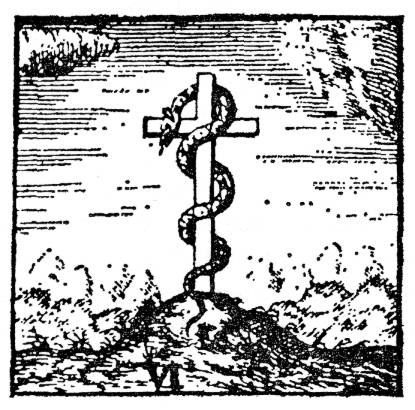
For thousands of years, the serpent or dragon was worshiped by many cultures all around the world. To these ancient people, the serpent had signified wisdom, intelligence, life and rebirth. In a sense, the symbol of the serpent represented Gnosis in the highest sense, which would equate to human godlike status and the equivalent of a Christ or the messiah. However, to modern Christians, the serpent is the devil incarnated and the followers of this ancient wisdom are called Demons. Hence, the 2, 000 year old war between the new savior, Jesus who was the Roman-Jewish messiah of the New Testament (New Law), and the serpent savior who is the prince of Demons of the Greek Old Testament (Old Law).
As Saint John had magically said, “The great dragon was hurled down—that ancient serpent called the devil, or Satan, who leads the whole world astray. He was hurled to the earth, and his angels with him.” – Revelation 12:9
In ancient Greece, the Greatest of all Serpents and the Prince of Good Demons (Angels) was Ophis (Οφιων, Ophiôn, Ophion who had reigned on Mount Olympus with his consort Eurynome). The name Ophis, is Greek for serpent. Author and occultist, HP Blavatsky had written in Isis Unveiled, that the Greeks called Apollo also by the name of Python, which is rendered the same as Ophis, Opis, Oupis, and Oub. Both, Apollo and Ophis were the sons of Zeus who is father of the Gods, father of men, the god of light, truth and prophecy, healing, plague, music, poetry, and more. The followers of Ophis were called the Ophites. Ophis is the Greek equivalent to the ancient Egyptian Apap or Aph-ophis, the Great Serpent who later became Apis, or Epaphus, the Sacred Bull of Egypt. Blavatsky had written, that Apollo and Python, Osiris and Typhon, Christos and the Serpent, are all convertible terms and the followers of this cult that were called Masters of Wisdom, and all Initiates into the Sacred Mysteries, are called Nagas, or Serpents of Wisdom. However, I disagree that Typhon would be considered the same as Apollo, Python, or Osiris.
From the Nile in Egypt, the African plains of Ethiopia, the deserts of Arabia, the highlands of Persia, to the plains of Syria, and to the Phoenicians or Greeks of the Mediterranean Sea and their Holy Island of Crete, to the their biblical tribes of Canaan, the land of Scotia, Ireland, Brittain and to the island of the Culdee Druids in Iona; the ancient priesthoods of these people had always venerated the serpent. One of the symbols of both, Hercules and the Celtic Druid Hu was a serpent.
WHAT HAPPENED TO THE SERPENT ON A POLE?
It wasn’t the Jews who had actually symbolically crucified Jesus to the cross at Golgatha (Place of the skull), but Roman soldiers. St. John tells us clearly, that it was the Jews who had cried out “Crucify Him,” and the soldiers who were Roman that executed the orders of the sentence of death. The Jews would be the instigators, and the Romans the executors, which makes them both accomplices.
What had occurred at this time was simple as I had written above. “With the form of a serpent He kills the serpent, for the serpent made out of the rod swallowed up the other serpents.”
Over time, the Romans who were often at war with these various serpent tribes, had realized that in order to subjugate the world, they had to perform magic and rites that would counter attack the religious rites of the people they had wished to conquer. The main tactical magical method they would employ against these people of the serpent, would be to replace or rename their Gods which they would take ownership of under new names and also reverse symbology, and iconography in which Rome’s chosen Caesar’s, martyred Saints and gods would usurp all other old serpent Gods and demons of the Old Testament.
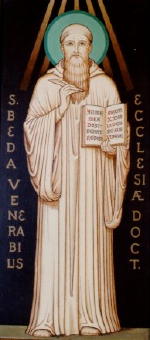 An example of these methods are related to us by the Father of English History and Doctor of the Church, Saint Bede who had lived during the 7th century; in his book, “The Lives of the Abbots of Wearmouth.” Bede tells the story, of how Saint Benedict, in the same time period had made his ‘6th’ and final trip to Rome in order to bring back relics and decorations to Northumbria in Monkwearmouth-Jarrow, for the newly built monasteries of St. Peter and St. Paul which was the main center of Anglo-Saxon learning. The purpose of these relics and art, was to show to people who had visited the monasteries concordance between the Old and New Testaments, how this change from the serpent of Moses to Jesus on the cross as a symbol of Christianity was passed down to us.
Soon after the appointment of Easterwine to the abbacy of St. Peter’s, and of Ceolfrid to the direction of St. Paul’s, Benedict had undertaken, and with his wonted prosperity accomplished his sixth and last journey to the city of Rome. Thence he now returned, laden as formerly with a store of ecclesiastical treasures. These, as usual, consisted of a bountiful provision of sacred writings, and an elegant collection of holy pictures. For he brought home on this occasion, the life of our Lord Jesus Christ, described in one series of paintings, with which he beautified the whole interior of the church annexed to the greater monastery, in honour of the virgin mother of God.
For the decoration also of St. Paul’s church and abbey he had procured another set, in which, upon an admirable system, was displayed the concordance between the Old and New Testaments. Of this, to give an instance: Isaac carrying the wood whereon he was ordered to be immolated, and Jesus bearing the cross, on which he died a sacrifice for our sins, are drawn in one piece, and exhibited as corresponding subjects; in a second are paired together, the Son of Man hanging on the cross, and the brazen serpent raised by Moses in the desert.
According to Greek Mythology, eventually the Good Serpent Ophis would be dethroned by his grandfather, the God of chaos  and darkness, Kronos (Saturn or Satan) and the goddess of fertility and war, Rhea (Saturn’s Moon). Hence, the true serpent and dragon of wisdom, Ophis was cast out, and in his place, chaos and darkness would rule under Cronus (Saturn or Satan) and the goddess of fertility and war, Rhea (Saturn’s Moon). This is the reason why, Jesus on the cross is considered by the Fathers of the church, as the standard of Christian warfare and the lower case Greek t, the symbol of death.
Based on the testimony of Bede, we can safely date the change of the symbolism, from the Old Testament serpent on the cross, to the son of man, Jesus on the cross for the Anglo-Saxons; it had occurred around the time of Bede in the 7th century, where it had first started in Rome and then later moved to the Anglo-Saxon territories such as Great Britain, England, France, Germany and Spain.
Moe is the founder of GnosticWarrior.com. He is a father, husband, author, martial arts black belt, and an expert in Gnosticism, the occult, and esotericism.
by Moe | Oct 21, 2013 | Apocalypse, History of the Brotherhood
Just as Noah did in ancient times, world-renowned evangelist Billy Graham is sounding the alarm that the Second Coming  is “near” and signs of the end of the age are “converging now for the first time since Jesus made those predictions.”
Earlier this month, Israeli Prime Minister Benjamin Netanyahu told the United Nations General Assembly “biblical prophecies are being realized.”
And last week, Rep. Michele Bachmann, R-Minn., claimed the world has entered the last days.
“When you see up is down and right is wrong, when this is happening, we were told this: that these days would be as the days of Noah,” Bachmann said.
The remarks by Graham, Netanyahu and Bachmann come amid a steadily rising wave of public interest in the end times, as demonstrated by recent polls and New York Times and Amazon.com bestselling books such as “The Harbinger: The Ancient Mystery That Holds the Secret of America’s Future,” by Rabbi Jonathan Cahn, and “Four Blood Moons: Something is About to Change,” by Pastor John Hagee.
In September, a poll by the Ventura, Calif.-based Barna Group found 4 in 10 Americans – and 77 percent of evangelical Christians – believe the “world is now living in the biblical end times.”
Now, a new wave of end-times predictions for 2014 and 2015 involving blood moons on Jewish holy days and prophetically significant events on the Shemitah – the ancient biblical year of the Sabbath – are igniting even more interest in humanity’s ultimate fate.
Throw in next year’s reboot of the “Left Behind” film featuring Nicolas Cage and the cinematic destruction of biblical proportions in “Noah,” starring Russell Crowe, and last-days fever is back with a mainstream vengeance.
“I think we’re on the verge of a global awakening in interest in apocalyptic events,” said Paul McGuire, an internationally recognized prophecy expert who is a regular commentator on Fox News and CNN and appeared on two highly rated History Channel specials, including “7 Signs of the Apocalypse.”
Read more at WMD
Moe is the founder of GnosticWarrior.com. He is a father, husband, author, martial arts black belt, and an expert in Gnosticism, the occult, and esotericism.