Not many people here in the West are aware of the world-wide royal and religious titles that the Russian Empire is known by. For example, did you know that Russia is called the “Third Rome,” or the “New Rome?” This had occurred when the Grand Duchy of Moscow (Russian: Великое Княжество Московское, Velikoye Knyazhestvo Moskovskoye), or Grand Principality of Moscow had successfully succeeded both the first Roman and the second Byzantium Greco-Roman empires approximately 500 years ago. In doing so, the founders of Russia, known as the Rus, along with the original ancient Muscovites of Moscow had also become the defacto “Masters of the Second Jerusalem.”
QUICK RUSSIAN FACTS
Russia is the largest country on earth. They rank 5th in the world in regards to the size of their Armed Forces, and the religion of Russia is mainly Christian. They have one of the, if not the world’s largest Christian populations per capita, with an incredible 75% of Russians being members of the Russian Orthodox Church. Their Christian membership is centralized all in one country, and is second only to the Catholic Church whose membership is spread all across the globe. Russia also holds the global chair to the Presidency of the world’s most powerful government organization “the G-20” on December 1, 2012, which was the first time ever.
THE FOUNDERS OF RUSSIA
Russia was founded by the Varangian prince Rurik, who established himself in Novgorod approximately in the year 862 AD. It has been written that they were Vikings who had predominantly come from the Scandinavian country of Sweden,in which the Prince had brought the name from his original homeland in the Swedish province of Ross Lagen. This is confirmed by an author in the 839 A.D. in the Annals of St Bertin who had written, “the Rhos came from Sweden.” The Greeks in the East were said to call them Russians, and in the West they were known as the Normans. In Finland, they are called the “Swedes Ruotz.”
The name Rus’ is an Old Norse or Swedish word meaning, “rowers or men who row,” which may give indication to the Viking origins of prince Rurik and the ruling dynasty of Kievan Rus’ who would become the founders of Russia. In Greek, Rus is spelled, Rho; Rosh or Ros in Hebrew, and Ru in Arabic. The meaning of the Hebrew name prince of Rosh is “the chief prince,” or “king of the Russian Empire.” The name Sia is an Old Norse or Swedish name derived from the word sigr, meaning “victory,” and in Hebrew it means “helper.” These words and various meanings would possibly signify the new order of the Brotherhood under the Second Jerusalem of the Temple of Solomon, where the original Muscovites become ‘sias,’ or helpers to the prince.
The Rurikids of the ruling dynasty of Kievan Rus’ had ruled all the lands of modern-day Russia (and later Grand Duchy of Moscow and Tsardom of Russia) until the 17th century. They are one of Europe’s oldest royal houses who trace their legendary genealogy to the first Roman emperor Augustus Caesar. Hence, why they are considered the Third Rome.
The theory that Moscow was the third Rome originated in these days, in order to formulate the new idea of the universal mission of the Russian national church. A learned monk, Philotheus, wrote to John III., the Muscovite prince:
The church of ancient Rome was destroyed in consequence of the heresy of Apollinarius, and the Constantinopolitan church of the second Rome was cut to pieces by the axes of Hagar’s posterity. But this Holy Apostolic church of the third Rome —to wit, of thy autocratic power—shines more brightly than the sun in the whole universe. Look here now and listen, Oh thou pious Tsar: Christian realms have all converged into thine, the only one; two Romes have fallen; the third stands upright, and there is no fourth to come; thou art the only Tsar of the Christians in the entire world; thy Christian sway shall never yield to anybody.
The meaning of Prince of Rosh found in biblical texts may represent the Prince of Russia, who are mentioned by Byzantine writers of the 10th century, under the name “Ol Pu.”
In the year 862, Rurik, a Scandinavian or Varangian chief, arrived at Novgorod, and laid the first foundation of the state which has grown into the Russian empire. The Russian people, under Varangian domination, rapidly increased in power, and reduced many of their neighbors to submission. Oskold and Dir, the princes of Kiof, rendered themselves masters of the whole course of the Dnieper, and it would seem that either commercial jealousy or the rapacity of ambition produced some collision with the Byzantine settlements on the northern shores of the Black Sea; but from what particular circumstances the Russians were led to make their daring attack on Constantinople is not known.
The Emperor Michael had taken the command of an army to act against the Saracens, and Oryphas, admiral of the fleet, acted as governor of the capital during his absence. Before the Emperor had commenced his military operations, a fleet of two hundred Russian vessels of small size, taking advantage of a favourable wind, suddenly passed through the Bosphorus, and anchored at the mouth of the Black River in the Propontis, about eighteen miles from Constantinople.
This Russian expedition had already plundered the shores of the Black Sea, and from its station within the Bosphorus it ravaged the country about Constantinople, and plundered the Prince’s Islands, pillaging the monasteries, and slaying the monks as well as the other Book i. inhabitants. The emperor, informed by Oryphas of the c”-‘”-8a attack on his capital, hastened to its defence. Though a daring and cruel enemy, the Russians were by no means formidable to the strength and discipline of the Byzantine forces. It required no great exertions on the part of the imperial officers to equip a force sufficient to attack and put to flight these invaders ; but the horrid cruelty of the barbarians, and the wild daring of their Varangian leaders, made a profound impression on the people of Constantinople, suddenly rendered spectators of the miseries of war, in their most hideous form, during a moment of perfect security.
We need not, therefore, be surprised to find that the sudden destruction of these dreaded enemies by the drunken emperor, of whom the citizens of the capital may have entertained even more contempt than he merited as a soldier, was ascribed to the miraculous interposition of the Virgin of the Blachern, rather than to the superior military tactics and overwhelming numbers of the imperial forces. How far this expedition of the Russians must be connected with the enterprising spirit of that vigorous band of warriors and pirates from Scandinavia, who, under the name of Danes, Normans, and Varangians, became the sovereigns of Normandy, Naples, Sicily, England, and Russia, is still a subject of learned discussion.
The Rus or Russians, who were not Christian and still considered pagan at the time, would attack Constantinople yet again on June 11, 941. These battles would result in two treaties being signed between both the Rus and the Byzantine Empires, dating in the years 907 and 911. The treaties most likely now allowed the Rus to resume regular trade relations with the Byzantium Empire in order for them to conduct and profit freely from the commerce in the regions they had ruled or would soon conquer.
In addition to these treaties with the Byzantines, in the year 954 A.D., Princess Ol’ha (Olga) of Kiev would be baptized, and later in 988, both the baptisms of Vladimir of Kiev and the Baptism of Rus’ would occur, signifying one of the most important events in the history of Russia. They would officially join the Byzantine Empire as Christians and Brothers. Olga’s grandson Vladimir (reigned 980-1015) was converted to Christianity in 988 A.D., and Christianized the Kievan Rus’. He would go on to marry Anna, the sister of the Byzantine Emperor. (Wikipedia) Over the course of the next few hundred years, the Rurikids would eventually go on to be the sovereigns of not only the massive country we know of today as Russia, but also Normandy, Naples, Sicily, and England etc. Hence, the “Masters of the Second Jerusalem.”
The Kievan church was originally a Metropolitanate of the Patriarchate of Constantinople, and the Byzantine patriarch appointed the metropolitan who governed the Church of Rus. The Metropolitan’s residence was originally located in Kiev. As Kiev was losing its political, cultural, and economical significance due to the Mongol invasion, Metropolitan Maximus moved to Vladimir in 1299; his successor, Metropolitan Peter moved the residence to Moscow in 1325.(Wikipedia)
In the beginning days of Greek Orthodox Christianity in Russia, a Greek was made the first metropolitan, or patriarch of Russia. But later this would change in the year 1588, from which time the Russian church became as independent as its empire and would appoint Russian Bishops to lead the Russian Church. The Russian Church and Bishops, from this time forward would be independent from Jerusalem, Constantinople, Antioch, and Alexandria. Therefor becoming a free and powerful independent patriarch.
A Greek was made the first metropolitan, or patriarch of Russia ; and from this time the Russians adopted an alphabet, taken partly from the Greek. This would have been of advantage to them, had they not still retained the principles of their own language, which is the Slavonian in every thing, but a few terms relating to their liturgy and church government. One of the Greek patriarchs, named Jeremiah, having a suit depending before the divan, came to Moscow to solicit it; where, after some time, he resigned his authority over the Russian churches, and consecrated patriarch, the archbishop of Novgorod, named Job. This was in the year 1588, from which time the Russian church became as independent as its empire. The patriarch of Russia has ever since been consecrated by the Russian bishops, and not by the patriarch of Constantinople. He ranked in the Greek church next to the patriarch of Jerusalem, but he was in fact the only free and powerful patriarch : and, consequently, the only real one. Those of Jerusalem, Constantinople, Antioch, Alexandria, are mercenary chiefs of a church, enslaved by the Turks ; and even the patriarchs of Jerusalem and Antioch are no longer considered as such, having no more credit or influence in Turkey, than the rabbis of the Jewish synagogues settled there.
THE RUS BECOME MASTERS OF THE SECOND JERUSALEM AND RUSSIA THE THIRD ROME
Eventually the original Mosocheni (Cappadocians, Men of Crete, Philistines or Tribe of Benjamin etc) of modern-day Moscow would be succeeded in approximately the year 862 AD by the Scandinavian dynasty of Rus; founded by the Viking prince, Rurik who would later align with the Byzantine Empire under the banner of Christianity.
This new role had made the Rosh or Rus the “Masters and Princes of the Second Jerusalem.” Thus making the Mosocheni, ‘sia or sias’, which the meaning in Hebrew is ‘helpers.’ This land under the dominion of the Rus, with the help of the Sia over the last 1,200 years would not only be known as the Third Rome, but also become the largest county in all the world by almost double the land mass of its closest competing country.
The Rurikids were the ruling dynasty of Kievan Rus’, who after the year 1199, would also officially become the rulers of the Grand Duchy of Moscow and the founders of the Tsardom of Russia, which today they govern all the lands of modern-day Russia and then some. Ivan III by 1503, had tripled the territory of Moscow as “Ruler of all Russia”, and with his marriage to the niece of the last Byzantine emperor, he established Moscow as the successor state of the Roman Empire, the “Third Rome.”
The Orthodox Church during the Kievan period was subject to Constantinople, and until 1237, the “Metropolitans of Rus” were usually Greek. The Rus’ Church continues to sing in Greek the solemn greeting to a bishop, eis polla eti, despota (“Many years to you, Master”), in memory of the days when the metropolitan came from Constantinople. Orthodoxy became the State religion of Rus’, and eventually Russia until 1917. (Rus’ was not completely converted to Christianity at this time, and the Church was at first restricted mainly to the cities, while much of the countryside remained pagan until the fourteenth and fifteenth centuries.) Today, the predominant religion in Russia is mostly Christian under the rule of the Russian Orthodox Church, and it currently ranks fifth after the Churches of Constantinople, Alexandria, Antioch, and Jerusalem. (Wikipedia)
THE PROPHECY OF THE JEWS AND CHRISTIANS IN THE END TIME
In Acts 2:5, we find that the Cappadocians appear to be “God-fearing Jews.” Cappadocia is mentioned twice in the New Testament as well, as the “Cappadocian Jews” listened to Peter’s sermon (Acts 29), and his first epistle is addressed to Christian residents in the province (i Pet.li). This makes sense, because recently, the Russian President Vladimir Putin said that at least 80 percent of the members of the first Soviet government were Jewish. On June 13th, 2013, President Putin made a special visit to Moscow’sJewish Museum and Tolerance Center ;
According to the official transcription of Putin’s speech at the museum, he went on to say that the politicians on the predominantly Jewish Soviet government “were guided by false ideological considerations and supported the arrest and repression of Jews, Russian Orthodox Christians, Muslims and members of other faiths. They grouped everyone into the same category.
“Thankfully, those ideological goggles and faulty ideological perceptions collapsed. And today, we are essentially returning these books to the Jewish community with a happy smile.”
This year in March at the Papal installation of Pope Francis, for the first time, the gospel was read in the Greek language rather than in the traditional Latin. The Pope had also prayed with Eastern rite Catholic patriarchs and archbishops before the tomb of St. Peter whose bones went on display this past month on Sunday November 24th. These prophetic signs indicate a mutual concordance between both the East and West, which symbolize the union of the Roman Latin Church with the Greek Orthodox Church. In addition to these most recent historic events, there is this past week’s historic summit between Pope Francis and Russian President Vladimir Putin. An event that is marked as the most important meeting between Rome and Russia in a quarter of a century.
The dynasty of Kievan Rus’ is one of Europe’s oldest royal houses, with numerous existing cadet branches throughout the world. The current President of the largest country in the world, Russia and also the Third Rome, is Vladimir Putin. President Putin is also currently the President of the most powerful organization in the world, the G20.
This story may be reflected in the bible as the Philistines, who were also known as the Cappodicans that were subjugated by Israel and then became the Tribe of Benjamin. The English name Benjamin is derived from the Hebrew name, “Banu- Yamina,” meaning “the Son of the right hand.” This symbology is described in the Old Testament when Moses had delivered Israel from the Pharaoh, he then became the “Right hand of God.” This phrase is also mentioned again when Christ had ascended to heaven and sat down in the place of authority on the right hand of God as written in Peter 3:22 – “Who is gone into heaven, and is on the right hand of God; angels and authorities and powers being made subject unto him.”
Within decades after the capture of Constantinople by Mehmed II of the Ottoman Empire on 29 May 1453, some Eastern Orthodox people were nominating Moscow as the “Third Rome”, or the “New Rome”.[1] Stirrings of this sentiment began during the reign of Ivan III of Russia who had married Sophia Paleologue. Sophia was a niece of Constantine XI, the last Byzantine emperor. By the rules and laws of inheritance followed by most European monarchies of the time, Ivan could claim that he and his offspring were heirs of the fallen Empire, but the Roman traditions of the empire had never recognized automatic inheritance of the Imperial office.[2] A stronger claim was based on religion. The Orthodox faith was central to Byzantine notions of their identity and what distinguished them from ‘barbarians.” Vladimir the Great had converted Kievan Rus’ to Orthodoxy in 989, in return for which he became the first barbarian to ever get an Imperial princess as a wife.
The story of “Third Rome” (“the second Constantinople”) started in 14th century Bulgaria, under the reign of Tsar Ivan Alexander. He aimed to raise the prestige of his land and capital, introducing the name Tsarevgrad Tǎrnov for it (in comparison to the Slavic name of Constantinople – Tsarigrad), which was later supported by the words of Patriarch Callistus I of Constantinople that “Tǎrnovo is the capital of the Bulgarians and second both in words and deeds after Constantinople”. After the fall of Tǎrnovo to the Ottoman Turks in 1393, a number of Bulgarian clergymen sought shelter in the Russian lands and transferred the idea of the Third Rome there, which eventually resurfaced in Tver, during the reign of Boris of Tver, when the monk Foma (Thomas) of Tver had written The Eulogy of the Pious Grand Prince Boris Alexandrovich in 1453.[3][4] The idea crystallized with a panegyric letter composed by the Russian monk Philotheus (Filofey) of Pskov in 1510 to their son Grand Duke Vasili III, which proclaimed, “Two Romes have fallen. The third stands. And there will be no fourth. No one shall replace your Christian Tsardom!”. Contrary to the common misconception, Filofey [5] explicitly identifies Third Rome with Muscovy (the country) rather than with Moscow (the city). In addition, Moscow is placed on seven hills, as is Rome and Constantinople. The terms Muscovy (The City) and the boundaries of the Russian Empire were considered both in Russia and abroad to be synonymous at the time.(Wikipedia)
Inner Jerusalem By Ada Goodrich-Freer
It is alleged that the Russian pilgrims are a considerable source of ecclesiastical revenue, as it is calculated that each spends, on an average, some £10 in the country, of which a considerable proportion is paid for candles, masses, and fees to priests on various occasions. Moreover it is said that, after their return home, additional and supplementary offerings are forwarded, amounting in the aggregate to many thousands of pounds, sums which naturally, though intended for the Greek priests at the Holy Places, have to pass through the Russian Consulate, a fact which, all else apart, might well and naturally suggest the importance of obtaining a national share in the ceremonies of Bethlehem, the Holy Sepulchre and elsewhere.
Constantinople and Jerusalem, Russia has succeeded in placing a native upon the Patriarchal chair of Antioch, and in obtaining his official recognition by the Sultan. The patriarch of Antioch has his residence at Damascus, which has long been a centre of Syrian “orthodoxy,” and has had several native bishops, and it is even alleged that it was in view of this candidature that Damascus was raised from a vice-consulate to a consulate. It is at least difficult to assign any other reason in a city where there are few resident Russians and where Russia has little commercial interest.
SOURCES:
1. Links are made to source books which are all Open Source and also Wikipedia
2. This article is open source and not for commercial purposes.
Moe is the founder of GnosticWarrior.com. He is a father, husband, author, martial arts black belt, and an expert in Gnosticism, the occult, and esotericism.
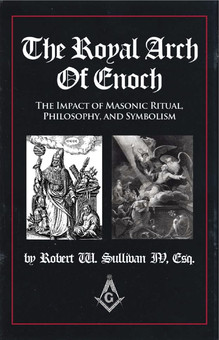
Later today on the Gnostic Warrior Radio Show and Podcast we have the pleasure of interviewing author Robert W. Sullivan IV. Robert is a philosopher, historian, antiquarian, jurist, theologian, writer, and lawyer who will discuss the esoteric doctrines contained in his new book “The Royal Arch of Enoch: The Impact of Masonic Ritual, Philosophy, and Symbolism.” The video below by Robert was taken in the library of the Scottish Rite Temple, Baltimore, Maryland, USA where he explains his book which is the result of over twenty years of research that is a true life “Da Vinci Code/National Treasure.”
“And Enoch walked with God: and he was not; for God took him.” — Genesis 5:24. The Royal Arch of Enoch: The Impact of Masonic Ritual, Philosophy, and Symbolism documents an undiscovered historical anomaly: how a high degree Masonic Ritual — developed in France in the mid 1700’s — included elements of the Book of Enoch (a/k/a I Enoch) which was considered lost until Freemason and traveler James Bruce returned to Europe with copies from Ethiopia in 1773. These copies were not translated into English until 1821 at Oxford University. This high degree ritual — titled The Royal Arch of Enoch — documents the recovery of the “Lost Word of a Master Mason“, the Name of God.
It is this ritual in particular that has defined, among other things, the American national character. The Royal Arch of Enoch also documents the symbolic restoration of the sun as the premier icon in all of Freemasonry and as the supreme emblem of imperial administration and religiosity lifted from the Ancient Mysteries, incorporated in the Abrahamic faiths, and carried on in both Blue Lodge and High Degree Masonry.
Moe is the founder of GnosticWarrior.com. He is a father, husband, author, martial arts black belt, and an expert in Gnosticism, the occult, and esotericism.
“Concerning these things will I speak, and these things will I explain unto you, my children: I am Enoch. In consequence of that which has been shown to me, from my heavenly vision and from the voice of the holy angels, I have acquired knowledge, and from the tablet of heaven have I acquired understanding.”- Book of Enoch, Verse III
(Part II of Who were the Nephilim? By Moe) – After the Exodus, Cain had built a city calling it by the name of his son Enoch, or the City of Discipline and Training. His father Cain is known for killing his brother Abel and was cursed seven times over by the Lord. The LORD set a mark upon Cain, lest any finding him should kill him. 1 6 11 And Cain went out from the presence of the LORD. This was the time when Cain had left his homeland and went into the “Land of Nod” on the east of Eden, where he built a city, and called it after the name of his son Enoch.
Enoch (Hebrew: חֲנוֹךְ, ModernH̱anokhTiberianḤănōḵ; Arabic: إدريس ʼIdrīs) was said to be the first-born son of Cain through Seth, and great-grandson of Noah. He is the seventh progenitor of the race in the “book of the generations of Adam.” Enoch was a warrior and a builder of cities. In Mohammedan Literature, he is known to the Mohammedans as “Idris” (the Instructor), a man of truth and a prophet, raised by Allah to a lofty place, and as a model of patience. Baidawi, in identifying him with Enoch, explains “Idris” as indicating his knowledge of divine mysteries.
MEANING OF THE LAND OF NOD
The meaning of the name ‘Nod’ varies depending on the language. For example, in Greek the noun ‘nod’ is spelled “χώρα του ύπνου ουσ.θηλ,” meaning the “land of sleep,” and the verb Nod is spelled “μεταφορικά κουτουλάω (από τη νύστα) ρ.αμ,” which means to fall asleep. Hence, to the Ancient Greeks, “The Land of Nod” refers to the mythical land of sleep, which today in English would be akin to when someone suddenly goes to sleep and “Nods off”. These were the children of Cain who had turned their faces away from the LORD, love and light in the garden of Eden of the East (Right brain Spirit, Reason and Love), and were cursed to be wanderers in the West (Left Hemisphere Brain of Intellect and Materialism ) and to spiritually go to “asleep in the land of Nod.” A magickal curse was cast upon the race of Cain which placed them in spiritual darkness for seven generations.
Nay, even while Adam was alive, it came to pass that the posterity of Cain became exceedingly wicked, every one successively dying one after the other, more wicked than the former. They were intolerable in war, and vehement in robberies; and if any one were slow to murder people, yet was he bold in his profligate behaviour, in acting unjustly, and doing injury for gain.
These stories about Cain and his children indicate a change in how the world and human race was governed, in which it went from a spiritually religious government based on the Mosaic Laws, to a more material government based on selfishness, materialism and Roman Law or the Rule of Law. Hence, it was after this time that the Cainanites became merchants and murderer scapegoats of Israel who had spiritually went to sleep because of the curse of the LORD. A curse that still lasts to this day.
Cain had two children, Lamech and Zillah who then gave birth to “Tubal Cain” who is described in Genesis 4:22 as the “forger of all instruments of bronze and iron” (ESV), or an “instructer of every artificer in brass and iron” (KJV). Tubal Cain is the widow’s son who originally was “a sharpener”—one who whets or sharpens instruments. The name Tubal comes from the Hebrew verb (yabal), meaning to bring, carry, lead, conduct, and is also explained as meaning, “to cause to transport an object from one place to another.” The the name Cain may be derived from the Egyptian “ka or ba” meaning ‘soul.’
In Hebrew, the meaning of the word Nod is related to the participle דנ in 4:12 which the LXX translated as τρέμων (trembling). “Nod” (נוד) is the Hebrew root of the verb “to wander” (לנדוד). Therefore, to dwell in the land of Nod is usually taken to mean that one takes up a wandering life. Hence, the Land of Nod is known as an allegorical code for the “Land of Shaking”, which must mean Nod was known for its earthquakes. A big clue to where Cain had brought his people after he went out from the presence of the Lord. This land I believe was actually the fifth largest island in the Mediterranean Sea, known today as Crete in the country of Greece. An island that is one of the most earthquake active in all the lands of the Mediterranean, with a deep history of many earthquakes and natural catastrophes that have left the land in trembling state. A land that may very well be the Land of Nod.
MEANING OF THE NAME ENOCH
The name ‘Enoch (e’nok)’ is derived from the Hebrew (Phoenician) word ‘Henoch (or Onech),” and means “one trained up” or ‘initiated.’ The closely related Semitic word, ‘Enos’ means pro-eminently, “The Man : that is, the Messenger; the Man of men.” Hence, Enoch is a “title or given name,” and not an actual birth name of a singular person. 33rd Degree Freemason, Many P Hall said this about Enoch in his book, Secret Teachings of All Ages;
According to Freemasonic symbolism, Enoch, fearing that all knowledge of the sacred Mysteries would be lost at the time of the Deluge, erected the two columns mentioned in the quotation. Upon the metal column in appropriate allegorical symbols he engraved the secret reaching and upon the marble column placed an inscription stating that a short distance away a priceless treasure would be discovered in a subterranean vault. After having thus faithfully completed his labors, Enoch was translated from the brow Of Mount Moriah. In time the location of the secret vaults was lost, but after the lapse of ages there came another builder–an initiate after the order of Enoch–and he, while laying the foundations for another temple to the Great Architect of the Universe, discovered the long-lost vaults and the secrets contained within.
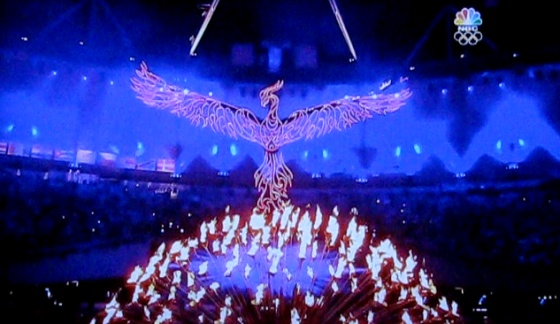
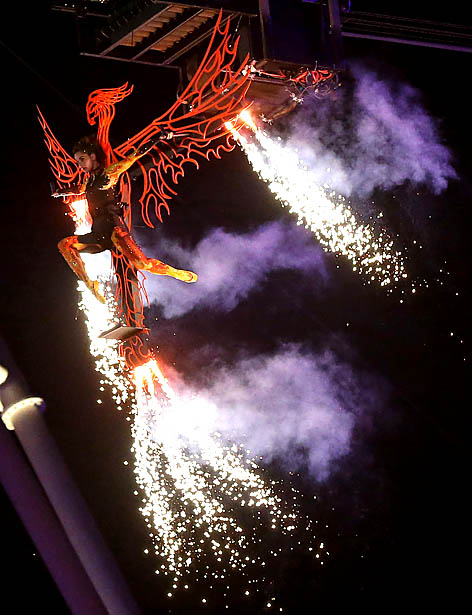
The symbol of Enoch is the Phenoch (or Phenoch, Phinoach, and Phanak), or the magnificent immortal bird known to us today as the ‘Phoenix.’ The phoenix is an allegorical fire bird of time, signifying re-birth and resurrection out of its own ashes. It is the symbol of the messenger, and especially more of the Sixth race, the offspring of Phen. The phoenix also symbolizes a secret cycle and initiation used by various cultures around the world to delineate a historical age. This is interesting, because in the 2012 closing Olympic Ceremonies, there was a massive phoenix on display that was lit up with thousands of lights. Could this symbolize the end of the sixth age and the beginning of a new era?
In the Ethiopic Books of Enoch, in Gen. v. 24 we find that “Enoch walked with God” and “God took him.” Jewish legends of Enoch describe him as a man, credited with superhuman knowledge, and the “Visions of Enoch” describe the secret Mysteries of Initiation, one of which is the Burning Valley of the “Fallen Angels.” In the Book of Enoch, Mount Hermon is the place where the “Watchers, Sons of God or the Nephilim,” a class of fallen angels descended to Earth. The Anak or the Anakim were the descendants of the Nephilim that were seen by Jacob when he described giants in the land of Canaan. Enoch’s Angels, the Sons of God (Nephilim) who saw that the daughters of men were fair (Gen., vi.), and who married them and taught the daughters of Earth the secrets of Heaven. Mount Hermon is located at 33 degrees latitude and longitude, and this region has long been associated with the Nephilim. Mount Hermon is where the Phoenician Prince Cadmus and the Cadmonites had inhabited, which was in the Land of Canaan. Cadmus whose name means ‘son’, was also known by the name Hermes, and just like Enoch, Hermes is the initiator, an intermediate agent between mankind. Herodotus had called Hermes, Mercury. He was usually depicted carrying a caduceus, and in Greek, Caduceus means magic wand, and why we always see him carrying his magic double DNA serpent wand, which is the symbol of immortality. Helena Petrovna Blavatsky gives us the meaning as well, in her book, The Secret Doctrine: Anthropogenesis;
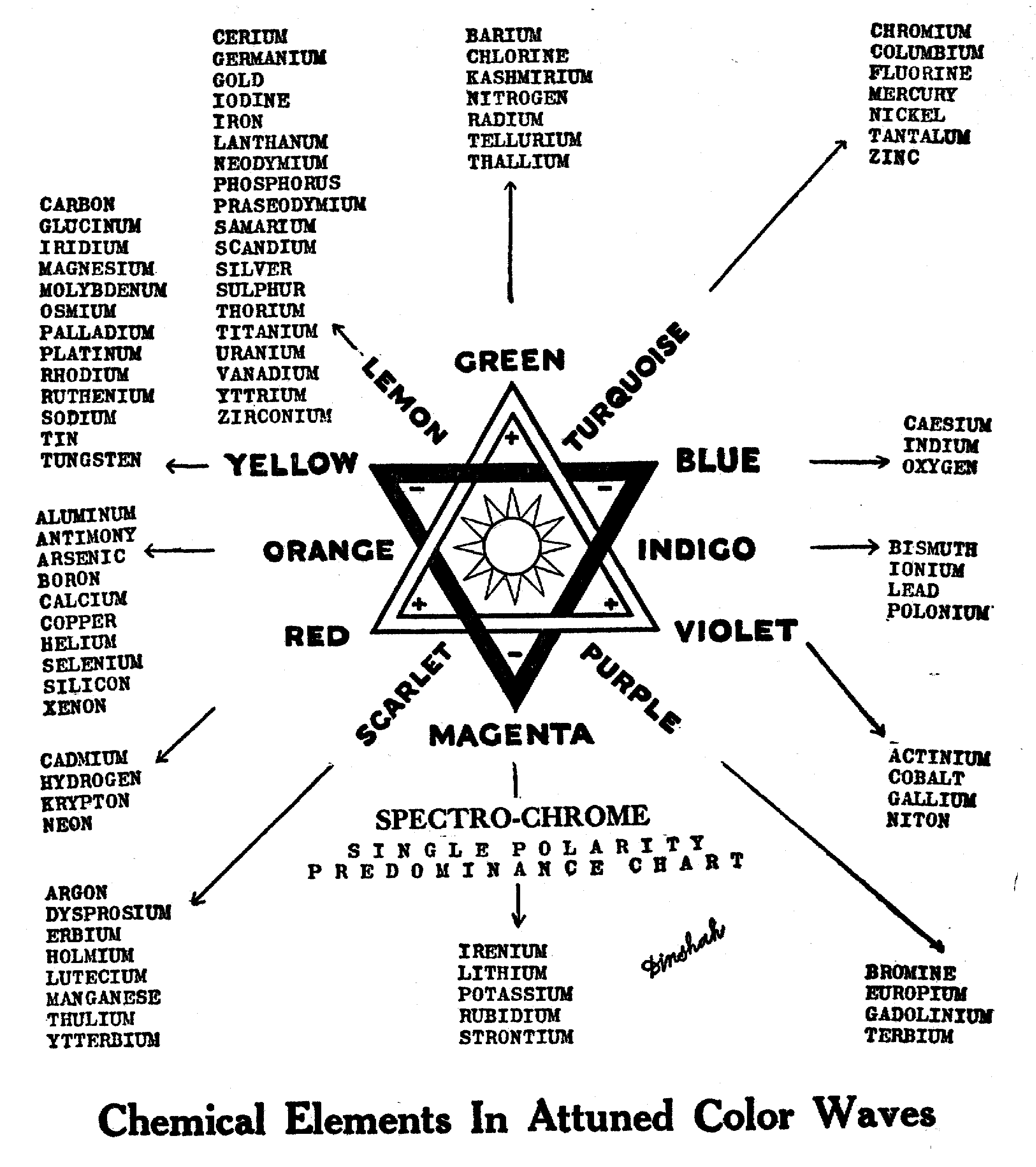
Enoch is the type of the dual nature of man—spiritual and physical. Hence he occupies the centre of the Astronomical Cross, as given by Eliphas Levi from a secret work, which is a Six-pointed Star, the “Adonai.” In the upper angle of the upper Triangle is the Eagle; in the left, lower angle stands the Lion; in the right, the Bull; while between the Bull and the Lion, over them and under the Eagle, is the face of Enoch or Man.’ Now the figures on the upper Triangle represent the Four Races, omitting the First, the Chhayas or Shadows, and the “Son of Man,” Enos or Enoch, is in the centre, where he stands between the Fourth and the Fifth Races, for he represents the Secret Wisdom of both. These are the four Animals of Ezekiel and of the Revelation. The Double Triangle…
Moe is the founder of GnosticWarrior.com. He is a father, husband, author, martial arts black belt, and an expert in Gnosticism, the occult, and esotericism.
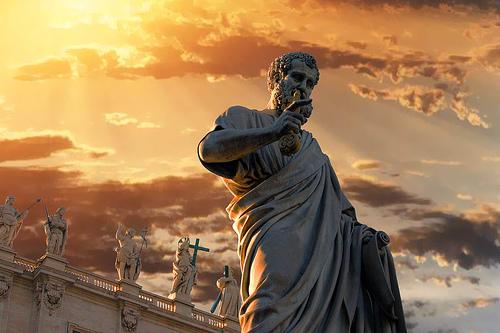
Christ said: ‘Thou art Peter (Petros), and upon this Rock (Petra) will I build my Church.’
It is said that the power of the Roman and Eastern Papacy had been established with the magical words said above by Christ to Saint Peter. It is the mystery behind these allegorical words where we can discover the true light of what is symbolically meant by Christ when he had stated that he will build his church upon a rock.
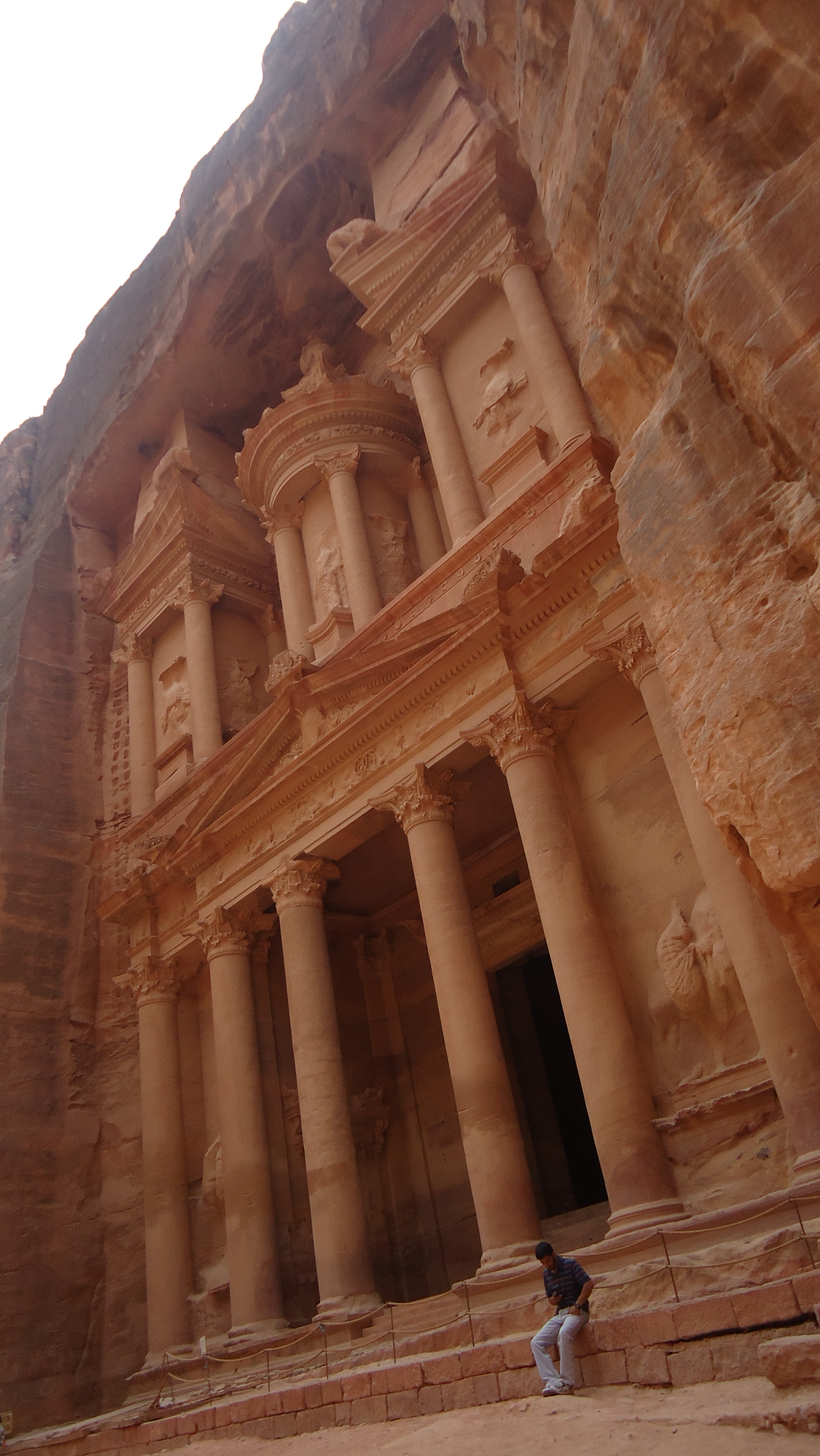
The Rock (Petra) where Christ said he would build his church can be found on a sandy high-road between Arabia and Syria in a tract of ancient Judea. It was once called “The Rose Red City of Esau”. It is this magnificent Biblical town of Edom where we can find the territory that was allotted to Jacob’s brother Esau (Genesis 36), and also the capital of the Nabateans where the Edomites, or in Greek the ‘Idumeans’ had lived. Today the lost rock city is known by its Greek name of Petra that represents Zeus Peter (Ju’Piter/Ju-Peter), or in English Peter which means “the rock” or “the father.”
Matthew 16:18 – And I tell you that you are PETRA (Peter), and on this rock I will build my church, and the gates of Hades will not overcome it.
On the great Treasury of the Pharaoh is the figure of Isis as they both face the rising sun in the East. Petra via the Mother Isis is the successor to Christ as the infallible head of the church, who has power and authority over all the other apostles and the entire church. It is Peter who has the keys to unlock and lock the kingdom of heaven and hell to anyone as he chose, and it is under the spell of Isis that the gates of Hades will not overcome it. (more…)
Moe is the founder of GnosticWarrior.com. He is a father, husband, author, martial arts black belt, and an expert in Gnosticism, the occult, and esotericism.
For the first time in the history of the Catholic Church, the Vatican announced this past week that they will be placing the holy remains of St. Peter on display for the world to witness. The bones of St. Peter were first discovered in June of 1968 in a Roman cemetery in the city of the Vatican. He had died 1,950 years ago and was one of the first Christian martyrs.
Before I continue with the details surrounding this most historic event, I would like to provide you some past history with a quote from Ezekiel 37:1-14, that appears to mention these days. It is known as “The Valley of Dry Bones.”
Then he said to me: “Son of man, these bones are the people of Israel. They say, ‘Our bones are dried up and our hope is gone; we are cut off.’ 12 Therefore prophesy and say to them: ‘This is what the Sovereign Lord says: My people, I am going to open your graves and bring you up from them; I will bring you back to the land of Israel.
I believe this event is significant due to the fact that there are signs in the bible, such as the one I quoted above that relates to the land of Israel and the bones. St Peter had said when speaking to the Jews; “the times of refreshing shall come, as in that these dry bones represented the whole house of Israel, and that as the dry bones were made to live, so the time shall come when dispersed Judah and outcast Israel shall be converted to God and live. This is the time of which St Peter speaks of; “the time of reanimation, or the refreshing, and the Times of the Restitution of all Things, (A8s iii. 21.).” This is connected to the prophecy with the second advent of Christ where it is written; “there shall come out of Zion the deliverer, and shall turn away ungodliness from Jacob.”
DETAILS ABOUT THE ANNOUNCEMENT OF ST. PETER’S BONES
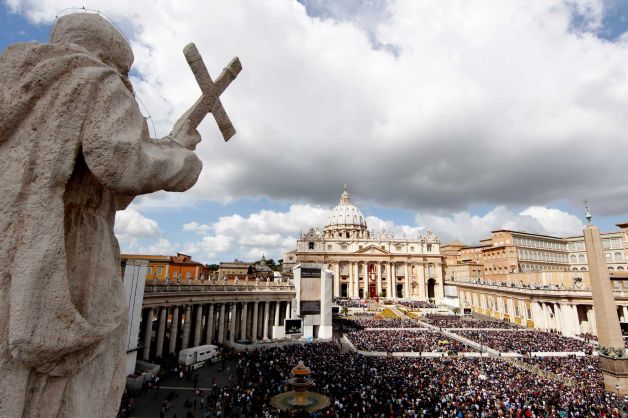
The bones of St. Peter will go on display November 24th. They will be displayed in St Peter’s Square at a Mass celebrated by Pope Francis to conclude the Year of Faith.
Last week, Archbishop Rino Fisichella, president of the Pontifical Council for Promoting New Evangelization; wrote that the Catholic faithful making a pilgrimage to St. Peter’s tomb to mark the end of the Year of Faith will enjoy “the exposition … of the relics traditionally recognized as those of the apostle who gave his life for the Lord on this spot.”
According to the Guardian, Fisichella said the decision to display the relics was not to spark debate over their authenticity.
He said the bones hold “symbolic” and “underlying theological value” despite what any scientific tests may show.
“For the first time, the relics of the apostle will be displayed for the veneration of believers.(1)
RELATED HISTORY AND CURRENT WORLD WIDE EVENTS
These announcements fall close to the day of dedication for the churches of SS Peter and Paul at Rome which was on November 18th. It took over 100 years to build St. Peter’s Basilica and was consecrated on November 18, 1626 by Pope Urban VIII. It is the largest Catholic Church in the world, holding over 60,000 people.
The First St. Peter’s had been erected by Constantine in about 315 c.e. to honor the bones of Peter. On November 18, 326, the church was consecrated by Pope St. Sylvester in presence of the Emperor Constantine and Court on November 18, 324.(2)
The date that they will display the bones is the 24th of November, which has a connecting thread to history with the year 380 A.D. when Roman Emperor Theodosius I had made his adventus, or formal entry into Constantinople. The adventus was a military ceremony in ancient Rome, in which an emperor was formally welcomed into a city, either during a progress or after a military campaign, often (but not always) Rome. Theodosius I (Latin: Flavius Theodosius Augustus;11 January 347 – 17 January 395), also known as Theodosius the Great, was Roman Emperor from 379 to 395. Theodosius was the last emperor to rule over both the eastern and the western halves of the Roman Empire. (Wikipedia)
His social transformation was a pivotal, if under-recognized, milestone in European history, it parted with the Roman slavery and inaugurated a feudal society.
In addition, these connections in time with the beginning of Roman dominion and a feudal society, we have matching dates with biblical passages that refer to the Son of man; these bones are the people of Israel coupled with the Vatican’s announcement on St. Peter. Last but not least, there is also next week’s historic summit between Pope Francis and Russian President Vladmir Putin. An event, that is marked as the most important meeting between Rome and Russia in a quarter of a century.
Rome, Italy, Nov 11, 2013 / 03:48 pm (CNA).- Pope Francis will meet with Russian President Vladimir Putin on Nov. 25 at the Vatican, according to the director of the Holy See’s Press Office, Father Federico Lombardi.
On the following day, the Pontiff will meet with the President of Italy, Giorgio Napolitano.
The first meeting between Pope Francis and the Russian president comes after the Holy Father sent Putin a letter on Sept. 5, at the opening of the G-20 summit, calling on the group’s leaders to set aside the “useless” search for a military solution to the conflict in Syria and to pursue a peaceful resolution through dialogue and negotiation.
In February 2011, Russian President Dmitry Medvedev had a half hour meeting with Benedict XVI at the Vatican, which was two years after Russia had established full diplomatic relations with the Holy See in 2009, and just this year in May, Russia had appointed an ambassador to the Holy See.
ST PETER IN THE CHURCH
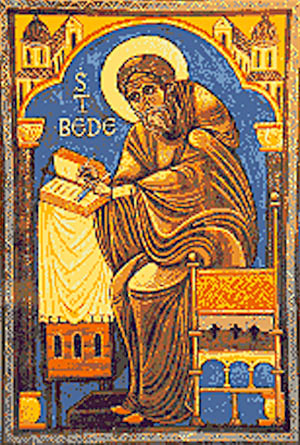
The English Peter is derived from the Latin “petra”, from the Greek word πέτρος (petros) meaning “stone” and also Father. Peter is the Rock, which the Catholic Church was built. This is confirmed by Jesus Christ who had said; ‘Thou art Peter (Petros), and upon this Rock (Petra) will I build my Church.’ Saint Peter would be the Father of the Catholic Church via the New Testament, and his predecessor was King David; the Father of the Old Testament. These facts are described by Saint Bede who had written;
‘Thou art Peter, and upon this Rock from which thou didst receive thy name, that is, upon Me Myself, I will build My Church. Upon this perfection of faith which thou didst confess I will build My Church, and if anyone turns aside from the society of this confession, even though it may seem to him that he does great things, he will not belong to the building which is My Church,;: [“Homily I.165, Aftr Epiphany,” Homilies on the Gospels,Bk. One. 163.]
As I mentioned above, St Peter when speaking to the Jews had said, “the times of refreshing shall come”. “The time of reanimation, or refreshing,” which is connected in prophecy with the second advent of Christ,’ as it is written; “There shall come out of Zion the deliverer, and shall turn away ungodliness from Jacob.”
The hand of the Lord was on me, and he brought me out by the Spirit of the Lord and set me in the middle of a valley; it was full of bones. 2 He led me back and forth among them, and I saw a great many bones on the floor of the valley, bones that were very dry. 3 He asked me, “Son of man, can these bones live?”
I said, “Sovereign Lord, you alone know.”
Then he said to me, “Prophesy to these bones and say to them, ‘Dry bones, hear the word of the Lord! 5 This is what the Sovereign Lord says to these bones: I will make breath[a] enter you, and you will come to life. 6 I will attach tendons to you and make flesh come upon you and cover you with skin; I will put breath in you, and you will come to life. Then you will know that I am the Lord.’”
So I prophesied as I was commanded. And as I was prophesying, there was a noise, a rattling sound, and the bones came together, bone to bone. 8 I looked, and tendons and flesh appeared on them and skin covered them, but there was no breath in them.
Then he said to me, “Prophesy to the breath; prophesy, son of man, and say to it, ‘This is what the Sovereign Lord says: Come, breath, from the four winds and breathe into these slain, that they may live.’” 10 So I prophesied as he commanded me, and breath entered them; they came to life and stood up on their feet—a vast army.
Then he said to me: “Son of man, these bones are the people of Israel. They say, ‘Our bones are dried up and our hope is gone; we are cut off.’ 12 Therefore prophesy and say to them: ‘This is what the Sovereign Lord says: My people, I am going to open your graves and bring you up from them; I will bring you back to the land of Israel. 13 Then you, my people, will know that I am the Lord, when I open your graves and bring you up from them. 14 I will put my Spirit in you and you will live, and I will settle you in your own land. Then you will know that I the Lord have spoken, and I have done it, declares the Lord.’”
SOURCES:
1. Pilgrim-walks in Rome: a guide to the holy places in the city and its vicinity By Peter Joseph Chandlery
Moe is the founder of GnosticWarrior.com. He is a father, husband, author, martial arts black belt, and an expert in Gnosticism, the occult, and esotericism.
The Kohen (Cohen, Kohain; Hebrew: כֹּהֵן, plural כֹּהֲנִים Kohanim or the English Koan) come from the YDNA Haplogroup E-M215 (formerly E3b1a) and also haplogroups J1 and J2. For the purpose of this article, I will focus on the E-M123 haplogroup, that I believe is the Kohanim Levite branch of the original priesthood from the island of Kos (Now Dia) who had separated from the other Tribes of Israel at the time of the destruction of the Temple.
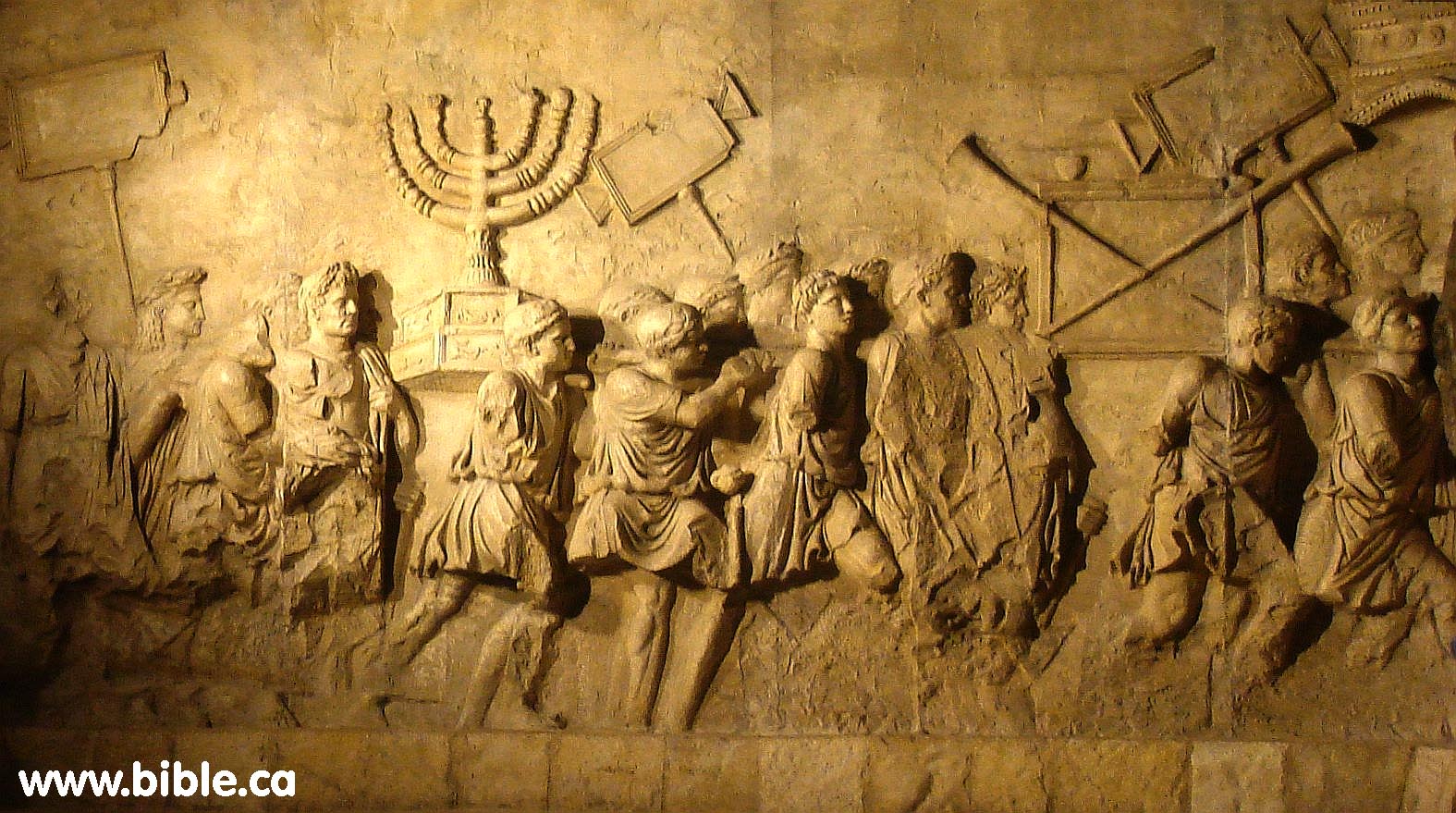
This is when the Kohanim Levites were absorbed or taken over by the Roman Empire under the leadership of Augustus Caesar in the 1st century. These events can now be tracked by historical accounts, artifacts and DNA. One of these accounts comes from one of the most famous Doctors of the Catholic Church and also the Father to English History, the Venerable Saint Bede (Beda). Bede had written on the Levites being connected to the Catholic Church in his book, “On Ezra and Nehemiah;” “Allegorically, the Levites represent those attached to the Catholic Church.” Hence, Bede is clearly stating that the Levites had become attached to the Catholic Church; I believe this happened when the Tribes of Israel were separated during the Exodus from their original homelands. This is why you can find the DNA of the Kohen Levite, which spread around the world in all the same cities where the Romans had conquered and rebuilt their empires.
This is also explained in several places in the bible, such as in the Book of Genesis, where the third son of Jacob is the founder of the Israelite Tribe of Levi. Hence, this would make Joseph the lawful founder of the Levites; for whom King David said, “None ought to carry the ark of God, but the Levites; for them hath the Lord chosen to carry the ark of God, and to minister unto him for ever.” Also, when Joshua led the Israelites into the land of Canaan, the Levites were the only Israelite tribe that received cities, but were not allowed to be landowners “because the Lord, the God of Israel Himself is their inheritance” (Deuteronomy 18:2). (Wikipedia) In the Book of Malachi, God explains why he chose the Levites to be his priests. This would make sense, since the high priests for judgment of the New Testament are the Levites. The root in Hebrew means “to join,” to “‘ bind ” (see Lui-than “snaky-monster “).
When the land of Israel was apportioned among the tribes in the days of Joshua, the Tribe of Levi, being chosen as priests, did not receive land (Joshua 13:33, (14:3). However, the tribe of Levi were given cities. Six cities were given to the tribe as refuge cities for all men of Israel, which were to be controlled by the Levites. Three of these cities were located on each side of the Jordan River. In addition, 42 other cities (and their respective open spaces), totaling 48 cities were given to the Tribe of Levi. (Numbers 35).
This is very important in understanding, that out of all the Tribes of Israel, it was only the Levites that received cities. Some of these cities I believe are Sicily and Venice. It is also important to understand, who were Levites in the bible, and who were not. For example, some of the most important biblical people were Moses and his brother Aaron, who were both Levites. The descendants of Levi, the son of Jacob. (LEW (1).] He had three sons: Gershon or Gershom, Kohath, and Merari (Gen. xlvi. 11 ; Exod. vi. 16: Numb. iii. 17; 1 Chron. vi. 10, 43). Moses and Aaron were the grandsons of Kohath, and the great grandsons of Levi (Exod. vi. 16, 18, •JO, 2G). Gershon, Kohath, and Merari all founded families, but a certain prominence attached to the Kohathites, from whom the leaders of Israel at the critical period of the departure from Egypt had sprung (Numb. iv. 1-40);
The descendants of Aaron, who was the first kohen gadol; high priest of Israel, who were designated as the priestly class, the kohanim. In Egypt, the Levites were the only tribe that remained committed to God. During the Exodus, the Levite tribes were particularly zealous in protecting the Mosaic law in the face of those worshipping the Golden Calf, which may have been a reason for their priestly status. As such, kohanim comprise a family dynasty (although people claiming to be kohanim have many haplogroups) within the tribe of Levi, and thus all kohanim are traditionally considered to be Levites, but not all Levites are kohanim. (Wikipedia)
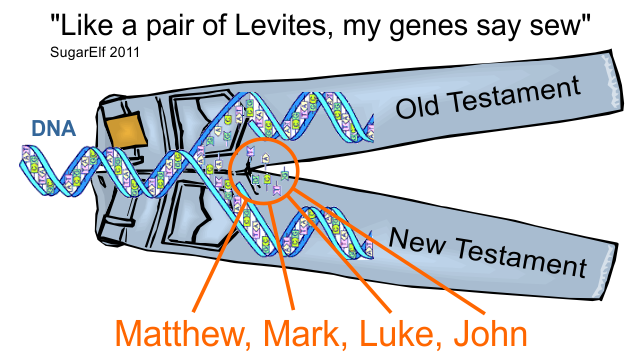
The Levites had helped form the original Catholic Church and many of the first Levites had also assisted in the writing of the New Testament.
KOHANIM LEVITE DNA
I’m a Kohen of Levite decent and I’m from the United States of America. My DNA was tested in 2011, which told me that I come from the Haplogroup of E1b1b1c; E-M123, which is found scattered widely in Europe, America, Greece, North Africa and the Middle East. You can see proof of my DNA test by clicking here if you like.
This haplogroup is quite common in many Semitic language communities, including among both Ashkenazi and SephardicJews, accounting for over 10% of all male lines (Semino 2004). Shen et al. (2004) found 10 out of 169 Israelis and Palestinians of various ancestry to be M123+ and M34+, with the highest level group being 4 out of 20 Israeli Jews of Libyan ancestry.
Semino et al. (2004) reports relatively high levels of 13% in the Albanian community of Cosenza, in Calabria. The ancient town is the seat of the Cosentian Academy, the second academy of philosophical and literary studies to be founded in the old Kingdom of Sicily (1511), and one of the oldest in Europe. There is a Kohanim Levite connection in Sicily, where E-M123 was found by Di Gaetano et al. (2008) to have 4.66% overall in their 236 person study of Sicily, and with higher levels in the east of the island. They found none in Trapani (33 people), Alcamo (24 people), and Cacamo (16 people), along the west of the north coast; 3.23% in San Ninfa (31 people), inland in the west; 3.57% in Sciacca (28 people) and Ragusa (28 people), along the south coast. Also, high levels in the east in Troina (10% of 30 people), Piazza Armerina (10.71% of 28 people), as well as near the Southwestern extreme facing Africa at Mazaro de Vallo (11.11% of 18 people). (Wikipedia)
A notably high regional frequency for E-M123 was also found in Oman, where it is apparently the dominant clade of E-M35. The reason a high percentage of Kohanim DNA is found here, is because the Parthian Empire was friendly with the Greeks, and especially under the Arsacid dynasties. An inscription from this time period shows Heracles and the inscription, ΒΑΣΙΛΕΩΣ ΜΕΓΑΛΟΥ ΑΡΣΑΚΟΥ ΦΙΛΕΛΛΗΝΟΣ; “Great King Arsaces, friend of Greeks“. (Wikipedia) They always had a large Jewish community here in the Parthian Empire, and I assume many Kohanim Levites as well. Later the Parthians would also develop a friendly relationship with Rome in the time of Augustus, that had thrived here for centuries before the Persians had conquered the empire in the 7th century A.D. under the banner of Islam that had taken control of these lands.
Here is what FamilyTreeDNA has to say about these haplogroups:
The E haplogroup has been observed in all Jewish groups world-wide. One of its major subclades, E1b1b (formerly E3b) is considered to be the 2nd most prevalent haplogroup among the Jewish population.
According to one major paper, Contrasting patterns of Y chromosome variation in Ashkenazi Jewish and host non-Jewish European populations E-M35, which defines the E1b1b1 (formerly E3b1) haplogroup, is considered to be the second highest, next to J, for “Founding Jewish Lineages” in Europe. It is found in moderate amounts in all Jewish populations, from Ashkenazi, Sephardic, Kurdish, Yemen, Samaritan and even among Djerba Jewish groups.
The Samaritan Kohanim belong to haplogroup E1b1b1a (formerly known as E3b1a).
Their findings reported on four family lineages among the Samaritans: the Tsdaka family (tradition: tribe of Menasseh), the Joshua-Marhiv and Danfi families (tradition: tribe of Ephraim), and the Cohen family (tradition: tribe of Levi). All Samaritan families were found in haplogroups J1 and J2, except the Cohen family which was found in haplogroup E3b1a-M78.[7] This article predated the E3b1a subclades based on the research of Cruciani, et al.[8] The Samaritan Cohen family were Levites until the previous Cohen family died out around 1700, so the fact that they don’t share CMH is expected. These findings may offer more proof that E1b1 was one of the founding lineages of the Levites.
THE ANCIENT ISLAND OF THE KOHEN
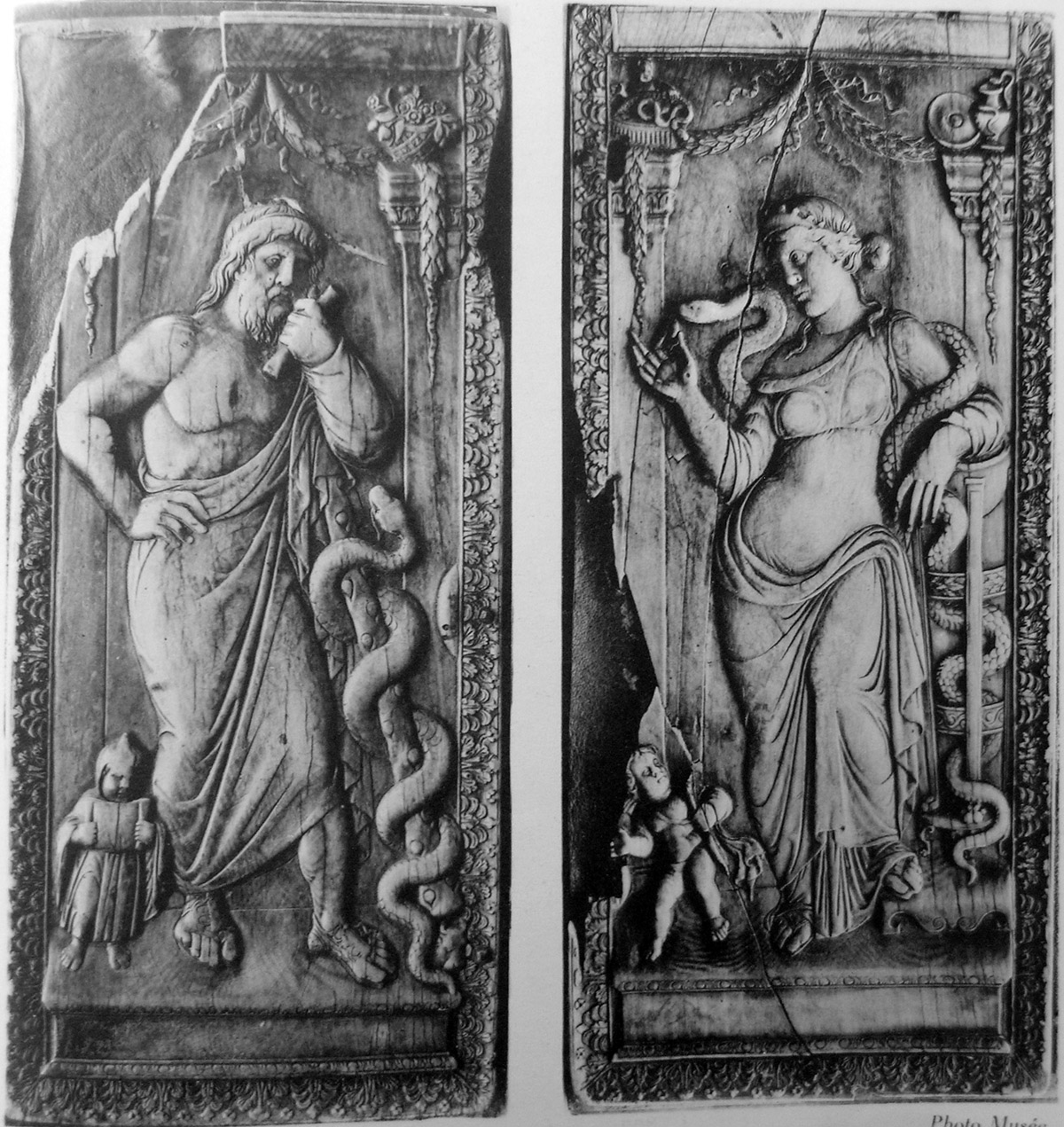
The name Kohen is the Hebrew spelling of the original Greek word, which is also the current English spelling of “Koan or Coan.” The name simply means ‘priest’, and Kohanim is plural. Hence, before they were called the Kohanim, they were simply known for centuries as the “Koans of Kos.” Some of the most famous people in ancient history, such as the Father of Medicine, Hippocrates, and the Greco-Egyptian Pharaoh, Ptolemy II, come from the family of the Kohanim.
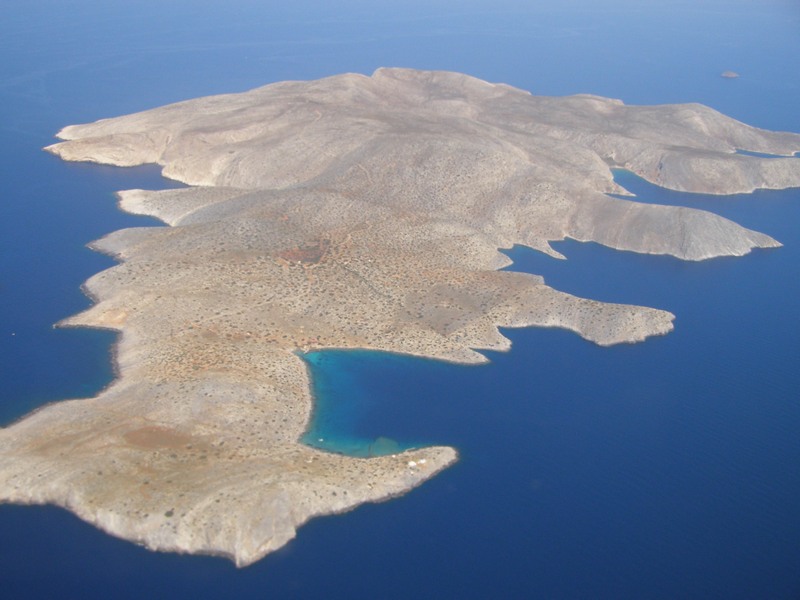
The key to understanding the story of the Kohanim Levites, is to study where they had originally come from. To get up to speed on who the Kohanim were, and where they had lived for many centuries, I suggest you read my previous articles, The Origins of the Kohen Priesthood, Dragon Isle: The Kohen of the Lost Island of Dia, The Royal Purple Silk Prostitute, and The Lost Priesthood of the Kohen. To give you a quick brief summary, they are an ancient family who originally hail from a small island located in the Mediterranean Sea just 7 miles across from Crete, and that today is called Dia. Now the island is completely uninhabited, but at one time, it was one of the most famous and busy islands in all the world. Back then it was known as “Kos (Cos, Coos, Ceus, Letos, Zia etc.)”, and the name was changed several times over history, with the most recent to Dia well after the Romans had conquered or had absorbed their kingdom of the Kohanim Levites into the Republic prior to the 1st century. It was simply known as Kos for approximately 1,000 years from around 550 B.C. through 500 A.D. or later.
KOHEN DNA CAME TO CRETE AND DIA (KOS) FROM THE EAST, IN ETHIOPIA AND EGYPT
It is likely that this DNA haplogroup had migrated to the island of Dia (Kos) via Egypt, and previously Ethiopia where this DNA can still be found. There are many stories told of the Priests known as the Curetes. According to Diodorus Siculus, the Curetes lived in the time of Rhea; Herodotus and Strabo both had said that the Curetes were originally Phoenicians who accompanied Cadmus (Kadmos or Kadmos) out of Phoenicia. Strabo had written, that these are the names of the various groups known as the Curetes (Kuretes), Corybantes, Dactyls, Cabiri, and Telchines, which are names that are often used interchangeably with one another. I had written about the Telchines and the island of Crete in my article, Crete: The Lost Island of Atlantis;
Herodotus had said that the Curetes had come to Crete with the Phoenician, Prince Cadmus. In Latin, Crete is called “Cappadocia or Cappadocian”; who were known as a large tribe of the Magi, and are also called fire-kindlers. Herodotus tells us that the name of the Cappadocians was applied to them by the Persians, while the Greeks had simply called them “Syrians” or “White Syrians.” The Latin name of the Cappadocians were known as “the men of Caphtor”, and who we can call today, “the men of Crete.”
This DNA haplogroup is also been said to be Phoenician, and even on my DNA certificate, it says that is one of my tribes. The word Cadmus, in Hebrew signifies “One who came from the East.” He was a Phoenician Prince who was the founder of the Ancient City of Thebes, and the first to introduce letters to the Greeks. Hence, the Curetes would be the descendants of the Ancient Priesthood of Thebes who were of a distinct race called the Phoenicians who had come from the East into the West, to the island of Crete and Dia (Kos)where they would continue their religious rites and ceremonies under new Gods and Goddesses imported with them from Egypt.
In other history, these people were also known as the Boetians, Cadmeans, Dorians and Spartans. In the Talmud, the Samaritans are called Cutheans (Hebrew: כותים, Kutim). The Cutheans were from ‘Cuthah’, which was one of several cities from which people were brought to Samaria. A colony of Cutheans (Samaritans) had settled in Crete, whose priests were the ancient Curetes, and in the bible, the Kohanim Levites. As I stated above, the island we know of as Crete today, was called Keftiu and Kaftor in the Ancient Egyptian texts, or Caphtor in the Old Testament.
As you can see, the many stories and various names can make this research very confusing and unintelligible for some people. But if you are a fellow Kohen who is actually from the same DNA haplogroup, it should not be that difficult because it is built within your blood via Gnosis. However, for the sake of everyone and for this article, I will mainly focus on the Kohanim Levites from the island of Dia (Kos).
THE KOHEN OF DIA (KOS) ARE TAKEN OVER BY ROME AND GIVEN SPECIAL CITIZEN STATUS IN THE REPUBLIC
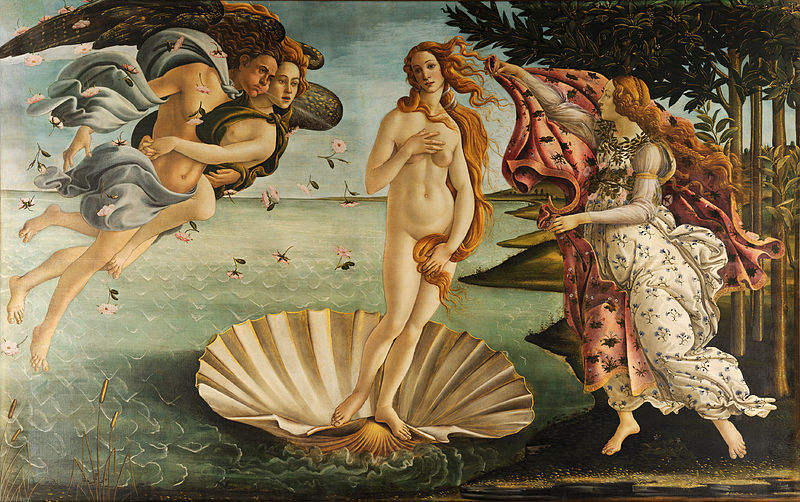
This new name of the island of Dia is derived from the Roman Goddess, Diana which is modeled after the Goddess named Aphrodite. They are all deviations of the Goddess Venus who embodies love, sex, seduction, beauty, and the goddess of prostitutes. The name Venus is derived from venus, meaning “sexual love” and “sexual desire.” The key in understanding the significance of the name change, is because at the time when Rome had conquered the Kohen of Kos, Augustus Caesar had taken their chief ornament of Venus rising from the sea from the island, to Rome. In doing so, he had given the Kohanim Levites special citizen status in the Roman Empire. This is also mentioned in the time of Emperor Claudius, who in 53 A.D. granted the Tribe of the Kohanim Levites immunity from taxes.
These events with Rome are paramount in tracking this family and their DNA after they had abandoned the Island of Dia (Kos). This is the exact reason why their DNA can be found widely around the world, and often near Roman settlements. What happened, is after they were conquered by the Romans around the 1st century, thereafter they were absorbed into various sections of the Roman Republic because of their talents and extreme wealth. Not only were they the 1st people in history given special tax-free service in Rome, but their priesthood was chosen as the only priesthood that would be accepted into Rome; the Kohanim would play a large role in forming the Roman Priesthood and government. These facts can be proved by both historical accounts that I have listed in many of my previous articles, and now also by DNA science.
THE EXODUS OF THE KOHEN FROM DIAAND THE DNA THEY LEFT BEHIND
Before the Kohanim were taken over or absorbed into Rome, they were well-known as an educated people who were in high demand around the world. Their arts and inventions were needed by various government officials, such as in Athens and Rhodes, so they would often travel and be hired to handle various tasks set forth by their employers. Examples of these Kohen would be Prodicus (Greek: Πρόδικος, Pródikos; c. 465 BC – c. 395 BC), a Greek philosopher, who was part of the first generation of Sophists who went to Athens as an ambassador from Dia 9Kos); he became well-known as a speaker and a teacher. There is Philitas (340 – 285 BC), who was a scholar and poet during the early Hellenistic period of ancient Greece, and in the second half of the 4th century BC was appointed tutor to the heir to the throne, Ptolemy I of Ptolemaic Egypt. In addition, another Kohen of Kos who left the island and made his influence in another country is Erasistratus of Kos, who was a Greek anatomist and royal physician under Seleucus I Nicator of Syria.
So, a whole 300 years before they were absorbed by Rome, they were already in high demand and traveling around the world to places such as Athens, and the royal courts of Egypt and Syria. This is why it is rather difficult to properly track the DNA of the original Samaritan Kohen, and why it is imperative, that in order to track this tribe, we need to research their original homelands before, and also right after the Exodus from their tiny island of Dia (Kos). This island of Dia (Kos) is now completely uninhabited, so there is no one to test there for DNA. Hence, they had moved from Dia (Kos) a long time ago, and most likely away from Crete as well, because their DNA there is the lowest in all of Greece.
Many of these facts are found in historical accounts, that can also be compared to their specific DNA Haplogroups that were found in the places they had went during their golden purple years and also after leaving their homeland of Dia (Kos). Places we can study, such as Rhodes and Dia (Kos) which were the great Dorian islands, and also Thessaly. In Italy, they can be found in cities such as Rome, Sicily and Venice, and also throughout Europe in places such as Ireland, Britain, England, Scotland, and many other countries. Their DNA footprints in these locations is small, but their influence has always been huge.
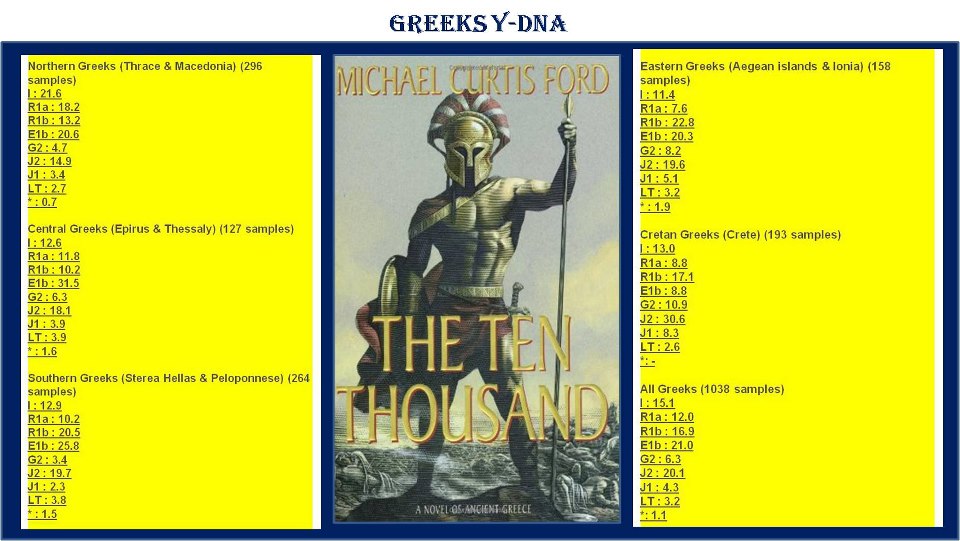
In Greece, the most dominant DNA haplogroup is E1b1 and is found all around the Mediterranean Sea. I had written about this fact in my article, Greek YDNA haplogroups. This is the reason that in recent DNA tests, 1038 samples confirms that the Greeks tested were;
The overall DNA results for all of Greece were as follows:
The highest DNA Haplogroup was E1b1b, and it was found in high concentrations in cities such as Thessaly @ 31.5%, and also at Hellas and Ionia. It is at these same locations, where science is confirming this haplogroup, along with history, which also confirms that the Kohanim were a huge influence in these exact same places. For example, there have been text found of several decrees of the Kohen from Thessaly, where the national heroes of Dia (Kos), the Temple Asklepiadae, represent Thessaly.
Greek mythology in regards to the Dorians also connects these two places with the Kohen priesthood. There are connections to Ionia and the Kohen, because as I mentioned above, the Kohen were also known as a tribe of the Dorians, and there was a well-known Dorian and Boetian migration and colonization of all these same areas. These events are explained by Herodotus;
Herodotos tells us that Kos and the adjacent islands were colonized from Epidauros, and in this way the old Dorian element was strengthened. The sterner features of the Dorian character were, however, mollified in Kos. The discipline (dyaryi;) of Sparta and Crete is not found there, though the population of the island was purely Dorian, and was divided into the three Dorian tribes, the Dymanes, Hylleis, and Pamphyli. Six of the cities in this region formed a religious league, the Doric Hexapolis. They were, besides Kos, Lindos, Ialysos, Kamiros, Knidos, and Halikarnassos. These states met at the temple of Apollo on the Triopian promontory, to take part in the worship of the god and also in games. Later on Halikarnassos it was expelled, and the Hexapolis became a Pentapolis.
Now with the help of science, we can find DNA haplogroups that place the Dorians and Samaritan Kohen in all these cities in Greece that I had mentioned above, and also in locations that connect them with Rome. We can also verify that they were given special tax and citizen status in Rome, and also possibly cities such as Venice and Sicily where we can also find their DNA at about 6.6%. These two places have seen a strong cultural influence of these people all throughout their governments and arts that can be witnessed to this day. The Venetians would have a strong influence in the area of the Mediterranean Sea, such as when the Venetians had first occupied the island of Crete in 1205 A.D. and took over complete rule of the island in 1212. They had exposed the Greek population there to a new Renaissance and learning like they haven’t seen in centuries. They would rule Crete for approximately 500 years, until 1715 when the Ottomans would invade and take the island jewel from the Venetians.
THE KOHANIM LEVITES AND THE CATHOLIC CHURCH
As I mentioned above, the Father of English History and Doctor of the Church, Saint Bede (Beda) had written on Ezra and Nehemiah; “Allegorically, the Levites represent those attached to the Catholic Church.” This fact is imperative in understanding who the Kohanim Levites were, and where they had went. Crucial information, that helps substantiate the history at approximately the same time the Romans had either taken over or absorbed the Kohen kingdom in Dia (Kos) just 7 miles across the sea from Crete. Their special tax status and the historical accounts about the many Kohen Priests from Dia (Kos), helps verify that these are the true Kohanim Levites. We also now have DNA to help match the many places they had migrated to. A science we can now use to match the DNA haplogroup of the many descendants that can be found in these same exact received cities as described in Deuteronomy 18:2, where they had received cities “because the Lord the God of Israel Himself is their inheritance”
My family had originally come to America from Canada, and before they migrated to New France, they had lived in Old France in a city called Paris. Many of them were Saints, Fathers and theologians. One of my ancestors, Noel Beda (Bede) was principal of the College of Montaign there at Paris in 1502, and syndic of the faculty of theology about 1520. He had fiercely opposed the divorce of the Norman king Henry VIII of England, and he had often let his voice be heard in Paris about his disapproval of the divorce. In fact, he upset the king so much, that he was arrested in the year 1530 and then banished to Mont Saint Michel, where he died the following year. Soon thereafter, the Beda name was corrupted and later became Bedard, whose family in the mid 1600’s was part of the first migrants to New France, now known as Canada. This is how some of the Kohen DNA would migrate to North America, and eventually my immediate family to the United States where I now live in the state of California. Today, there are estimated to be 300,000 Levites living now in the United States and another 25,000 in Canada.
This Noel Beda from Paris, I believe to be a direct descendant of Saint Beda who had actually lived and taught in Paris as well. In fact, I believe he had helped found the school there. Saint Bede had written many books that would indicate he was a Levite. Books such as Bede: On the Tabernacle, and Bede: On the Temple, where he was the first Kohen Christian and Catholic to put in writing the relationship of the Old Testament with the Tabernacle, and Solomon’s Temple with the New Testament, in which Solomon’s Temple would be built by living stones composed of both Jews and Gentiles. In the Book of Numbers, the Levites were charged with ministering to the Kohanim (priests) and keeping watch over the Tabernacle.(Wikipedia) These traditions have always been passed from father to son, and this is why Bede was such an authority to be chosen by the priesthood to be the voice of their Brotherhood.
This is why I believe based on Kohanim Levites, that they were the priests of both the Old Testament and the chosen Hebrew priesthood of Rome under Augustus Caesar of the New Testament and the New Covenant. The first Pontifex Maximus or Pope of this 6th Age was Augustus Caesar, who was also considered their anointed messiah because he had saved them and absorbed their priesthood into the Roman religion and government, where their influences can still be seen to this very day. A new law under Rome, in which both Jews and Gentiles would be accepted into the Universal Brotherhood, based on merit and work they had put in for this same said Brotherhood who would help establish the institution we know of today as the “Catholic Church.”
Moe is the founder of GnosticWarrior.com. He is a father, husband, author, martial arts black belt, and an expert in Gnosticism, the occult, and esotericism.

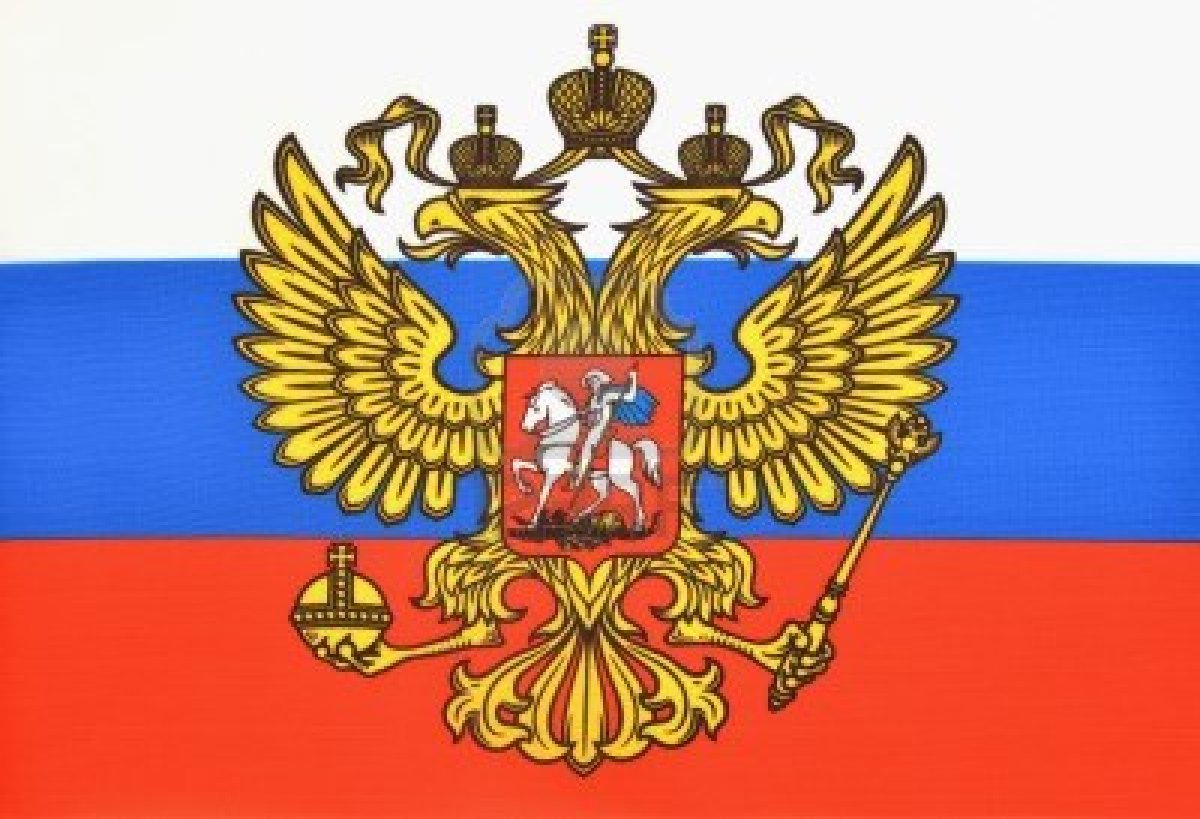 example, did you know that Russia is called the “Third Rome,” or the “New Rome?” This had occurred when the Grand Duchy of Moscow (Russian: Великое Княжество Московское, Velikoye Knyazhestvo Moskovskoye), or Grand Principality of Moscow had successfully succeeded both the first Roman and the second Byzantium Greco-Roman empires approximately 500 years ago. In doing so, the founders of Russia, known as the Rus, along with the original ancient Muscovites of Moscow had also become the defacto “Masters of the Second Jerusalem.”
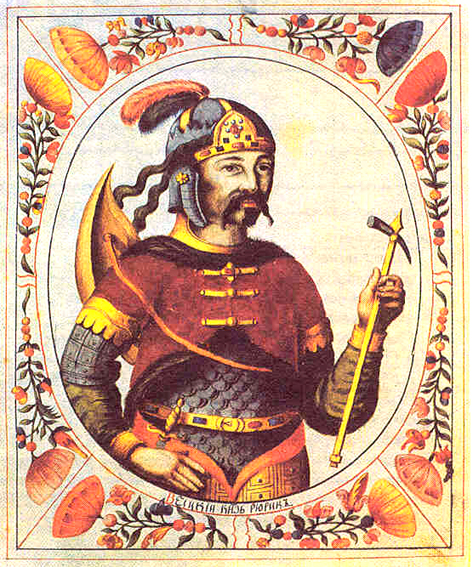 Russia was founded by the Varangian prince Rurik, who established himself in Novgorod approximately in the year 862 AD. It has been written that they were Vikings who had predominantly come from the Scandinavian country of Sweden,in which the Prince had brought the name from his original homeland in the Swedish province of Ross Lagen. This is confirmed by an author in the 839 A.D. in the Annals of St Bertin who had written, “the Rhos came from Sweden.” The Greeks in the East were said to call them Russians, and in the West they were known as the Normans. In Finland, they are called the “Swedes Ruotz.”
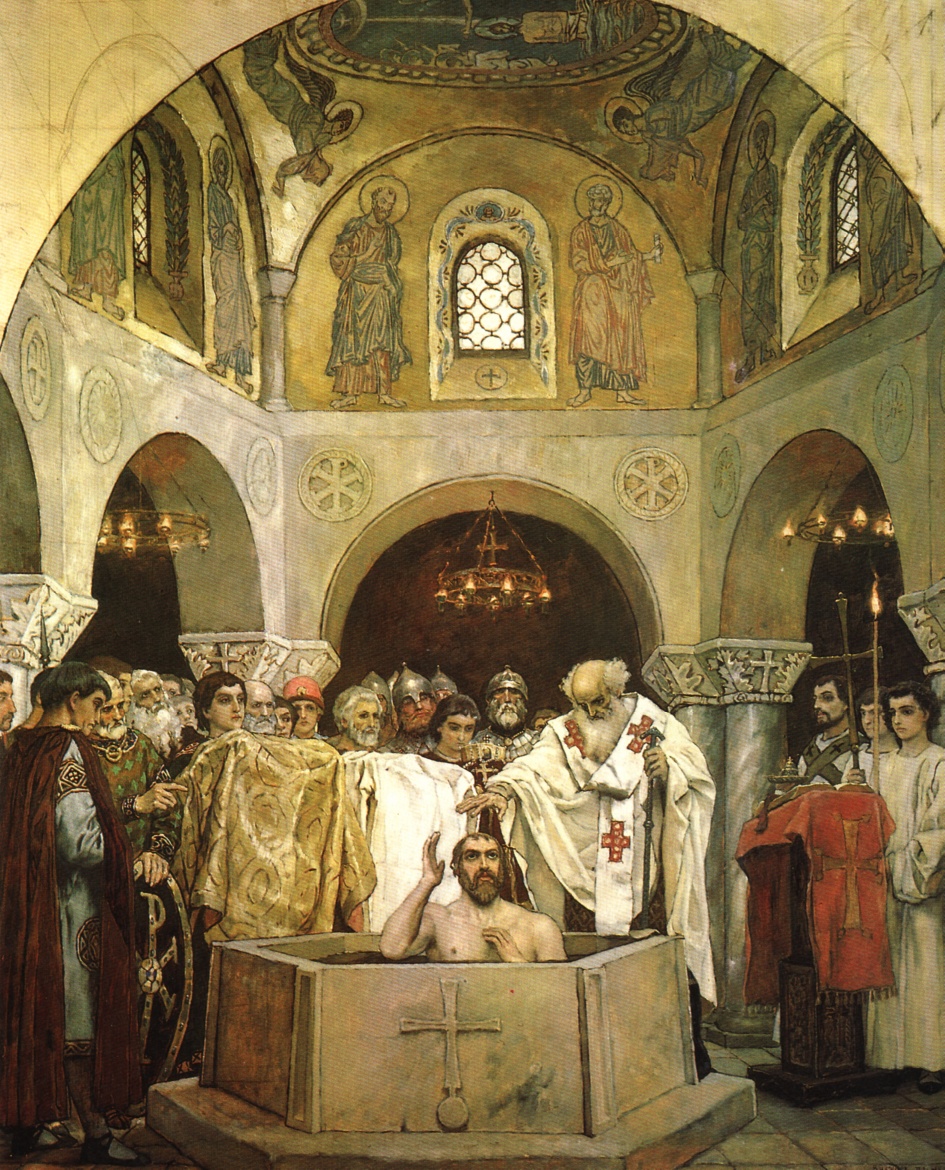 In addition to these treaties with the Byzantines, in the year 954 A.D., Princess Ol’ha (Olga) of Kiev would be baptized, and later in 988, both the baptisms of Vladimir of Kiev and the Baptism of Rus’ would occur, signifying one of the most important events in the history of Russia. They would officially join the Byzantine Empire as Christians and Brothers. Olga’s grandson Vladimir (reigned 980-1015) was converted to Christianity in 988 A.D., and Christianized the Kievan Rus’. He would go on to marry Anna, the sister of the Byzantine Emperor. (Wikipedia) Over the course of the next few hundred years, the Rurikids would eventually go on to be the sovereigns of not only the massive country we know of today as Russia, but also Normandy, Naples, Sicily, and England etc. Hence, the “Masters of the Second Jerusalem.”
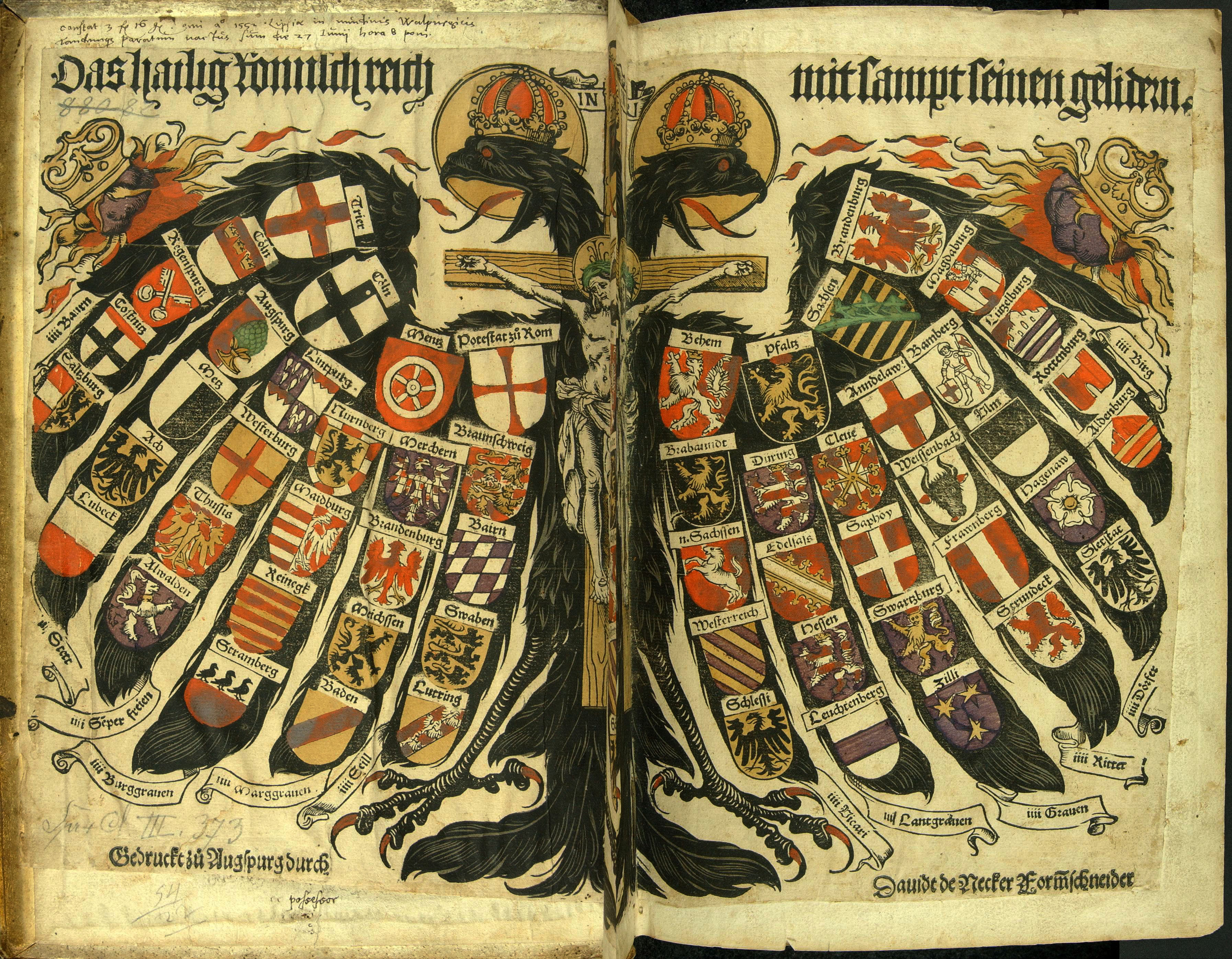 THE RUS BECOME MASTERS OF THE SECOND JERUSALEM AND RUSSIA THE THIRD ROME
 (yabal), meaning to bring, carry, lead, conduct, and is also explained as meaning, “to cause to transport an object from one place to another.” The the name Cain may be derived from the Egyptian “ka or ba” meaning ‘soul.’