by Moe
Page 73
“The mirror of the soul cannot reflect both earth and heaven; and the one vanishes from
its surface, as the other is glassed upon its deep.” ZANONI.
“Qui, donc, t’a donne la mission d’annoncer au peuple que la Divinite n’existe pas — quel
avantage trouves tu a persuader a l’homme qu’une force aveugle preside a ses destinees
et frappe au hasard le crime et la vertu?”
ROBESPIERRE (Discours), May 7, 1794. WE believe that few of those physical phenomena which are genuine are caused by disembodied human spirits. Still, even those that are produced by occult forces of nature, such as happen through a few genuine mediums, and are consciously employed by the so-called “jugglers” of India and Egypt, deserve a careful and serious investigation by science; especially now that a number of respected authorities have testified that in many cases the hypothesis of fraud does not hold. No doubt, there are professed “conjurors” who can perform cleverer tricks than all the American and English “John Kings” together. Robert Houdin unquestionably could, but this did not prevent his laughing outright in the face of the academicians, when they desired him to assert in the newspapers, that he could make a table move, or rap answers to questions, without contact of hands, unless the table was a prepared one. The fact alone, that a now notorious London juggler refused to accept a challenge for £1,000 offered him by Mr. Algernon Joy, to produce such manifestations as are usually obtained through mediums, unless he was left unbound and free from the hands of a committee, negatives his expose of the occult phenomena. Clever as he may be, we defy and challenge him to reproduce, under the same conditions, the “tricks” exhibited even by a common Indian juggler. For instance, the spot to be chosen by the investigators at the moment of the performance, and the juggler to know nothing of the choice; the experiment to be made in broad daylight, without the least preparations for it; without any confederate but a boy absolutely naked, and the juggler to be in a condition of semi-nudity. After that, we should select out of a variety three tricks, the most common among such public jugglers, and that were recently exhibited to some gentlemen belonging to
Page 74
the suite of the Prince of Wales: 1. To transform a rupee — firmly clasped in the hand of a skeptic — into a living cobra, the bite of which would prove fatal, as an examination of its fangs would show. 2. To cause a seed chosen at random by the spectators, and planted in the first semblance of a flower-pot, furnished by the same skeptics, to grow, mature, and bear fruit in less than a quarter of an hour. 3. To stretch himself on three swords, stuck perpendicularly in the ground at their hilts, the sharp points upward; after that, to have removed first one of the swords, then the other, and, after an interval of a few seconds, the last one, the juggler remaining, finally, lying on nothing — on the air, miraculously suspended at about one yard from the ground. When any prestidigitateur, to begin with Houdin and end with the last trickster who has secured gratuitous advertisement by attacking spiritualism, does the same, then — but only then — we will train ourselves to believe that mankind has been evolved out of the hind-toe of Mr. Huxley’s Eocene Orohippus.
We assert again, in full confidence, that there does not exist a professional wizard, either of the North, South or West, who can compete with anything approaching success, with these untutored, naked sons of the East. These require no Egyptian Hall for their performances, nor any preparations or rehearsals; but are ever ready, at a moment’s notice, to evoke to their help the hidden powers of nature, which, for European prestidigitateurs as well as for scientists, are a closed book. Verily, as Elihu puts it, “great men are not always wise; neither do the aged understand judgment.” To repeat the remark of the English divine, Dr. Henry More, we may well say: “. . . indeed, if there were any modesty left in mankind, the histories of the Bible might abundantly assure men of the existence of angels and spirits.”
Moe is the founder of GnosticWarrior.com. He is a father, husband, author, martial arts black belt, and an expert in Gnosticism, the occult, and esotericism.
by Moe
Page 99
“I choose the nobler part of Emerson, when, after various disenchantments, he
exclaimed, ‘I covet Truth.’ The gladness of true heroism visits the heart of him who is
really competent to say this.” — TYNDALL.
“A testimony is sufficient when it rests on:
1st. A great number of very sensible witnesses who agree in having seen well.
2d. Who are sane, bodily and mentally.
3d. Who are impartial and disinterested.
4th. Who unanimously agree.
5th. Who solemnly certify to the fact.” — VOLTAIRE, Dictiannaire Philosophique. THE Count Agenor de Gasparin is a devoted Protestant. His battle with des Mousseaux, de Mirville and other fanatics who laid the whole of the spiritual phenomena at the door of Satan, was long and fierce. Two volumes of over fifteen hundred pages are the result, proving the effects, denying the cause, and employing superhuman efforts to invent every other possible explanation that could be suggested rather than the true one.
The severe rebuke received by the Journal des Debats from M. de Gasparin, was read by all civilized Europe. After that gentleman had minutely described numerous manifestations that he had witnessed himself, this journal very impertinently proposed to the authorities in France to send all those who, after having read the fine analysis of the “spiritual hallucinations” published by Faraday, should insist on crediting this delusion, to the lunatic asylum for Incurables. “Take care,” wrote de Gasparin in answer, “the representatives of the exact sciences are on their way to become . . . the Inquisitors of our days. . . . Facts are stronger than Academies. Rejected, denied, mocked, they nevertheless are facts, and do exist.”
The following affirmations of physical phenomena, as witnessed by himself and Professor Thury, may be found in de Gasparin’s voluminous work.
“The experimenters have often seen the legs of the table glued, so to say, to the floor, and, notwithstanding the excitement of those present, refuse to be moved from their place. On other occasions they have seen the tables levitated in quite an energetic way. They heard, with their own
Page 100
ears, loud as well as gentle raps, the former threatening to shatter the table to pieces on account of their violence, the latter so soft as to become hardly perceptible. . . . As to LEVITATIONS WITHOUT CONTACT, we found means to produce them easily, and with success. . . . And such levitations do not pertain to isolated results. We have reproduced them over THIRTY times. . . . One day the table will turn, and lift its legs successively, its weight being augmented by a man weighing eighty-seven kilogrammes seated on it; another time it will remain motionless and immovable, notwithstanding that the person placed on it weighs but sixty.. . . On one occasion we willed it to turn upside down, and it turned over, with its legs in the air, notwithstanding that our fingers never touched it once.”
“It is certain,” remarks de Mirville, “that a man who had repeatedly witnessed such a phenomenon, could not accept the fine analysis of the English physicist.”
Since 1850, des Mousseaux and de Mirville, uncompromising Roman Catholics, have published many volumes whose titles are cleverly contrived to attract public attention. They betray on the part of the authors a very serious alarm, which, moreover, they take no pains to conceal. Were it possible to consider the phenomena spurious, the church of Rome would never have gone so much out of her way to repress them.
Both sides having agreed upon the facts, leaving skeptics out of the question, people could divide themselves into but two parties: the believers in the direct agency of the devil, and the believers in disembodied and other spirits. The fact alone, that theology dreaded a great deal more the revelations which might come through this mysterious agency than all the threatening “conflicts” with Science and the categorical denials of the latter, ought to have opened the eyes of the most skeptical. The church of Rome has never been either credulous or cowardly, as is abundantly proved by the Machiavellism which marks her policy. Moreover, she has never troubled herself much about the clever prestidigitateurs whom she knew to be simply adepts in juggling. Robert Houdin, Comte, Hamilton and Bosco, slept secure in their beds, while she persecuted such men as Paracelsus, Cagliostro, and Mesmer, the Hermetic philosophers and mystics — and effectually stopped every genuine manifestation of an occult nature by killing the mediums.
Moe is the founder of GnosticWarrior.com. He is a father, husband, author, martial arts black belt, and an expert in Gnosticism, the occult, and esotericism.
by Moe

Image via Wikipedia
Page 125
“Ich bin der Geist der stets verneint.”
(I am the spirit which still denies.) — (Mephisto in FAUST.)
“The Spirit of truth, whom the world cannot receive because it seeth Him not; neither
knoweth Him.” — Gospel according to John, xiv., 17.
“Millions of spiritual creatures walk the earth
Unseen, both when we wake and when we sleep.” — MILTON. “
Mere intellectual enlightenment cannot recognize the spiritual. As the sun puts out a
fire, so spirit puts out the eyes of mere intellect. — W. HOWITT. THERE has been an infinite confusion of names to express one and the same thing. The chaos of the ancients; the Zoroastrian sacred fire, or the Antusbyrum of the Parsees; the Hermes-fire; the Elmes-fire of the ancient Germans; the lightning of Cybele; the burning torch of Apollo; the flame on the altar of Pan; the inextinguishable fire in the temple on the Acropolis, and in that of Vesta; the fire-flame of Pluto’s helm; the brilliant sparks on the hats of the Dioscuri, on the Gorgon head, the helm of Pallas, and the staff of Mercury; the [[pur asbeston]]; the Egyptian Phtha, or Ra; the Grecian Zeus Cataibates (the descending); the pentecostal fire-tongues; the burning bush of Moses; the pillar of fire of the Exodus, and the “burning lamp” of Abram; the eternal fire of the “bottomless pit”; the Delphic oracular vapors; the Sidereal light of the Rosicrucians; the AKASA of the Hindu adepts; the Astral lightof
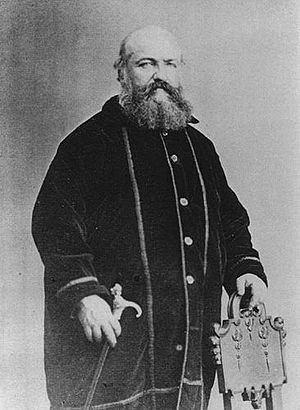
Image via Wikipedia
Eliphas Levi; the nerve-aura and the fluid of the magnetists; the od of Reichenbach; the fire-globe, or meteor-cat of Babinet; the Psychod and ectenic force of Thury; the psychic force of Sergeant Cox and Mr. Crookes; the atmospheric magnetism of some naturalists; galvanism; and finally, electricity, are but various names for many different manifestations, or effects of the same mysterious, all-pervading cause — the Greek Archeus, or [[Archaios]].
Sir E. Bulwer-Lytton, in his Coming Race, describes it as the VRIL, used by the subterranean populations, and allowed his readers to take it
Page 126
for a fiction. “These people,” he says, “consider that in the vril they had arrived at the unity in natural energic agencies”; and proceeds to show that Faraday intimated them “under the more cautious term of correlation,” thus:
“I have long held an opinion, almost amounting to a conviction, in common, I believe, with many other lovers of natural knowledge, that the various forms under which the forces of matter are made manifest, HAVE ONE COMMON ORIGIN; or, in other words, are so directly related and naturally dependent, that they are convertible, as it were, into one another, and possess equivalents of power in their action.”
Absurd and unscientific as may appear our comparison of a fictitious vril invented by the great novelist, and the primal force of the equally great experimentalist, with the kabalistic astral light, it is nevertheless the true definition of this force. Discoveries are constantly being made to corroborate the statement thus boldly put forth. Since we began to write this part of our book, an announcement has been made in a number of papers of the supposed discovery of a new force by Mr. Edison, the electrician, of Newark, New Jersey, which force seems to have little in common with electricity, or galvanism, except the principle of conductivity. If demonstrated, it may remain for a long time under some pseudonymous scientific name; but, nevertheless, it will be but one of the numerous family of children brought forth from the commencement of time by our kabalistic mother, the Astral Virgin. In fact, the discoverer says that, “it is as distinct, and has as regular laws as heat, magnetism, or electricity.” The journal which contains the first account of the discovery adds that, “Mr. Edison thinks that it exists in connection with heat, and that it can also be generated by independent and as yet undiscovered means.“
Moe is the founder of GnosticWarrior.com. He is a father, husband, author, martial arts black belt, and an expert in Gnosticism, the occult, and esotericism.
by Moe
Page 163
“Hermes, who is of my ordinances ever the bearer . . .
Then taking his staff, with which he the eyelids of mortals
Closes at will, and the sleeper, at will, reawakens.” — Odyssey, Book V.
“I saw the Samothracian rings
Leap, and steel-filings boil in a brass dish
So soon as underneath it there was placed
The magnet-stone; and with wild terror seemed
The iron to flee from it in stern hate. . . .” — Lucretius, Book VI.
“But that which especially distinguishes the Brotherhood is their marvellous knowledge
of the resources of the medical art. They work not by charms but by simples.” — (MS.
Account of the Origin and Attributes of the True Rosicrucians.) ONE of the truest things ever said by a man of science is the remark made by Professor Cooke in his New Chemistry. “The history of Science shows that the age must be prepared before scientific truths can take root and grow. The barren premonitions of science have been barren because these seeds of truth fell upon unfruitful soil; and, as soon as the fulness of the time has come, the seed has taken root and the fruit has ripened . . . every student is surprised to find how very little is the share of new truth which even the greatest genius has added to the previous stock.”
The revolution through which chemistry has recently passed, is well calculated to concentrate the attention of chemists upon this fact; and it would not be strange, if, in less time than it has required to effect it, the claims of the alchemists would be examined with impartiality, and studied from a rational point of view. To bridge over the narrow gulf which now separates the new chemistry from old alchemy, is little, if any harder than what they have done in going from dualism to the law of Avogadro.
As Ampere served to introduce Avogadro to our contemporary chemists, so Reichenbach will perhaps one day be found to have paved the way with his OD for the just appreciation of Paracelsus. It was more than fifty years before molecules were accepted as units of chemical calculations; it may require less than half that time to cause the superlative merits of the Swiss mystic to be acknowledged. The warning paragraph about healing mediums, which will be found elsewhere, might have
Page 164
been written by one who had read his works. “You must understand,” he says, “that the magnet is that spirit of life in man which the infected seeks, as both unite themselves with chaos from without. And thus the healthy are infected by the unhealthy through magnetic attraction.”
The primal causes of the diseases afflicting mankind; the secret relations between physiology and psychology, vainly tortured by men of modern science for some clew to base their speculations upon; the specifics and remedies for every ailment of the human body — all are described and accounted for in his voluminous works. Electro-magnetism, the so-called discovery of Professor Oersted, had been used by Paracelsus three centuries before. This may be demonstrated by examining critically his mode of curing disease. Upon his achievements in chemistry there is no need to enlarge, for it is admitted by fair and unprejudiced writers that he was one of the greatest chemists of his time. Brierre de Boismont terms him a “genius” and agrees with Deleuze that he created a new epoch in the history of medicine. The secret of his successful and, as they were called, magic cures lies in his sovereign contempt for the so-called learned “authorities” of his age. “Seeking for truth,” says Paracelsus, “I considered with myself that if there were no teachers of medicine in this world, how would I set to learn the art? No otherwise than in the great open book of nature, written with the finger of God. . . . I am accused and denounced for not having entered in at the right door of art. But which is the right one? Galen, Avicenna, Mesue, Rhasis, or honest nature? I believe, the last! Through this door I entered, and the light of nature, and no apothecary’s lamp directed me on my way.”
Moe is the founder of GnosticWarrior.com. He is a father, husband, author, martial arts black belt, and an expert in Gnosticism, the occult, and esotericism.
by Moe
Page 205
“Thou great First Cause, least understood.” — POPE.
“Whence this pleasing hope, this fond desire,
This longing after immortality?
Or whence this secret dread, and inward horror
Of falling into naught? Why shrinks the soul
Back on herself, and startles at destruction?
‘Tis the divinity that stirs within us;
‘Tis heaven itself that points out our hereafter
And intimates eternity to man.
ETERNITY! Thou pleasing, dreadful thought!” — ADDISON.
“There is another and a better world.” — KOTZEBUE: The Stranger. AFTER according so much space to the conflicting opinions of our men of science about certain occult phenomena of our modern period, it is but just that we give attention to the speculations of mediaeval alchemists and certain other illustrious men. Almost without exception, ancient and mediaeval scholars believed in the arcane doctrines of wisdom. These included Alchemy, the Chaldeo-Jewish Kabala, the esoteric systems of Pythagoras and the old Magi, and those of the later Platonic philosophers and theurgists. We also propose in subsequent pages to treat of the Indian gymnosophists and the Chaldean astrologers. We must not neglect to show the grand truths underlying the misunderstood religions of the past. The four elements of our fathers, earth, air, water, and fire, contain for the student of alchemy and ancient psychology — or as it is now termed, magic — many things of which our philosophy has never dreamed. We must not forget that what is now called Necromancy by the Church, and Spiritualism by modern believers, and that includes the evoking of departed spirits, is a science which has, from remote antiquity, been almost universally diffused over the face of the globe.
Although neither an alchemist, magician, nor astrologer, but simply a great philosopher, Henry More, of Cambridge University — a man universally esteemed, may be named as a shrewd logician, scientist, and metaphysician. His belief in witchcraft was firm throughout his life. His faith in immortality and able arguments in demonstration of the survival of man’s spirit after death are all based on the Pythagorean system, adopted by Cardan, Van Helmont, and other mystics. The infinite and
Page 206
uncreated spirit that we usually call GOD, a substance of the highest virtue and excellency, produced everything else by emanative causality. God thus is the primary substance, the rest, the secondary; if the former created matter with a power of moving itself, he, the primary substance, is still the cause of that motion as well as of the matter, and yet we rightly say that it is matter which moves itself. “We may define this kind of spirit we speak of to be a substance indiscernible, that can move itself, that can penetrate, contract, and dilate itself, and can also penetrate, move, and alter matter,” which is the third emanation. He firmly believed in apparitions, and stoutly defended the theory of the individuality of every soul in which “personality, memory, and conscience will surely continue in the future state.” He divided the astral spirit of man after its exit from the body into two distinct entities: the “aerial” and the “aethereal vehicle.” During the time that a disembodied man moves in its aerial clothing, he is subject to Fate — i.e., evil and temptation, attached to its earthly interests, and therefore is not utterly pure; it is only when he casts off this garb of the first spheres and becomes ethereal that he becomes sure of his immortality. “For what shadow can that body cast that is a pure and transparent light, such as the ethereal vehicle is? And therefore that oracle is then fulfilled, when the soul has ascended into that condition we have already described, in which alone it is out of the reach of fate and mortality.” He concludes his work by stating that this transcendent and divinely-pure condition was the only aim of the Pythagoreans.
As to the skeptics of his age, his language is contemptuous and severe. Speaking of Scot, Adie, and Webster, he terms them “our new inspired saints . . . sworn advocates of the witches, who thus madly and boldly, against all sense and reason, against all antiquity, all interpreters, and against the Scripture itself, will have even no Samuel in the scene, but a confederate knave! Whether the Scripture, or these inblown buffoons, puffed up with nothing but ignorance, vanity, and stupid infidelity, are to be believed, let any one judge,” he adds.
Moe is the founder of GnosticWarrior.com. He is a father, husband, author, martial arts black belt, and an expert in Gnosticism, the occult, and esotericism.
by Moe
Page 253
“Think not my magic wonders wrought by aid
Of Stygian angels summoned up from Hell;
Scorned and accursed by those who have essay’d
Her gloomy Divs and Afrites to compel.
But by perception of the secret powers
Of mineral springs, in nature’s inmost cell,
Of herbs in curtain of her greenest bowers,
And of the moving stars o’er mountain tops and towers.” — TASSO, Canto XIV., xliii.
“Who dares think one thing and another tell
My heart detests him as the gates of Hell!” — POPE.
“If man ceases to exist when he disappears in the grave, you must be compelled to affirm
that he is the only creature in existence whom nature or providence has condescended to
deceive and cheat by capacities for which there are no available objects.” — BULWER-
LYTTON: Strange Story. THE preface of Richard A. Proctor’s latest work on astronomy, entitled Our Place among Infinities, contains the following extraordinary words: “It was their ignorance of the earth’s place among infinities, which led the ancients to regard the heavenly bodies as ruling favorably or adversely the fates of men and nations, and to dedicate the days in sets of seven to the seven planets of their astrological system.”
Mr. Proctor makes two distinct assertions in this sentence: 1. That the ancients were ignorant of the earth’s place among infinities; and 2. That they regarded the heavenly bodies as ruling, favorably or adversely, the fates of men and nations. We are very confident that there is at least good reason to suspect that the ancients were familiar with the movements, emplacement, and mutual relations of the heavenly bodies. The testimony of Plutarch, Professor Draper, and Jowett, are sufficiently explicit. But we would ask Mr. Proctor how it happens, if the ancient astronomers were so ignorant of the law of the birth and death of worlds that, in the fragmentary bits which the hand of time has spared us of ancient lore there should be — albeit couched in obscure language — so much information which the most recent discoveries of science have verified? Beginning with the tenth page of the work under notice, Mr. Proc-
Page 254
tor sketches for us the theory of the formation of our earth, and the successive changes through which it passed until it became habitable for man. In vivid colors he depicts the gradual accretion of cosmic matter into gaseous spheres surrounded with “a liquid non-permanent shell”; the condensation of both; the ultimate solidification of the external crust; the slow cooling of the mass; the chemical results following the action of intense heat upon the primitive earthy matter; the formation of soils and their distribution; the change in the constitution of the atmosphere; the appearance of vegetation and animal life; and, finally, the advent of man.
Now, let us turn to the oldest written records left us by the Chaldeans, the Hermetic Book of Numbers, and see what we shall find in the allegorical language of Hermes, Kadmus, or Thuti, the thrice great Trismegistus. “In the beginning of time the great invisible one had his holy hands full of celestial matter which he scattered throughout the infinity; and lo, behold! it became balls of fire and balls of clay; and they scattered like the moving metal into many smaller balls, and began their ceaseless turning; and some of them which were balls of fire became balls of clay; and the balls of clay became balls of fire; and the balls of fire were waiting their time to become balls of clay; and the others envied them and bided their time to become balls of pure divine fire.
” Could any one ask a clearer definition of the cosmic changes which Mr. Proctor so elegantly expounds?
Here we have the distribution of matter throughout space; then its concentration into the spherical form; the separation of smaller spheres from the greater ones; axial rotation; the gradual change of orbs from the incandescent to the earthy consistence; and, finally, the total loss of heat which marks their entrance into the stage of planetary death. The change of the balls of clay into balls of fire would be understood by materialists to indicate some such phenomenon as the sudden ignition of the star in Cassiopeia, A.D. 1572, and the one in Serpentarius, in 1604, which was noted by Kepler. But, do the Chaldeans evince in this expression a profounder philosophy than of our day? Does this change into balls of “pure divine fire” signify a continuous planetary existence,
Moe is the founder of GnosticWarrior.com. He is a father, husband, author, martial arts black belt, and an expert in Gnosticism, the occult, and esotericism.