Even if destitute of any formal or official enunciation of those important truths, which even in a cultivated age it was often found inexpedient to assert except under a veil of allegory, and which moreover lose their dignity and value in proportion as they are learned mechanically as dogmas, the shows of the Mysteries certainly contained suggestions if not lessons, which in the opinion not of one competent witness only, but of many, were adapted to elevate the character of the spectators. enabling them to augur
p. 356
something of the purposes of existence, as well as of the means of improving it, to live better and to die happier.
Unlike the religion of books or creeds, these mystic shows and performances were not the reading of a lecture, but the opening of a problem, implying neither exemption from research, nor hostility to philosophy: for, on the contrary, philosophy is the great Mystagogue or Arch-Expounder of symbolism: though the interpretations by the Grecian Philosophy of the old myths and symbols were in many instances as ill-founded, as in others they are correct.
No better means could be devised to rouse a dormant intellect, than those impressive exhibitions, which addressed it through the imagination: which, instead of condemning it to a prescribed routine of creed, invited it to seek, compare, and judge. The alteration from symbol to dogma is as fatal to beauty of expression, as that from faith to dogma is to truth and wholesomeness of thought.
The first philosophy often reverted to the natural mode of teaching; and Socrates, in particular, is said to have eschewed dogmas, endeavoring, like the Mysteries, rather to awaken and develop in the minds of his hearers the ideas with which they were already endowed or pregnant, than to fill them with ready-made adventitious opinions.
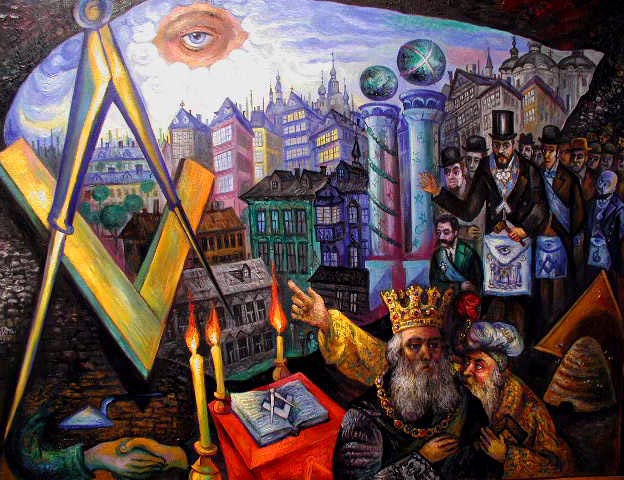
So Masonry still follows the ancient manner of teaching. Her symbols are the instruction she gives; and the lectures are but often partial and insufficient one-sided endeavors to interpret those symbols. He who would become an accomplished Mason, must not be content merely to hear or even to understand the lectures, but must, aided by them, and they having as it were marked out the way for him, study, interpret, and develop the symbols for himself.
The earliest speculation endeavored to express far more than it could distinctly comprehend; and the vague impressions of the mind found in the mysterious analogies of phenomena their most apt and energetic representations. The Mysteries, like the symbols of Masonry, were but an image of the eloquent analogies of Nature; both those and these revealing no new secret to such as were or are unprepared, or incapable of interpreting their significance.
Everywhere in the old Mysteries, and in all the symbolisms and ceremonial of the Hierophant was found the same mythical personage, who, like Hermes, or Zoroaster, unites Human Attributes
p. 357
with Divine, and is himself the God whose worship he introduced, teaching rude men the commencements of civilization through the influence of song, and connecting with the symbol of his death, emblematic of that of Nature, the most essential consolations of religion.
The Mysteries embraced the three great doctrines of Ancient Theosophy. They treated of God, Man, and Nature. Dionusos, whose Mysteries Orpheus is said to have founded, was the God of Nature, or of the moisture which is the life of Nature, who prepares in darkness the return of life and vegetation, or who is himself the Light and Change evolving their varieties. He was theologically one with Hermes, Prometheus, and Poseidon. In the Egean Islands he is Butes, Dardanus, Himeros, or Imbros. In Crete he appears as Iasius or Zeus, whose worship remaining unveiled by the usual forms of mystery, betrayed to profane curiosity the symbols, which, if irreverently contemplated, were sure to be misunderstood. In Asia he is the long-stoled Bassareus coalescing with the Sabazius of the Phrygian Corybantes: the same with the mystic Iacchus, nursling or son of Ceres, and with the dismembered Zagreus, son of Persephoné.
In symbolical forms the Mysteries exhibited THE ONE, of which THE MANIFOLD is an infinite illustration, containing a moral lesson, calculated to guide the soul through life, and to cheer it in death. The story of Dionusos was profoundly significant. He was not only creator of the world, but guardian, liberator, and Savior of the soul. God of the many-colored mantle, he was the resulting manifestation personified, the all in the many, the varied year, life passing into innumerable forms.
Moe is the founder of GnosticWarrior.com. He is a father, husband, author, martial arts black belt, and an expert in Gnosticism, the occult, and esotericism.