by Moe | Oct 1, 2015 | Ancient America, Phoenicians
The Phoenicians were masters at metal working, religion and the art of war just like the American Indians. In mythical lore, the 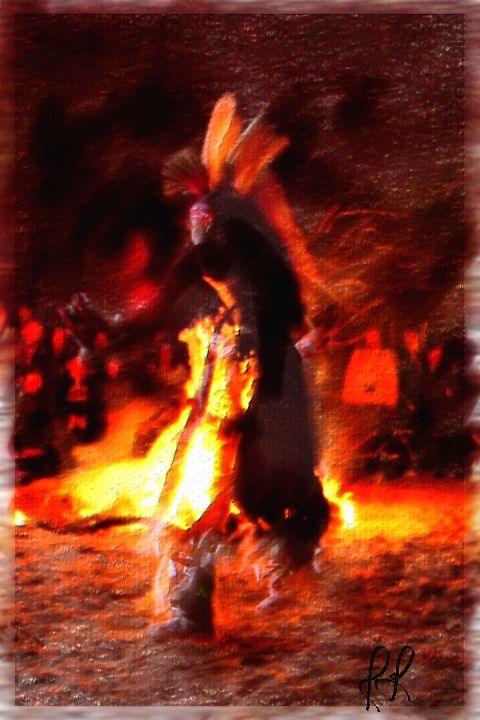 Phoenician Magi priests were known under several names such as the Corybnates, Coarbs, Cabiri, Telchines, and Curetes of Crete who were masters of magic, alchemy of plants, and archery just like the American Indians. These names of Magi priests from Phoenicia can also be easily found in the history of the American Indians, which connect these two ancient cultures as one separated by time and continents.
It is important to note that this Phoenician tribe of the Magi from Crete had worshiped the serpent and were also called fire-kindlers much like the American Indians had done. They had worshiped their main deity in the form of fire that they had constantly kept kindled in which the holy and powerful priests were the guardians of the divine power.
This fire was not the worship of flames and heat that can be found in a kindled fore, but an ancient symbol of the sacred force energy that can be found in humans and all living creatures. This energy force in the form of fire later became incorporated into idols being that of the various Gods of fire that can be found in many different parts of the world, and in the Scripture as the God Baal.
In ancient Phoenicia, this God was known under various names such as Moloch, Baal, and later under their cousins the Greeks as Hephaestus, and the Romans as Vulcan. Many Indian tribes had called this fire deity, Ochre. The Mayans even had a holy book known as Chilam Balam. Chilan or Chilam is a title of Mayan priests.
Two of the greatest of ancient Greek historians, Herodotus and Diodorus, both mention that the tower of Babel contained in one of its upper stories a statue of Belus. Strabo calls it the tomb of Bel (Baal). The Bible records the fact that Bel or Baal was the God worshiped at these high places and upon the roofs of houses, and in whose worship the Phoenician Hebrews caused their children to pass through the fire, (see Jer. 32:29 and 19:5.). A religious rite practiced also by many American Indian Tribes. (more…)
by Moe | Sep 6, 2015 | History of the Brotherhood
From the Hebrews, who used it mystically at the Temple, it passed over to the Freemasons, who adopted it as the symbol of 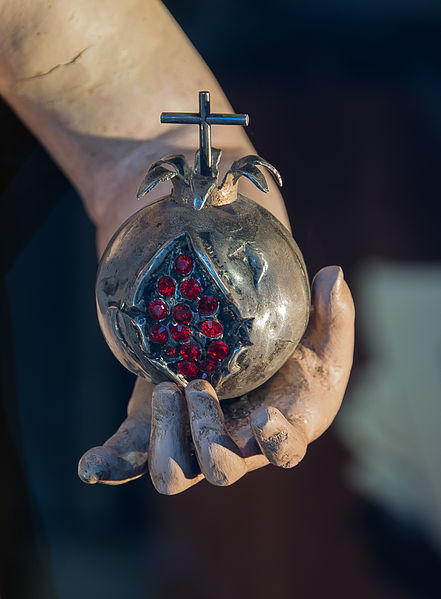 plenty, for which it is well adapted by its swelling and seed-abounding fruit. – Albert Mackey
In the history of our world’s religions, and buried deep within the lights of the Brotherhood are the Gnostic mysteries of the sacred pomegranate. It is said by some to be one of the most holy secrets known to all Abrahamic religions, and secret societies which are based on the oldest of holy sciences known as Gnosis.
This is why we can find the red pomegranate as a symbol of fertility, abundance and the seeds of the holy blood line for the Jews, and both Greek Orthodox, and Roman Catholic Christianity. According to Christian tradition, the pomegranate is a symbol of Mary as Mother of the Church. In Spain, the pomegranate flourished and came to be regarded as the symbol of the Golden Age in Granada.
The pomegranate held by Jesus, (pictured to the right in Granada, Spain) symbolizes the victory of the Catholic Monarchy. When the Spanish Monarchy had conquered the Americas and Mexico in 1521, the Jesuit Brotherhood began their missionary work among the Indians, and with them they brought the fruit of the pomegranate.
The Ancient Egyptians regarded the pomegranate as a symbol of prosperity and ambition. According to the Ebers Papyrus, one of the oldest medical writings from around 1500 BC, Egyptians used the pomegranate for treatment of tapeworm and other infections.
In Ancient Greek mythology, the pomegranate was mentioned many times in early Grecian history before the founding of Rome. It was was known as the “fruit of the dead”, and believed to have sprung from the blood of Adonis, and were offered to the Goddess Demeter.
Homer mentions the pomegranate twice in the Odyssey as a fruit common to the gardens of Phoenicia (Crete) and Phrygia. Herodotus, the Greek historian, states that when the Persians under Xerxes invaded Greece there was a regiment or battalion known as the “Pomegranate Brigade.” These soldiers constituted Xerxes’ own bodyguard, and carried spears with golden pomegranates at the lower end instead of spikes.(The Pomegranate by Robert Willard Hodgson) (more…)
by Moe | Sep 2, 2015 | History of the Brotherhood
In ancient silk mythology, it has been written that the invention of silk had come from an ancient Kohen (Cohen, Koan or  Coan) woman from the island of Kos (Cos, Coos, Zia or Dia) called Pamphila, who was the daughter of Plateus. She had invented the means of producing and weaving the local silk, which at the time became one of the great luxuries lasting many centuries.
It was also said in ancient folk-lore, that Kohen silk was so much esteemed by prostitutes, to the extent that a prostitute was simply called a Kohen. A tale that was most likely told by their foes or competitors such as the 1st century Roman philosopher, Nigrinus who had mocked the Greeks and Athenian athletes purple garments that he had likened to prostitutes. A common tactic amongst philosophers from competing empires who were jealous of, or had attempted to discredit the power and wealth of their foes who had derived it from the bright, deep, red dying of silk called “royal purple.” (more…)
by Moe | Jul 22, 2015 | Meaning of Symbols
The Phoenician God Hermes was often represented in ancient art carrying a ram. Zeus, the greatest of all Greek Gods had once 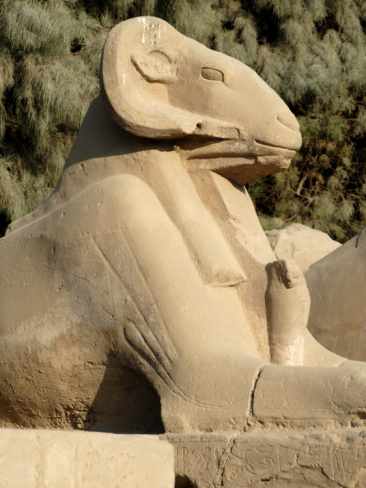 exhibited himself to Hercules clad in the fleece and wearing the head of a ram. The Hindu version of the ram is the name Brahmin.
The Freemasons honor the symbol of the Ram in the name of their Masonic King known as Hi-Ram Abiff. The Jews today uses a ram’s horn known in Hebrew as a shofar to announce their holy days and drive away evil spirits.
Elihu was the Hierophant, one of the wise friends of Job, he proclaimed himself “ of the kindred of Ram,” or an A-ram-ean (Genesis ’ xxii, 21). This name became one of the first Christian kingdoms known as Armenia. In Palestine, there were several very ancient towns that were called Rama, and the capital of the followers of the Ram was later moved to a place in Italy that we know as Rome (Roma or Ram-a).
In Christianity, many of these ancient symbols were changed and incorporated into the religious fold where the ram becomes the lamb and Jesus the Lamb of God. The Irish Luam signifies the head of the Church, an Abbot and in Tibet the lamb is known as the Dali Lama. (more…)
by Moe | Jul 10, 2015 | Modern Gnosis
“Your blood contains DNA, which is like a history book.” Spencer Wells (DNA Geneticist)
Many ancient cultures had said that our blood was the seat of our soul. The giver of life. I would like to go one step further by claiming that our blood is where we obtain true Gnosis, wisdom and by its mastery, evolution of the soul.
A red reservoir of our family’s history that some of us are able to tap into in order to discover the secrets of our pasts. When a person successfully connects with this Gnosis, they have become enlightened and awakened to who they truly are.
Gnosis (Greek for knowledge) in its simplest form is the intuitive spiritual knowledge that comes with knowing thyself, and thyworld. A type of computer code encoded within each of our own DNA that contains unique “genetic knowledge” or “intuitive insight” that each of us are born with. A computer hard drive in our blood that we can use to help us think, reason, intuit and form knowledge with the help of our very own DNA. (more…)