by Moe | Aug 26, 2011 | Morals and Dogma
p. 581
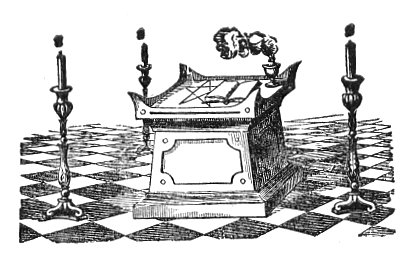 GOD is the author of everything that existeth; the Eternal, the Supreme, the Living, and Awful Being; from Whom nothing in the Universe is hidden. Make of Him no idols and visible images; but rather worship Him in the deep solitudes of sequestered forests; for He is invisible, and fills the Universe as its soul, and liveth not in any Temple!
Light and Darkness are the World’s Eternal ways. God is the principle of everything that exists, and the Father of all Beings. He is eternal, immovable, and Self-Existent. There are no bounds to His power. At one glance He sees the Past, the Present, and the Future; and the procession of the builders of the Pyramids, with us and our remotest Descendants, is now passing before Him. He reads our thoughts before they are known to ourselves. He rules the movements of the Universe, and all events and revolutions are the creatures of His will. For He is the Infinite Mind and Supreme Intelligence.
In the beginning Man had the WORD, and that WORD was from God: and out of the living power which, in and by that WORD, was communicated to man, came the LIGHT of his existence. Let no man speak the WORD, for by it THE FATHER made light and darkness, the world and living creatures!
p. 582
The Chaldean upon his plains worshipped me, and the sea-loving Phœnician. They builded me temples and towers, and burned sacrifices to me upon a thousand altars. Light was divine to them, and they thought me a God. But I am nothing–nothing; and LIGHT is the creature of the unseen GOD that taught the true religion to the Ancient Patriarchs: AWFUL, MYSTERIOUS, THE ABSOLUTE.
Man was created pure; and God gave him TRUTH, as He gave him LIGHT. He has lost the truth and found error. He has wandered far into darkness; and round him Sin and Shame hover evermore. The Soul that is impure, and sinful, and defiled with earthly stains, cannot again unite with God, until, by long trials and many purifications, it is finally delivered from the old calamity; and Light overcomes Darkness and dethrones it, in the Soul.
God is the First; indestructible, eternal, UNCREATED, INDIVISIBLE. Wisdom, Justice, Truth, and Mercy, with Harmony and Love, are of His essence, and Eternity and Infinitude of Extension. He is silent, and consents with MIND, and is known to Souls through MIND alone. In Him were all things originally contained, and from Him all things were evolved. For out of His Divine SILENCE and REST, after an infinitude of time, was unfolded the WORD, or the Divine POWER; and then in turn the Mighty, ever-acting, measureless INTELLECT; and from the WORD were evolved the myriads of suns and systems that make the Universe; and fire, and light, and the electric HARMONY, which is the harmony of spheres and numbers: and from the INTELLECT all Souls and intellects of men.
In the Beginning, the Universe was but ONE SOUL. HE was THE ALL, alone with TIME and SPACE, and Infinite as they.
—— HE HAD THIS THOUGHT: “I Create Worlds:” and lo! the Universe, and the laws of harmony and motion that rule it. the expression of a thought of God; and bird and beast, and every living thing but Man: and light and air, and the mysterious cur-rents, and the dominion of mysterious numbers!
—— HE HAD THIS THOUGHT: “I Create Man, whose Soul shall be my image, and he shall rule.” And lo! Man, with senses, instinct, and a reasoning mind!
—— And yet not MAN! but an animal that breathed, and saw, and thought: until an immaterial spark from God’s own
p. 583
[paragraph continues] Infinite Being penetrated the brain, and became the Soul: and lo, MAN THE IMMORTAL! Thus, threefold, fruit of God’s thought, is Man; that sees and hears and feels; that thinks and reasons; that loves and is in harmony with the Universe.
Before the world grew old, the primitive Truth faded out from men’s Souls. Then man asked himself, “What am I? and how and whence am I? and whither do I go?” And the Soul, looking inward upon itself, strove to learn whether that “I” were mere matter; its thought and reason and its passions and affections mere results of material combination; or a material Being enveloping an immaterial Spirit: . . and further it strove, by self-examination, to learn whether that Spirit were an individual essence, with a separate immortal existence, or an infinitesimal portion of a Great First Principle, inter-penetrating the Universe and the infinitude of space, and undulating like light and heat: . . and so they wandered further amid the mazes of error; and imagined vain philosophies; wallowing in the sloughs of materialism and sensualism, of beating their wings vainly in the vacuum of abstractions and idealities.
by Moe | Aug 26, 2011 | Morals and Dogma
p. 504
In ancient times the mark Tau was set on those who had been acquitted by their judges, as a symbol of innocence. The military commanders placed it on soldiers who escaped unhurt from the field of battle, as a sign of their safety under the Divine Protection.
It was a sacred symbol among the Druids. Divesting a tree of part of its branches, they left it in the shape of a Tau Cross, preserved it carefully, and consecrated it with solemn ceremonies. On the tree they cut deeply the word THAU, by which they meant God. On the right arm of the Cross, they inscribed the word HESULS, on the left BELEN or BELENUS, and on the middle of the trunk THARAMIS. This represented the sacred Triad.
It is certain that the Indians, Egyptians, and Arabians paid veneration to the sign of the Cross, thousands of years before the coming of Christ. Everywhere it was a sacred symbol. The Hindus and the Celtic Druids built many of their Temples in the form of a Cross, as the ruins still remaining clearly show, and particularly the ancient Druidical Temple at Classerniss in the Island of Lewis in Scotland. The Circle is of 12 Stones. On each of the sides, east, west, and south, are three. In the centre was the image of the Deity; and on the north an avenue of twice nineteen stones, and one at the entrance. The Supernal Pagoda at Benares is in the form of a Cross; and the Druidical subterranean grotto at New Grange in Ireland.
The Statue of Osiris at Rome had the same emblem. Isis and Ceres also bore it; and the caverns of initiation were constructed in that shape with a pyramid over the Sacellum.
Crosses were cut in the stones of the Temple of Serapis in Alexandria; and many Tau Crosses are to be seen in the sculptures of Alabastion and Esné, in Egypt. On coins, the symbol of the Egyptian God Kneph was a Cross within a Circle.
The Crux Ansata was the particular emblem of Osiris, and his sceptre ended with that figure. It was also the emblem of Hermes, and was considered a Sublime Hieroglyphic, possessing mysterious powers and virtues, as a wonder-working amulet.
The Sacred Tau occurs in the hands of the mummy-shaped figures between the forelegs of the row of Sphynxes, in the great avenue leading from Luxor to Karnac. By the Tau Cross the
p. 505
[paragraph continues] Cabalists expressed the number 10, a perfect number, denoting Heaven, and the Pythagorean Tetractys, or incommunicable name of God. The Taft Cross is also found on the stones in front of the door of the Temple of Amunoth III, at Thebes, who reigned about the time when the Israelites took possession of Canaan: and the Egyptian Priests carried it in all the sacred processions.
Tertullian, who had been initiated, informs us that the Tau was inscribed on the forehead of every person who had been admitted into the Mysteries of Mithras.
As the simple Tau represented Life, so, when the Circle, symbol of Eternity, was added, it represented Eternal Life.
At the Initiation of a King, the Tau, as the emblem of life and key of the Mysteries, was impressed upon his lips.
In the Indian Mysteries, the Tau Cross, under the name of Tiluk, was marked upon the body of the candidate, as a sign that he was set apart for the Sacred Mysteries.
On the upright tablet of the King, discovered at Nimroud, are the names of thirteen Great Gods (among which are YAV and BEL); and the left-hand character of every one is a cross composed of two cuneiform characters.
The Cross appears upon an Ancient Phœnician medal found in the ruins of Citium; on the very ancient Buddhist Obelisk near Ferns in Ross-shire; on the Buddhist Round Towers in Ireland, and upon the splendid obelisk of the same era at Forres in Scot-land.
Upon the facade of a temple at Kalabche in Nubia are three regal figures, each holding a Crux Ansata.
Like the Subterranean Mithriatic Temple at New Grange in Scotland, the Pagodas of Benares and Mathura were in the form of a Cross. Magnificent Buddhist Crosses were erected, and are still standing, at Clonmacnoise, Finglas, and Kilcullen in Ireland. Wherever the monuments of Buddhism are found, in India, Ceylon, or Ireland, we find the Cross: for Buddha or Boudh was represented to have been crucified.
by Moe | Aug 26, 2011 | Morals and Dogma
p. 413
ineffable symbol of religious mysteries, to be looked upon in profound silence. Such as it was, its figure was that of a small urn of burnished gold, hollowed very artistically, rounded at the bottom, and covered all over the outside with the wonderful hieroglyphics of the Egyptians. The spout was not elevated, but extended laterally, projecting like a long rivulet; while on the opposite side was the handle, which, with similar lateral extension, bore on its summit an asp, curling its body into folds, and stretching upward, its wrinkled, scaly, swollen throat.”
The salient basilisk, or royal ensign of the Pharaohs, often occurs on the monuments–a serpent in folds, with his head raised erect above the folds. The basilisk was the Phœnix of the serpent-tribe; and the vase or urn was probably the vessel, shaped like a cucumber, with a projecting spout, out of which, on the monuments of Egypt, the priests are represented pouring streams of the crux ansata or Tau Cross, and of sceptres, over the kings.
In the Mysteries of Mithras, a sacred cave, representing the whole arrangement of the world, was used for the reception of the Initiates. Zoroaster, says Eubulus, first introduced this custom of consecrating caves. They were also consecrated, in Crete, to Jupiter; in Arcadia, to the Moon and Pan; and in the Island of Naxos, to Bacchus. The Persians, in the cave where the Mysteries of Mithras were celebrated, fixed the seat of that God, Father of Generation, or Demiourgos, near the equinoctial point of Spring, with the Northern portion of the world on his right, and the Southern on his left.
Mithras, says Porphyry, presided over the Equinoxes, seated on a Bull, the symbolical animal of the Demiourgos, and bearing a sword. The equinoxes were the gates through which souls passed to and fro, between the hemisphere of light and that or darkness. The milky way was also represented, passing near each of these gates: and it was, in the old theology, termed the pathway of souls. It is, according to Pythagoras, vast troops of souls that form that luminous belt.
The route followed by souls, according to Porphyry, or rather their progressive march in the world, lying through the fixed stars and planets, the Mithriac cave not only displayed the zodiacal and other constellations, and marked gates at the four equinoctial and solstitial points of the zodiac, whereat souls enter into and escape from the world of generations; and through which they
p. 414
pass to and fro between the realms of light and darkness; but it represented the seven planetary spheres which they needs must traverse, in descending from the heaven of the fixed stars to the elements that envelop the earth; and seven gates were marked, one for each planet, through which they pass, in descending or returning.
We learn this from Celsus, in Origen; who says that the symbolical image of this passage among the Stars, used in the Mithriac Mysteries, was a ladder, reaching from earth to Heaven, divided into seven steps or stages, to each of which was a gate, and at the summit an eighth, that of the fixed stars. The first gate, says Celsus, was that of Saturn, and of lead, by the heavy nature whereof his dull slow progress was symbolized. The second, of tin, was that of Venus, symbolizing her soft splendor and easy flexibility. The third, of brass, was that of Jupiter, emblem of his solidity and dry nature. The fourth, of iron, was that of Mercury, expressing his indefatigable activity and sagacity. The fifth, of copper, was that of Mars, expressive of his inequalities and variable nature. The sixth, of silver, was that of the Moon: and the seventh, of gold, that of the Sun. This order is not the real order of these Planets; but a mysterious one, like that of the days of the Week consecrated to them, commencing with Saturday, and retrograding to Sunday. It was dictated, Celsus says, by certain harmonic relations, those of the fourth.
Thus there was an intimate connection between the Sacred Science of the Mysteries, and ancient astronomy and physics; and the grand spectacle of the Sanctuaries was that of the order of the Known Universe, or the spectacle of Nature itself, surrounding the soul of the Initiate, as it surrounded it when it first descended through the planetary gates, and by the equinoctal and solstitial doors, along the Milky Way, to be for the first time immured in its prison-house of matter. But the Mysteries also represented to the candidate, by sensible symbols, the invisible forces which move this visible Universe, and the virtues, qualities, and powers attached to matter, and which maintain the marvellous order observed therein. Of this Porphyry informs us.
by Moe | Aug 26, 2011 | Morals and Dogma
p. 393
And in this sense, as presiding over life and death, Dionusos is in the highest sense the LIBERATOR: since, like Osiris, he frees the soul, and guides it in its migrations beyond the grave, preserving it from the risk of again falling under the slavery of matter or of some inferior animal form, the purgatory of Metempsychosis; and exalting and perfecting its nature through the purifying discipline of his Mysteries. “The great consummation of all philosophy,” said Socrates, professedly quoting from traditional and mystic sources, “is Death: He who pursues philosophy aright, is studying how to die.”
All soul is part of the Universal Soul, whose totality is Dionusos; and it is therefore he who, as Spirit of Spirits, leads back the vagrant spirit to its home, and accompanies it through the purifying processes, both real and symbolical, of its earthly transit. He is therefore emphatically the Mystes or Hierophant, the great Spiritual Mediator of Greek religion.
The human soul is itself δαιμονιος a God within the mind, capable through its own power of rivalling the canonization of the Hero, of making itself immortal by the practice of the good, and the contemplation of the beautiful and true. The removal to the Happy Islands could only be understood mythically; everything earthly must die; Man, like Œdipus, is wounded from his birth, his real elysium can exist only beyond the grave. Dionusos died and descended to the shades. His passion was the great Secret of the Mysteries; as Death is the Grand Mystery of existence. His death, typical of Nature’s Death, or of her periodical decay and restoration, was one of the many symbols of the palingenesia or second birth of man.
Man descended from the elemental Forces or Titans [Elohim], who fed on the body of the Pantheistic Deity creating the Universe by self-sacrifice, commemorates in sacramental observance this mysterious passion; and while partaking of the raw flesh of the victim, seems to be invigorated by a fresh draught from the fountain of universal life, to receive a new pledge of regenerated existence. Death is the inseparable antecedent of life; the seed dies in order to produce the plant, and earth itself is rent asunder and dies at the birth of Dionusos. Hence the significancy of the phallus, or of its inoffensive substitute, the obelisk, rising as an emblem of resurrection by the tomb of buried Deity at Lerna or at Sais.
p. 394
Dionusos-Orpheus descended to the Shades to recover the lost Virgin of the Zodiac, to bring back his mother to the sky as Thyone; or what has the same meaning, to consummate his eventful marriage with Persephone, thereby securing, like the nuptials of his father with Semele or Danaë, the perpetuity of Nature. His under-earth office is the depression of the year, the wintry aspect in the alternations of bull and serpent, whose united series makes up the continuity of Time, and in which, physically speaking, the stern and dark are ever the parents of the beautiful and bright.
It was this aspect, sombre for the moment, but bright by anticipation, which was contemplated in the Mysteries: the human sufferer was consoled by witnessing the severer trials of the Gods; and the vicissitudes of life and death, expressed by apposite symbols, such as the sacrifice or submersion of the Bull, the extinction and re-illumination of the torch, excited corresponding emotions of alternate grief and joy, that play of passion which was present at the origin of Nature, and which accompanies all her changes.
The greater Eleusiniæ were celebrated in the month Boëdromion, when the seed was buried in the ground, and when the year, verging to its decline, disposes the mind to serious reflection. The first days of the ceremonial were passed in sorrow and anxious silence, in fasting and expiatory or lustral offices. On a sudden, the scene was changed: sorrow and lamentation were discarded, the glad name of Iacchus passed from mouth to mouth, the image of the God, crowned with myrtle and bearing a lighted torch, was borne in joyful procession from the Ceramicus to Eleusis, where, during the ensuing night, the initiation was completed by an imposing revelation. The first scene was in the προναος, or outer court of the sacred enclosure, where amidst utter darkness, or while the meditating God, the star illuminating the Nocturnal Mystery, alone carried an unextinguished torch, the candidates were overawed with terrific sounds and noises, while they painfully groped their way, as in the gloomy cavern of the soul’s sublunar migration; a scene justly compared to the passage of the Valley of the Shadow of Death. For by the immutable law exemplified in the trials of Psyche, man must pass through the terrors of the under-world, before he can reach the height of Heaven. At length the gates of the adytum were thrown open, a supernatural light streamed from the illuminated statue
by Moe | Aug 26, 2011 | Morals and Dogma
p. 352
AMONG most of the Ancient Nations there was, in addition to their public worship, a private one styled the Mysteries; to which those only were admitted who had been prepared by certain ceremonies called initiations.
The most widely disseminated of the ancient worships were those of Isis, Orpheus, Dionusos, Ceres and Mithras. Many barbarous nations received the knowledge of the Mysteries in honor of these divinities from the Egyptians, before they arrived in Greece; and even in the British Isles the Druids celebrated those of Dionusos, learned by them from the Egyptians.
The Mysteries of Eleusis, celebrated at Athens in honor of Ceres, swallowed up, as it were, all the others. All the neighboring nations neglected their own, to celebrate those of Eleusis; and in a little while all Greece and Asia Minor were filled with the Initiates. They spread into the Roman Empire, and even beyond its limits, “those holy and august Eleusinian Mysteries,” said Cicero, “in which the people of the remotest lands are initiated.” Zosimus says that they embraced the whole human race; and Aristides termed them the common temple of the whole world.
There were, in the Eleusinian feasts, two sorts of Mysteries, the great, and the little. The latter were a kind of preparation for the former; and everybody was admitted to them. Ordinarily there was a novitiate of three, and sometimes of four years.
Clemens of Alexandria says that what was taught in the great Mysteries concerned the Universe, and was the completion and perfection of all instruction; wherein things were seen as they were, and nature and her works were made known.
The ancients said that the Initiates would be more happy after death than other mortals; and that, while the souls of the Profane on leaving their bodies, would be plunged in the mire, and remain buried in darkness, those of the Initiates would fly to the Fortunate Isles, the abode of the Gods.
p. 353
Plato said that the object of the Mysteries was to re-establish the soul in its primitive purity, and in that state of perfection which it had lost. Epictetus said, “whatever is met with therein has been instituted by our Masters, for the instruction of man and the correction of morals.”
Proclus held that initiation elevated the soul, from a material, sensual, and purely human life, to a communion and celestial intercourse with the Gods; and that a variety of things, forms, and species were shown Initiates, representing the first generation of the Gods.
Purity of morals and elevation of soul were required of the Initiates. Candidates were required to be of spotless reputation and irreproachable virtue. Nero, after murdering his mother, did not dare to be present at the celebration of the Mysteries: and Antony presented himself to be initiated, as the most infallible mode of proving his innocence of the death of Avidius Cassius.
The Initiates were regarded as the only fortunate men. “It is upon us alone,” says Aristophanes, “shineth the beneficent day-star. We alone receive pleasure from the influence of his rays; we, who are initiated, and who practise toward citizen and stranger every possible act of justice and piety.” And it is therefore not surprising that, in time, initiation came to be considered as necessary as baptism afterward was to the Christians; and that not to have been admitted to the Mysteries was held a dishonor.
“It seems to me,” says the great orator, philosopher, and moralist, Cicero, “that Athens, among many excellent inventions, divine and very useful to the human family, has produced none comparable to the Mysteries, which for a wild and ferocious life have substituted humanity and urbanity of manners. It is with good reason they use the term initiation; for it is through them that we in reality have learned the first principles of life; and they not only teach us to live in a manner more consoling and agreeable, but they soften the pains of death by the hope of a better life hereafter.”
Where the Mysteries originated is not known. It is supposed that they came from India, by the way of Chaldæa, into Egypt, and thence were carried into Greece. Wherever they arose, they were practised among all the ancient nations; and, as was usual, the Thracians, Cretans, and Athenians each claimed the honor of