Those who have sought to identify CHiram with the murdered King Charles the First conceive the Hiramic legend to have been invented for that purpose by Elias Ashmole, a mystical philosopher, who was probably a member of the Rosicrucian Fraternity. Charles was dethroned in 1647 and died on the block in 1649, leaving the Royalist party leaderless. An attempt has been made to relate the term “the Sons of the Widow” (an appellation frequently applied to members of the Masonic Order) to this incident in English history, for by the murder of her king England became a Widow and all Englishmen Widow’s Sons.
To the mystic Christian Mason, CHiram. represents the Christ who in three days (degrees) raised the temple of His body from its earthly sepulcher. His three murderers were Cæsar’s agent (the state), the Sanhedrin (the church), and the incited populace (the mob). Thus considered, CHiram becomes the higher nature of man and the murderers are ignorance, superstition, and fear. The indwelling Christ can give expression to Himself in this world only through man’s thoughts, feelings, and actions. Right thinking, right feeling, and right action–these are three gates through which the Christ power passes into the material world, there to labor in the erection of the Temple of Universal Brotherhood. Ignorance, superstition, and fear are three ruffians through whose agencies the Spirit of Good is murdered and a false kingdom, controlled by wrong thinking, wrong feeling, and wrong action, established in its stead. In the material universe evil appears ever victorious.
“In this sense,” writes Daniel Sickels, “the myth of the Tyrian is perpetually repeated in the history of human affairs. Orpheus was murdered, and his body thrown into the Hebrus; Socrates was made to drink the hemlock; and, in all ages, we have seen Evil temporarily triumphant, and Virtue and Truth calumniated, persecuted, crucified, and slain. But Eternal justice marches surely and swiftly through the world: the Typhons, the children of darkness, the plotters of crime, all the infinitely varied forms of evil, are swept into oblivion; and Truth and Virtue–for a time laid low–come forth, clothed with diviner majesty, and crowned with everlasting glory!” (See General Ahiman Rezon.)
If, as there is ample reason to suspect, the modern Freemasonic Order was profoundly influenced by, if it is not an actual outgrowth of, Francis Bacon’s secret society, its symbolism is undoubtedly permeated with Bacon’s two great ideals: universal education and universal democracy. The deadly enemies of universal education are ignorance, superstition, and fear, by which the human soul is held in bondage to the lowest part of its own constitution. The arrant enemies of universal democracy have ever been the crown, the tiara, and the torch. Thus CHiram symbolizes that ideal state of spiritual, intellectual, and physical emancipation which has ever been sacrificed upon the altar of human selfishness. CHiram is the Beautifier of the Eternal House. Modern utilitarianism, however, sacrifices the beautiful for the practical, in the same breath declaring the obvious lie that selfishness, hatred, and discord are practical.
Dr. Orville Ward Owen found a considerable part of the first
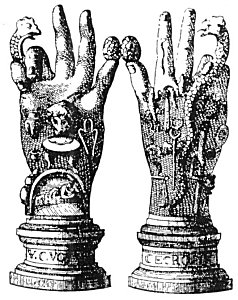
THE EMBLEMATIC HAND OF THE MYSTERIES.
From Montfaucon’s Antiquities. A hand covered with numerous symbols was extended to the neophytes when they entered into the Temple of Wisdom. An understanding of the embossed upon the surface of the hand brought with it Divine power and regeneration Therefore, by means of these symbolic hands the candidate was said to be raised from the dead.
p. 79
thirty-two degrees of Freemasonic ritualism hidden in the text of the First Shakespeare Folio. Masonic emblems are to be observed also upon the title pages of nearly every book published by Bacon. Sir Francis Bacon considered himself as a living sacrifice upon the altar of human need; he was obviously cut down in the midst of his labors, and no student of his New Atlantis can fail to recognize the Masonic symbolism contained therein. According to the observations of Joseph Fort Newton, the Temple of Solomon described by Bacon in that utopian romance was not a house at all but the name of an ideal state. Is it not true that the Temple of Freemasonry is also emblematic of a condition of society? While, as before stated, the principles of the Hiramic legend are of the greatest antiquity, it is not impossible that its present form may be based upon incidents in the life of Lord Bacon, who passed through the philosophic death and was raised in Germany.
Moe is the founder of GnosticWarrior.com. He is a father, husband, author, martial arts black belt, and an expert in Gnosticism, the occult, and esotericism.