Non nobis Domine, non nobis, sed nomini tuo da gloriam
Non nobis is a short Latin hymn used as a prayer of thanksgiving and expression of humility. The Latin motto of the Knights Templar is “Non nobis Domine, non nobis, sed nomini tuo da gloriam.” Meaning in English, 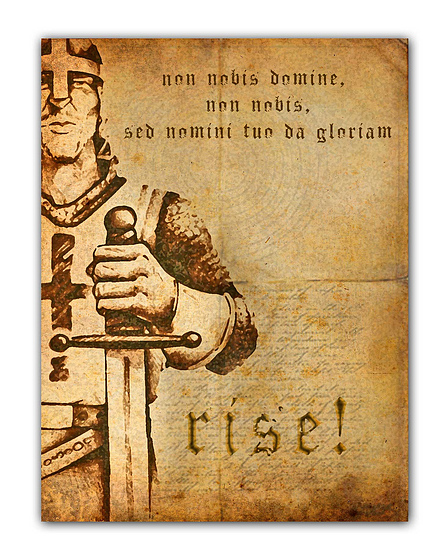 “Not to us Lord, not to us, but to Your Name give the glory.”
The Latin text derives from Psalm 113:9 (according to the Vulgate numbering), which corresponds to Psalm 115:1 in the King James Version. This prayer was also said after meals in England and is a famous song.
Shakespeare’s Books: A Dissertation on Shakespeare’s Reading and …, Volume 1;
The idea of ‘Non nobis’ was caught from Holinshed, who says: “the king . . . gave thanks to almighty God for so happy a victory; “causing his prelates and chaplains to sing this psalm:
“In exit Israel de “Aegypto”; and commanded every man to kneel down on the ground “at this verse: “Non nobis, Domine, non nobis sed nomini tuo da gloriam.”
“Which done, he caused Te Deum, with certain anthems to be song; “giving laud and praise to God, without boasting of his own force or “any humane power.”
(Boswell-Stone, Shakespeare’s Holinshed, p. 197.)
(17) Ps. CXV1II, 9: It is better to trust in the Lord: then to put any
confidence in princes. Cf. Ps. CXLVI, 2: 0 put not your trust in princes, nor in any childe of man: for there is no helpe in them.
Compare:
“O, how wretched ” Is that poor man that hangs on princes’ favours!” etc. (Henry VIII., Act 111, Ii, 366.)
The song, “Non nobis Domine, non nobis, sed nomini tuo da gloriam ,” was said to be arranged by a man named, “William Bird”, or as the name is sometimes spelled, Byrd or Byrde, was the composer of this canon. Here is a video of the song performed at the end of the battle of Agincourt in the movie Henry V.
Charles Dickens explains the history of the song;
Another old song, concerning which there has been a controversy, is associated so exclusively with festive doings that we do not hear it or of it at any other time.When a grand banquet is held, and the choice viands have gone the way of all viands, and the chairman of the evening is doing his very best (or worst) to prepare some neat speeches for health-proposing, then does this song make itself heard. Non Nobis Domine is, indeed, not quite a song; it is a grace after meat, something between a hymn and a prayer of thanksgiving; but very few of the guests think of it in that light. There is no controversy about tie words; they are simple, and traceable to a well-known source. “Non nobis, Domine, non nobis, sed nomini tuo da Gloriam,” is the Latin of “Not unto us, O Lord, not unto us, but unto Thy name give the praise.”
The composer, whoever he may have been, simply took these words, and composed music to them. The tune is of the kind called a canon, in which three voices take up the subject alternately. The first goes through the words once, arranged in six bars of common time: then he goes through them again, with a different order of notes; while the second singer takes up the first part, both singing together. Then the third singer, taking his share, begins with the first line of music, and so proceeds to the end, while the other two are singing the second and third lines respectively.
The three lines of music harmonise, and blend pleasantly to the ear; they are almost alike, differing chiefly in pitch or register. All the three singers, too, sing the same words, though they are not pronouncing the same syllables at the same time. This is not a very scientific way of describing the affair; but perhaps it will suffice to give a general notion of the style of composition. Some composers have a great liking for the canon, and for another and somewhat similar composition called a round. In both the voices imitate one another, observing particular rules in the imitation. A madrigal and a glee are constructed on other principles. All four kinds may be arranged for three or more voices, according to the taste and skill of the composer.

Moe is the founder of GnosticWarrior.com. He is a father, husband, author, martial arts black belt, and an expert in Gnosticism, the occult, and esotericism.