No Results Found
The page you requested could not be found. Try refining your search, or use the navigation above to locate the post.


A common spiritual theme that you will find amongst hardcore methamphetamine (METH) addicts are their claims of seeing and conversing with demons. Especially when it involves criminal acts such as a physical assault and, more often than not, murder, which is typically carried out on a family member living in the same home as the METH addict.
There isn’t a week that goes by where somewhere in the U.S., there are news reports of a brutal assault and or murder carried out by someone high on methamphetamine who reports seeing demons.
My articles, videos for a new-media series for my Cult of Demons Podcast will document these crimes by people who I have dubbed, “METH Demons,” and the psychospiritual disease they suffer from.
For example, in early January, Channel 7 News in Lake Charles, Louisianna reported that local Sheriff’s deputies discovered Patrick T. Amos, 19, covered in blood.

The suspect told deputies he had been doing meth throughout the night and that he was being tormented by a demon inside a family member, according to Kayla Vincent, spokeswoman for the Calcasieu Parish Sheriff’s Office.
According to 7 News; “Vincent said deputies were dispatched to the 2200 block of Hodges Street after receiving a call from a person who said a man she did not know had contacted her on social media saying he had just attempted to kill someone and needed a ride. The man gave her his location, which she gave to authorities.
When they arrived, deputies found the suspect,
When deputies arrived at that location, they found the victim covered in blood and suffering from numerous lacerations to her arms, legs, and head, Vincent said. She was transported to a local hospital and is listed in stable condition
Amos told deputies that he had been on meth throughout the night, Vincent said. He also told deputies he was being tormented by a demon inside the family member, which he attempted to kill with a large knife.
Amos was booked into the Calcasieu Correctional Center for attempted second-degree murder. Judge Derrick Kee set bond at $175,000.”

Moe is the founder of GnosticWarrior.com. He is a father, husband, author, martial arts black belt, and an expert in Gnosticism, the occult, and esotericism.
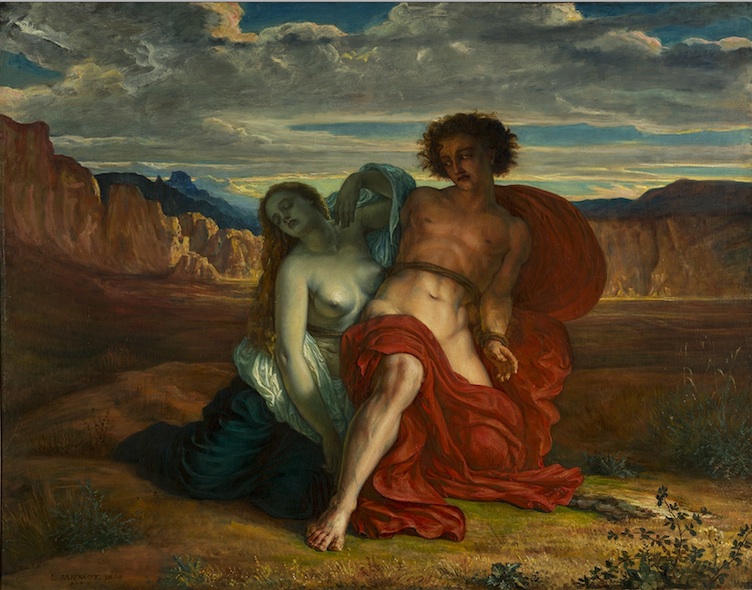
The ancient Etruscans had developed a severe form of punishment for their prisoners by tying them to a rotting corpse and allowing them to walk around day and night until the fungal infected carcass’s organisms had started to putrefy the living person’s body.
We are told by Aristotle that “at the time, that we are punished much as those were who once upon a time when they had fallen into the hands of Etruscan robbers, were slain with elaborate cruelty; their bodies, the living [corpora viva] with the dead, were bound so exactly as possible one against another: so our souls, tied together with our bodies as the living fixed upon the dead.”
Aristotle compares the state of the soul imprisoned in the body, to the Etruscan pirates joining dead corpses to living ones.
The story is further related by Virgil in The Aeneid who says that the Etruscan king Mezentius, “went so far even as to tie dead bodies to living persons, hand to hand, face to face, as a kind of torture, thus inflicting a slow death to these beings who liquefied themselves into pus and rot, in a miserable embrace.”
The meaning of putrefaction is the process of decay or rotting in a body or other organic matter by the action of living microorganisms (bacteria, fungi, and protozoa). We can now say that corpse is far from dead when viewed at the microorganism level of fungi/molds and bacterias.

Hence, the living dead.
This form of Etruscan punishment is impressive given that the corpses organisms become one with the living forming a necrotic bond via a fungal infection that enhances the decomposition of the living, making them “become one.”
I believe the infected must do as Reza Negastrani says in The Corpse Bride: Thinking with Nigredo, “a pact with putrefaction must be made; the moment of nucleation with nigredo and Nupta Contagioso or Nupta Cadavera, which suggests a marriage with the diseased or the dead: a forcible conjugation with a corpse, and consummation of marriage with the dead as a bride.”

Negastrani writes;
“Yet more ambitiously, this fragment subtly points to a moment in philosophy when both the philosophy of Ideas and the science of being qua being are fundamentally built upon putrefaction and act in accordance with the chemistry of decay.
It is the moment when beings must undergo necrosis and decay in order to remain in being and the Ideas must be founded on intensive necrosis and an extensive decay in order to remain in their essence and to synthesize with other Ideas.
In other words, this moment marks a necessity for Ideas – even the Idea of ontology itself:
In order to be active intensively and extensively, inwardly and outwardly, the Idea must first be fully necrotized and
blackened on all levels, intensively and extensively.
The following is a disorganized venture – more in line with grave robbers and necrophiles than with archaeologists and scholars of history – to disinter the twist inherent to the fragment associated with Aristotle and to delve into the moment when, prior to all arrangements and establishments, a pact with putrefaction must be made; the moment of nucleation with nigredo, as we must call it.”
Negistrani tells us that this practice was revived during the reign of the Roman Emperor Marcus Macrinus, the notoriety of this atrocity survives antiquity and the Middle Ages. In the sixteenth century, the horror of this torture is expressed, once again, by a popular emblem called Nupta Contagioso showing a woman being tied to a man plagued by syphilis, at the King’s order.
Today, we can say that by default, through arrested development, lack of knowledge, and subsequent ignorant health and spiritual choices, many people in the West have taken it upon themselves to nucleate with nigredo, and by doing so, many make a spiritual pact with putrefaction.
When I look around our current world and see the drug addiction and lifestyle choices are causing people to putrefy and rot from the inside out as if they have become de-facto married to nigredo – AKA fungal infections that then infect our children and the culture from the very black goo that the unseen filaments that are wrapping around our souls feed upon through horizontal gene transfer.
Instead of making a pact with God, a pact is forged with the demonic fungi necrotizing our culture from the inside out, one person and one soul at a time. The So Below, As Above through the GI tract of its victims as it passes the blood-brain barrier for the battle of the Neursphere for the planet’s Noosphere. It is here where life’s eternal laws reside and the true legislators of our existence who in Christian literature is known as the devil and his legions of demons hand down sentences of death to those souls deemed unworthy, where their reality is akin to living hell as they are tortured and eaten alive.
To cope with their fate, these people who were forcibly putrified to start rotting while alive must make pacts with the intelligent demonic fungi/molds that are now taking over their minds and souls.
But unlike Negastrani’s idea of “a marriage with the diseased or the dead: a forcible conjugation with a corpse, and consummation of marriage with the dead as a bride.”
I would say that it is a forcible conjugation with decay or the devil, and consummation of marriage with the living dead as “their bride.”
Nucleation with Nigredo: A spiritual pact with putrefaction or marriage with the So Below who has taken its bride on the As Above.
Moe is the founder of GnosticWarrior.com. He is a father, husband, author, martial arts black belt, and an expert in Gnosticism, the occult, and esotericism.

During the 1970s through the 1990s, it was reported that impure brown heroin contaminated with fungi was causing fungal infections within users, according to Stuart Levitz, MD, professor of medicine and microbiology & physiological systems at the University of Massachusetts.
Dr. Levitz explained;
“During that period, the heroin supply was relatively impure, and people would use lemon juice to dissolve it,” said Levitz, whose research and clinical interest is in fungal infections. “It was believed the lemon juice got contaminated with candida, and drug users were injecting candida into their bloodstream and getting Candida infections. But, the problem went away when the heroin supply became much purer.”
According to the 2018 study by the University of Massachusetts Medical School and published by the CDC, infectious disease, Levitz and his colleagues identified a re-emergence of fungal infections associated with illicit intravenous drug use in a review of candida in patients at UMass Memorial Medical Center. After analyzing198 cases of fungal infections over a 7 year period in patients 14 or older. (1,2)
An unexpectedly large number of patients, 24, had a history of illicit intravenous drug use.
“The take-home point from the study is not necessarily that we compared 24 patients with intravenous drug use to 174 without. It’s the fact that we had 24 patients who were using IV drugs and suffered from Candida infections,” Levitz added. “In addition, nine of the 24 cases were in the last year of the study in correspondence with the surging opioid crisis.”
The researchers concluded, “These cases emphasize that in addition to overdoses, infections remain a serious cause of illness and death for intravenous drug users.”
Interestingly, many of the mental issues and drug psychosis that drug addicts complain of can be easily connected to symptoms associated with a fungal infection. For example, many addicts complain of bugs, parasites, and or mites biting them and eating their organs, such as their brains.
These symptoms are common with METH, cocaine, and heroin addicts, and they are all different drugs. That is why I contend with my supporting research that it is not the drug causing these health conditions and mental illnesses, but the fungal infection within users as a result of doing the drug.
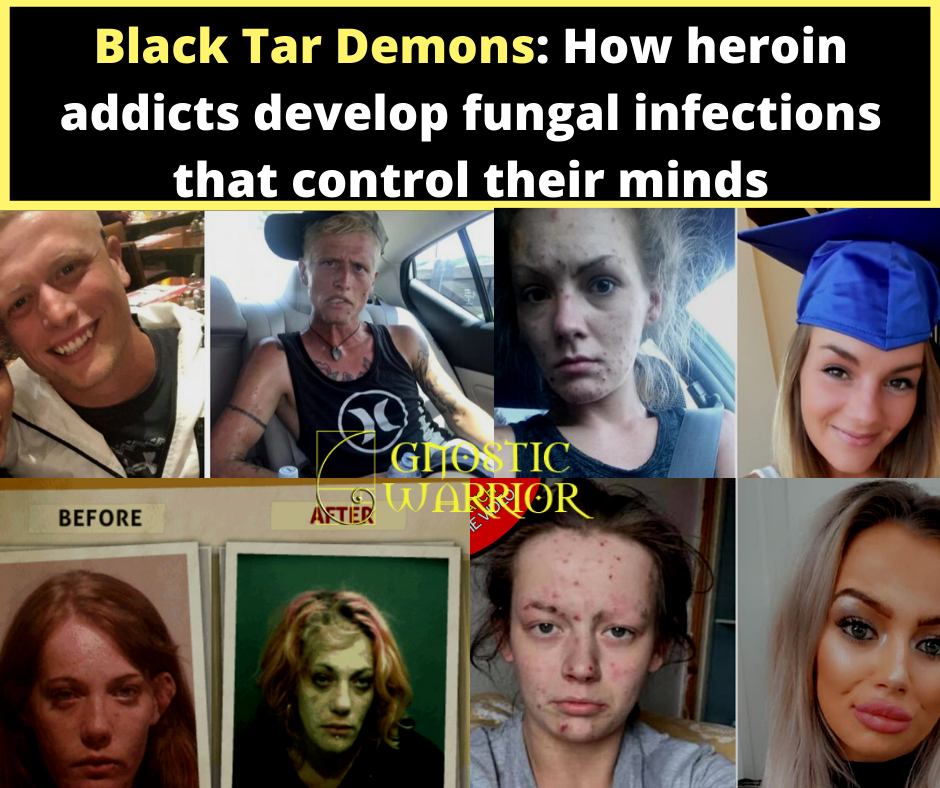
When you look at before and after images of addicts, it does not matter if they are heroin addicts, meth addicts, or cocaine addicts, they all start to “look the same and act very similar or the same”.
Here are some before and after images of heroin addicts.

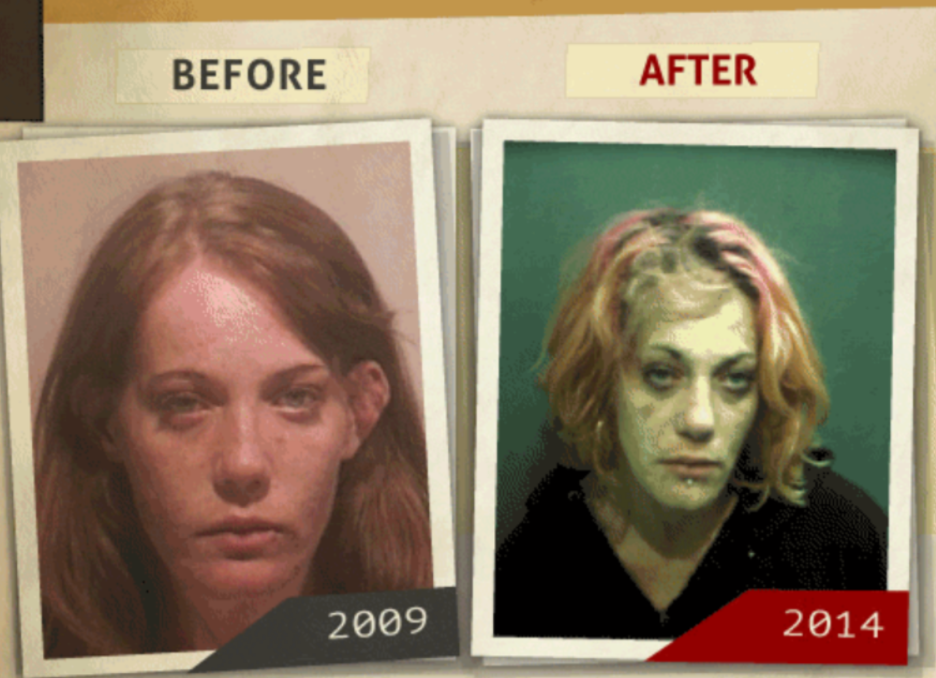

Now, this is a cocaine addict.

And Meth addicts all look very simlar or the same, which I contend is because they all have fungal infections.

It has been well documented for several decades in the U.S. that systemic candida infections cause skin lesions and even brain abscesses, so heroin addicts, just like METH and other addicts who are complaining of these symptoms, should not be automatically considered crazy and or psychotic by ignorant doctors who have not read the science.
The facts are that obtaining a severe fungal infection from using drugs has been well known for decades in the United States. For example, a study from 1992 discovered that drugs like heroin are already infected with various genus’ of microscopic fungi even before it gets to the nose, lungs, and or blood of a user. Meaning, that when a heroin addict snorts, smokes, and or injects it, they are also injecting the live fungi that are already growing on the heroin into his or her bloodstream.
The researchers studied “the fungal spectrum of brown and white heroin and cocaine sold in the streets of Spain to analyze the extent of adulteration, as well as their toxicological potential. They found that of the 205 drug samples cultured in the appropriate medium grew 91 colonies of micellar fungi from 53 taxa, of which only 8 were found in the 3 types of drugs.”
“Statistical analyses revealed brown heroin to be significantly more contaminated by fungi on the basis of numbers of colonies per milligram of sample than the other two drugs. Forty-five of the 54 taxa isolated were found in brown heroin, with 275 colonies,” according to the study.
Samples of white heroin contained 68 colonies of 18 taxa, while cocaine samples included 48 colonies of 13 taxa. The potential pathogenicity to man of the different isolated taxa includes allergies, pulmonary mycosis, sporosis, systemic or subcutaneous mucormycosis, and asthma.
The researchers concluded, “The fact that brown heroin is more contaminated and heterogeneous in the taxa found in its samples suggests that the contaminants may be introduced during its synthesis or during adulteration with contaminated substances.” (3)
In 1987, researchers sounded the alarm when “a case of Candida albicans endocarditis is described which developed in a heroin addict with aortic valvulopathy after an episode of cutaneous and chondrocostal candidiasis related to the use of “brown” heroin.
The researchers said, “To our knowledge, this is the first case reported in the English literature. This complication should be suspected in all heroin addicts with this new syndrome, especially if valvulopathy is present.” (4)
A 1992 study of disseminated candidiasis was diagnosed in 83 heroin addicts from November 1983 to April 1990. All patients had consumed brown heroin diluted in fresh lemon juice.
Sixty-two (75%) had skin lesions, 41 (49%) had ocular lesions, and 35 (42%) had one or several costochondral tumors. Candida albicans was grown in culture or histopathologically identified in 34 cases (41%). The patients who had only cutaneous lesions were treated with ketoconazole, and they were all cured. The patients with ocular involvement received systemic amphotericin B with or without oral flucytosine; 29 of these patients developed varying degrees of vision loss.
The researchers concluded, “This is a new syndrome of candidal infection in drug addicts who use brown heroin; ocular lesions are the most harmful manifestation, and loss of vision is the major sequela.” (5)
When my six-year-old son who never took heroin or any illegal drug for that matter, was sick due to toxic mold from a home we rented in Carlsbad, California, one of his major symptoms was that he complained was vision loss and as if he was in a tunnel and his vision was seriously impaired. These vision loss episodes would happen “sporadically,” so when I read the research that heroin addicts suffer from ocular lesions and loss of vision from fungal infections, it made perfect sense.
In 1983, researchers reported about a 21-year old heroin addict from Brittain who was losing his vision has the result of a candida fungal infection. The physicians handling this your man’s case discovered that a white fungus was literally starting to cover his eyeball.
What was really weird was that “there was no evidence of yeasts or other fungi in blood or urine. Serum precipitin tests for candida and aspergillus were also negative.”
A week later, as the eye continued to deteriorate, they were able to culture the white growth to get a specimen from the heroin addict’s eyes. The researcher stated, “In this specimen, a few budding yeasts with occasional short pseudohyphae were seen in the Gram-stained tissue, and cultures produced pure growth of Candida albicans.” (6)
The doctors ended up curing and restoring the man’s vision with the antifungal drugs 5-fluorocytosine (150mg/day in 3 doses) and ketoconazole (200 mg/kg/day oral administration).
A 2004 study titled, Serious bacterial and fungal infections in intravenous drug addicts found that invasive infections caused by bacteria and fungi are common complications of intravenous heroin abuse.
Researchers have documented how these heroin addicts developed fungal infections causing skin abscesses, pyomyositis, spondylodiscitis, septic arthritis, costal osteomyelitis, infective endocarditis, recurrent bacteraemia, and multiple brain abscesses. (7)
Last but not least, there are many reports that the heroin supply has been intentionally contaminated with fungal pathogens and some growers like in Afghanistan even suspect foul play by the U.S.

The article stated, “When the report of the fungus was first published, a reliable source directed the author of this article to the Sunshine Project, a now suspended non-profit organisation. In 2000, the international NGO had published a report about “dangerous US fungus experiments”, warning against the potentially harmful impact of the fungus on biodiversity in the target drug-producing regions.
The report said: “The strains of the fungi fusarium oxysporum and pleospora papveracae might infect and kill plants other than coca, poppy, and cannabis in ecologically sensitive areas of Asia and the Americas.”
Whether this is true, I cannot comment, but what we can be certain of is that this fungal infected heroin is still making its way onto the black market and into people’s noses, lungs, eyes, brains, and blood.
SOURCES:
1. UMASS – Fungal infections re-emerge with surge in opioid crisis, study shows
2. CDC
3. Myocontamination of Illicit Samples of Heroin and Cocaine as an Indicator of Adulteration
4. Candida albicans endocarditis possibly related to systemic candidiasis in a heroin addict
5. Disseminated candidiasis in addicts who use brown heroin: report of 83 cases and review
6. Serious bacterial and fungal infections in intravenous drug addicts
7. Candida endophthalmitis in a heroin addict: a case report
Moe is the founder of GnosticWarrior.com. He is a father, husband, author, martial arts black belt, and an expert in Gnosticism, the occult, and esotericism.

In 2015, researchers reported that a heroin addict died from a fungus/mold growing within his brain and body as a result of smoking the contaminated drug.
According to UC Health, “When the patient’s autopsy report came back to the neurologists, they saw the damage: broad ribbon-like branches of fungus extended throughout the brain tissues.
Areas of dying tissue (necrosis) and bleeding (hemorrhage) had caused the fatal brain swelling.
The fungus was identified as zygomycosis.”
Cerebral mucormycosis is a rare entity usually seen in intravenous drug users.
According to the CDC, “Mucormycosis (previously called zygomycosis) is a serious but rare fungal infection caused by a group of molds called mucormycetes. These molds live throughout the environment. Mucormycosis mainly affects people who have health problems or take medicines that lower the body’s ability to fight germs and sickness.
It most commonly affects the sinuses or the lungs after inhaling fungal spores from the air, or the skin after the fungus enters the skin through a cut, burn, or other type of skin injury. However, it can occur in nearly any part of the body.”
How did fungi typically found in the soil (in decaying leaves, compost, or rotten wood) get into the brain of this heroin user?
“The heroin itself or needles used for injection could have been contaminated with spores,” Dr. Ferioli says.
“Then, the spores either circulated in the blood to the brain or were transported via the smoke. It’s not an uncommon fungus. But it can be devastating if it enters the blood stream, even in healthy individuals.”
Moe is the founder of GnosticWarrior.com. He is a father, husband, author, martial arts black belt, and an expert in Gnosticism, the occult, and esotericism.

[powerpress]
In this episode of the Gnostic Warrior Podcast, I have the pleasure of interviewing author, and historian of psychedelia, Thomas Hatsis.
Tom is an expert in witchcraft, magic, Western religions, contemporary psychedelia, entheogens, and medieval pharmacopeia.
Tom’s Website – PsychedelicHistorian.com
The page you requested could not be found. Try refining your search, or use the navigation above to locate the post.
Moe is the founder of GnosticWarrior.com. He is a father, husband, author, martial arts black belt, and an expert in Gnosticism, the occult, and esotericism.