by Moe | Sep 12, 2018 | Mystical Christianity, Phoenicians
The text below contains The Theology of the Phoenicians from Sanchoniatho.
Sanchoniatho was of Phoenician descent and one of the most esteemed authors of his time.
Second century Christian Bishop and Church Historian, Eusebius of Caesarea said that he wrote the truest history about the Jews because he obtained records from “Hierombalus” priest of the god Ieuo (Yahweh).
These Phoenician writings I seem to resonate with being that it is closest to my ancestors given the fact that I’m also of Phoenician descent. What stands out in particular for me is the Cosmology section which begins with Erebus and Wind, between which Eros ‘Desire’ came to be.
From this was produced Môt which is the Semitic word for ‘Death’ but which the account says may mean ‘mud’ which some call Ilus (Mud), but others the putrefaction of a watery mixture. And from this sprung all the seed of the creation, and the generation of the universe.
And there were certain animals without sensation, from which intelligent animals were produced, and these were called Zophasemin, that is, the overseers of the heavens.
Here is The Theology of the Phoenicians from Sanchoniatho…
COSMOLOGY
He supposes that the beginning of all things was a dark and condensed windy air, or a breeze of thick air and a Chaos turbid and black as Erebus: and that these were unbounded, and for a long series of ages destitute of form. But when this wind became enamored of its own first principles (the Chaos), and an intimate union took place, that connexion was called Pothos: and it was the beginning of the creation of all things.
And it (the Chaos) knew not its own production; but from its embrace with the wind was generated Môt; which some call Ilus (Mud), but others the putrefaction of a watery mixture. And from this sprung all the seed of the creation, and the generation of the universe.
And there were certain animals without sensation, from which intelligent animals were produced, and these were called Zophasemin, that is, the overseers of the heavens; and they were formed in the shape of an egg: and from Môt shone forth the sun, and the moon, the less and the greater stars.
And when the air began to send forth light, by its fiery influence on the sea and earth, winds were produced, and clouds, and very great defluxions and torrents of the heavenly waters. And when they were thus separated, and carried out of their proper places by the heat of the sun, and all met again in the air, and were dashed against each other, thunder and lightnings were the result: and at the sound of the thunder, the before-mentioned intelligent animals were aroused, and startled by the noise, and moved upon the earth and in the sea, male and female. (After this our author proceeds to say:)
These things were found written in the Cosmogony of Taautus, and in his commentaries, and were drawn from his observations and the natural signs which by his penetration he perceived and discovered, and with which he has enlightened us.
(Afterwards, declaring the names of the winds Notus, Boreas, and the rest, he makes this epilogue:)—But these first men consecrated the productions of the earth, and judged them gods, and worshipped those things, upon which they themselves lived, and all their posterity, and all before them; to these they made libations and sacrifices. (Then he proceeds:—Such were the devices of their worship in accordance with the imbecility and narrowness of their souls.)—Euseb. Præp. Evan. lib. I. c. 10.
THE GENERATIONS
Of the wind Colpias, and his wife Baau, which is interpreted Night, were begotten two mortal men, Æon and Protogonus so called: and Æon discovered food from trees.
The immediate descendants of these were called Genus and Genea, and they dwelt in Phœnicia: and when there were great droughts they stretched forth their hands to heaven towards the Sun; for him they supposed to be God, the only lord of heaven, calling him Beelsamin, which in the Phœnician dialect signifies Lord of Heaven, but among the Greeks is equivalent to Zeus.
Afterwards by Genus the son of Æon and Protogonus were begotten mortal children, whose names were Phôs, Pûr, and Phlox. These found out the method of producing fire by rubbing pieces of wood against each other, and taught men the use thereof.
These begat sons of vast bulk and height, whose names were conferred upon the mountains which they occupied: thus from them Cassius, and Libanus, and Antilibanus, and Brathu received their names.
Memrumus and Hypsuranius were the issue of these men by connexion with their mothers; the women of those times, without shame, having intercourse with any men whom they might chance to meet. Hypsuranius inhabited Tyre: and he invented huts constructed of reeds and rushes, and the papyrus. And he fell into enmity with his brother Usous, who was the inventor of clothing for the body which he made of the skins of the wild beasts which he could catch.
And when there were violent storms of rain and wind, the trees about Tyre being rubbed against each other, took fire, and all the forest in the neighbourhood was consumed. And Usous having taken a tree, and broken off its boughs, was the first who dared to venture on the sea. And he consecrated two pillars to Fire and Wind, and worshipped them, and poured out upon them the blood of the wild beasts he took in hunting: and when these men were dead, those that remained consecrated to them rods, and worshipped the pillars, and held anniversary feasts in honour of them.
And in times long subsequent to these; were born of the race of Hypsuranius, Agreus and Halieus, the inventors of the arts of hunting and fishing, from whom huntsmen and fishermen derive their names.
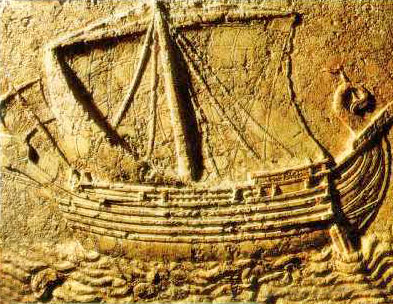
Of these were begotten two brothers who discovered iron, and the forging thereof. One of these called Chrysor, who is the same with Hephæstus, exercised himself in words, and charms and divinations; and he invented the hook, and the bait, and the fishing-line, and boats of a light construction; he was the first of all men that sailed. Wherefore he was worshipped after his death as a God, under the name of Diamichius. And it is said that his brothers invented the art of building walls with bricks.
Afterwards, of this race were born two youths, one of whom was called Technites, and the other was called Geïnus Autochthôn. These discovered the method of mingling stubble with the loam of bricks, and of baking them in the sun; they were also the inventors of tiling.
By these were begotten others, of whom one was named Agrus, the other Agrouerus or Agrotes, of whom in Phœnicia there was a statue held in the highest veneration, and a temple drawn by yokes of oxen: and at Byblus he is called, by way of eminence, the greatest of the Gods. These added to the houses, courts and porticos and crypts: husbandmen, and such as hunt with dogs, derive their origin from these: they are called also Aletæ, and Titans.
From these were descended Amynus and Magus, who taught men to construct villages and tend flocks.
By these men were begotten Misor and Sydyc, that is, Well-freed and Just: and they found out the use of salt.
From Misor descended Taautus, who invented the writing of the first letters: him the Egyptians called Thoor, the Alexandrians Thoyth, and the Greeks Hermes. But from Sydyc descended the Dioscuri, or Cabiri, or Corybantes, or Samothraces: these (he says) first built a ship complete.
From these descended others; who were the discoverers of medicinal herbs, and of the cure of poisons and of charms.
Contemporary with these was one Elioun, called Hypsistus, (the most high); and his wife named Beruth, and they dwelt about Byblus.
By these was begotten Epigeus or Autochthon, whom they afterwards called Ouranus (Heaven); so that from him that element, which is over us, by reason of its excellent beauty is named heaven: and he had a sister of the same parents, and she was called Ge (Earth), and by reason of her beauty the earth was called by the same name.
Hypsistus, the father of these, having been killed in a conflict with wild beasts, was consecrated, and his children offered libations and sacrifices unto him.
But Ouranus, succeeding to the kingdom of his father, contracted a marriage with his sister Ge, and had by her four sons, Ilus who is called Cronus, and Betylus, and Dagon, which signifies Siton (Bread-corn,) and Atlas.
But by other wives Ouranus had much issue; at which Ge, being vexed and jealous of Ouranus, reproached him so that they parted from each other: nevertheless Ouranus returned to her, again by force whenever he thought proper, and having laid with her, again departed: he attempted also to kill the children whom he had by her; but Ge often defended herself with the assistance of auxiliary powers.
But when Cronus arrived at man’s estate, acting by the advice and with the assistance of Hermes Trismegistus, who was his secretary, he opposed himself to his father Ouranus, that he might avenge the indignities which had been offered to his mother.
And to Cronus were born children, Persephone and Athena; the former of whom died a virgin; but, by the advice of Athena and Hermes, Cronus made a scimitar and a spear of iron. Then Hermes addressed the allies of Cronus with magic words, and wrought in them a keen desire to make war against Ouranus in behalf of Ge. And Cronus having thus overcome Ouranus in battle, drove him from his kingdom, and succeeded him in the imperial power.
In the battle was taken a well-beloved concubine of Ouranus who was pregnant; and Cronus bestowed her in marriage upon Dagon, and, whilst she was with him, she was delivered of the child which she had conceived by Ouranus, and called his name Demarous.
After these events Cronus surrounded his habitation with a wall, and founded Byblus, the first city of Phœnicia. Afterwards Cronus having coneived a suspicion of his own brother Atlas, by the advice of Hermes, threw him into a deep cavern in the earth, and buried him.
At this time the descendants of the Dioscuri, having built some light and other more complete ships, put to sea; and being cast away over against Mount Cassius, there consecrated a temple.
But the auxiliaries of Ilus, who is Cronus, were called Eloeim, as it were, the allies of Cronus; being so called after Cronus. And Cronus, having a son called Sadidus, dispatched him with his own sword, because he held him in suspicion, and with his own hand deprived his child of life. And in like manner he cut off the head of his own daughter, so that all the gods were astonished at the disposition of Cronus.
But in process of time, whilst Ouranus was still in banishment, he sent his daughter Astarte, being a virgin, with two other of her sisters, Rhea and Dione, to cut off Cronus by treachery; but Cronus took the damsels, and married them notwithstanding they were his own sisters. When Ouranus understood this, he sent Eimarmene and Mora with other auxiliaries to make war against Cronus: but Cronus gained the affections of these also, and detained them with himself. Moreover, the god Ouranus devised Bætulia, contriving stones that moved as having life.
And by Astarte Cronus had seven daughters called Titanides, or Artemides; by Rhea also he had seven sons, the youngest of whom was consecrated from his birth; also by Dione he had daughters; and by Astarte again he had two other sons, Pothos and Eros.
And Dagon, after he had found out bread-corn, and the plough, was called Zeus Arotrius.
To Sydyc, who was called the just, one of the Titanides bare Asclepius: and to Cronus there were born also in Peræa three sons, Cronus bearing the same name with his father, and Zeus Belus, and Apollo.
Contemporary with these were Pontus, and Typhon, and Nereus the father of Pontus: from Pontus descended Sidon, who by the excellence of her singing first invented the hymns of odes or praises: and Poseidon.
But to Demarous was born Melicarthus, who is also called Heracles.
Ouranus then made war against Pontus, but afterwards relinquishing the attack he attached himself to Demarous, when Demarous invaded Pontus: but Pontus put him to flight, and Demarous vowed a sacrifice for his escape.
In the thirty-second year of his power and reign, Ilus, who is Cronus, having laid an ambuscade for his father Ouranus in a certain place situated in the middle of the earth, when he had got him into his hands dismembered him over against the fountains and rivers. There Ouranus was consecrated, and his spirit was separated, and the blood of his parts flowed into the fountains and the waters of the rivers; and the place, which was the scene of this transaction, is shewed even to this day.
(Then our historian, after some other things, goes on thus:) But Astarte called the greatest, and Demarous named Zeus, and Adodus who is entitled the king of gods, reigned over the country by the consent of Cronus: and Astarte put upon her head, as the mark of her sovereignty, a bull’s head: and travelling about the habitable world, she found a star falling through the air, which she took up, and consecrated in the holy island of Tyre: and the Phœnicians say that Astarte is the same as Aphrodite.
Moreover, Cronus visiting the different regions of habitable world, gave to his daughter Athena the kingdom of Attica: and when there happened a plague with a great mortality, Cronus offered up his only begotten son as a sacrifice to his father Ouranus, and circumcised himself, and compelled his allies to do the same: and not long afterwards he consecrated after his death another of his sons, called Muth, whom he had by Rhea; this (Muth) the Phœnicians esteem the same as Death and Pluto.
After these things, Cronus gave the city of Byblus to the goddess Baaltis, which is Dione, and Berytus to Poseidon, and to the Caberi who were husbandmen and fishermen: and they consecrated the remains of Pontus at Berytus.
But before these things the god Taautus, having pourtrayed Ouranus, represented also the countenances of the gods Cronus, and Dagon, and the sacred characters of the elements. He contrived also for Cronus the ensign of his royal power, having four eyes in the parts before and in the parts behind, two of them closing as in sleep; and upon the shoulders four wings, two in the act of flying, and two reposing as at rest. And the symbol was, that Cronus whilst he slept was watching, and reposed whilst he was awake.
And in like manner with respect to the wings, that he was flying whilst he rested, yet rested whilst he flew. But for the other gods there were two wings only to each upon his shoulders, to intimate that they flew under the controul of Cronus; and there were also two wings upon the head, the one as a symbol of the intellectual part, the mind, and the other for the senses.
And Cronus visiting the country of the south, gave all Egypt to the god Taautus, that it might be his kingdom.
These things, says he, the Caberi, the seven sons of Sydyc, and their eighth brother Asclepius, first of all set down in the records in obedience to the commands of the god Taautus.
All these things the son of Thabion, the first Hierophant of all among the Phœnicians, allegorized and mixed up with the occurrences and accidents of nature and the world, and delivered to the priests and prophets, the superintendants of the mysteries: and they, perceiving the rage for these allegories increase, delivered them to their successors, and to foreigners: of whom one was Isiris, the inventor of the three letters, the brother of Chna who; is called the first Phœnician.—Euseb. Præp. Evan. lib. I. c. 10.
OF THE MYSTICAL SACRIFICE OF THE PHOENICIANS
It was the custom among the ancients, in times of great calamity, in order to prevent the ruin of all, for the rulers of the city or nation to sacrifice to the avenging deities the most beloved of their children as the price of redemption: they who were devoted this purpose were offered mystically.
For Cronus, whom the Phœnicians call Il, and who after his death was deified and instated in the planet which bears his name, when king, had by a nymph of the country called Anobret an only son, who on that account is styled Ieoud, for so the Phœnicians still call an only son: and when great dangers from war beset the land he adorned the altar, and invested this son with the emblems of royalty, and sacrificed him.—Euseb. Præp. Evan. lib. I. c. 10.—lib. IV.
OF THE SERPENT
Taautus first attributed something of the divine nature to the serpent and the serpent tribe; in which he was followed by the Phœnicians and Egyptians. For this animal was esteemed by him to be the most inspirited of all the reptiles, and of a fiery nature; inasmuch as it exhibits an incredible celerity, moving by its spirit without either hands, or feet, or any of those external members, by which other animals effect their motion. And in its progress it assumes a variety of forms, moving in a spiral course, and darting forward with whatever degree of swiftness it pleases. It is moreover long-lived, and has the quality not only of putting off its old age, and assuming a second youth, but of receiving at the same time an augmentation of its size and strength. And when it has fulfilled the appointed measure of its existence, it consumes itself; as Taautus has laid down in the sacred books; upon which account this animal is introduced in the sacred rites and mysteries.—Euseb. Præp. Evan. lib. I. c. 10.
Next
Footnotes
1 This union, among the Heathens, and particularly among the Phœnicians, was symbolized by an Egg enfolded by a Serpent, which disjunctively represented the Chaos and the Ether, but, when united, the hermaphroditic first principle of the Universe Cupid or Pothos.
2 “Wind knew not, &c.” Vig. Col. Orel. Cumb. &c.
Moe is the founder of GnosticWarrior.com. He is a father, husband, author, martial arts black belt, and an expert in Gnosticism, the occult, and esotericism.