The Christian Big Boys in Washington are up to something and this something, many of the Satanists suspect means nothing good for their cult.
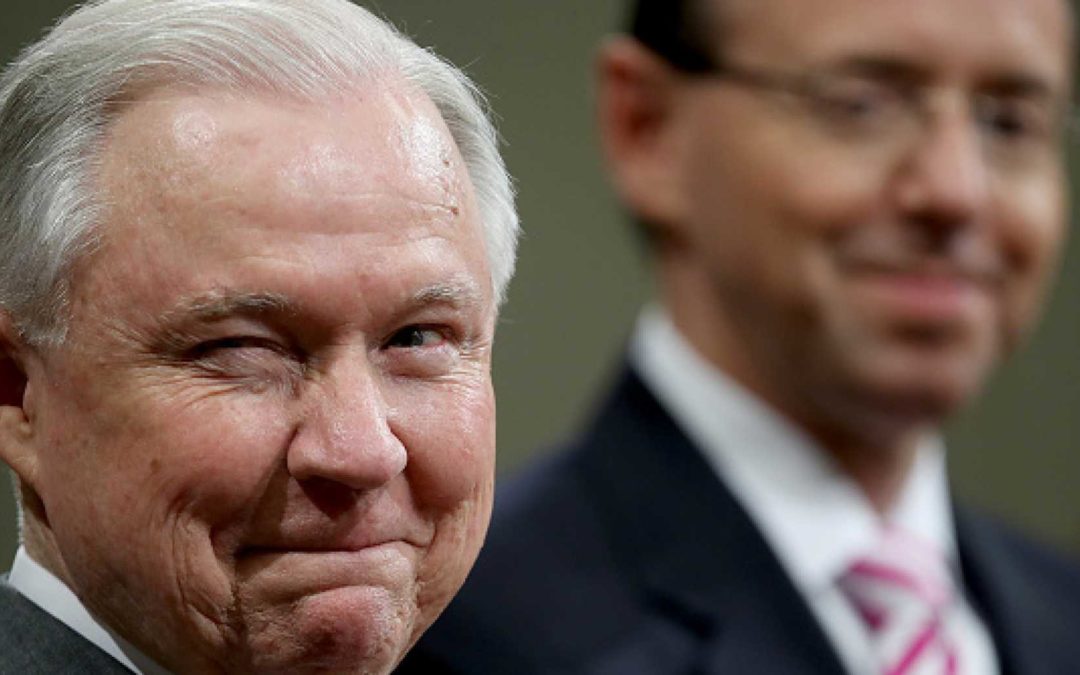
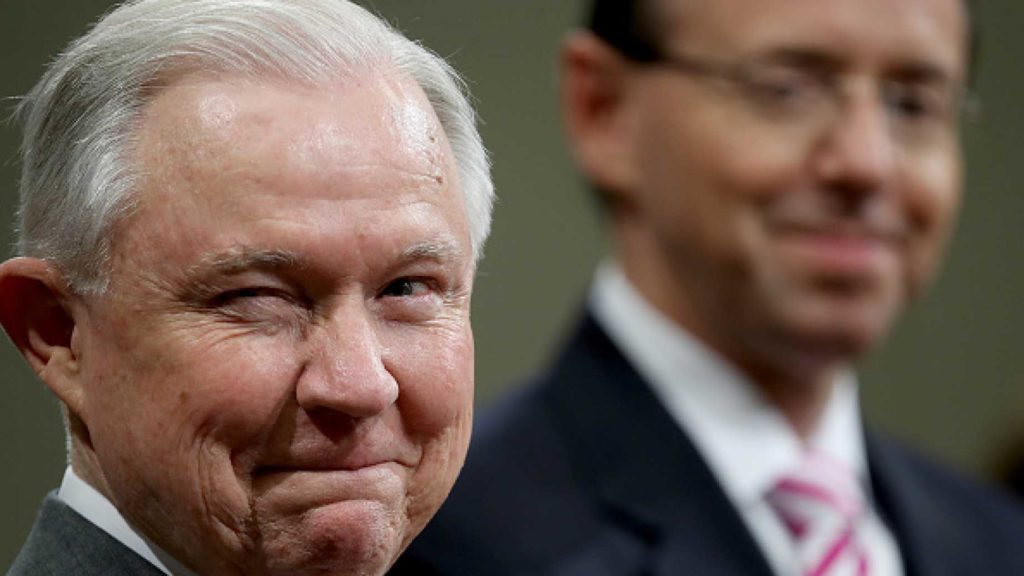
Possibly, Satanism is one of the underground movements that Attorney General Sessions had warned the U.S. public about when he announced the Religious Liberty Task Force on July 30, 2018 that, “a dangerous movement, undetected by many, is now challenging and eroding our great tradition of religious freedom.”
This movement, he left unnamed. Open to conjecture and internet interpretations.
This is mine…
One of the big questions the Satanists are asking is, “Just whose religious liberty will this task force protect?”
It’s a good question.
Let me remind some of you that Attorney General Sessions is a Christian and member of the United Methodist Church (UMC) which is a mainline Protestant denomination.
Simply put, he is as conservative as you can get and he follows the teachings of the bible which is the same book that he was sworn into office on.
His comrades, Vice President Pence and many other members of the Trump administration are also Christians with strong ties to the Christain Churches and communities across the nation.
A nation that has on its dollar bill, “In God We Trust” which was placed there in the 1950’s as a result of the advocacy of the U.S. Catholic Church and the Knights of Columbus.
A church who it is well known in the Roman built West as one of the world’s oldest Christian Churches of whom we know that Satan is their Adversary – an Apostate of the Faith.
I’m sure I do not have to inform you all that these guys – the elite U.S. Christians have a lot of money, big guns, armies, mercenaries and God on their side.
They don’t F around with underground movements threatening and eroding all the hard work they have put in building this nation.
With that said, the facts are that many of the competing religious organizations and cults such as Satanism are up in arms over this news of this Religious Liberty Task Force and for good reason.
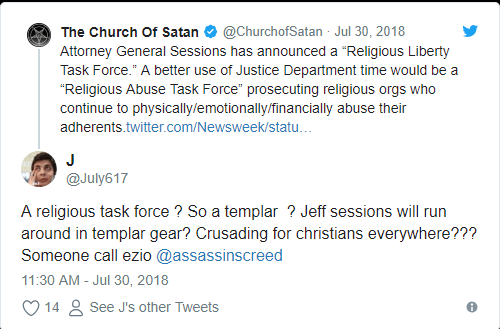
Attorney General Sessions has announced a “Religious Liberty Task Force.” A better use of Justice Department time would be a “Religious Abuse Task Force” prosecuting religious orgs who continue to physically/emotionally/financially abuse their adherents.https://t.co/wif04c8Xwd
— The Church Of Satan (@ChurchofSatan) July 30, 2018
Yes, the very fallen angels (evil demons) who hellishly flourish at the expense of sacrificing your own children to Moloch and they have now taken their war to Twitter for the final Babylonian battle of this “Age of Heretics.”
This is the exact place they were expected to voice their ignorant opinions 280 character tweets at a time about things they have no knowledge (Gnosis) about and the creators of the Religious Liberty Task Force could not be more joyed. After all, every word is being recorded and categorized by the Deep State and as the famous Gnostic, St, John had revealed to them,
A religious task force ? So a templar ? Jeff sessions will run around in templar gear? Crusading for christians everywhere??? Someone call ezio @assassinscreed
They just prosecuted one in my area that’s been on the run in the Phillipines for 20 years. 20 YEARS! And with so many in other areas, and then the continued persecution of non-christian faiths (or lack of faith), it’s pretty obvious what they REALLY want.
The Religious Liberty Task Force discussed today by Jeff Sessions is expected to, “reach out to religious organizations for feedback and develop new policies and strategies to protect religious freedoms.” I wonder if that will include Satanism & others? Something tells me not.
🏳️🌈✝️🔻HATE in the Name of God is still HATE. This is NOT what GOD wants from His TRUE FOLLOWERS. These EVIL MEN and WOMEN in WASHINGTON are following ORDERS from SATAN. Jeff Sessions announces a ‘Religious Liberty Task Force’ to protect hate groups https://t.co/swHLjjO6xcpic.twitter.com/QM7TkCksn3
Moe is the founder of GnosticWarrior.com. He is a father, husband, author, martial arts black belt, and an expert in Gnosticism, the occult, and esotericism.
Nergal was the name of the Babylonian God of Hell and Plagues that the Samaritan Levites who were also known as the Cutha (Cuthites, Cush, Kush etc.), which is the same city as the earthly home of the king of Hades (Hell). We can also find the name Nergal being taken on by Samaritan Tribal officials who we find at the siege of Jerusalem.
For example, Nergal-sar-uzur (Neriglissar, Nergal-Sharezer, Nergal-shar-ezer) is one such name that has been excavated from the so-called Babylonian bricks and he is believed to have been the Rag-Mag mentioned by the Jewish prophet Jerimiah. (Jer. 39:3) The name Rag-mag refers to the “Chief of the Magi (Magicians AKA Priests)” which would mean that Nergal-Sharezer was in charge of all magical operations in relation to governing Babylon.
It was around this time that we can then find many names were compounded with the name of Nergal in Babylonia. First, we have King Nergal-Sharezer who is listed as the Son-in-Law of Nebuchadnezzar, who when Jerusalem was taken, came in and sat in the middle gate, with the other princes and officers. Then there are many names containing Nergal which occur in the Babylonian commercial and legal documents, such as Nergal/al-ahh-iddin, or “Nergal gives a brother”; Nergal-ubaUU, or “Nergal gives life “; Nergal-shuzibanni, or ” Nergal, save me!”
In the Babylonian biblical account documenting the genealogy of Nergal (Nirgal, Nergilos or Nirgali), we discover that Ner in the Scripture was the Ancient Patriarch and Father of the Tribe of Saul who was the first king of the land of Israel. He was the son of Abiel (Jehiel), according to (1 Chronicles 8:33) father of Abner, and grandfather of King Saul. (B.C. 1140.), of the tribe of Benjamin, and the father of Cush.
Abner was, therefore, uncle to Saul, as stated in (1 Samuel 14:50) and Saul was the father of Jonathan, Malchishua, Abinadab, and Esh-baal. The son of Jonathan, Merib-baal was the father of Micah. 1 Samuel 14:51 should be read, “Cush, the father of Saul, and Ner, the father of Abner, were the sons of Abiel.” And hence this Cush and Ner were brothers, and Saul and Abner were first cousins (Comp. 1 Chronicles 9:36).
The Biblical description of the end of the reign of the Assyrian King Sennacherib shows us that he was killed by his two sons, Adrammelech and Nergal-Sharezer (Neriglissar – ner’gal-sha-re’zer) – Sharezer (2 Kings xix:37; Is. xxxvii:38).
We can also find a Nergal-Sharezer (Neriglissar, ner’gal-sha-re’zer or Ne.Nun.Gal-Lugal-u-su-ur) Fourth King of the dynasty of Babylon X (Chaldean dynasty). He is some accounts is listed as the son of Belsum-iskum who was a military chieftain under Nebuchadnezzar ( Nabucodonosor ) (Jer, xxxix:3) and the chief of the magi (Rab-mag) under the same king, and present in the same expedition (Jer. xxxix:3, 13).
His name appears as “Nerigassolassar” in the Canon of Ptolemy, which was compiled by Claudius Ptolemy [90 – 168 AD], who lived in the second century AD and worked at the Alexandria Library compiled a list of the kings of Babylon. In the Canon of Ptolemy,” He married Nebuchadnezzar’s daughter and ascended the throne two years after Nebuchadnezzar’s death. A palace built by him has been discovered among the ruins of Babylon, and his name found on bricks.
Nergal-sharezer and Nebuzaradan are listed as high officials of King Nebuchadnezzar II, who in 586 B.C. destroyed the First Temple, as well as Jerusalem, and exiled most of the remaining population of Judah. We can also find an exorcist priest, Nergal-Eres, son of Bel-apla-usur, who was a brewer witness in an allotment for an exorcist at Kutha temple superintendent and guild president at Cutha. They are mentioned at the scene of the destruction in Jeremiah 39:3 and 39:9, and are mentioned in a list of his courtiers that was written on clay tablets.
This proves that the family of Nergal who is listed as ‘courtiers’ of King Nebuchadnezzar II which means they were the sovereign protectors of the king who were also temple superintendents and guild presidents ie: Freemasons.
It is also interesting we find the appellation of “Gal” the pronunciations of the name of this Samaritan official and this same name is later taken by the magicians we know as Jesus and his Apostles. As I explained before, Gal if from gallus or gallinaceous which Latin for the English “rooster, cockerel or cock.” (male chicken).This is why one of the surnames for Jesus was “Jesus the Galilean from Gallillee” and his Apostles like Simon was also surnamed “Peter the Galilean.”
It is said that in Babylon at Cutha was one of several cities from which people were brought to Samaria, and they worshiped Nergal. Saint Bede says that in the Book of Places we read that Benoth and Nergal were cities built in the region of Judea by Samaritans who had migrated from Babylon; the town of Ashima.
In the biblical account, however, Kuthah was one of several cities from which people were brought to Samaria, and they worshiped Nergal. The “men of Cuth,” when transported as colonists via mass deportations to Samaria by the Assyrians, they introduced his worship into the land of their forced adoption. They were also introduced by the Assyrian Empire into Samaria, in a policy of mass deportations. It was on the Samaritan Temple on Mount Gerizim, opposite the Temple in Jerusalem, where they worshipped Nergal.
We know today that these Samaritans who are known as the Cutheans AKA Sons of Seth and Levites would have traveled with the Romans and were a very early ethnic group, widely distributed and powerful. From Assyria, we can now say they extended their power to Crete, Egypt, India, China, Arabia Petraea, Abyssinia, and many other lands. ”
I believe my bloodline is the same and have traced my DNA Haplogroup in all these same areas and in other Roman-conquered territories all over the world which can be verified by both history and science. These articles are testaments of our ancestral knowledge/gnosis which comes from the same blood.
Moe is the founder of GnosticWarrior.com. He is a father, husband, author, martial arts black belt, and an expert in Gnosticism, the occult, and esotericism.
On July 30, the United States Department of Justice hosted the “Religious Liberty Summit” in order to announce the new creation of a special unit called the “Religious Liberty Task Force,” which will be tasked with protecting and defending the religious rights of Americans.
The First Amendment to the U.S. Constitution says that everyone in the U.S. has the right to practice his or her religion freely which we define as religious liberty for all kinds of beliefs and all peoples – including Christianity, Islam, and even Paganism and Satanism.
Speaking at the summit, U.S. Attorney General, Jeff Sessions issued an ominous warning when he stated, “a dangerous movement, undetected by many, is now challenging and eroding our great tradition of religious freedom.”
Sessions called freedom of religion “indeed our first freedom being the first listed right in the First Amendment” and said that the Trump administration is “actively seeking to accommodate people of faith.”
The attorney general charged that the freedom to practice religion in America has come “under attack” in the nation’s current “cultural climate.”
Here is a complete copy of the DOJ press release titled, “Attorney General Sessions Delivers Remarks at the Department of Justice’s Religious Liberty Summit” – Washington, DC ~ Monday, July 30, 2018
Thank you, Beth, for that generous introduction and thank you for your outstanding leadership at the Office of Legal Policy.
I want to thank Deputy Attorney General Rosenstein and our acting Associate Attorney General, Jesse Pannuccio, for their leadership, as well.
Thank you to Dorothy Williams from the Civil Rights Division for sharing your beautiful voice with us and singing our national anthem.
And thank you to Archbishop Kurtz, my good friend Senator Lankford, as well as all of our panelists: Acting Assistant Attorney General John Gore, Kerri Kupec, Derrick Max, Professor McConnell, Asma Uddin, Shay Dvoretzky, Emilie Kao, and of course Jack Phillips.
I want to thank all of you for your courage and insight to speak out for religious liberty.
Let us be frank.
A dangerous movement, undetected by many, is now challenging and eroding our great tradition of religious freedom. There can be no doubt. This is no little matter. It must be confronted and defeated.
This election, and much that has flowed from it, gives us a rare opportunity to arrest these trends. Such a reversal will not just be done with electoral victories, but by intellectual victories.
We have gotten to the point where courts have held that morality cannot be a basis for law; where ministers are fearful to affirm, as they understand it, holy writ from the pulpit; and where one group can actively target religious groups by labeling them a “hate group” on the basis of their sincerely held religious beliefs.
This President and this Department of Justice are determined to protect and even advance this magnificent heritage.
Freedom of religious is indeed our “first freedom”—being the first listed right of our First Amendment.
This has been a core American principle from the beginning.
It is one of the reasons that this country was settled in the first place.
The promise of freedom of conscience brought the Pilgrims to Plymouth, the Catholics to Maryland, the Quakers to Pennsylvania, the Scot-Presbyterians to the middle colonies, and Roger Williams to Rhode Island.
Each one of these groups and others knew what it was like to be hated, persecuted, outnumbered, and discriminated against.
Each one knew what it was like to have a majority try to force them to deny their natural right to practice the faith they held dear.
Our Founders gave religious expression a double protection in the First Amendment. Not only do we possess freedom to exercise our beliefs but we also enjoy the freedom of speech.
Our Founders’ understanding of and commitment to religious freedom was truly brilliant as well as historic.
It arose in large part from the principals delineated in the Virginia Statute for Religious Freedom—and its effective advocates: Madison and Jefferson.
These guys were ferocious. This weekend, I was rereading Gary Will’s fabulous book, Head and Heart, in which he quotes extensively from the Jefferson’s Statute, as he refers to it.
I commend all of it to you; but one line stood out in particular to me, “That almighty God hath created the mind free, and manifested His supreme will that free it shall remain, by making it altogether insusceptible of restraint.”
Of course, this is entirely consistent with another of my favorite Jefferson quotes that you will find at his memorial just across the mall from where we are today:
“For I have sworn upon the altar of god eternal hostility against every form of tyranny over the mind of man.” This is what our Founders believed.
They clearly recognized that an individual’s relationship to God is a natural right and precedes the existence of the state, and is not subject to state control.
These concepts were placed into our Constitution and laws and formed a national consensus that has greatly militated against religious hostility and violence—and has helped us to this day to be one of the world’s most diverse religious people.
There can be no doubt that we are stronger as a nation because of the contribution of religious Americans.
Every day across America, they feed the hungry, shelter the homeless, educate our young people, and care for the sick. They do so not because the government tells them to, but because they want to. They do these things because of their faith.
Their faith provides something the state can never provide—meaning and purpose and joy in their life.
But in recent years, the cultural climate in this country—and in the West more generally—has become less hospitable to people of faith. Many Americans have felt that their freedom to practice their faith has been under attack.
And it’s easy to see why. We’ve seen nuns ordered to buy contraceptives.
We’ve seen U.S. Senators ask judicial and executive branch nominees about dogma—even though the Constitution explicitly forbids a religious test for public office. We’ve all seen the ordeal faced so bravely by Jack Phillips.
Americans from a wide variety of backgrounds are concerned about what this changing cultural climate means for the future of religious liberty in this country.
President Trump heard this concern.
I believe this unease is one reason that he was elected. In substance, he said he respected people of faith and he promised to protect them in the free exercise of their faith. He declared we would say “Merry Christmas” again.
The Department of Justice has settled 24 civil cases with 90 plaintiffs regarding the previous administration’s wrong application of the contraception mandate to objecting religious employers.
Last month, a district court in Colorado issued a permanent injunction in the case involving the Little Sisters of the Poor, a group of nuns who serve the elderly poor.
This is a permanent injunction and a major victory for the Little Sisters of the Poor and religious freedom.
The government has no business telling the Little Sisters that they must provide an insurance policy that violates their sincere religious beliefs.
And since day one, this administration has been delivering on that promise.
Soon after taking office, President Trump directed me to issue explicit legal guidance for all executive agencies on how to apply the religious liberty protections in federal law. Our team embraced that challenge.
I issued that guidance in October, and it lays out 20 fundamental principles for the Executive Branch to follow.
Those include the principle that free exercise means a right to act—or to abstain from action.
They include the principle that government shouldn’t impugn people’s motives or beliefs.
We don’t give up our rights when we go to work, start a business, talk about politics, or interact with the government.
We don’t give up our rights when we assemble or join together. We have religious freedom as individuals and as groups.
In short, we have not only the freedom to worship—but the right to exercise our faith. The Constitution’s protections don’t end at the parish parking lot nor can our freedoms be confined to our basements.
Under this administration, the federal government is not just reacting—we are actively seeking, carefully, thoughtfully and lawfully, to accommodate people of faith. Religious Americans are no longer an afterthought.
We will take potential burdens on one’s conscience into consideration before we issue regulations or new policies.
And this Department of Justice is going to court across America to defend the rights of people of faith.
First of all, we are aggressively and appropriately enforcing our civil rights laws, our hate crimes laws, and laws protecting churches and faith groups.
Since January 2017, we have obtained 11 indictments and seven convictions in cases involving arson or other attacks or threats against houses of worship. Our Civil Rights Division has also obtained 12 indictments in other attacks or threats against people because of their religion.
And we are not slowing down.
Three weeks ago, we obtained a jury verdict against a man who set fire to a mosque in Texas and sentenced for a man from Missouri for threatening to kill members of a mosque.
In addition to protecting the safety of people of faith, we are also protecting them against unjust discrimination.
In January, we filed a brief in a Montana court to defend parents who claim that the state barred their children from a private school scholarship program because they attend a religious school.
We also filed an amicus brief on behalf of the Archdiocese of Washington, D.C., which was refused advertising space for having a religious message—including “joy to the world” on Merry Christmas.
And, of course, we were proud to file a brief in support of Jack Phillips.
We are taking steps to become even more effective.
In June I announced the Place to Worship Initiative. Under this initiative, the Department of Justice is holding public events across America and improving training for federal prosecutors about legal protections for houses of worship.
When I was in the Senate, we passed a law called the Religious Land Use and Institutionalized Persons Act, or RLUIPA. Under RLUIPA, the Department of Justice can file a civil action in court when religious groups are discriminated against in zoning laws.
Under my tenure as Attorney General, we have not hesitated to use this tool when necessary.
In June, we filed suit against a town in New Jersey that had refused over and over again—for eight years—to let an Orthodox Jewish congregation buy land for a synagogue.
And just last week we filed a brief in federal court supporting the case of a Hindu temple in Maryland that claimed to have suffered discrimination in its attempts to purchase land.
We are going to keep going to court. And I believe that we’re going to keep winning.
Today I am announcing our next step: the Religious Liberty Task Force, to be co-chaired by the Associate Attorney General and the Assistant Attorney General for the Office of Legal Policy—Jesse and Beth.
The Task Force will help the Department fully implement our religious liberty guidance by ensuring that all Justice Department components are upholding that guidance in the cases they bring and defend, the arguments they make in court, the policies and regulations they adopt, and how we conduct our operations. That includes making sure that our employees know their duties to accommodate people of faith.
As the people in this room know, you have to practice what you preach. We are also going to remain in contact with religious groups across America to ensure that their rights are being protected. We have been holding listening sessions and we will continue to host them in the coming weeks.
This administration is animated by that same American view that has led us for 242 years: that every American has a right to believe, worship, and exercise their faith in the public square.
This approach has served this country well. We are perhaps the most religiously developed nation in the world and can take pride in respecting all people as they fully exercise their faiths.
It is clear that these policies have furthered peace, prosperity, freedom, lawfulness, and clarity.
As our nation grows order, we must not let it depart from this magnificent tradition.
Now I have the pleasure of introducing Archbishop Joseph Kurtz, someone who is an expert on these matters.
Archbishop Kurtz was ordained a priest of the Diocese of Allentown in 1972. Over the next two decades he served in a variety of capacities in the Diocese, including teaching at two seminaries.
He was named a Monsignor in 1986 and appointed a pastor in 1988.
In 1999 Pope John Paul II appointed him Bishop of Knoxville and in 2007 Pope Benedict XVI appointed him Archbishop of Louisville, where he now leads the oldest inland diocese in the United States and the oldest Archdiocese West of the Appalachias.
In 2010 he was elected Vice President of the U.S. Conference of Catholic Bishops and then served as President from 2013 to 2016.
In 2017 he was elected chairman of the Conference’s Committee for Religious Liberty.
Please join me in welcoming Archbishop Joseph Kurtz.
Moe is the founder of GnosticWarrior.com. He is a father, husband, author, martial arts black belt, and an expert in Gnosticism, the occult, and esotericism.
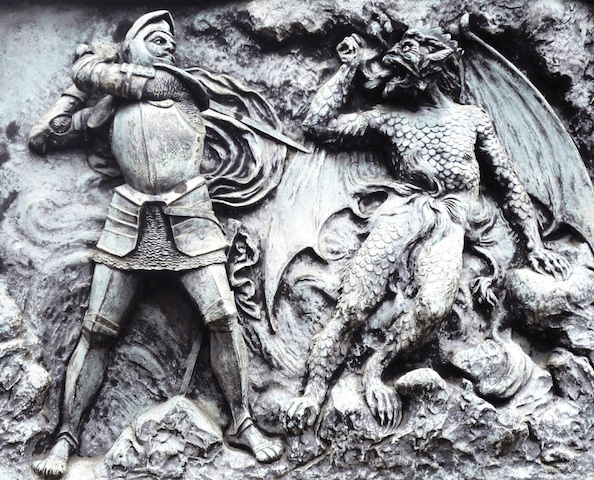
In Revelation 9:11, it is said, “the angel of the bottomless pit, whose name in the Hebrew tongue is Abaddon ( Abbaton), but in the Greek tongue hath his name Apollyon and in the Vulgate by the Latin Exterminans (Destroyer). We are told he is the king of the deep pit which is is the great gathering place of the dead, more commonly known as Sheol ie: hell or the abyss and the name given to the angel who with Maweth, i.e. ‘death,’ stands over the six angels of destruction, who aid God in the punishment of the wicked.
Moe is the founder of GnosticWarrior.com. He is a father, husband, author, martial arts black belt, and an expert in Gnosticism, the occult, and esotericism.
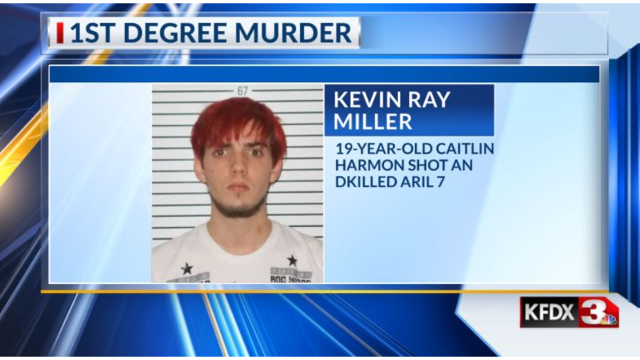
The mother of a cold-blooded killer told police that her son had suffered from mental issues and she believed he was possessed by a demon so she took him to a priest in Tulsa, Oklahoma to have it removed.
Apparently, the exorcism did not work or was not performed because Kevin Ray Miller allegedly shot his ex-girlfriend, Caitlin Harmon who was married to another man in the head as she watched a movie on Netflix on her phone.
Oklahoma police said that the suspect had spent his free time before the murder watching videos on YouTube and he also bought a satanic Bible off of Amazon before performing satanic rituals in his backyard.
Miller confessed to police that on the morning of the murder that he was seeing faces and hearing voices.
According to media reports, the killer was in a custody battle with his ex-girlfriend and he told police that he had killed her because she did not want to be with him and he was jealous of what she had.
Moe is the founder of GnosticWarrior.com. He is a father, husband, author, martial arts black belt, and an expert in Gnosticism, the occult, and esotericism.