by Moe
The term Ain Sof, Ayn Sof, or Ayn Sof (/ /, Hebrew: אין סוף) is used to describe the cycle of time that is circular in 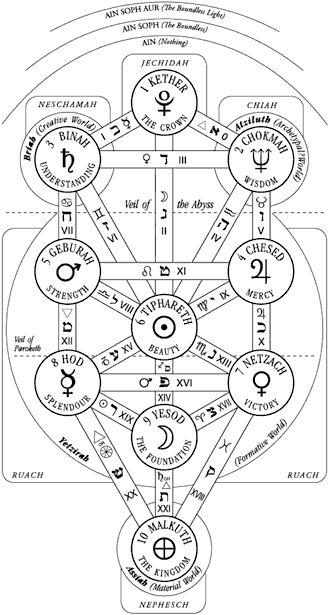 motion. It is understood as God prior to his self-manifestation in the production of any spiritual Realm. Ain or атп, signifies a great circle, the vacuum of pure spirit, moved and created AIN SOPH, or Infinity. The meaning of Ain is nothingness, motionless space, and abstract space. Ain Sof may be translated as “no end”, “unending”, “there is no end”, or Infinity.
The Zohar explains the term “Ain Sof” as follows: “Before He gave any shape to the world, before He produced any form, He was alone, without form and without resemblance to anything else. Who then can comprehend how He was before the Creation?
Hence it is forbidden to lend Him any form or similitude, or even to call Him by His sacred name, or to indicate Him by a single letter or a single point… But after He created the form of the Heavenly Man, He used him as a chariot wherein to descend, and He wishes to be called after His form, which is the sacred name “YHWH“.
Many P. Hall had said, “THE Qabbalists conceive of the Supreme Deity as an Incomprehensible Principle to be discovered only through the process of eliminating, in order, all its cognizable attributes. That which remains–when every knowable thing has been removed–is AIN SOPH, the eternal state of Being. Although indefinable, the Absolute permeates all space. Abstract to the degree of inconceivability, AIN SOPH is the unconditioned state of all things. Substances, essences, and intelligences are manifested out of the inscrutability of AIN SOPH, but the Absolute itself is without substance, essence, or intelligence. (more…)
Moe is the founder of GnosticWarrior.com. He is a father, husband, author, martial arts black belt, and an expert in Gnosticism, the occult, and esotericism.
by Moe
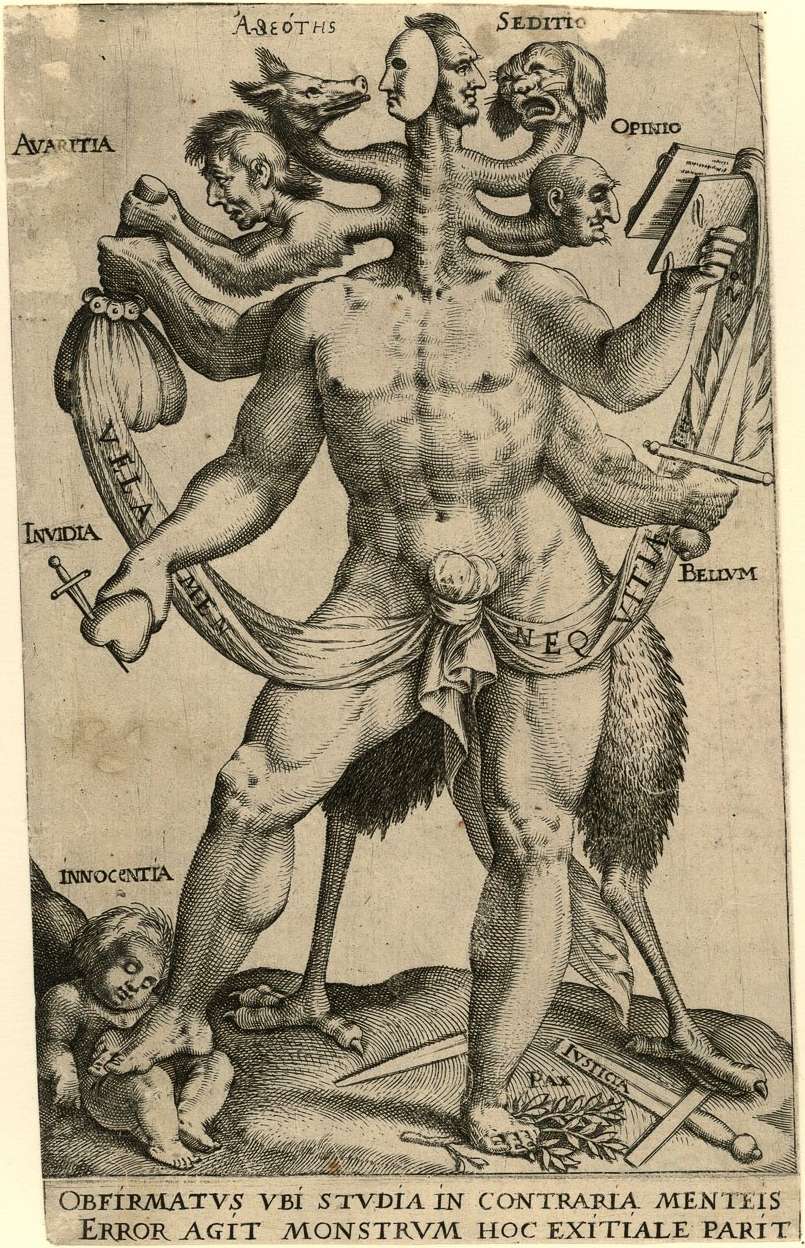
An alchemical engraving of the “Allegory of the Five Obstinate Monsters,” made in 1575 – 1618. In its country of origin, the Netherlands, it is actually known as De Warminiaen.
All these words are in Latin. The meaning of Aeoths is”Godlessness” or “Atheism. “The meaning of Seditio is “a conduct or speech inciting people to rebel against the authority of a state or monarch.” Avaritia means greed. The meaning of Opinio is “a belief or conclusion held with confidence but not substantiated by positive knowledge.” Invidia means the sense of envy or jealousy, a “looking upon” associated with the evil eye, from invidere, “to look against, to look at in a hostile manner.” A bellum is “a state of open, armed, often prolonged conflict carried on between nations, states, or parties.”
Moe is the founder of GnosticWarrior.com. He is a father, husband, author, martial arts black belt, and an expert in Gnosticism, the occult, and esotericism.
by Moe
“And Pistis Sophia cried out most exceedingly, she cried to the Light of lights, which she had seen from the beginning… and uttered this repentance: Save me, O Light, for evil thoughts have entered into me” (Pistis Sophia ch. 32)
Painting by By Johannes Franciscus Gijsbertus van den Berg
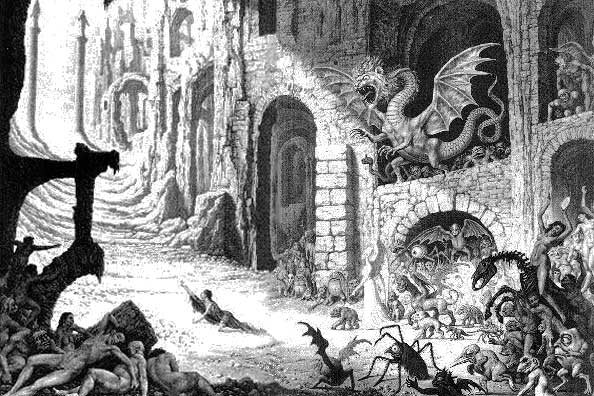
After nine years at the Lectorium Rosicrucianum, esoteric motifs began to appear in Johfra’s work in the late 1950’s. Up to that time, he had painted mostly Surrealist landscapes. But over the course of the sixties, these landscapes became increasingly populated by esoteric symbols. One of his earliest attempts at an expressly Esoteric painting is his Pistis Sophia (1959).
Here, a woman in rags crawls toward a distant light, which appears between two columns in the background. Meanwhile, she is being mocked or pursued by a caval of demons and beasts, including a lion-headed dragon. In the right foreground human figures are dancing in drunken revelry while, on the left, other figures are sleeping. Some however have gradually awoken and, like the tattered woman, are reaching towards the light.
The title of the painting is taken from a Gnostic Gospel which relates a dialogue between the risen Christ and his disciples. In it, many essential elements of Gnosticism are described. G.R.S. Mead’s English translation appeared in 1921 (from a British Museum manuscript acquired in 1785). Meanwhile, the chief corpus of Gnostic writings, the Nag Hammadi library, was not discovered until 1945, and did not appear in English until 1978. When Johfra painted this canvas in 1959, the Pistis Sophia was one of the few Gnostic works available to him.
In this text, Christ says to his disciples that we are all drunken with desire, or else slumbering in forgetfulness of our true origins. Only those who have ‘sobered up’ or ‘awoken’ can remember the events that transpired at the beginning of the world. This is the knowledge and revelation, the gnosis, which Christ brings to man. He reveals the ‘indweller of light’ in each of us, which Gnostics also called the ‘pneuma’, symbolized by a spark or pearl.
Through the pearl in us, we remember that, at the beginning, ‘a Great Light’ appeared and separated itself into the upper aeons (or heavens). In these heavens appeared Pistis Sophia (Wisdom), a female companion who aided the Father in creating the cosmos.
But, acting alone and without his knowledge, she gave birth to Yaldabaoth, a Demiurge who generated the lower aeons: the seven planets and the earth whirling around in the darkness. Yaldabaoth is a lion-headed serpent who glows like the fire of the sun. He commands the seven archons who appear to us as the seven planets in lower aeons. Also under his command are the many demons who hold sway on the earth and in our bodies, as lust, envy, anger, etc. All of these trap humans and their particles of the divine Light in matter, time, passion, desire, fate, and forgetting.
After generating him, Sophia’s own progeny turned against her. “And the great lion-faced light-power devoured all the light powers in Sophia… and her matter was thrust into chaos” (Pistis Sophia ch. 31). As a result, Sophia fell to the earth in the form of a woman, and forgot her origins in the divine. And indeed, all of us, who possess the ‘indweller of light’ in us, have also forgotten that we too were once descended from the Great Light. That is the revelation that Christ brings, the gnosis, the remembrance of our origins.
In light of the Gnostic text, we now see Johfra’s painting as an image to help us remember our forgotten origins. As we meditate upon it, we recognize the Pistis Sophia in rags, fallen to the earth but still reaching for the light. One or two figures on the left also reach for it. But the majority are sleeping or enmired in drunkeness. Yaldabaoth, the lion-headed dragon, rules over this darkened realm with his court of archons and demons. The composition as a whole evokes a particular passage from the Pistis Sophia.
“And Pistis Sophia cried out most exceedingly, she cried to the Light of lights, which she had seen from the beginning… and uttered this repentence: Save me, O Light, for evil thoughts have entered into me” (Pistis Sophia ch. 32).
SOURCE: VISIONARY REVUE
Moe is the founder of GnosticWarrior.com. He is a father, husband, author, martial arts black belt, and an expert in Gnosticism, the occult, and esotericism.
by Moe
All throughout the course of recorded human and religious history, you’ll find various images a very famous people and god’s 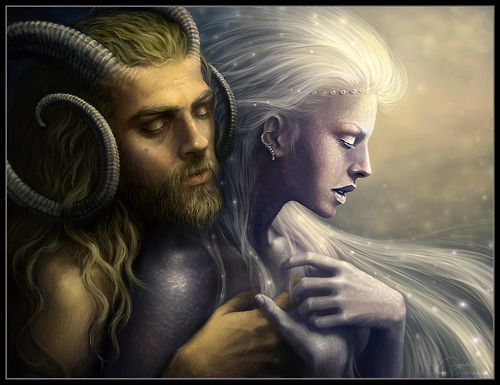 wearing horns. Often the horns are depicted as coming out of each sides of their skulls. If you look back during the Old Testament days prior to the coming of Jesus, you will find many ancient Hittite, Egyptian, Greek, Roman and Celtic gods, various military leaders and even Kings who can be found on statues, coins and on various tribal seals with two horns coming out of the sides of their heads.
Many modern Christians and other people influenced by Christian literature would most likely associate these horned deities with the devil and any people who wear horns would without a doubt be considered evil. But in ancient times, this was simply not the case.
The horns were the main symbol of the world wide Gnostic religion in which many of these Gods and people were its representatives. They were the intermediaries between God and or the spirit world and man. (more…)
Moe is the founder of GnosticWarrior.com. He is a father, husband, author, martial arts black belt, and an expert in Gnosticism, the occult, and esotericism.