by Moe
p. 106
MASONRY is a succession of allegories, the mere vehicles of great lessons in morality and philosophy. You will more fully appreciate its spirit, its object, its purposes, as you advance in the different Degrees, which you will find to constitute a great, complete, and harmonious system.
If you have been disappointed in the first three Degrees, as you have received them, and if it has seemed to you that the performance has not come up to the promise, that the lessons of morality are not new, and the scientific instruction is but rudimentary, and the symbols are imperfectly explained, remember that the ceremonies and lessons of those Degrees have been for ages more and more accommodating themselves, by curtailment and sinking into commonplace, to the often limited memory and capacity of the Master and Instructor, and to the intellect and needs of the Pupil and Initiate; that they have come to us from an age when symbols were used, not to reveal but to conceal; when the commonest learning was confined to a select few, and the simplest principles of morality seemed newly discovered truths; and that these antique and simple Degrees now stand like the broken columns of a roofless Druidic temple, in their rude and mutilated greatness; in many parts, also, corrupted by time, and disfigured by modern additions and absurd interpretations. They are but the entrance to the great Masonic Temple, the triple columns of the portico.
You have taken the first step over its threshold, the first step toward the inner sanctuary and heart of the temple. You are in the path that leads up the slope of the mountain of Truth; and
p. 107
it depends upon your secrecy, obedience, and fidelity, whether you will advance or remain stationary.
Imagine not that you will become indeed a Mason by learning what is commonly called the “work,” or even by becoming familiar with our traditions. Masonry has a history, a literature, a philosophy. Its allegories and traditions will teach you much; but much is to be sought elsewhere. The streams of learning that now flow full and broad must be followed to their heads in the springs that well up in the remote past, and you will there find the origin and meaning of Masonry.
A few rudimentary lessons in architecture, a few universally admitted maxims of morality, a few unimportant traditions, whose real meaning is unknown or misunderstood, will no longer satisfy the earnest inquirer after Masonic truth. Let whoso is content with these, seek to climb no higher. He who desires to understand the harmonious and beautiful proportions of Freemasonry must read, study, reflect, digest, and discriminate. The true Mason is an ardent seeker after knowledge; and he knows that both books and the antique symbols of Masonry are vessels which come down to us full-freighted with the intellectual riches of the Past; and that in the lading of these argosies is much that sheds light on the history of Masonry, and proves its claim to be acknowledged the benefactor of mankind, born in the very cradle of the race.
Knowledge is the most genuine and real of human treasures; for it is Light, as Ignorance is Darkness. It is the development of the human soul, and its acquisition the growth of the soul, which at the birth of man knows nothing, and therefore, in one sense, may be said to be nothing. It is the seed, which has in it the power to grow, to acquire, and by acquiring to be developed, as the seed is developed into the shoot, the plant, the tree. “We need not pause at the common argument that by learning man excelleth man, in that wherein man excelleth beasts; that by learning man ascendeth to the heavens and their motions, where in body he cannot come, and the like. Let us rather regard the dignity and excellency of knowledge and learning in that whereunto man’s nature doth most aspire, which is immortality or continuance. For to this tendeth generation, and raising of Houses and Families; to this buildings, foundations, and monuments; to this tendeth the desire of memory, fame, and celebration, and in effect the strength of all other human desires.” That our influences shall
Moe is the founder of GnosticWarrior.com. He is a father, husband, author, martial arts black belt, and an expert in Gnosticism, the occult, and esotericism.
by Moe
p. 85
The consequence is, that those who feel themselves competent and qualified to serve the people, refuse with disgust to enter into the struggle for office, where the wicked and jesuitical doctrine that all is fair in politics is an excuse for every species of low villainy; and those who seek even the highest places of the State do not rely upon the power of a magnanimous spirit, on the sympathizing impulses of a great soul, to stir and move the people to generous, noble, and heroic resolves, and to wise and manly action; but, like spaniels erect on their hind legs, with fore-paws obsequiously suppliant, fawn, flatter, and actually beg for votes. Rather than descend to this, they stand contemptuously aloof, disdainfully refusing to court the people, and acting on the maxim, that “mankind has no title to demand that we shall serve them in spite of themselves.”
* * * * * * It is lamentable to see a country split into factions, each following this or that great or brazen-fronted leader with a blind, unreasoning, unquestioning hero-worship; it is contemptible to see it divided into parties, whose sole end is the spoils of victory, and their chiefs the low, the base, the venal and the small. Such a country is in the last stages of decay, and near its end, no matter how prosperous it may seem to be. It wrangles over the volcano and the earthquake. But it is certain that no government can be conducted by the men of the people, and for the people, without a rigid adherence to those principles which our reason commends as fixed and sound. These must be the tests of parties, men, and measures. Once determined, they must be inexorable in their application, and all must either come up to the standard or declare against it. Men may betray: principles never can. Oppression is one invariable consequence of misplaced confidence in treacherous man, it is never the result of the working or application of a sound, just, well-tried principle. Compromises which bring fundamental principles into doubt, in order to unite in one party men of antagonistic creeds, are frauds, and end in ruin, the just and natural consequence of fraud. Whenever you have settled upon your theory and creed, sanction no departure from it in practice, on any ground of expediency. It is the Master’s word.
p. 86
[paragraph continues] Yield it up neither to flattery nor force! Let no defeat or persecution rob you of it! Believe that he who once blundered in statesmanship will blunder again; that such blunders are as fatal as crimes; and that political near-sightedness does not improve by age. There are always more impostors than seers among public men, more false prophets than true ones, more prophets of Baal than of Jehovah; and Jerusalem is always in danger from the Assyrians.
Sallust said that after a State has been corrupted by luxury and idleness, it may by its mere greatness bear up under the burden of its vices. But even while he wrote, Rome, of which he spoke, had played out her masquerade of freedom. Other causes than luxury and sloth destroy Republics. If small, their larger neighbors extinguish them by absorption. If of great extent, the cohesive force is too feeble to hold them together, and they fall to pieces by their own weight. The paltry ambition of small men disintegrates them. The want of wisdom in their councils creates exasperating issues. Usurpation of power plays its part, incapacity seconds corruption, the storm rises, and the fragments of the incoherent raft strew the sandy shores, reading to mankind another lesson for it to disregard.
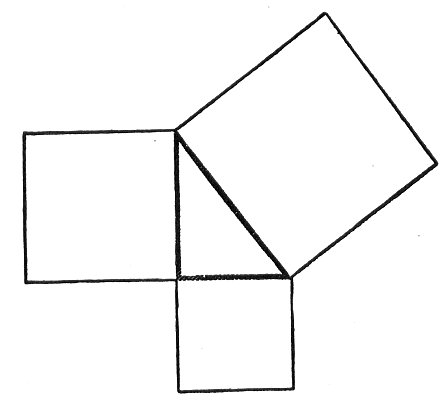
* * * * * * The Forty-seventh Proposition is older than Pythagoras. It is this: “In every right-angled triangle, the sum of the squares of the base and perpendicular is equal to the square of the hypothenuse.”
p. 87
The square of a number is the product of that number, multi-plied by itself. Thus, 4 is the square of 2, and 9 of 3.
| The first ten numbers are: |
1, 2, 3, 4, 5, 6, 7, 8, 9, 10; |
| their squares are |
1, 4, 9, 16, 25, 36, 49, 64, 81, 100; |
| and |
3, 5, 7, 9, 11, 13, 15, 17, 19 |
Moe is the founder of GnosticWarrior.com. He is a father, husband, author, martial arts black belt, and an expert in Gnosticism, the occult, and esotericism.
by Moe
p. 62
* * * * * * To understand literally the symbols and allegories of Oriental books as to ante-historical matters, is willfully to close our eyes against the Light. To translate the symbols into the trivial and commonplace, is the blundering of mediocrity.
All religious expression is symbolism; since we can describe only what we see, and the true objects of religion are THE SEEN. The earliest instruments of education were symbols; and they and all other religious forms differed and still differ according to external circumstances and imagery, and according to differences of knowledge and mental cultivation. All language is symbolic, so far as it is applied to mental and spiritual phenomena and action. All words have, primarily, a material sense, however they may afterward get, for the ignorant, a spiritual non-sense. “To retract,” for example, is to draw back, and when applied to a statement, is symbolic, as much so as a picture of an arm drawn back, to express the same thing, would be. The very word “spirit” means “breath,” from the Latin verb spiro, breathe.
To present a visible symbol to the eye of another is not necessarily to inform him of the meaning which that symbol has to you. Hence the philosopher soon superadded to the symbols explanations addressed to the ear, susceptible of more precision, but less effective and impressive than the painted or sculptured forms which he endeavored to explain. Out of these explanations grew by degrees a variety of narrations, whose true object and meaning were gradually forgotten, or lost in contradictions and incongruities. And when these were abandoned, and Philosophy resorted to definitions and formulas, its language was but a more complicated symbolism, attempting in the dark to grapple with and picture ideas impossible to be expressed. For as with the visible symbol, so with the word: to utter it to you does not inform you of the exact meaning which it has to me; and thus religion and philosophy became to a great extent disputes as to the meaning
p. 63
of words. The most abstract expression for DEITY, which language can supply, is but a sign or symbol for an object beyond our comprehension, and not more truthful and adequate than the images of OSIRIS and VISHNU, or their names, except as being less sensuous and explicit. We avoid sensuousness only by resorting to simple negation. We come at last to define spirit by saying that it is not matter. Spirit is–spirit.
A single example of the symbolism of words will indicate to you one branch of Masonic study. We find in the English Rite this phrase: “I will always hail, ever conceal, and never reveal;” and in the Catechism, these:
Q∴ “I hail.”
A∴ “I conceal;”
and ignorance, misunderstanding the word “hail,” has interpolated the phrase, “From whence do you hail!'”
But the word is really “hele,” from the Anglo-Saxon verb elan, helan, to cover, hide, or conceal. And this word is rendered by the Latin verb tegere, to cover or roof over. “That ye fro me no thynge woll hele,” says Gower. “They hele fro me no priuyte,” says the Romaunt of the Rose. “To heal a house,” is a common phrase in Sussex; and in the west of England, he that covers a house with slates is called a Healer. Wherefore, to “heal” means the same thing as to “tile,”–itself symbolic, as meaning, primarily, to cover a house with tiles,–and means to cover, hide, or conceal. Thus language too is symbolism, and words are as much misunderstood and misused as more material symbols are.
Symbolism tended continually to become more complicated; and all the powers of Heaven were reproduced on earth, until a web of fiction and allegory was woven, partly by art and partly by the ignorance of error, which the wit of man, with his limited means of explanation, will never unravel. Even the Hebrew Theism became involved in symbolism and image-worship, borrowed probably from an older creed and remote regions of Asia,–the worship of the Great Semitic Nature-God AL or ELS and its symbolical representations of JEHOVAH Himself were not even confined to poetical or illustrative language. The priests were monotheists: the people idolaters.
Moe is the founder of GnosticWarrior.com. He is a father, husband, author, martial arts black belt, and an expert in Gnosticism, the occult, and esotericism.
by Moe
p. 42
folded back upon themselves. In the vast cosmical changes the universal life comes and goes in unknown quantities, enveloping all in the invisible mystery of the emanations, losing no dream from no single sleep, sowing an animalcule here, crumbling a star there, oscillating and winding in curves; making a force of Light, and an element of Thought; disseminated and indivisible, dissolving all save that point without length, breadth, or thickness, The MYSELF; reducing everything to the Soul-atom; making everything blossom into God; entangling all activities, from the highest to the lowest, in the obscurity of a dizzying mechanism; hanging the flight of an insect upon the movement of the earth; subordinating, perhaps, if only by the identity of the law, the eccentric evolutions of the comet in the firmament, to the whirlings of the infusoria in the drop of water. A mechanism made of mind, the first motor of which is the gnat, and its last wheel the zodiac.
A peasant-boy, guiding Blücher by the right one of two roads, the other being impassable for artillery, enables him to reach Waterloo in time to save Wellington from a defeat that would have been a rout; and so enables the kings to imprison Napoleon on a barren rock in mid-ocean. An unfaithful smith, by the slovenly shoeing of a horse, causes his lameness, and, he stumbling, the career of his world-conquering rider ends, and the destinies of empires are changed. A generous officer permits an imprisoned monarch to end his game of chess before leading him to the block; and meanwhile the usurper dies, and the prisoner reascends the throne. An unskillful workman repairs the compass, or malice or stupidity disarranges it, the ship mistakes her course, the waves swallow a Cæsar, and a new chapter is written in the history of a world. What we call accident is but the adamantine chain of indissoluble connection between all created things. The locust, hatched in the Arabian sands, the small worm that destroys the cotton-boll, one making famine in the Orient, the other closing the mills and starving the workmen and their children in the Occident, with riots and massacres, are as much the ministers of God as the earthquake; and the fate of nations depends more on them than on the intellect of its kings and legislators. A civil war in America will end in shaking the world; and that war may be caused by the vote of some ignorant prize-fighter or crazed fanatic in a city or in a Congress, or of some stupid boor in an obscure country parish. The
p. 43
electricity of universal sympathy, of action and reaction, pervades everything, the planets and the motes in the sunbeam. FAUST, with his types, or LUTHER, with his sermons, worked greater results than Alexander or Hannibal. A single thought sometimes suffices to overturn a dynasty. A silly song did more to unseat James the Second than the acquittal of the Bishops. Voltaire, Condorcet, and Rousseau uttered words that will ring, in change and revolutions, throughout all the ages.
Remember, that though life is short, Thought and the influences of what we do or say are immortal; and that no calculus has yet pretended to ascertain the law of proportion between cause and effect. The hammer of an English blacksmith, smiting down an insolent official, led to a rebellion which came near being a revolution. The word well spoken, the deed fitly done, even by the feeblest or humblest, cannot help but have their effect. More or less, the effect is inevitable and eternal. The echoes of the greatest deeds may die away like the echoes of a cry among the cliffs, and what has been done seem to the human judgment to have been without result. The unconsidered act of the poorest of men may fire the train that leads to the subterranean mine, and an empire be rent by the explosion.
The power of a free people is often at the disposal of a single and seemingly an unimportant individual;–a terrible and truthful power; for such a people feel with one heart, and therefore can lift up their myriad arms for a single blow. And, again, there is no graduated scale for the measurement of the influences of different intellects upon the popular mind. Peter the Hermit held no office, yet what a work he wrought!
* * * * * * From the political point of view there is but a single principle,–the sovereignty of man over himself. This sovereignty of one’s self over one’s self is called LIBERTY. Where two or several of these sovereignties associate, the State begins. But in this association there is no abdication. Each sovereignty parts with a certain portion of itself to form the common right. That portion is the same for all. There is equal contribution by all to the joint sovereignty. This identity of concession which each makes to all, is EQUALITY. The common right is nothing more or less than the protection of all, pouring its rays on each. This protection of each by all, is FRATERNITY.
Moe is the founder of GnosticWarrior.com. He is a father, husband, author, martial arts black belt, and an expert in Gnosticism, the occult, and esotericism.
by Moe
p. 22
IN the Ancient Orient, all religion was more or less a mystery and there was no divorce from it of philosophy. The popular theology, taking the multitude of allegories and symbols for realities, degenerated into a worship of the celestial luminaries, of imaginary Deities with human feelings, passions, appetites, and lusts, of idols, stones, animals, reptiles. The Onion was sacred to the Egyptians, because its different layers were a symbol of the concentric heavenly spheres. Of course the popular religion could not satisfy the deeper longings and thoughts, the loftier aspirations of the Spirit, or the logic of reason. The first, therefore, was taught to the initiated in the Mysteries. There, also, it was taught by symbols. The vagueness of symbolism, capable of many interpretations, reached what the palpable and conventional creed could not. Its indefiniteness acknowledged the abstruseness of the subject: it treated that mysterious subject mystically: it endeavored to illustrate what it could not explain; to excite an appropriate feeling, if it could not develop an adequate idea; and to make the image a mere subordinate conveyance for the conception, which itself never became obvious or familiar.
Thus the knowledge now imparted by books and letters, was of old conveyed by symbols; and the priests invented or perpetuated a display of rites and exhibitions, which were not only more attractive to the eye than words, but often more suggestive and more pregnant with meaning to the mind.
Masonry, successor of the Mysteries, still follows the ancient manner of teaching. Her ceremonies are like the ancient mystic shows,–not the reading of an essay, but the opening of a problem, requiring research, and constituting philosophy the arch-expounder. Her symbols are the instruction she gives. The lectures are endeavors, often partial and one-sided, to interpret these symbols. He who would become an accomplished Mason must not be content merely to hear, or even to understand, the lectures; he
p. 23
must, aided by them, and they having, as it were, marked out the way for him, study, interpret, and develop these symbols for himself.
* * * * * * Though Masonry is identical with the ancient Mysteries, it is so only in this qualified sense: that it presents but an imperfect image of their brilliancy, the ruins only of their grandeur, and a system that has experienced progressive alterations, the fruits of social events, political circumstances, and the ambitious imbecility of its improvers. After leaving Egypt, the Mysteries were modified by the habits of the different nations among whom they were introduced, and especially by the religious systems of the countries into which they were transplanted. To maintain the established government, laws, and religion, was the obligation of the Initiate everywhere; and everywhere they were the heritage of the priests, who were nowhere willing to make the common people co-proprietors with themselves of philosophical truth.
Masonry is not the Coliseum in ruins. It is rather a Roman palace of the middle ages, disfigured by modern architectural improvements, yet built on a Cyclopæan foundation laid by the Etruscans, and with many a stone of the superstructure taken from dwellings and temples of the age of Hadrian and Antoninus.
Christianity taught the doctrine of FRATERNITY; but repudiated that of political EQUALITY, by continually inculcating obedience to Cæsar, and to those lawfully in authority. Masonry was the first apostle of EQUALITY. In the Monastery there is fraternity and equality, but no liberty. Masonry added that also, and claimed for man the three-fold heritage, LIBERTY, EQUALITY, and FRATERNITY.
It was but a development of the original purpose of the Mysteries, which was to teach men to know and practice their duties to themselves and their fellows, the great practical end of all philosophy and all knowledge.
Truths are the springs from which duties flow; and it is but a few hundred years since a new Truth began to be distinctly seen; that MAN IS SUPREME OVER INSTITUTIONS, AND NOT THEY OVER HIM. Man has natural empire over all institutions. They are for him, according to his development; not he for them. This seems to us a very simple statement, one to which all men, everywhere, ought to assent. But once it was a great new Truth,—not
Moe is the founder of GnosticWarrior.com. He is a father, husband, author, martial arts black belt, and an expert in Gnosticism, the occult, and esotericism.
by Moe
p. 1
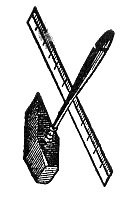
THE TWELVE-INCH RULE AND THE COMMON GAVEL.
FORCE, unregulated or ill-regulated, is not only wasted in the void, like that of gunpowder burned in the open air, and steam unconfined by science; but, striking in the dark, and its blows meeting only the air, they recoil and bruise itself. It is destruction and ruin. It is the volcano, the earthquake, the cyclone;–not growth and progress. It is Polyphemus blinded, striking at random, and falling headlong among the sharp rocks by the impetus of his own blows.
The blind Force of the people is a Force that must be economized, and also managed, as the blind Force of steam, lifting the ponderous iron arms and turning the large wheels, is made to bore and rifle the cannon and to weave the most delicate lace. It must be regulated by Intellect. Intellect is to the people and the people’s Force, what the slender needle of the compass is to the ship–its soul, always counselling the huge mass of wood and iron, and always pointing to the north. To attack the citadels built up on all sides against the human race by superstitions, despotisms, and prejudices,
p. 2
the Force must have a brain and a law. Then its deeds of daring produce permanent results, and there is real progress. Then there are sublime conquests. Thought is a force, and philosophy should be an energy, finding its aim and its effects in the amelioration of mankind. The two great motors are Truth and Love. When all these Forces are combined, and guided by the Intellect, and regulated by the RULE of Right, and Justice, and of combined and systematic movement and effort, the great revolution prepared for by the ages will begin to march. The POWER of the Deity Himself is in equilibrium with His WISDOM. Hence the only results are HARMONY.
It is because Force is ill regulated, that revolutions prove fail-tires. Therefore it is that so often insurrections, coming from those high mountains that domineer over the moral horizon, Justice, Wisdom, Reason, Right, built of the purest snow of the ideal after a long fall from rock to rock, after having reflected the sky in their transparency, and been swollen by a hundred affluents, in the majestic path of triumph, suddenly lose themselves in quagmires, like a California river in the sands.
The onward march of the human race requires that the heights around it should blaze with noble and enduring lessons of courage. Deeds of daring dazzle history, and form one class of the guiding lights of man. They are the stars and coruscations from that great sea of electricity, the Force inherent in the people. To strive, to brave all risks, to perish, to persevere, to be true to one’s self, to grapple body to body with destiny, to surprise defeat by the little terror it inspires, now to confront unrighteous power, now to defy intoxicated triumph–these are the examples that the nations need and the light that electrifies them.
There are immense Forces in the great caverns of evil beneath society; in the hideous degradation, squalor, wretchedness and destitution, vices and crimes that reek and simmer in the darkness in that populace below the people, of great cities. There disinterestedness vanishes, every one howls, searches, gropes, and gnaws for himself. Ideas are ignored, and of progress there is no thought. This populace has two mothers, both of them stepmothers–Ignorance and Misery. Want is their only guide–for the appetite alone they crave satisfaction. Yet even these may be employed. The lowly sand we trample upon, cast into the furnace, melted, purified by fire, may become resplendent crystal.
p. 3
[paragraph continues] They have the brute force of the HAMMER, but their blows help on the great cause, when struck within the lines traced by the RULE held by wisdom and discretion.
Yet it is this very Force of the people, this Titanic power of the giants, that builds the fortifications of tyrants, and is embodied in their armies. Hence the possibility of such tyrannies as those of which it has been said, that “Rome smells worse under Vitellius than under Sulla. Under Claudius and under Domitian there is a deformity of baseness corresponding to the ugliness of the tyranny. The foulness of the slaves is a direct result of the atrocious baseness of the despot. A miasma exhales from these crouching consciences that reflect the master; the public authorities are unclean, hearts are collapsed, consciences shrunken, souls puny. This is so under Caracalla, it is so under Commodus, it is so under Heliogabalus, while from the Roman senate, under Cæsar, there comes only the rank odor peculiar to the eagle’s eyrie.”
Moe is the founder of GnosticWarrior.com. He is a father, husband, author, martial arts black belt, and an expert in Gnosticism, the occult, and esotericism.