by Moe
p. 87
 THE ceremony of opening and conducting the business of a Lodge of Master Masons is nearly the same as in the Entered Apprentice and Fellow Crafts’ Degrees, already explained. All the business of a “Blue Lodge” (a Lodge of three Degrees) is done in the Lodge while opened on this Degree, except that of entering an Apprentice or passing a Fellow Craft, when the Lodge is lowered from the Masters’ Degree for that purpose.
The Third Degree is said to be the height of Ancient Free-masonry, and the most sublime of all the Degrees in Masonry (Royal Arch not even excepted); and when it is conferred, the Lodge is generally well filled with the members of the Lodge and visiting brethren.
The traditional account of the death, several burials, and resurrections of one of the craft, Hiram Abiff, the widow’s son, as developed in conferring this Degree, is very interesting.
We read in the Bible, that Hiram Abiff was one of the head workmen employed at the building of King Solomon’s Temple, and other ancient writings inform us that he was an arbiter between King Solomon and Hiram, king of Tyre; but his tragical death is nowhere recorded, except in the archives of Freemasonry. Not even the Bible, the writings of Josephus, nor any other writings, however ancient, of which we have any knowledge, furnish any information respecting his death. It is very singular, that
p. 88
a man so celebrated as Hiram Abiff was, universally acknowledged as the third most distinguished man then living, and, in many respects, the greatest man in the world, should pass from off the stage of action, in the presence of King Solomon, three thousand three hundred grand overseers, and one hundred and fifty thousand workmen, with whom he had spent a number of years, and with King Solomon, his bosom friend, without any of his numerous confrères even recording his death, or any thing about it.
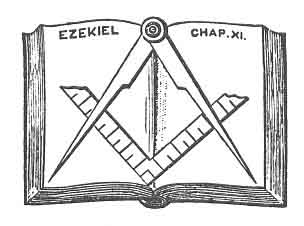
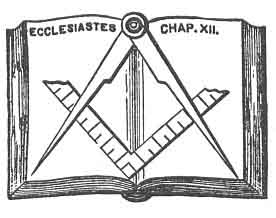
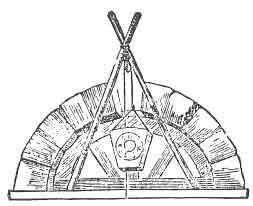
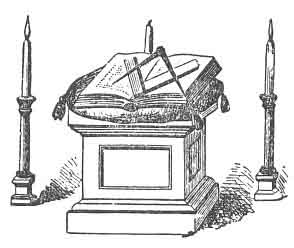 COMPASSES, PLACED IN A LODGE OF MASTER MASONS, ”BOTH POINTS ELEVATED ABOVE THE SQUARE,” (See Note B, Appendix.) COMPASSES, PLACED IN A LODGE OF MASTER MASONS, ”BOTH POINTS ELEVATED ABOVE THE SQUARE,” (See Note B, Appendix.) |
A Master Masons’ Lodge is styled by the Craft the “Sanctum Sanctorum, or Holy of Holies, of King Solomon’s Temple,” and when the Lodge is opened on this Degree, both points of the compasses are elevated above the square. (See engraving.)
A candidate for the sublime Degree of a Master Mason is generally (as in the preceding Degrees) prepared by the Junior Deacon and the two Stewards, or some other brethren acting as such.
PREPARING THE CANDIDATE
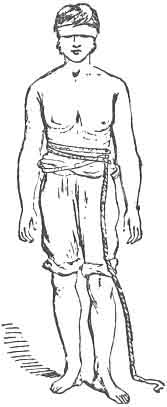
The candidate is divested of all wearing apparel, except his shirt and drawers, and if he has not the latter, he is furnished with a pair by the brethren preparing him. The drawers are rolled up just above the candidate’s knees, and both arms are taken out of his shirt-sleeves, leaving his legs and breast bare. A rope, technically called, by Masons, a cable-tow, is wound around his body three times, and a bandage, or hoodwink, is tied very closely over his eyes. (See engraving.)
When the candidate is prepared, the Deacon takes him by the left arm, leads him up to the door of the Lodge, and gives three loud, distinct knocks.
The Senior Deacon, who has stationed himself at the inner door, at the right of the Senior Warden, on hearing these raps rises to his feet, makes the sign of a Master Mason to the Master (see Fig. 6, p. 18), and says:
p. 89
Worshipful Master, while engaged in the lawful pursuit of Masonry, there is an alarm at the inner door of our Lodge.
W. M.–You will attend to the alarm, and ascertain the cause.
Senior Deacon gives three loud knocks (• • •), which are responded to by one (•) from the parties outside. The Senior Deacon then answers with one rap (•), and opens the door.
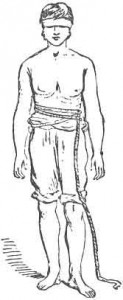 CANDIDATE DULY AND TRULY PREPARED. CANDIDATE DULY AND TRULY PREPARED. |
(See Note J, Appendix.)
Moe is the founder of GnosticWarrior.com. He is a father, husband, author, martial arts black belt, and an expert in Gnosticism, the occult, and esotericism.
by Moe
p. 150
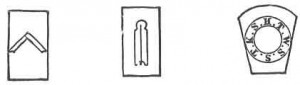
THE Degree of Mark Master, which is the Fourth in the Masonic series, is, historically considered, of the utmost importance, since we are informed that, by its influence, each operative Mason, at the building of King Solomon’s Temple, was known and distinguished, and the disorder and confusion which might otherwise have attended so immense an undertaking was completely prevented, and not only the craftsmen themselves, but every part of their workmanship was discriminated with the greatest nicety and the utmost facility.
It is claimed by Masonic writers,1 that this Degree in Masonry was instituted by King Solomon, at the building of the Temple, for the purpose of detecting impostors, while paying wages to the craftsmen. Each operative was required to put his mark upon the product of his labor, and these distinctive marks were all known to the Senior Grand Warden. If any of the workman-ship was found to be defective, it was a matter of no difficulty for the overseers to ascertain at once who was the imperfect craftsman, and remedy the defect. Thus the faulty workman was punished, without diminishing the wages of the diligent and faithful craftsmen. A candidate upon whom this Degree has been conferred is said to have been “advanced to the honorary Degree of Mark Master.”
Eight officers are necessary to open a Lodge in this Degree. viz.:
1. R. W. Master; 2. S. G. Warden; 3. J. G. Warden; 4. Senior Deacon; 5. Junior Deacon; 6. Master Overseer; 7. Senior Overseer; S. Junior Overseer.
p. 151
The officers of a Chapter rank as follows, viz.: the High Priest, as R. W. Master; King, as Senior Grand Warden; Scribe, as Junior Grand Warden; Captain of the Host, as Master of Ceremonies; Principal Sojourner, as Senior Deacon; Royal Arch Captain, as Junior Deacon; Master of the Third Veil, as Master Overseer; Master of the Second Veil, as Senior Overseer; Master of the First Veil, as .Junior Overseer. The Treasurer, Secretary, and Tyler, corresponding in rank with the same officers in other Degrees. These officers are filled by the officers of the Chapter under whose warrant the Lodge is held.
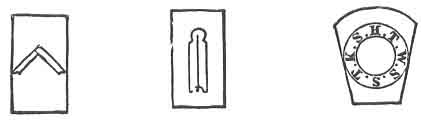
The symbolic color of the Mark Degree is purple. The apron is of white lambskin, edged with purple, and the collar of purple, edged with gold. But as Mark Lodges are no longer independent bodies, but always held under the warrant of a Royal Arch Chapter, the collars, aprons, and jewels of the Chapter are generally made use of in conferring the Mark Degree.
Lodges of Mark Masters are “dedicated to Hiram, the Builder.”
The interior arrangements of the Lodge, and the positions of the Master, Wardens, Deacons, Secretary, and Treasurer, are the same as those in the Entered Apprentices’ Degree (p. 8). The Master Overseer takes his seat on the right of the Right Worshipful Master in the east. The Senior Overseer sits on the right of the Senior Grand Warden in the west, and his Junior on the right of the Junior Grand Warden in the south.
Right Worshipful Master (giving a rap with his gavel.)–Brethren, I am about to open a Lodge of Mark Master Masons in this place, for the dispatch of business. I will thank you for your attention and assistance. If there is any person present who has not taken this Degree, he is requested to retire.
To Senior Grand Warden:
Brother Senior, are you satisfied that all present are Mark Masters?
S. G. W.–Right Worshipful, I wish the pass-word might be given by the brethren.
The two Deacons thereupon go round and receive the word, which is JOPPA, in the same manner as in the Master Mason’s Degree (p. 20).
R. W M. (giving one rap.)–Brother Junior Deacon, the first care of congregated Masons?
J. D. (rising on his feet, and, at the same time, giving a sign–see Fig. 20, p. 154.)–To see the Lodge tyled, Right Worshipful.
R. W. M.–Perform that part of your duty, and inform the Tyler that we are about to open a Lodge of Mark Master Masons
p. 152
Moe is the founder of GnosticWarrior.com. He is a father, husband, author, martial arts black belt, and an expert in Gnosticism, the occult, and esotericism.
by Moe
p. 184
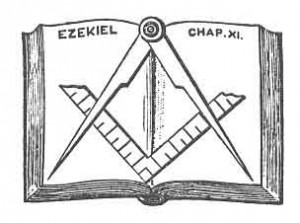 THIS degree in Masonry was instituted to try the qualifications of a Master Mason before becoming Master of a Lodge, and no Mason can constitutionally preside over a Lodge of Master Masons unless he has been admitted to this Degree. A Mason usually takes this Degree before offering himself as a candidate for presiding in a Master’s Lodge; but should it so happen that a Mason is elected Master of a Lodge who is not a Past Master, the Past Master’s Degree may be conferred upon him without any other ceremony than that of administering the obligation. In such a case it is usually done by Royal Arch Masons, acting by order of a Grand Master.
The Past Master’s Lodge consists of seven officers, as follows:–
1. Right Worshipful Master; 2. Senior Warden; 1. Junior Warden; 4. Secretary; 5. Treasurer; 6. Senior Deacon; 7. Junior Deacon.1
The interior arrangement is the same as in the first degree, and the officers are similarly seated. (See p. 8.)
p. 185
The symbolic color of the Past Master’s Degree is purple. The apron is of white lambskin, edged with purple, and should have the jewel of the Degree inscribed upon it. The collar is of purple, edged with gold. But, as Past Masters’ Lodges are held under the warrants of Royal Arch Chapters, the collars, aprons, and jewels of the Chapter are generally made use of is conferring the Past Master’s Degree.
When a Lodge of Past Masters is opened in due form, the ceremony is similar to that of a Master’s Lodge. If there is a candidate in waiting he is usually introduced into the Lodge as though it were open on the Mark Master’s Degree, and he is made a Past Master before he is aware of it. Since the many disclosures of this and other Degrees in Masonry, it requires a great deal of tact and ingenuity to confer this Degree so as to produce the effect desired. The candidate is elected to the Degree in the Royal Arch Chapter, as no business is permitted to be done in this Degree except that of initiation. Formerly it was the custom for all the members to wear their hats while conferring this Degree, but now no member wears his hat except the Right Worshipful Master. We will now proceed to give the manner of conferring this Degree “in old times,” as described by Richardson, and, at the close, will give the reader an idea of the modern way of conferring it. By comparing this with Richardson’s work, the initiated will perceive that we have made some trifling alterations, and corrected several errors which occur in that book.
A Master Mason wishing to enter on the Degree of Past Master, petitions the Chapter, and is balloted for in the same way that a candidate would be in one of the first Degrees; but he is received very differently. Having had the requisite ballot, the Junior Deacon conducts him into the Lodge, places him on a seat, and then repairs to his own station near the Senior Warden in the west. Soon after, a heavy alarm is given at the outer door.
J. D. (to the Master, rising.)–There is an alarm at the outer door, Right Worshipful.
R. W. M.–Attend to the alarm, and see who comes there.
Junior Deacon goes to the door, and soon returns, bringing a letter to the Master, who opens it, and reads aloud to the Lodge as follows:–
DEAR BROTHER–Our dear mother has been taken suddenly very ill, and the physician despairs of saving her life. Come home immediately; do not lose a moment in delay.
Your affectionate sister, ALICE. p. 186
R. W. M. (addressing the Lodge.)–Brethren, you see by the tenor of this letter to me that it is necessary I should leave immediately. You must appoint some one to fill the chair, for I cannot stay to confer this Degree.
J. W.–Right Worshipful, I certainly sympathize with you for the afflicting calamity which has befallen your family, and am sorry that it seems so urgently necessary for you to leave; but could you not stop a few moments? Brother Gabe has come on purpose to receive this Degree, and expects to receive it. I believe he is in the room, and can speak for himself; and unless he is willing to put off the ceremony, I do not see how you can avoid staying.
Moe is the founder of GnosticWarrior.com. He is a father, husband, author, martial arts black belt, and an expert in Gnosticism, the occult, and esotericism.
by Moe
p. 200
 No Mason can receive the Degree of Most Excellent Master until after he has become a Past Master, and presided in a Lodge, or, in other words, been inducted into the Oriental Chair of King Solomon. When the Temple of Jerusalem was finished,1 those who had proved themselves worthy, by their virtue, skill, and fidelity, were installed as Most Excellent Masters, and, even at this date, none but those who have a perfect knowledge of all preceding Degrees are (or should be) admitted.2
p. 201
A Lodge of Most Excellent Masters is opened in nearly the same manner as Lodges in the preceding Degrees. The officers are, a Master, Senior and Junior Wardens and Deacons, Secretary and Treasurer, and of course a Tyler.
The officers of a Chapter rank as follows:–
The High Priest, as Right Worshipful Master; King, as Senior Warden; Scribe, as Junior Warden; Principal Sojourner, as Senior Deacon; Royal Arch Captain, as Junior Deacon. The Treasurer, Secretary, and Tyler corresponding in rank with the same officers of other Degrees.
The symbolic color of the Most Excellent Master’s Degree is purple. The apron is of white lambskin, edged with purple. The collar is of purple, edged with gold. But, as Lodges of this Degree are held under warrants of Royal Arch Chapters, the collars, aprons, and jewels of the Chapter are generally made use of in conferring the Degree.
The Right Worshipful Master represents King Solomon, and should be dressed in a crimson robe, wearing a crown, and holding a sceptre in his hand.
A candidate receiving this Degree is said to be “received and acknowledged as a Most Excellent Master.”
Lodges of Most Excellent Masters are “dedicated to King Solomon.”
The officers of the Lodge are stationed as in the Entered Apprentice’s Degree, described on Page 8. The Master presiding calls the Lodge to order, and says:
Master (to the Junior Warden.)–Brother Junior, are they all Most Excellent Masters in the south?
J. W.–They are, Right Worshipful.
Master (to the Senior Warden.)–Brother Senior, are they all Most Excellent Masters in the west?
S. W.–They are, Right Worshipful.
Master–They are also in the east.
Master gives one rap, which calls up the two deacons.
Master (to Junior Deacon.)–Brother Junior, the first care of a Mason?
J. D.–To see the door tyled, Most Excellent.
Master–Attend to that part of your duty, and inform the Tyler that we are about to open this Lodge of Most Excellent Masters, and direct him to tyle accordingly.
Junior Deacon goes to the door and gives six knocks, which the Tyler from without answers by six more. He then gives one knock, which the Tyler answers with one, and he then partly
p. 202
opens the door, and informs the Tyler that by order of the Most Excellent Master a Lodge of Most Excellent Masters is now about to be opened in this place, and he must tyle accordingly. He then returns to his place and addresses the Master:
J. D.–The Lodge is tyled, Most Excellent.
Master–By whom?
J. D.–By a Most Excellent Master Mason without the door, armed with the proper implements of his office.
Master–His duty there?
J. D.–To keep off all cowans and eavesdroppers, and see that none pass or repass without permission of the Right Worshipful Master.
The Master now questions each officer of the Lodge as to his duties, which are recited by them as in the other Degrees.
Master (to Senior Warden.)–Brother Senior, you will assemble the brethren around the altar for our opening.
S. W.–Brethren, please to assemble around the altar, for the purpose of opening this Lodge of Most Excellent Master Masons.
The brethren now assemble around the altar, and form a circle, and stand in such a position as to touch each other, leaving a space for the Right Worshipful Master; they then all kneel on their left knee, and join hands, each giving his right-hand brother his left hand, and his left-hand brother his right hand; their left arms uppermost, and their heads inclining downward: all being thus situated, the Right Worshipful Master reads the following verses from Psalm xxiv:
Moe is the founder of GnosticWarrior.com. He is a father, husband, author, martial arts black belt, and an expert in Gnosticism, the occult, and esotericism.
by Moe
p. 217
 THE Royal Arch Degree seems not to have been known to what are called modern Masons as late as about 1750. That portion of the old Freemasons who met at the famous Apple-Tree Tavern, in 1717, and formed the society upon somewhat new principles, that is, so far as to admit into fellowship, indiscriminately, respectable individuals of all professions, were denominated, by the non-adherents to this plan, modern Masons. This affair caused the division of the Masonic Society into two parties, which continued till 1813, nearly one hundred years. To the rivalry occasioned by this schism, Masonry, it is presumed, is mainly indebted for the great celebrity it has obtained in the world.
It appears that the non-conformists to this new scheme, who considered themselves the orthodox party, by rummaging among the old records of the Order, first discovered the Royal Arch Degree, which had probably lain dormant for centuries; during which time, it would appear, the society had been confined almost exclusively to operative masons; who continued the ceremonies only of the apprentice, fellow-craft or journeyman, and master mason, these being deemed appropriate to their occupation.
A society of Royal Arch Masons is called a Chapter, and not a Lodge, as in the previous Degrees. All Chapters of Royal Arch Masons are “dedicated to Zerubbabel,” and the symbolic color of this Degree is scarlet. The several Degrees of Mark Master, Present or Past Master, and Most Excellent Master, are given only under the sanction of the Royal Arch Chapter; and a Master Mason who applies for these Degrees usually enters the Chapter also, and sometimes the four degrees are given at once. If he takes the four, he is only balloted for once, viz.: in the Mark Master’s Degree. Candidates receiving this Degree are said to be “exalted to the most sublime Degree of the Royal Arch.”
It is a point of the Royal Arch Degree not to assist, or be
p. 218
present, at the conferring of this Degree upon more or less than three candidates at one time. If there are not three candidates present, one or two companions, as the case may be, volunteer to represent candidates, so as to make the requisite number, or a “team,” as it is technically styled, and accompany the candidate or candidates through all the stages of exaltation.
At the destruction of Jerusalem by Nebuchadnezzar, three Most Excellent Masters were carried captives to Babylon, where they remained seventy years, and were liberated by Cyrus, King of Persia. They returned to Jerusalem to assist in rebuilding the Temple, after travelling over rugged roads on foot. They arrived at the outer veil of the Tabernacle, which was erected near the ruins of the Temple. This Tabernacle was an oblong square, enclosed by four veils, or curtains, and divided into separate apartments by four cross veils, including the west end veil or entrance. The veils were parted in the centre, and guarded by four guards, with drawn swords.
At the east end of the Tabernacle, Haggai, Joshua, and Zerubbabel usually sat in grand council, to examine all who wished to be employed in the noble and glorious work of rebuilding the Temple. Since that time, every Chapter of Royal Arch Masons, if properly formed, represents the Tabernacle erected by our ancient brethren, near the ruins of King Solomon’s Temple, and our engraving shows the interior arrangement of a Chapter of the Royal Arch Degree.1 (See Fig. 31.)
These three Most Excellent Masters, on their arrival, were introduced to the Grand Council, and employed, furnished with tools, and directed to commence their labors at the northeast corner of the ruins of the old Temple, and to clear away and remove the rubbish, in order to lay the foundation of the new. The Grand Council also gave them strict orders to preserve whatever should fall in their way (such as specimens of ancient architecture, &c.,) and bring it up for their inspection.
Among the discoveries made by the three Masters was a secret vault in which they found treasures of great benefit to the craft, &c. The ceremony of exalting companions to this Degree, is a recapitulation of the adventures of these three Most Excellent Masters, and hence it is that three candidates are necessary for an initiation.
Moe is the founder of GnosticWarrior.com. He is a father, husband, author, martial arts black belt, and an expert in Gnosticism, the occult, and esotericism.
by Moe
p. 266
ACHILLES.–Perhaps some worthy people may stare when we point out Achilles as a Freemason. What! we hear them ex-claim, is it possible that that fierce and ferocious man-slayer, nay, man-eater at heart, for he exhibited a strong propensity to cannibalism in longing to have devoured the dead body of Hector–is it possible that he could have been one of our philanthropic society? Yes, we reply, such is the actual fact, and Bonaparte was one, too, in the highest degree. But, if you will not believe Homer, or us, believe your own eyes, if, indeed, you are a Mason. Ecce signum! Behold Achilles giving Priam THE HAND, when the latter is supplicating for the body of his slain son:
“Thus having spoken, the old man’s right hand at the wristHe grasped, that he might not in any respect be alarmed in mind.”
Such is the Masonic and literal translation of the text by that illustrious Grecian and brother, Christopher North; and who will say, now, that Achilles was not a Mason?–Freemasons’ Quarterly Review.
[According to this, Brother Achilles gave Brother Priam the Master Mason’s Grip, but there is no evidence to show whether they used the word MAH-HAH-BONE, and the Five Points of Fellowship.]
ESSENTIAL SECRETS.–The essential secrets of Masonry consist of nothing more than the signs, grips, pass-words, and tokens, essential to the preservation of the society from the inroads of impostors; together with certain symbolical emblems, the technical terms appertaining to which served as a sort of universal language, by which the members of the fraternity could distinguish -each other, in all places and countries where Lodges were instituted.–Stone.
EYESIGHT.–He who has been temporarily deprived of his sight is reduced to the condition of a new-born babe, or of one of those unfortunate individuals whose natural infirmity renders the presence of a conductor indispensably necessary; but when there are no outward objects to distract his attention, it is then that with the eye of reflection he probes into the deepest and
p. 267
darkest recesses of his own heart, and discovers his natural imperfections and impurities much more readily than he could possibly have done had he not been deprived of his sight. This short deprivation of sight has kindled in his heart a spark of the brightest and purest flame. . . We must further admit, that those who have been deprived of their sight, and who have hopes of being restored to it, strive most industriously and diligently to obtain it; that they have no greater desire, and that they will most readily pledge themselves to do all that can be required of them, in order to obtain that inestimable blessing.
A man who has been deprived of his sight may be introduced into places where he is surrounded by the strangest and the rarest objects, without a possibility of his becoming a traitor. At the same time, those who are in possession of their sight cannot feel the care of their guides so much as those who are hoodwinked, and who feel that without the constant attention of their conductors they would be much more helpless than they now are; but, however many proofs of attention and care they may receive, there is still something left to wish for; and to the question, What is your chief desire? the answer will ever assuredly be, “Light.”–Gadicke.
FIVE POINTS OF FELLOWSHIP.–The five points of fellowship were thus illustrated in the lectures used by the Athol Masons of the last century:
1. When the necessities of a brother call for my support, I will be ever ready to lend him a helping hand to save him from sinking, if I find him worthy thereof.
2. Indolence shall not cause my footsteps to halt, nor wrath to turn them aside; but, forgetting every selfish consideration, I will be ever swift of foot to save, help, and execute benevolence to a fellow-creature in distress, but more particularly to a brother Mason.
3. When I offer up my ejaculations to Almighty God, I will remember my brother’s welfare, even as my own; for as the voice of babes and sucklings ascends to the throne of grace, so, most assuredly, will the breathings of a fervent heart ascend to the mansions of bliss.
Moe is the founder of GnosticWarrior.com. He is a father, husband, author, martial arts black belt, and an expert in Gnosticism, the occult, and esotericism.

 CANDIDATE DULY AND TRULY PREPARED.