by Moe
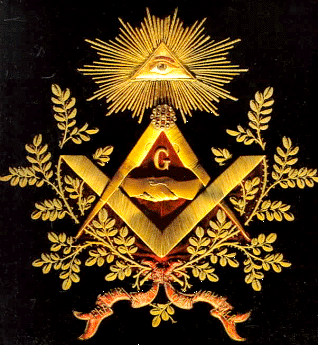 “The Blazing Star in our Lodges represent Sirius. The Blazing Star has been regarded as an emblem of Omniscience, or the All Seeing Eye, which to the Ancients was the Sun.” – Albert Pike, Morals and Dogma.
The word “Seirios” is Greek for the English “Sirius” meaning “scorching” or “sparkling.” The ancients described the rising of the star Sirius to be associated with the scorching heat of the torrid days of midsummer we know of today as the “dog-days” for this reason. The spirit of Isis was said to be in Dog Star and the Greeks called Sirius the soul and water carrier of Isis. Initiates into the Secret Mysteries of Isis wore masks representing heads of dogs. In the Kyme Aretology, Isis declares that, “I am She that riseth in the Dog Star.” The description of her star in Hesiod’s Shield of Heracles described the influence of the magic of Isis, “Of these men the souls sink into the earth into the house of Hades, but their bones, once the skin has putrefied around them, putrefy in the dark earth under the influence of scorching Sirius.”
Proverbs 2:18 – For her house leads down to death and her paths to the spirits of the dead. (more…)
Moe is the founder of GnosticWarrior.com. He is a father, husband, author, martial arts black belt, and an expert in Gnosticism, the occult, and esotericism.
by Moe
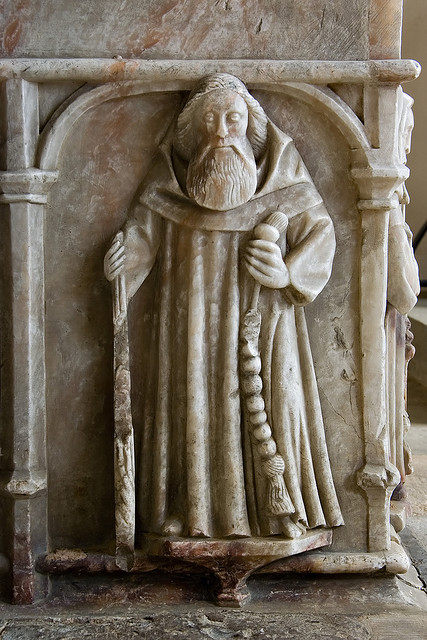 Not that many people and even Templar historians are aware of the fact that there was a secret fraternity under the Temple of Solomon who wore the cross patte on their chests long before the Knight’s Templar had become militarized in the 11th century. My research proves that they were the first men with the assignment of specifically building the Temple which would make them the first Templars and it appears that this mysterious hidden fraternity has basically flown beneath the researcher radar for centuries until now.
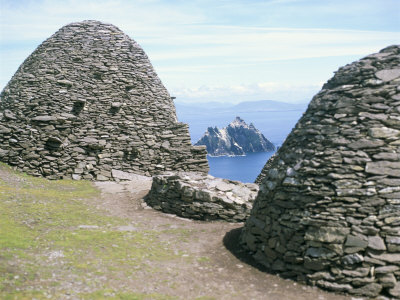
Back in the ninth century, the original Templars were simply known as the “Poor Knights of the Temple” or the “Bedesmen.” They were the predecessors to Saint Cuthbert and their founder, Saint Bede who they were named after. These Poor Knights would be the first official Templars who were in all the cathedrals of the New Foundation in the time shortly after Saint Columba of Iona in the sixth century. This was when the Irish and Scottish Celtic Druid Church who were called Culdees had joined the Roman Church to then become the official Universal Brotherhood, or what we know today as the Catholic Church. A time when Petra (Saint Peter) was made the rock of the church and Jesus the Grand Master or Cornerstone was made Christ of the new foundation in which these Bedesmen were given the task of saying prayers for the founder, Kings and knights under the Temple of Solomon and Rosy-Cross of the new law which we know as the New Testament. (more…)
Moe is the founder of GnosticWarrior.com. He is a father, husband, author, martial arts black belt, and an expert in Gnosticism, the occult, and esotericism.
by Moe
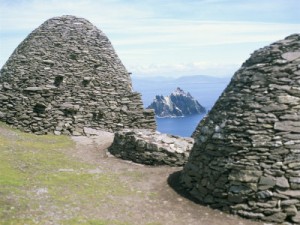 The Culdees, sometimes Kyllidei, Colidei, and Kelidei were at one time Druid Bards before they had become Christian. They had been formed in a time where it was very dangerous to be anything other than pagan. After all, the Druids had long held the title of the priestly class in Britain, Ireland, and Gaul.
A “Culdee” is an anglicisation of Céli Dé (plural of Céile Dé, lit. “client/companion of God”). The Culdees, or clergy of the order of St. Columba {or Colum, as his name was before it was Latinized) had resided on on the island of Iona or Hii-colum-kiU (Icolmkill),” the island of Columba of the Cell,” or also known as Innis nan Druidhneah (” the island of the Druids “). This would the starting point of Christianity in this area of the world when it was ruled by various tribes of peoples. Hence, this is a very important time and island in the history of Christianity.
“Isle of Columba’s cell,
where Christian piety‘s soul-cheering spark
(Kindled from heaven between the light and dark
Of time) shone like the morning star.”
The year was approximately 564 when Columba had reached the Island of Iona, on the evening of Whit-Monday, according to the annals of Innisfallen. It was said that he made the voyage in a wicker boat, covered with hides and was accompanied by twelve friends. The Druids who were in power and occupied the island had tried their best from making Columba and his crew from settling there. Saint Bede said in his book, Ecclesiastical History, I that Columba had been met with fierce opposition from the Druids whose early miracles in the country of the Picts, the greater part were performed ” in order to confound the Druids and glorify God.”
Saint Columba was born in the year 521, and was a lineal descendant, in the sixth generation, from Niall Noígíallach or known in English as Niall of the Nine Hostages, an Irish king, son of Eochaid Mugmedón, and whose mother had descended from Lorn, one of the earliest princes of the Scots. Therefor you can say that when Columba had went out to establish Christianity under the Culdees, he had a very powerful family backing him up. After all that would make Columba of royal blood as well and now would be aligned with Rome. This power play at that time that would be a new alliance between the Irish King Nial, ancestor of the Uí Néill kindred who dominated Ireland from the 6th to the 10th century and Rome.
The Culdee Church was very different than the Roman Church for they were allowed to be married and had surrounded themselves by their own families similar to how the Druid Bards had done. They were succeeded by their own sons. They also were self sufficient and supported themselves by their own labor. The differences between the Culdees and the Roman Church would often cause problems in the rocky relationship. They were protestant to the practices of the Roman church at that time and many times thereafter.
This brotherhood of the Culdees would be the one where the Scot born Saint Bede, Clement and Albinus had come from before we find thehistorical story of Clement and Albinus arrive to the court of
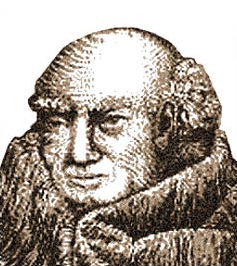
Johannes Scotus Eriugena was among the first to propose that God became the Universe, and did so to learn something about itself. (Photo credit: Wikipedia)
Charlemagne:
The court of Charlemagne was crowded with Irish scholars, and a story told by a foreign chronicler of good authority, of the arrival of two distinguished Irishmen in France during the reign of that monarch, is peculiarly characteristic. The names of these two scholars were Clement and Albinus, and they arrived on the coast of France in company with a party of merchants.
John Scotus Erigena succeeded these great evangelists, and settled at Charles the Bald’s Court
Claude Clement, known as Claude of Turin, was also of the same missionary army, labouring all around the city which has given him its name, afterwards founding the University of Paris, as John Scott, surnamed Albinus, founded the University of Pavia. In North Italy these Culdee missionaries had another representative in Sedulius, afterwards Bishop of Oreta in Spain, as Donatus similarly became bishop of the Italian Fiesole.
The Cisalpine valleys were the home of the Culdee missionaries, who did much to give them that primitive faith from which all-powerful Rome could never shake them.
In the book The Scots Worthies: In two volumes, Volume 1 By John Howie, William M’Gavin
Mention is first made of Clements and Samson, two famous Culdees, who, as we have seen in the seventh century, supported the authority of Christ as the only head of his church, against the usurped power of Rome, and who rejected the superstitious rites of Antichrist, as contrary to the simplicity of Gospel institutions. The succeeding age was still more famous for learned and pious men, to whom Scotland gave birth, and whose praise was in the churches abroad; particularly Joannes Scotus iErigena, who wrote a book upon the eucharist, which was condemned by Leo IX. in the year 1030, long after his death.
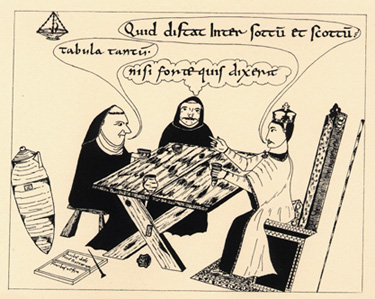
William of Malmesburyhad told the story of King Charles the Bald and John the Scot (Eriugena) were seated at the same table, when the latter did “something” which offended good Gallic manners (quod Gallicanam comitatem offendebat). Thereupon the King said: “What separates a Sot from a Scot?” To which John answered: “Only a table.”
Moe is the founder of GnosticWarrior.com. He is a father, husband, author, martial arts black belt, and an expert in Gnosticism, the occult, and esotericism.
by Moe
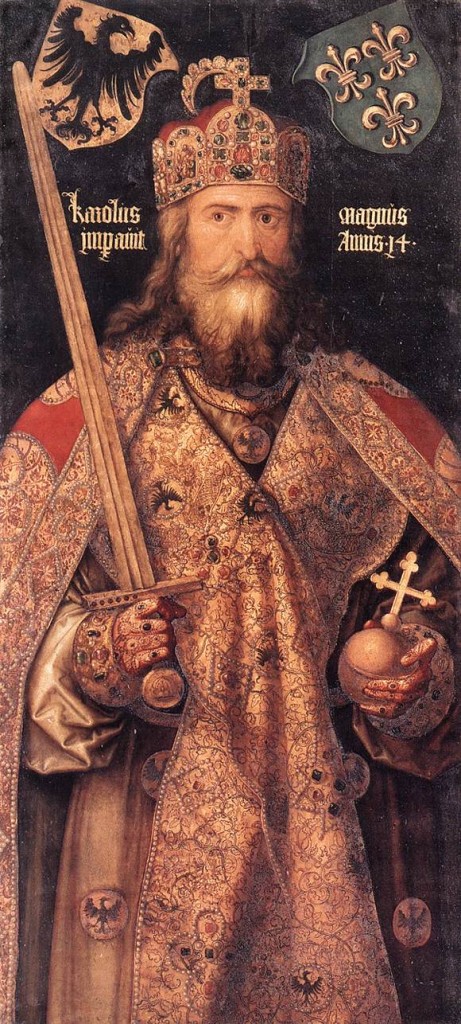
“What shall I say of Ireland,” cries Heiric, ” which, despising the dangers of the ocean, emigrates entirely with her troops of philosophers, and descends on our shores ? Her most learned masters become exiles, to place themselves under the obedience of our wise Solomon.” Charles the Bald, this Solomon, this Charlemagne,—for contemporaries give him, too, that glorious name, — had at least the merit of protecting letters, and the Irish especially. They were welcomed at their arrival, and when they could not be detained, their departure was witnessed with regret. ” This did Chromnal charge me to tell when he left, for you Irishmen are always leaving,” says Walafrid to Probus
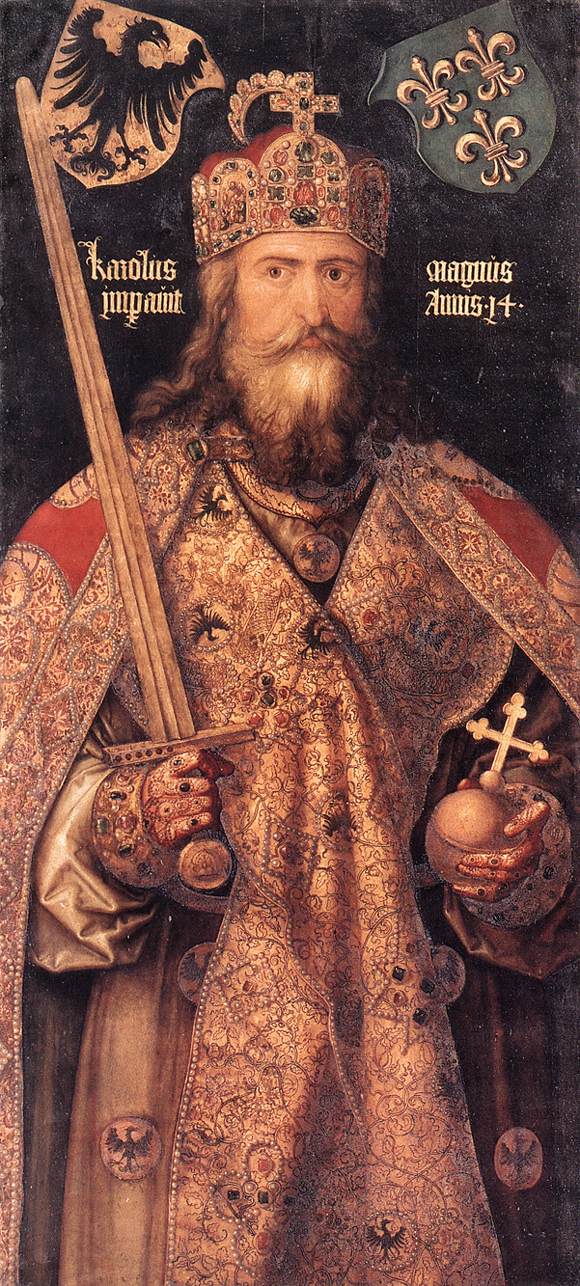
Not many Freemasons or Templars are aware of the fact that the “Father of Europe” (pater Europae), and the first “Roman Emperor” in Western Europe since the fall of the Roman Empire was named King Solomon. I know this may come as surprise to many of you that King Solomon was actually the Father of Europe and the first “Roman Emperor” in Western Europe, but it is true. However, with that said, let me state that this Western King would not be the first Solomon, but he definitely would forever be known as one of the most influential of this 6th Age.
The true birth name for the allegorical name of King Solomon would be no other than the founder of the Carolingian Empire and King of the Franks, who we know in Latin as Carolus Magnus, in English as Charles the Great, or simply King Charlemagne.
The illuminated revelations that I AM spreading here has to be one of the greatest Templar mysteries ever. The mystery of King Solomon and HiRam Abiff that no other author has been Able to uncover until now. I understand that there will be many of you who read my research that will discount it not as factual, but the facts are that these findings are well documented if you know where to search intuitively and also how to intelligently piece information together. My hopes are to connect the dots for you in the most simple and logical fashion that I know how. (more…)
Moe is the founder of GnosticWarrior.com. He is a father, husband, author, martial arts black belt, and an expert in Gnosticism, the occult, and esotericism.
by Moe
Britain, an island in the Atlantic, formerly called Albion, lies to the north-west, facing, though at a considerable distance, the coasts of Germany, France, and Spain, which form the greatest part of Europe. It extends 800 miles in length towards the north, and is 200 miles in breadth, except where several promontories extend further in breadth, by which its compass is made to be 4,875 miles. To the south lies Belgic Gaul. To its nearest shore there is an easy passage from the city of Rutubi Portus, by the English now corrupted into Reptacaestir. The distance from here across the sea to Gessoriacum, the nearest shore in the territory of the Morini, is fifty miles, or as some writers say, 450 furlongs. On the other side of the island, where it opens upon the boundless ocean, it has the islands called Orcades. Britain is rich in grain and trees, and is well adapted for feeding cattle and beasts of burden. It also produces vines in some places, and has plenty of land and water fowl of divers sorts; it is remarkable also for rivers abounding in fish, and plentiful springs. It has the greatest plenty of salmon and eels; seals are also frequently taken, and dolphins, as also whales; besides many sorts of shell-fish, such as mussels, in which are often found excellent pearls of all colours, red, purple, violet and green, but chiefly white. There is also a great abundance of snails, of which the scarlet dye is made, a most beautiful red, which never fades with the heat of the sun or exposure to rain, but the older it is, the more beautiful it becomes. It has both salt and hot springs, and from them flow rivers which furnish hot baths proper for all ages and both sexes, in separate places, according to their requirements. For water, as St. Basil says, receives the quality of heat, when it runs along certain metals, and becomes not only hot but scalding. Britain is rich also in veins of metals, as copper, iron, lead, and silver; it produces a great deal of excellent jet, which is black and sparkling, and burns when put to the fire, and when set on fire, drives away serpents; being warmed with rubbing, it attracts whatever is applied to it, like amber. The island was formerly distinguished by twenty-eight famous cities, besides innumerable forts, which were all strongly secured with walls, towers, gates, and bars. And, because it lies almost under the North Pole, the nights are light in summer, so that at midnight the beholders are often in doubt whether the evening twilight still continues, or that of the morning has come; since the sun at night returns to the east in the northern regions without passing far beneath the earth. For this reason the days are of a great length in summer, and on the other hand, the nights in winter are eighteen hours long, for the sun then withdraws into southern parts. In like manner the nights are very short in summer, and the days in winter, that is, only six equinoctial hours. Whereas, in Armenia, Macedonia, Italy, and other countries of the same latitude, the longest day or night extends but to fifteen hours, and the shortest to nine.
There are in the island at present, following the number of the books in which the Divine Law was written, five languages of different nations employed in the study and confession of the one self-same knowledge, which is of highest truth and true sublimity, to wit, English, British, Scottish, Pictish, and Latin, the last having become common to all by the study of the Scriptures. But at first this island had no other inhabitants but the Britons, from whom it derived its name, and who, coming over into Britain, as is reported, from Armorica, [Editor’s note: In Caesar’s time, the whole district lying along the northwestern coast of Gaul, afterwards narrowed down to the modern Brittany. That the Britons (or Brythons)came from Gaul is doubtless a fact. Another branch of the Celtic race, the Goidels or Gaels, appears to have been in possession in Britain before them. They possessed themselves of the southern parts thereof. Starting from the south, they had occupied the greater part of the island, when it happened, that the nation of the Picts, putting to sea from Scythia, as is reported, in a few ships of war, and being driven by the winds beyond the bounds of Britain, came to Ireland and landed on its northern shores. Editors note: By Scythia Bede means Scandinavia. He only mentions this account as a tradition. The problem of the Picts has not been solved yet. According to one view, they belonged to the pre-Aryan inhabitants of Britain, pushed westward and northward by the Celtic invaders. In Scotland they held their own for a considerable time in a wide tract of country, and they may have to some extent amalgamated with the Celts who dispossessed them (Rhys). Others regard them as Celts of the same branch as Welsh, Cornish, and Britons, being probably nearest to Cornish. The absence of all but the scantiest remains of their language makes the question of their origin one of great difficulty.] There, finding the nation of the Scots, they begged to be allowed to settle among them, but could not succeed in obtaining their request. Ireland is the largest island next to Britain, and lies to the west of it; but as it is shorter than Britain to the north, so, on the other hand, it runs out far beyond it to the south, over against the northern part of Spain, though a wide sea lies between them. The Picts then, as has been said, arriving in this island by sea, desired to have a place granted them in which they might settle. The Scots answered that the island could not contain them both; but “We can give you good counsel,” said they, “whereby you may know what to do; we know there is another island, not far from ours, to the eastward, which we often see at a distance, when the days are clear. If you will go thither, you can obtain settlements; or, if any should oppose you, we will help you.” The Picts, accordingly, sailing over into Britain, began to inhabit the northern parts thereof, for the Britons had possessed themselves of the southern. Now the Picts had no wives, and asked them of the Scots; who would not consent to grant them upon any other terms, than that when any question should arise, they should choose a king from the female royal race rather than from the male: which custom, as is well known, has been observed among the Picts to this day. In process of time, Britain, besides the Britons and the Picts, received a third nation, the Scots, who, migrating from Ireland under their leader, Reuda, either by fair means, or by force of arms, secured to themselves those settlements among the Picts which they still possess. From the name of their commander, they are to this day called Dalreudini; for, in their language, Dal signifies a part.
Moe is the founder of GnosticWarrior.com. He is a father, husband, author, martial arts black belt, and an expert in Gnosticism, the occult, and esotericism.
by Moe
IN the year of our Lord 565, when Justin, the younger, the successor of Justinian, obtained the government of the Roman empire, there came into Britain from Ireland a famous priest and abbot, marked as a monk by habit and manner of life, whose name was Columba,to preach the word of God to the provinces of the northern Picts, who are separated from the southern parts belonging to that nation by steep and rugged mountains. For the southern Picts, who dwell on this side of those mountains, had, it is said, long before forsaken the errors of idolatry, and received the true faith by the preaching of Bishop Ninias, a most reverend and holy man of the British nation, who had been regularly instructed at Rome in the faith and mysteries of the truth; whose episcopal see, named after St. Martin the bishop, and famous for a church dedicated to him (wherein Ninias himself and many other saints rest in the body), is now in the possession of the English nation. The place belongs to the province of the Bernicians, and is commonly called the White House, because he there built a church of stone, which was not usual among the Britons.
Columba came into Britain in the ninth year of the reign of Bridius, who was the son of Meilochon, and the powerful king of the Pictish nation, and he converted that nation to the faith of Christ, by his preaching and example. Wherefore he also received of them the gift of the aforesaid island whereon to found a monastery. It is not a large island, but contains about five families, according to the English computation; his successors hold it to this day; he was also buried therein, having died at the age of seventy-seven, about thirty-two years after he came into Britain to preach.Before he crossed over into Britain, he had built a famous monastery in Ireland, which, from the great number of oaks, is in the Scottish tongue called Dearmach—The Field of Oaks. From both these monasteries, many others had their beginning through his disciples, both in Britain and Ireland; but the island monastery where his body lies, has the pre-eminence among them all.
That island has for its ruler an abbot, who is a priest, to whose jurisdiction all the province, and even the bishops, contrary to the usual method, are bound to be subject, according to the example of their first teacher, who was not a bishop, but a priest and monk;of whose life and discourses some records are said to be preserved by his disciples. But whatsoever he was himself, this we know for certain concerning him, that he left successors renowned for their continence, their love of God, and observance of monastic rules. It is true they employed doubtful cycles in fixing the time of the great festival, as having none to bring them the synodal decrees for the observance of Easter, by reason of their being so far away from the rest of the world; but they earnestly practiced such works of piety and chastity as they could learn from the Prophets, the Gospels and the Apostolic writings. This manner of keeping Easter continued among them no little time, to wit, for the space of 150 years, till the year of our Lord 715.
But then the most reverend and holy father and priest, Egbert, of the English nation, who had long lived in banishment in Ireland for the sake of Christ, and was most learned in the Scriptures, and renowned for long perfection of life, came among them, corrected their error, and led them to observe the true and canonical day of Easter; which, nevertheless, they did not always keep on the fourteenth of the moon with the Jews, as some imagined, but on Sunday, although not in the proper week.For, as Christians, they knew that the Resurrection of our Lord, which happened on the first day of the week, was always to be celebrated on the first day of the week; but being rude and barbarous, they had not learned when that same first day after the Sabbath, which is now called the Lord’s day, should come. But because they had not failed in the grace of fervent charity, they were accounted worthy to receive the full knowledge of this matter also, according to the promise of the Apostle, “And if in any thing ye be otherwise minded, God shall reveal even this unto you.” Of which we shall speak more fully hereafter in its proper place.
Moe is the founder of GnosticWarrior.com. He is a father, husband, author, martial arts black belt, and an expert in Gnosticism, the occult, and esotericism.