by Moe | Aug 8, 2018 | Egypt, Meaning of Words
In researching the meaning and etymology of words for the last 10 years, I have come to the conclusion that many researchers of modernity have systematically butchered the original meanings out of existence. It has got so bad that I have found that it is much better to just to do your own research well before our modern Babylonian era.
Take for example the people who the Egyptians called the ‘Keftiu.’
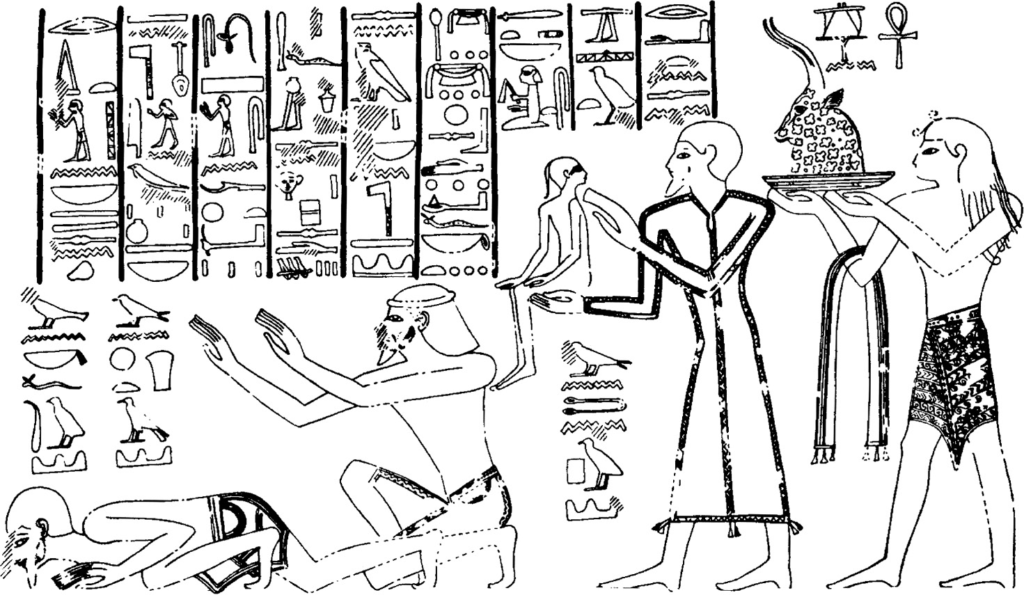
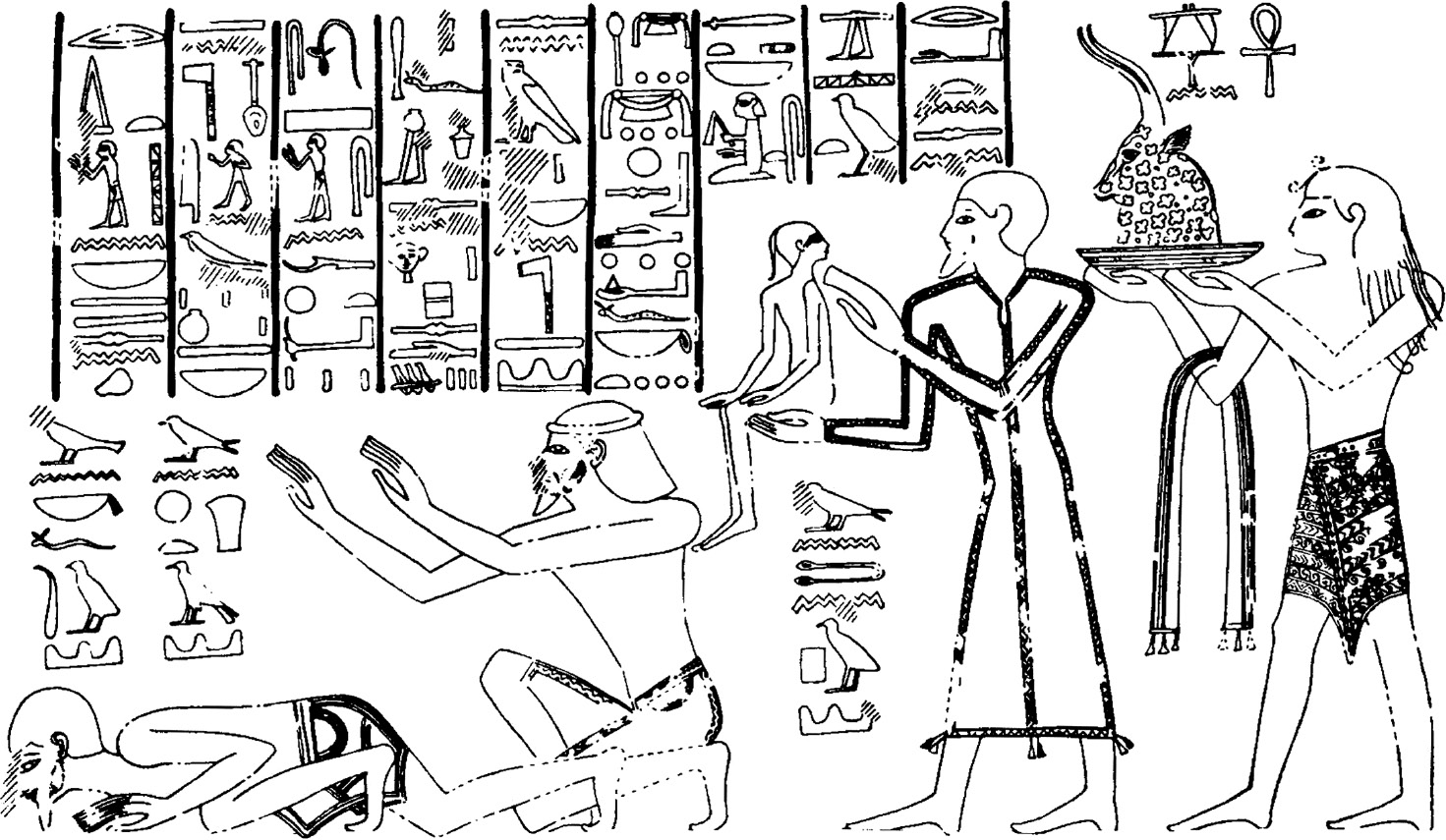
As I have explained in numerous articles, the Keftiu is just another name for the Cretans from the island in the sea called Crete which was considered the soul of the world and most powerful island for thousands of years.
If you try to research modern interpretations of the meaning and etymology of Keftiu, you will find some researchers with ludicrous meanings such as, “Those beyond or the men from the Back of Beyond; back behind; hinderland, the nail of the earth and even pillar.”
But the facts are the compound word Keftiu is derived from the words Kef or Keph and tiu or tu.
Kef is from the Greek words “kepha, kephas and or kephalé,” which mean “the head,” but also denote esoterically in religion as, “Rock, Ruler, Lord or a Cornerstone (Masonic), uniting two walls.”
The definition of Tiu we can find is borrowed from the Ancient Greek word – ταῦ (taû) which comes from the 22nd letter of the Phoenician abjad, called taw AKA ? (t) which is the Omega in the 22 letters of the Hebrew alphabet.
The taw, X, and t, all signify the mathematical formula the left and right brain bullseye in the 22 bones of the skull that we humans need to create AKA to do which must first happen in the Kef (Kepha) AKA the head.
This is why in Middle English tawen, from Old English tawian (“to do, make”), from Proto-Germanic *tawjaną (“to make, prepare”) or the Gothic ?????? (taujan, “to make, prepare”).
After all, the Ancient Egyptians had portrayed the Keftiu has the creators and makers of all sorts of crafts, buildings, and statues. Today, science has verified that Crete and the Cretans were essentially the creators of Western civilization in which they would have had to use their heads to do – AKA Kef Tiu.
Moe is the founder of GnosticWarrior.com. He is a father, husband, author, martial arts black belt, and an expert in Gnosticism, the occult, and esotericism.
by Moe | Aug 8, 2018 | Egypt, History of the Brotherhood
The connections and relations between the Ancient Egyptians and Cretans have been well documented by the historians of yesteryear. I would like to add that I believe the Egyptians were also racially and politically connected to the Cretans through the Thebans.
As I have written before, Crete was called Keftiu and Peoples of the Sea in the Ancient Egyptian texts who were often represented by the Egyptians of the XVIIIth Dynasty. The Greeks in the Old Testament called Crete by the name – Kaftor, or Caphtor. The Latins called it Cappadocia and the Arabs called the island Kerith. This same island has also been known by various names over the course of history like Arcadia, Candia, Minoa, Phoenicia, and Phrygia etc.
Today, in the tomb of Rekhmire at Thebes, we can find proof of these Cretan (Keftiu) connections that are preserved even to this day and most great researchers concur that Keftiu to be synonymous with Crete.
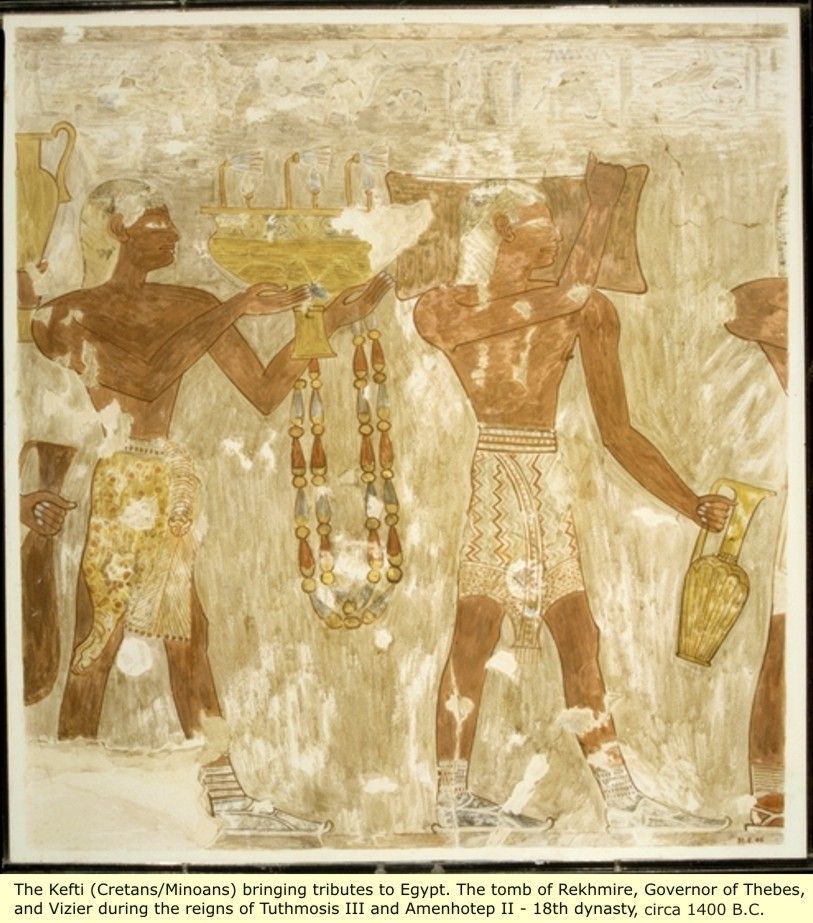
Evidence of their relations can be found in the famous tomb of the Egyptian Vizier Rekhmire at Thebes where we find the Cretans wearing different color kilts bringing tribute to their Egyptian masters. Here is Detail of Keftiu (Cretans) from TT100, Tomb of Rekhmire. (Original photo via Osirisnet)
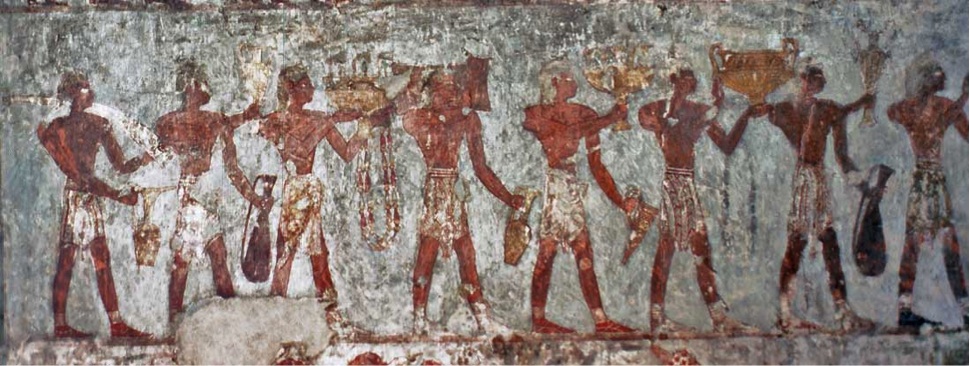
And here is another image of the Keftiu from TT100, Tomb of Rekhmire. (Original photo via Osirisnet)
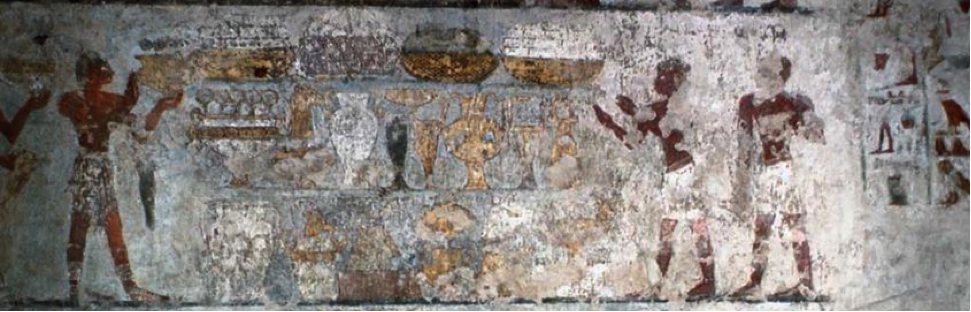
Throughout the tomb of Rekhmire, there are various paintings of fine dark red-skinned Cretan men with both dark brown and blonde hair wearing their symbolic kilts of different colors signifying their various ranks. Some of the men also all wear the upturned sandals with straps, indicative of the Israelites along with colorful leggings.
You will also find some of their heads shaven and others with a full head of hair with a carefully designed curl flowing down to their waists which also help signify their rank. The High Priests wore their hair long and the lower ranks of scribes, musicians, masons, and artificers wore their hair short.
Today we see a similar tradition in Christianity with the Orthodox Priests of the East wearing their hair long and the Roman Catholic of the West wear their hair short.
In these images, we see the Cretans bringing the various products of their fine crafts mainly vessels of gold and silver, jugs, drinking cups, amphorae, and rhytons. They also provide the products they have obtained by trade such as ingots and rings of silver, daggers, chains and pieces of lapis lazuli.
The Tribute is piled up at the feet of the scribes who would make records for the Pharaoh and royal court.
In the text titles the “Instructions to the Vizier,” we discover that the Egyptian royal court at Thebes had relations with the Island of Crete (Keiftu) whom they also governed and taxed.
The text notes that the Prince of Punt is coming with his tribute bringing it to the Pharaoh. Coming after the Tribute of Punt we find the “Princes of Crete and the islands of the Mediterranean.”
The chiefs from Crete are “bent and bowing before the might of his majesty.”
The accompanying text reads, “Coming in peace by the Great of Crete, islands that are in the middle of the sea, bending, bowing of the head, because of the power of His Majesty, the King of Lower Egypt, Menkheperre, given life forever, on learning of his strength in all foreign countries, their tribute being on their backs, in order that they may be given the breath of life, desiring to be faithful (literally: to be upon the water) to His Majesty, to ensure that his power protects them. It is the confidant of the King, Mayor of the City, Vizier Rekhmire, who receives all the tribute of all foreign countries, which are brought due to the power of His Majesty.”
His image is completely erased. Facing left, he witnessed the tribute ceremony. The accompanying text states;
“Receiving the attendants of the Southern regions along those of Punt, the Retenu (Syria-Palestine) attendants, the Cretan attendants, along with the loot from all foreign countries foreign, which has been sent through power of His Majesty, the King of Upper and Lower Egypt (Menkheperre) | living forever, by the Prince, Governor, Great among Greats, Dignitary among Friends, Director of the chief Works, efficient confidant of the sovereign, the one causing he who is in the Palace to praise him and to place him at the head of (his) friends, and as top chief of the entire country, (because) he recognized (him) as one who achieved useful things. The example is for him; his venerable status is before him, the Mayor of the City, the Vizier Rekhmire”.
Rekhmire is followed by six officials (called ‘friends’ or ‘companion’s) each carrying in his left hand a plant branch. Above them is the text:
“Friends of the Palace – life, health, strength – coming before the Vizier, reciting prayers. They recite a joyous chant:
The sovereign, the one whose monuments are perfect.
Menkheperre Every office is upheld, regions and cities are established, laws and regulations are enduring for their effects.
The children of Dignitaries are in the office of their fathers May he continue (literally again)… to do the same for millions of years. He is durable and stable on the throne of Horus. May he come to repeat the Sed-festival.
May he guide the living for eternity”.
This text shows that they clear the way for the Vizier who leaves the throne room after the King’s speech. Behind them appears to be a person holding a stick who must have been a guard which has almost completely disappeared.
Moe is the founder of GnosticWarrior.com. He is a father, husband, author, martial arts black belt, and an expert in Gnosticism, the occult, and esotericism.
by Moe | Aug 7, 2018 | Freemasonry, Mystical Christianity
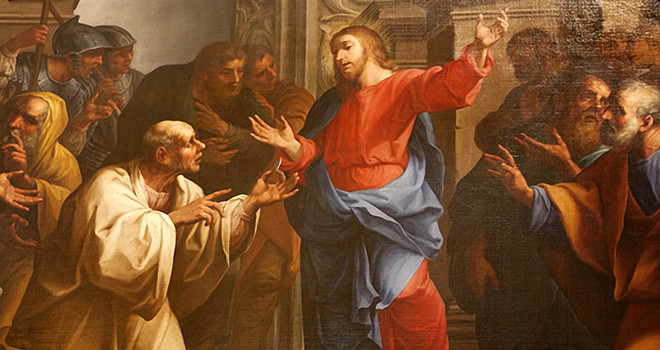
Jesus had said to the scribes and Pharisees, “Woe to you experts in the law! For you have taken away the key to knowledge. You yourselves have not entered, and you have hindered those who were entering.” As Jesus went on from there, the scribes and Pharisees began to oppose Him bitterly and to ply Him with questions about many things.” (Luke 11:52)
The Lord speaking to his Apostilistic Pharisees had proclaimed, “I am from above, ye are from beneath.”
These prophetic words indicate both the religious and political roles that the Pharisees had administered during the formation of the ministry of Jesus. What is interesting is that these Pharisees he says are from beneath and he is from above which shows it was a carefully constructed dual ministry (Light & Dark – Truth & Lies – Politics – Heaven & Hell) via the Masonic chessboard right from the beginning of this 6th Age.
The Masonic Pharisees of Jesus
When I research the formation and the political roles of this secret society of some of the world’s most celebrated Apostles, I see many parallels with modern Masonry who may very well be the modern descendants of the teachings of the Pharisee #33 global rule of Golgatha – ORDO AB CHAO.
Some of the most famous men in the religious history of the civilized world were members of this very powerful ancient secret political society. Pharisees like Saint Paul, Judas Maccabaeus, John Hyrcanus and the Roman-Jewish Historian – Josephus.
Most of our modern knowledge of the Pharisees comes down to us from Josephus in the first century of this 6th Age. He explains that they were kin (related/Family) to the sect known in Ancient Greece as the Stoics but that the Pharisees were able to make great opposition to kings, cause great mischief and when the Jews swore their allegiance to Caesar, the Pharisees did not swear.
Like the Masons of today, Josephus said that they had the power of true royal authority to become the real administrators of public affairs. Josephus writes;
“Being now nineteen years old, I began to conduct myself according to the rule of the sect of the Pharisees, which is kin to the sect of the Stoics, as the Greeks call them.
These are they that are called the sect of the Pharisees, who were able to make great opposition to kings; a cunning sect they were, and soon elevated to a pitch of open fighting and doing mischief.
Accordingly, when all the people of the Jews gave assurance of their goodwill to Caesar and to the king’s government, these men did not swear, being about six thousand.”
Joseph also states that they have the power to make freemen by the binding and loosing of souls. He had written;
“The Pharisees artfully insinuated themselves into Queen Alexandra’s favour by little and little, and became the real administrators of public affairs; they banished and restored whom they pleased; they bound and loosed at their pleasure; they had the enjoyment of the royal authority, while the expenses and the difficulties of it belonged to Alexandra.”
In studying the modern history of Masonry, we also find that the Masons have been involved in various important and what some call occult governments like here in the U.S. with the creation of its capital named after the first Freeman AKA Freemason – Washington.
Freemasons today are also heavily involved in all legal systems throughout the world and of course, their involvement in some of the world’s most famous revolutions such as the Masonic French Revolution in the 18th century.
One of the most important of the 12 Apostles, the Apostle Paul, declared himself to be a Pharisee before his conversion to Christianity. We do not know much about Paul’s family or upbringing, but we know that both his father and teacher had belonged to this secret society.
Paul stated that he was “a Pharisee, the son of a Pharisee” in Acts 23:6, and he “was educated by Gamaliel, a Pharisee.”
St. Paul mentions he is a Pharisee after he was arrested and put on trial – “And when he had so said, there arose a dissension between the Pharisees and the Sadducees: and the multitude was divided. . . . And there arose a great cry; and the Scribes that were of the Pharisees’ part arose, and strove, saying, We find no evil in this man.”
Pleading before King Agrippa in the presence of Festus, Paul says;
“The Jews knew me from the beginning, if they would testify, that after the most straitest sect of our religion I lived a Pharisee.”
Moe is the founder of GnosticWarrior.com. He is a father, husband, author, martial arts black belt, and an expert in Gnosticism, the occult, and esotericism.

by Moe | Aug 7, 2018 | Gnosis
It was once said that Tony Blair was so obsessed with David Bowie that he delayed a Cabinet meeting to discuss Bowie’s latest album.
Recently, a question has been circulating on the internet, “Was Tony Blair behind David Bowie’s fascination with Gnosticism?”
Apparently, the inquiry is in regards to the time in 1998 when Bowie visited Blair at Chequers. It was reported that Blair gave the star a Gnostic gift – The Gnostic Gospels by Elaine Pagels.
Later Bowie listed the book in his top 100 of all time.
In my article, David Bowie’s Gnostic Obsession With the Occult, Nazis, and Cocaine, I detail how Bowie was interested in the occult and Gnosticism. In 1976, he had said, “My overriding interest was Kabbalahah and Crowleyism.”
Bowie said, “That whole dark and rather fearsome never–world of the wrong side of the brain.” … And more recently, in 1995 he stated, ‘I’ve been interested in the Gnostics.’
So, there we have it.
David Bowie’s interest in the occult and Gnosticism had started well before Tony Blair gave him The Gnostic Gospels.
Moe is the founder of GnosticWarrior.com. He is a father, husband, author, martial arts black belt, and an expert in Gnosticism, the occult, and esotericism.
by Moe | Aug 5, 2018 | Mystical Christianity
The cock (rooster / Gallus) is a very important symbol for the Ancient Brotherhood.
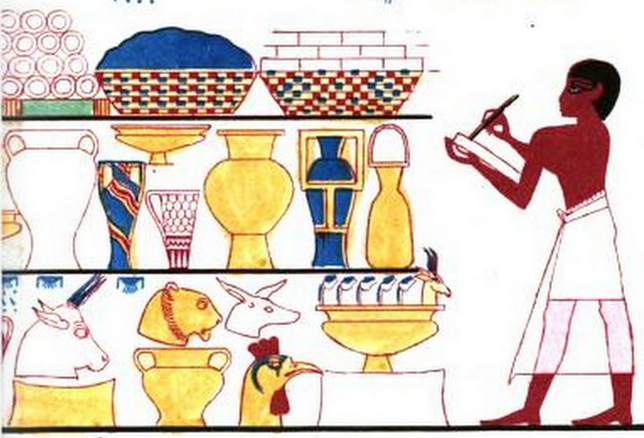
In researching the origins of this symbol, I have found one of the earliest depictions of a cock that we have discovered ironically is at Thebes in the Valley of the Kings at the tomb of who I call – Grand Master Rekhmire.
Rekhmire was one of the most powerful people in all of Egypt as the Vizier for Pharaoh’s Thutmose III (1458-1425 BCE) and his son Amenhotep II (1425-1400 BCE).
The head of a cock can be easily seen in a Tribute to the Keiftu who we know today are the Cretans.
Modern archeologists claim that the Cock was unknown to the ancient Egyptians until their Brethren, the Keiftu AKA the Cretans had introduced into North African lands.
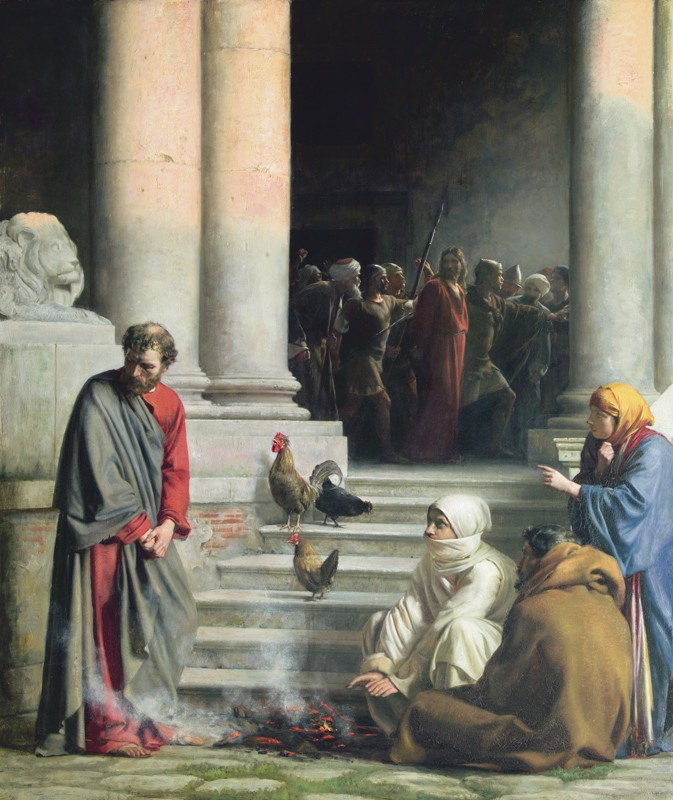
As I have mentioned before, the ancient Egyptians had called the Holy Island of Crete by the name Keiftu and this is where we find The Galileans from the River Galilee with The Supernatural Holy Cock With His Little Peters of Galilee and their House of Judgment.
Let me also remind some of you that Crete is considered by modern scientists to be the birthplace of Western Civilization which is also home to the Law Givers (ie: Minoans AKA Gnostics) of the world from the ancient City of Gnosis – Knossos. Gnostics like the 7th Century B.C. Savior of Athens, the tattooed Epimenides Gnosis and the mythical Archons such as Solon and Minos.
Like these Cretan lawgivers, Rekhmire was also known as a lawgiver who held the royal title of Vizier which is the highest-ranking government official with absolute power of attorney and dismissible only by the Pharaoh himself. In my opinion, the Cretans who we know are Phoenicians held their power at both Crete at Knossos and in North Africa at the City of the Ark, Thebes
A more well-known depiction of the cock has been found on a metal vase in between two tombs in the Valley of the Kings at the tomb of Rekhmire.
Moe is the founder of GnosticWarrior.com. He is a father, husband, author, martial arts black belt, and an expert in Gnosticism, the occult, and esotericism.