by Moe
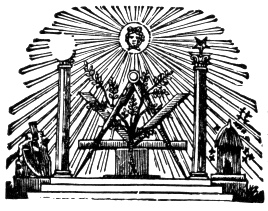
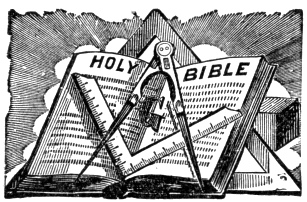
The Holy Bible ought to be opened at the 7th chapter of Amos and one point of the compass elevated above the square.
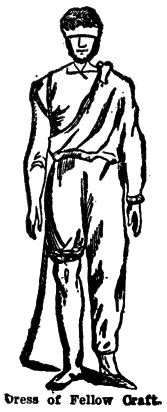
Preparation of Candidate Fellow Craft Degree.—He is ushered into the “preparation room” as before, and divested of all his clothing as in the preceding degree. In this case the right leg of the old drawers is raised up above the knee, the right sleeve of the shirt is rolled up above the elbow, the slipper is now put upon the left foot, the left heel being slip shod. The hoodwink is again put over both eyes and the cable-tow is put twice around the naked right arm and an apron tied on, in which condition he is “duly and truly prepared” and led by the Junior Deacon to the door of the lodge as before.
p. 107
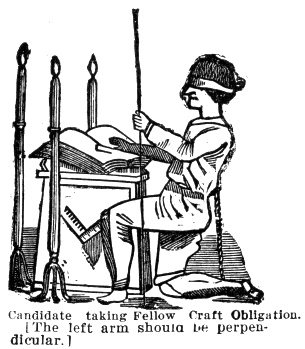
Worshipful Master to Candidate:—You will advance to the altar, kneel upon your naked right knee, your left forming a square, your right hand resting on the Holy Bible, square and compass, your left forming a right angle Supported by the square in which due form you will say, “I,” with your name in full, and repeat after me.
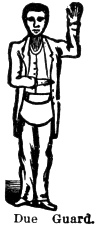
Due Guard of a Fellow Craft.—Hold out the right hand a little from the body and on a line with the lower button of the vest, the palm being open and turned down-ward; also raise the left arm so as to form a right angle at the elbow, from the shoulder to the elbow being horizontal and fore-arm perpendicular.
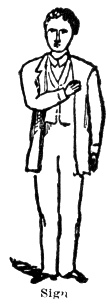
Sign of a Fellow Craft.—Made from the due-guard by dropping the left hand carelessly to the side and at Om same time raise the right hand to the left breast, with the palm towards the breast and the fingers a little crooked; then draw the hand smartly across the breast from left to right and let it drop perpendicularly to the side.
Sign without Due Guard.—The usual way outside the lodge). Draw the right hand, palm open and fingers a little crooked, smartly across the breast from left to right and drop it carelessly by your side.
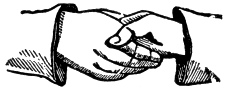
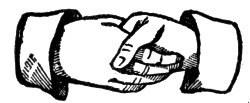
Pass Grip of a Fellow Craft.—Take each other’s hands as in ordinary hand-shaking and press the top of your thumb hard against the space between the first and second knuckles of the right hand. Should the person whose hand you hold be a Fellow Craft, he will return a like pressure on your hand, or else may give you the grip of an Entered Apprentice.
p. 108
Pass of Fellow Craft—Shibboleth. It is the name of this grip.
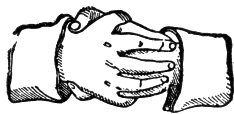
Real Grip of a Fellow Craft.—Take each other by the right hand as in ordinary hand-shaking and press top of your thumb hard against the second knuckle. Should the man whose hand you shake be a Fellow Craft, he will return a similar pressure on your hand, or may possibly give you any one of the two preceding grips.
Word of Fellow Craft—Jachin. It is the name of this the real grip.
Fellow Craft or Second Step.—Step off one step with the right foot and bring the heel of the left foot to the hollow of the right; your feet forming the angle of an oblong square.
Moe is the founder of GnosticWarrior.com. He is a father, husband, author, martial arts black belt, and an expert in Gnosticism, the occult, and esotericism.
by Moe
The Holy Bible ought to be opened at the 12th chapter of Ecclesiastes and both points of the compass elevated above the square.
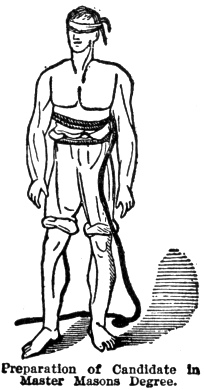
Preparation of Candidate Master Mason’s Degree.—He is conducted into the preparation room as in the preceding degree. All his clothing is removed as before; both legs of the drawers are tucked up above the knees, both sleeves of the shirt are tucked up above the elbows, both breasts of the shirt are turned, making both breasts bare. The hoodwink is again fastened over both eyes and the cable-tow is put three times around his body. No slipper is used in this degree. Should the shirt be closed in front, it must be taken off or turned front backwards, as both breasts must be bare. An apron is then tied on and worn as a Fellow Craft, and thus he is “duly and truly prepared.”
p. 109
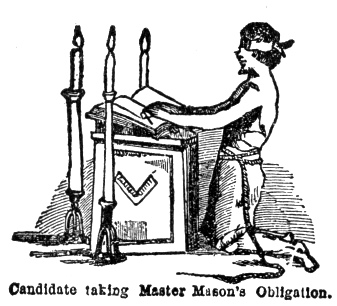
Worshipful Master to Candidate, “You will advance to the altar, kneel upon both your naked knees, both hands resting n the Holy Bible, square and compass in which due form you will say, “I,” with your name in full and repeat after me”
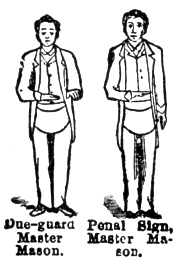
Due-Guard of a Master Mason.—Extend both hands in front of the body on a line with the lower button of the vest with the palms open and turned downward, both hands being close together, thumbs nearly touching.
Sign of a Master Mason.—Made from the due guard by dropping the left hand carelessly and drawing the right across the body from left to right side on a line with the lower button of the vest, the hand being open as before, palm down. ward and the thumb towards the body. Then drop the hand perpendicularly to the side.
Sign without Due-guard.—(Ordinary manner outside the lodge.) Simply draw the right hand as above described, carelessly across the body and drop it by the side.
Pass-Grip of a Master Mason—Take hold of each other’s hands as in ordinary hand shaking and press the top of your thumb hard against the space between the second and third knuckles. Should the man whose hand you shake be a Mason he may return or give any previous grip.
Pass of Master Mason—Tubal Cain. It is the name of this grip.
p. 110
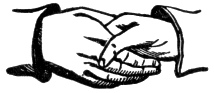
Strong Grip of a Master Mason or Lion’s Paw.—Grasp each other’s right hands very firmly, the spaces between the thumb and first finger being interlocked and the tops of the fingers being pressed hard against each other’s wrist where it joins the hand, the fingers of each being somewhat spread.
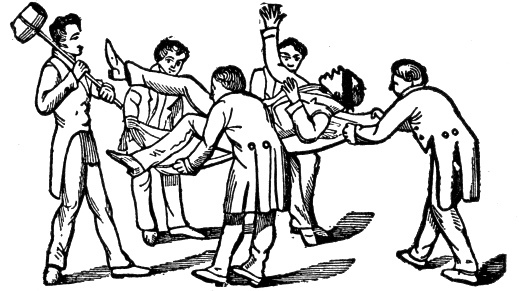 Candidate as Hiram Abiff falling into the Canvas, having been struck in the forehead by the setting maul of the supposed third ruffian, Jubelum.
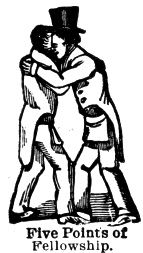
Five Points of Fellowship.
Worshipful Master:—Which are the five points of fellowship?
Senior Deacon:—Foot to foot (Master and candidate extend their right feet, placing the inside of one against that of the other). Knee to knee (they bring their right knees together); breast to breast (they bring their right breasts together); hand to back (Master places his left hand on the candidate’s back, the candidate’s is placed by the Deacon on the Master’s back); cheek to cheek or mouth to ear (Master puts his mouth to candidate’s right ear thus bringing the right cheek of each together. See figure).
Moe is the founder of GnosticWarrior.com. He is a father, husband, author, martial arts black belt, and an expert in Gnosticism, the occult, and esotericism.
by Moe
p. 839
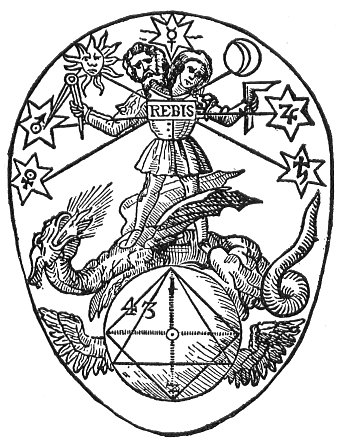
[Master of Royal Secret.]
THE Occult Science of the Ancient Magi was concealed under the shadows of the Ancient Mysteries: it was imperfectly revealed or rather disfigured by the Gnostics: it is guessed at under the obscurities that cover the pretended crimes of the Templars; and it is found enveloped in enigmas that seem impenetrable, in the Rites of the Highest Masonry.
Magism was the Science of Abraham and Orpheus, of Confucius and Zoroaster. It was the dogmas of this Science that were engraven on the tables of stone by Hanoch and Trismegistus. Moses purified and re-veiled them, for that is the meaning of the word reveal. He covered them with a new veil, when he made of the Holy Kabalah the exclusive heritage of the people of Israel,
p. 840
and the inviolable Secret of its priests. The Mysteries of Thebes and Eleusis preserved among the nations some symbols of it, al-ready altered, and the mysterious key whereof was lost among the instruments of an ever-growing superstition. Jerusalem, the murderess of her prophets, and so often prostituted to the false gods of the Syrians and Babylonians, had at length in its turn lost the Holy Word, when a Prophet announced to the Magi by the consecrated Star of Initiation, came to rend asunder the worn veil of the old Temple, in order to give the Church a new tissue of legends and symbols, that still and ever conceals from the Profane, and ever preserves to the Elect the same truths.
It was the remembrance of this scientific and religious Absolute, of this doctrine that is summed up in a word, of this Word, in fine, alternately lost and found again, that was transmitted to the Elect of all the Ancient Initiations: it was this same remembrance, preserved, or perhaps profaned in the celebrated Order of the Templars, that became for all the secret associations, of the Rose-Croix, of the Illuminati, and of the Hermetic Freemasons, the reason of their strange rites, of their signs more or less conventional, and, above all, of their mutual devotedness and of their power.
The Gnostics caused the Gnosis to be proscribed by the Christians, and the official Sanctuary was closed against the high initiation. Thus the Hierarchy of Knowledge was compromitted by the violences of usurping ignorance, and the disorders of the Sanctuary are reproduced in the State; for always, willingly or unwillingly, the King is sustained by the Priest, and it is from the eternal Sanctuary of the Divine instruction that the Powers of the Earth, to insure themselves durability, must receive their consecration and their force.
The Hermetic Science of the early Christian ages, cultivated also by Geber, Alfarabius, and others of the Arabs, studied by the Chiefs of the Templars, and embodied in certain symbols of the higher Degrees of Freemasonry, may be accurately defined as the Kabalah in active realization, or the Magic of Works. It has three analogous Degrees, religious, philosophical, and physical realization.
Its religious realization is the durable foundation of the true Empire and the true Priesthood that rule in the realm of human intellect: its philosophical realization is the establishment of an absolute Doctrine, known in all times as the “HOLY Doctrine,”
p. 841
and of which PLUTARCH, in the Treatise “de Iside et Osiride,” speaks at large but mysteriously; and of a Hierarchical instruction to secure the uninterrupted succession of Adepts among the Initiates: its physical realization is the discovery and application, in the Microcosm, or Little World, of the creative law that incessantly peoples the great Universe.
Measure a corner of the Creation, and multiply that space in proportional progression, and the entire Infinite will multiply its circles filled with universes, which will pass in proportional segments between the ideal and elongating branches of your Compass. Now suppose that from any point whatever of the Infinite above you a hand holds another Compass or a Square, the lines of the Celestial triangle will necessarily meet those of the Compass of Science, to form the Mysterious Star of Solomon.
Moe is the founder of GnosticWarrior.com. He is a father, husband, author, martial arts black belt, and an expert in Gnosticism, the occult, and esotericism.
by Moe
p. 825
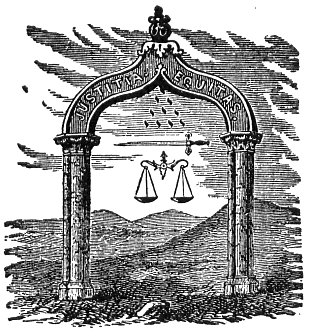
[Inspector Inquisitor.]
To hear patiently, to weigh deliberately and dispassionately, and to decide impartially;–these are the chief duties of a Judge. After the lessons you have received, I need not further enlarge upon them. You will be ever eloquently reminded of them by the furniture upon our Altar, and the decorations of the Tribunal.
The Holy Bible will remind you of your obligation; and that as you judge here below, so you will be yourself judged hereafter, by One who has not to submit, like an earthly judge, to the sad necessity of inferring the motives, intentions, and purposes of men [of which all crime essentially consists] from the uncertain and often unsafe testimony of their acts and words; as men in thick darkness grope their way, with hands outstretched before them: but before Whom every thought, feeling, impulse, and intention of every soul that now is, or ever was, or ever will be on earth, is, and ever will be through the whole infinite duration of eternity, present and visible.
p. 826
The Square and Compass, the Plumb and Level, are well known to you as a Mason. Upon you as a Judge, they peculiarly inculcate uprightness, impartiality, careful consideration of facts and circumstances, accuracy in judgment, and uniformity in decision As a Judge, too, you are to bring up square work and square work only. Like a temple erected by the plumb, you are to lean neither to one side nor the other. Like a building well squared and levelled, you are to be firm and steadfast in your convictions of right and justice. Like the circle swept with the compasses, you are to be true. In the scales of justice you are to weigh the facts and the law alone, nor place in either scale personal friendship or personal dislike, neither fear nor favor: and when reformation is no longer to be hoped for, you are to smite relentlessly with the sword of justice.
The peculiar and principal symbol of this Degree is the Tetractys of Pythagoras, suspended in the East, where ordinarily the sacred word or letter glitters, like it, representing the Deity. Its nine external points form the triangle, the chief symbol in Masonry, with many of the meanings of which you are familiar.
To us, its three sides represent the three principal attributes of the Deity, which created, and now, as ever, support, uphold, and guide the Universe in its eternal movement; the three supports of the Masonic Temple, itself an emblem of the Universe:–Wisdom, or the Infinite Divine Intelligence; Strength, or Power, the Infinite Divine Will; and Beauty, or the Infinite Divine Harmony, the Eternal Law, by virtue of which the infinite myriads of suns and worlds flash ever onward in their ceaseless revolutions, without clash or conflict, in the Infinite of space, and change and movement are the law of all created existences.
To us, as Masonic Judges, the triangle figures forth the Pyramids, which, planted firmly as the everlasting hills, and accurately adjusted to the four cardinal points, defiant of all assaults of men and time, teach us to stand firm and unshaken as they, when our feet are planted upon the solid truth.
It includes a multitude of geometrical figures, all having a deep significance to Masons. The triple triangle is peculiarly sacred, having ever been among all nations a symbol of the Deity. Prolonging all the external lines of the Hexagon, which also it includes, we have six smaller triangles, whose bases cut each other in the central point of the Tetractys, itself always the symbol of
p. 827
the generative power of the Universe, the Sun, Brahma, Osiris, Apollo, Bel, and the Deity Himself. Thus, too, we form twelve still smaller triangles, three times three of which compose the Tetractys itself.
I refrain from enumerating all the figures that you may trace within it: but one may not be passed unnoticed. The Hexagon itself faintly images to us a cube, not visible at the first glance, and therefore the fit emblem of that faith in things invisible, most essential to salvation. The first perfect solid, and reminding you of the cubical stone that sweated blood, and of that deposited by Enoch, it teaches justice, accuracy, and consistency.
Moe is the founder of GnosticWarrior.com. He is a father, husband, author, martial arts black belt, and an expert in Gnosticism, the occult, and esotericism.
by Moe
p. 814
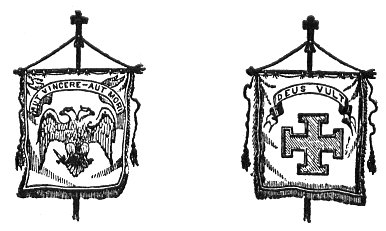 WE often profit more by our enemies than by our friends. “We support ourselves only on that which resists,” and owe our success to opposition. The best friends of Masonry in America were the Anti-Masons of 1826, and at the same time they were its worst enemies. Men are but the automata of Providence, and it uses the demagogue, the fanatic, and the knave, a common trinity in Republics, as its tools and instruments to effect that of which they do not dream, and which they imagine themselves commissioned to prevent.
The Anti-Masons, traitors and perjurors some, and some mere political knaves, purified Masonry by persecution, and so proved to be its benefactors; for that which is persecuted, grows. To them its present popularity is due, the cheapening of its Degrees, the invasion of its Lodges, that are no longer Sanctuaries, by the multitude; its pomp and pageantry and overdone display.
An hundred years ago it had become known that the ו ?Q?D?Sה were the Templars under a veil, and therefore the Degree was pro-scribed, and, ceasing to be worked, became a mere brief and formal ceremony, under another name. Now, from the tomb in which after his murders he rotted, Clement the Fifth howls against the successors of his victims, in the Allocution of Pio Nono against the Free-Masons. The ghosts of the dead Templars
p. 815
haunt the Vatican and disturb the slumbers of the paralyzed Papacy, which, dreading the dead, shrieks out its excommunications and impotent anathemas against the living. It is a declaration of war, and was needed to arouse apathy and inertness to action.
An enemy of the Templars shall tell us the secret of this Papal hostility against an Order that has existed for centuries in despite of its anathemas, and has its Sanctuaries and Asyla even in Rome.
It will be easy, as we read, to separate the false from the true, the audacious conjectures from the simple facts.
“A power that ruled without antagonism and without concurrence, and consequently without control, proved fatal to the Sacerdotal Royalties; while the Republics, on the other hand, had perished by the conflict of liberties and franchises, which, in the absence of all duty hierarchically sanctioned and enforced, had soon become mere tyrannies, rivals one of the other. To find a stable medium between these two abysses, the idea of the Christian Hierophants was to create a society devoted to abnegation by solemn vows, protected by severe regulations; which should be recruited by initiation, and which, sole depositary of the great religious and social secrets, should make Kings and Pontiffs, without exposing it to the corruptions of Power. In that was the secret of that kingdom of Jesus Christ, which, without being of this world, would govern all its grandeurs.
“This idea presided at the foundation of the great religious orders, so often at war with the secular authorities, ecclesiastical or civil. Its realization was also the dream of the dissident sects of Gnostics or Illuminati who pretended to connect their faith with the primitive tradition of the Christianity of Saint John. It at length became a menace for the Church and Society, when a rich and dissolute Order, initiated in the mysterious doctrines of the Kabalah, seemed disposed to turn against legitimate authority the conservative principle of Hierarchy, and threatened the entire world with an immense revolution.
“The Templars, whose history is so imperfectly known, were those terrible conspirators. In 1118, nine Knights Crusaders in the East, among whom were Geoffroi de Saint-Omer and Hugues de Payens, consecrated themselves to religion, and took an oath between the hands of the Patriarch of Constantinople, a See always secretly or openly hostile to that of Rome from the time of Photius. The avowed object of the Templars was to protect
p. 816
the Christians who came to visit the Holy Places: their secret object was the re-building of the Temple of Solomon on the model prophesied by Ezekiel.
“This re-building, formally predicted by the Judaïzing Mystics of the earlier ages, had become the secret dream of the Patriarchs of the Orient. The Temple of Solomon, re-built and consecrated to the Catholic worship would become, in effect, the Metropolis of the Universe; the East would prevail over the West, and the Patriarchs of Constantinople would possess themselves of the Papal power.
Moe is the founder of GnosticWarrior.com. He is a father, husband, author, martial arts black belt, and an expert in Gnosticism, the occult, and esotericism.
by Moe
p. 801
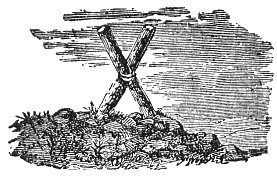 A MIRACULOUS tradition, something like that connected with the labarum of Constantine, hallows the Ancient Cross of St. Andrew. Hungus, who in the ninth century reigned over the Picts in Scotland, is said to have seen in a vision, on the night before a battle, the Apostle Saint Andrew, who promised him the victory; and for an assured token thereof, he told him that there should appear over the Pictish host, in the air, such a fashioned cross as he had suffered upon. Hungus, awakened, looking up at the sky, saw the promised cross, as did all of both armies; and Hungus and the Picts, after rendering thanks to the Apostle for their victory, and making their offerings with humble devotion, vowed that from thenceforth, as well they as their posterity, in time of war, would wear a cross of St. Andrew for their badge and cognizance.
John Leslie, Bishop of Ross, says that this cross appeared to Achaius, King of the Scots, and Hungus, King of the Picts, the night before the battle was fought betwixt them and Athelstane, King of England, as they were on their knees at prayer.
Every cross of Knighthood is a symbol of the nine qualities of a Knight of St. Andrew of Scotland; for every order of chivalry required of its votaries the same virtues and the same excellencies.
Humility, Patience, and Self-denial are the three essential qualities of a Knight of St. Andrew of Scotland. The Cross, sanctified by the blood of the holy ones who have died upon it; the
p. 802
[paragraph continues] Cross, which Jesus of Nazareth bore, fainting, along the streets of Jerusalem and up to Calvary, upon which He cried, “Not My will, O Father! but Thine be done,” is an unmistakable and eloquent symbol of these three virtues. He suffered upon it, because He consorted with and taught the poor and lowly, and found His disciples among the fishermen of Galilee and the despised publicans. His life was one of Humility, Patience, and Self-denial.
The Hospitallers and Templars took upon themselves vows of obedience, poverty, and chastity. The Lamb, which became the device of the Seal of the Order of the Poor Fellow Soldiery of the Temple of Solomon, conveyed the same lessons of humility and self-denial as the original device of two Knights riding a single horse. The Grand Commander warned every candidate not to be induced to enter the Order by a vain hope of enjoying earthly pomp and splendor. He told him that he would have to endure many things, sorely against his inclinations; and that he would be compelled to give up his own will, and submit entirely to that of his superiors.
The religious Houses of the Hospitallers, despoiled by Henry the Eighth’s worthy daughter, Elizabeth, because they would not take the oath to maintain her supremacy, had been Alms-houses, and Dispensaries, and Foundling-asyla, relieving the State of many orphan and outcast children, and ministering to their necessities, God’s ravens in the wilderness, bread and flesh in the morning, bread and flesh in the evening. They had been Inns to the wayfaring man, who heard from afar the sound of the Vesper-bell, inviting him to repose and devotion at once, and who might sing his matins with the Morning Star, and go on his way rejoicing. And the Knights were no less distinguished by bravery in battle, than by tenderness and zeal in their ministrations to the sick and dying.
The Knights of St. Andrew vowed to defend all orphans, maidens, and widows of good family, and wherever they heard of murderers, robbers, or masterful thieves who oppressed the people, to bring them to the laws, to the best of their power.
“If fortune fail you,” so ran the vows of Rouge-Croix, “in divers lands or countries wherever you go or ride that you find any gentleman of name and arms, which hath lost goods, in worship and Knighthood, in the King’s service, or in any other place of worship, and is fallen into poverty, you shall aid, and support,
Moe is the founder of GnosticWarrior.com. He is a father, husband, author, martial arts black belt, and an expert in Gnosticism, the occult, and esotericism.