by Moe | Aug 22, 2018 | Mystical Christianity
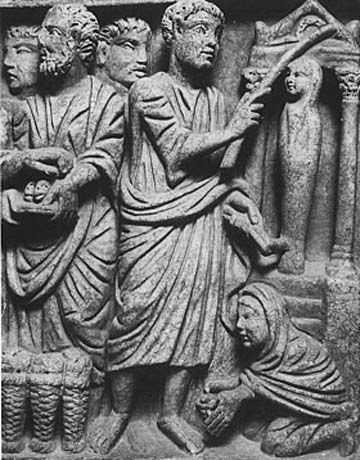
In my studies into the Gnosis of Jesus, I came across a peculiar text in the Sacred Writings of the Apocrypha of the New Testament as translated by The Ante-Nicene Fathers which details the early childhood of Jesus. It tells of a seldom-heard story of how Jesus was considered a child prodigy for his incredible superhuman abilities when it came to “knowledge of all things ie: True Gnosis” and also his magical abilities to heal and kill at will.
In fact, he was considered to be so smart that he regularly outwitted and admonished the more learned elders, priests and schoolmasters in public to the point that they became his disciples and believers. Below is an example of the Lord’s Gnosis that begins with a conversation between a schoolmaster named Zacchaeus with Joseph and the young magician, Jesus. The story details the Lord’s secret knowledge of letters and also how Jesus told the master about a certain Gnosis which he had never either heard or read in any book.
The Master then proclaims that Jesus is “more learned than all the masters” and “This son of thine has no need of instruction” – ie: DNA Gnosis.
Here is the story…
“There was, moreover, at Jerusalem, a certain man named Zacchaeus, who taught boys. He said to Joseph: Why, O Joseph, dost thou not bring Jesus to me to learn his letters? Joseph agreed to do so, and reported the matter to the Lady Mary.
They, therefore, took Him to the master; and he, as soon as he saw Him, wrote out the alphabet for Him, and told Him to say Aleph. And when He had said Aleph, the master ordered Him to pronounce Beth. And the Lord Jesus said to him: Tell me first the meaning of the letter Aleph, and then I shall pronounce Beth.
And when the master threatened to flog Him, the Lord Jesus explained to him the meanings of the letters Aleph and Beth; also which figures of the letter were straight, which crooked, which drawn round into a spiral, which marked with points, which without them, why one letter went before another; and many other things He began to recount and to elucidate which the master himself had never either heard or read in any book.
The Lord Jesus, moreover, said to the master: Listen, and I shall say them to thee. And He began clearly and distinctly to repeat Aleph, Beth, Gimel, Daleth, on to Tau. And the master was astonished and said:
“I think that this boy was born before Noah.”
And turning to Joseph, he said: Thou hast brought to me to be taught a boy more learned than all the masters. To the Lady Mary also he said:
“This son of thine has no need of instruction.”
In the next scene, Bad Boy Jesus comes out again and his mother Mary again put him on house arrest because everyone who opposes him, he kills.
“Thereafter they took Him to another and a more learned master, who, when he saw Him, said: Say Aleph. And when He had said Aleph, the master ordered him to pronounce Beth. And the Lord Jesus answered him, and said: First tell me the meaning of the letter Aleph, and then I shall pronounce Beth. And when the master hereupon raised his hand and flogged Him, immediately his hand dried up, and he died. Then said Joseph, to the Lady Mary:
From this time we shall not let him go out of the house, since every one who opposes him is struck dead.
And when He was twelve years old, they took Him to Jerusalem to the feast. And when the feast was finished, they indeed returned ; but the Lord Jesus remained in the temple among the teachers and elders and learned men of the sons of Israel, to whom He put various questions upon the sciences, and gave answers in His turn.” For He said to them : Whose son is the Messias P They answered Him: The son of David. Wherefore then, said He, does he in the Spirit call him his lord, when he says, The Lord said to my lord, Sit at my right hand, that I may put thine enemies under thy footsteps?’
Again the chief of the teachers said to Him : Hast thou read the books? Both the books, said the Lord Jesus, and the things contained in the books. And He explained the books, and the law, and the precepts, and the statutes, and the mysteries, which are contained in the books of the prophets — things which the understanding of no creature attains to. That teacher therefore said: I hitherto have neither attained to nor heard of such knowledge: Who, pray, do you think that boy will be?
And a philosopher who was there present, a skillful astronomer, asked the Lord Jesus whether He had studied astronomy. And the Lord Jesus answered him, and explained the number of the spheres, and of the heavenly bodies, their natures and operations; their opposition; their aspect, triangular, square, and sextile; their course, direct and retrograde; the twenty-fourths,” and sixtieths of twenty-fourths; and other things beyond the reach of reason.
There was also among those philosophers one very skilled in treating of natural science, and he asked the Lord Jesus whether He had studied medicine. And He, in reply, explained to him physics and metaphysics, hyperphysics and hypophysics, the powers likewise and humours of the body, and the effects of the same ; also the number of members and bones, of veins, arteries, and nerves; also the effect of heat and dryness, of cold and moisture, and what these give rise to ; what was the operation of the soul upon the body, and its perceptions and powers; what was the operation of the faculty of speech, of anger, of desire ; lastly, their conjunction and disjunction, and other things beyond the reach of any created intellect. Then that philosopher rose up, and adored the Lord Jesus, and said:
Lord, from this time I will be thy disciple and slave.
While they were speaking to each other of these and other things, the Lady Mary came, after having gone about seeking Him for three days along with Joseph. She therefore, seeing Him sitting among the teachers asking them questions, and answering in His turn, said to Him: My son, why hast thou treated us thus? Behold, thy father and I have sought thee with great trouble. But He said: Why do you seek me? Do you not know that I ought to occupy myself in my Father’s house? But they did not understand the words that He spoke to them. Then those teachers asked Mary whether He were her son; and when she signified that He was, they said:
Blessed art thou, O Mary, who hast brought forth such a son. And returning with them to Nazareth, He obeyed them in all things. And His mother kept all these words of His in her heart. And the Lord Jesus advanced in stature, and in wisdom, and in favour with God and man.5 54. And from this day He began to hide His miracles and mysteries and secrets, and to give attention to the law, until He completed His thirtieth year, when His Father publicly declared Him at the Jordan by this voice sent down from heaven:
This is my beloved Son, in whom I am well pleased ; the Holy Spirit being present in the form of a white dove.”
Moe is the founder of GnosticWarrior.com. He is a father, husband, author, martial arts black belt, and an expert in Gnosticism, the occult, and esotericism.
by Moe | Aug 21, 2018 | Demons
“I personally think, and I know it’s not very Christian, but I actually think it’s a demon that’s within me. At some point and time, it entered me when I was young. And it basically controlled me.”
The confession above came from a devout family man and Church President who murdered 10 people in cold blood, including two children which spread fear across Wichita, Kansas, beginning in the 1970s.

Dennis Rader, 73-year-old, who dubbed himself “BTK” (Bind, Torture, Kill) pleaded guilty in 2005 for the deaths in which he “trolled” for victims, including his neighbors that he then shot, stabbed or strangled.
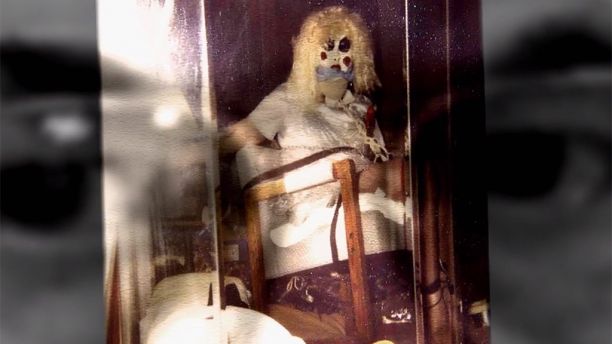
Here is a picture of Radar, the self-professed demon possessed carcass dressed up as one of his victims.
A new documentary on Oxygen Network titled “Snapped: Notorious BTK Serial Killer” will be airing on Sept. 2 to show the sick life of the man who posed as a seemingly normal dude by day, but brutally slaughtered people by night.
Rader said his problems began in grade school, with his sexual fantasies that were “just a little bit weirder” than other people’s.
“Somewhere along the line, someone had to pick something up from me somewhere that there was a problem,” he said. “They should have identified it.”
Radar meticulously stalked his victims, learned their pattern and chose them on a set of criteria. People who knew him said that he loved to exert his authority and control over others and was very focused on the rules to the point of being overzealous in his actions.
He was eventually caught as a result of mistakes like after hanging the girl, he masturbated on her legs, leading to his DNA being recovered which was compared in 2005 with a sample that the police managed to obtain from Rader’s own daughter.
Radar claims that all serial killers in history have what he calls the Factor X in common, which is this demon, making them to do things that they cannot control.
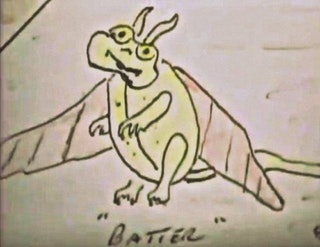
Here is an alleged drawing that the killer did who he said drove him to kill. He named him “batter”.
Moe is the founder of GnosticWarrior.com. He is a father, husband, author, martial arts black belt, and an expert in Gnosticism, the occult, and esotericism.
by Moe | Aug 21, 2018 | Gods & Goddesses
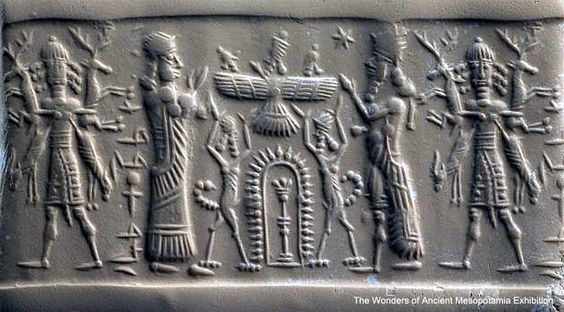
The Ancient Babylonians had left us the famous story on seals and stones of a half-human and half-divine hero named Gilgamesh (Gilgāmeš) who is king over the city of Erech. These stories are collectively known today as “The Epic of Gilgamesh.”
Gilgamesh stands out as the defied hero who some scholars say is based at one time on a real personage whose name may have been Gisdhubar, or Izdubar, but was later pronounced Gilgamesh. The other two Gods or Demons who are his consorts are named Eabani, who is said to represent primitive man, and Ut-Napishtim (Ūta-napišti or Parnapishtim), the hero of the Babylonian deluge myth.
The story is told that Gilgamesh is set on a mission to travel to the land of his ancestor in order to seek out “Ut-Napishtim,” the son of Kidin-Marduk.” Ut-Napishtim is called the “distant one” and his dwelling is far off, “at the confluence of the streams.” The road to the place is full of dangers, but Gilgamesh, undaunted, undertakes the journey. The hero himself furnishes the description.
I came to a glen at night,
Lions I saw and was afraid.
I raised my head and prayed to Sin.
To the leader (?) of the gods my prayer came.
[He heard my prayer (?)], and was gracious to me.
We can find Gilgamesh is pictured in many ancient seal and cylinders in the act of war – fighting with or strangling a lion and he is given the weapons of an ax and a sword for the fight. Gilgamesh comes to the mountain Mashu (Holy Mountain), which is also described as a place of terrors.
The mountains of Mashu are described as follows:
When [he arrived] at the mountain range of Mashu,
Which daily keeps watch over sun[rise and sunset]-
Whose peaks [reach to] the vault of heaven
(And) whose breasts reach to the netherworld below. (ANET, 88; Heidel 1946, 65).
Mashu is said to mean twin and it is from the “twin peaks” of the Mountain Mashu “daily keeps watch over sun[rise and sunset]” (ANET, 88) which was at the center of the Soul of the World and the two main geographic points of East and West. For it is the Western gate which the sun enters at night and the sun travels at night in subterranean caverns back under the earth to come out in the East at sunrise. The cave is also called the “vault of heaven” is the same phrase su-pu-uk same(e) meaning the “foundation of heaven.”
It is here where we find remnants of the Sabien Rite which is the Rites of the Apocalypse being performed by initiated priests known as the scorpion-men whose “glance is death” and guard the entrance to the cave in the mountain of Mashu or Mashi; that is, “the mountain of the Sunset” or “Dark Mountian of the Sunset.”
The scorpion-men of the Mountain would be the immortal and mortal spirits who took the sacrificial oaths at the beginning of this Age and who hold the keys to heaven and hell via binding and loosing. Gilgamesh must cross the Waters of Death and gain entrance to the Cave AKA the “vault of heaven” through the scorpion-men who are the guards in order to fulfill his mission.
The Scorpion Men stand guard outside the gates of the sun god Shamash at the mountains of Mashu. These give entrance to Kurnugi, the land of darkness which was a dark and dreary cavern located deep below the ground, where inhabitants were believed to continue “a shadowy version of life on earth”.
The only food or drink was dry dust.
The rulers of the underworld were the King of Hell and God of Death, Nergal and his Queen, the goddess Ereshkigal.
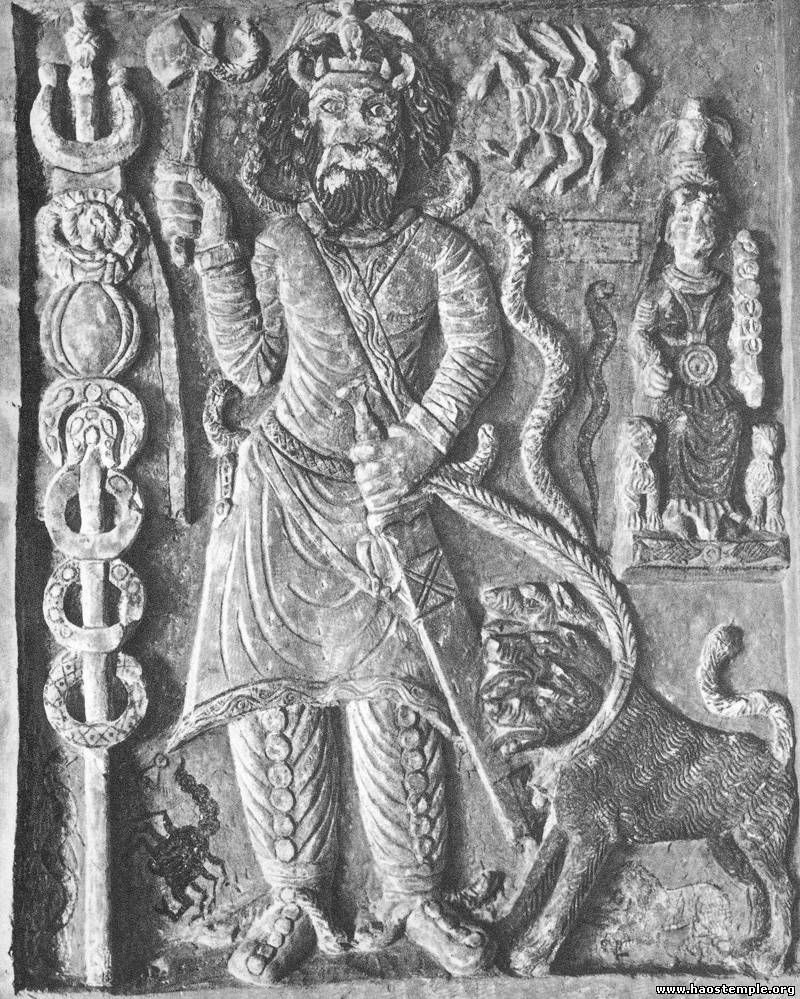
The scorpion men open the doors for Shamash as he travels out each day, and close the doors after him when he returns to the underworld at night. Their heads touch the sky, their “terror is awesome” and their “glance is death”. This meeting of Gilgameš, on his way to Ūta-napišti, with the Scorpion-folk guarding the entrance to the tunnel is described in Iškār Gilgāmeš, tablet IX, lines 47–81.
When one of the scorpion-man sees Gilgamesh at the cave entrance, he addresses his wife: ” He who comes to us is of divine appearance.” The wife agrees that Gilgamesh is in part divine, but she adds that in part he is human. The scorpion-man then announces that it is by the express command of the gods that Gilgamesh has come to the mountain.
It is at this time that Gilgamesh recovers his courage tells the scorpion-man of his purpose. The scorpion-man then proceeds to inform him of the extreme dangers that will come upon anyone who ventures to enter the dreadful district. Now that he is completely aware and conscious of the Gnosis of who he is and his immortal mission, the gate is then opened for Gilgamesh and his epic journey begins.
Gilgamesh magically makes it through the darkness which is enclosing him on all sides and after traversing a distance of twenty-four hours, he beholds a splendid tree decorated with precious stones and bearing beautiful fruit. He then reaches the sea where he meets the maiden Sabitum where she has her palace and throne as guardian (mermaid) of the sea.
When Sabitum sees Gilgamesh, she locks the gates and will not permit him to pass across the sea. Gilgamesh then pleads with Sabitum telling her of the loss of his friend Eabani, ‘who has become dust (mortal fungi – ie: men),” and whose fate he does not wish to share. When Gilgamesh speaks to Sabitum, it is then said in the text; “[Now] Sabitum, which is the way to Ut-Napishtim.”
The Ninth Tablet opens with the lament of Gilgamesh for the death of his friend, and his number one goal which is to seek out the spirit of his ancestor who is named “Tsit-napishtim (Ut-Napishtim)” so he might perhaps escape a similar fate.
Tsit-napishtim informs Gilgamesh that all men must die with he himself being an exception in exceptional circumstances. He then gives Gilgamesh an opportunity of eating the plant of life, which is then lost. However, Tsit-napishtim then cures Gilgamesh of his disease which he has contracted while crossing the Waters of Death, and he is finally restored to King of Erech.
The Babylonian tablet reads:
“For his friend Ea-bani “Gilgamesh wept bitterly and he lay stretched out upon the ground. “(He cried): ‘Let me not die like Ea-bani! “Grief hath entered into my body, and “I fear death, and I lie stretched out upon the
ground.
“To (test) the power of Tsit-napishtim, son of UbaraTutu,
“I will set out, and I will not tarry by the way.'” Gilgamesh describes his journey thus :— “To a mountain gorge I came by night, “Lions I beheld, and I was terrified. “I raised my head and I prayed to the Moon-god, “And to the [chief] of the gods came my cry, “[And he hearkened and] showed favour unto me.”
From what remains of the text it appears that Gilgamesh had a dream in which the Moon-god shewed him the way by which he might safely pass over the mountains. Gilgamesh succeeded in crossing the first mountain range which barred his path, and he next came to a still greater mountain named Mashu, that is to say, the Mountain of the Sunset.
The poem continues as follows:
“Then he came to the Mountain of Mashu, “The portals of which are guarded daily [by monsters];
“Their backs mount up to the ramparts of heaven, “And their fore parts reach down beneath Arallu. “Scorpion-men guard the gate (of Mashu); “They strike terror [into men], and it is death to behold them.
“Their splendour is great, for it overwhelms the mountains; “From sunrise to sunset they guard the Sun. “Gilgamesh beheld them, “And his face grew dark with fear and terror, “And the wildness of their aspect robbed him of his senses.”
One of the Scorpion-men then caught sight of Gilgamesh, and, turning to his wife, told her that the body of the man they saw approaching resembled that of a god. His wife replied that Gilgamesh was partly divine and partly human. The Scorpion-man then told her how Gilgamesh had set out on his long journey in accordance with the will of the gods, and he described the steep mountains which he had already crossed.
Gilgamesh, seeing that the monster regarded him with friendly eyes, recovered from his fright, and told him of the purpose of his journey, namely, to go to Tsit-napishtim, his ancestor, who stood in the assembly of the gods, and had the power over life and death.
The Scorpion-man replied by describing the difficulties and dangers which he would encounter if he persisted in his purpose of traversing the Mountain of Mashu, adding that for twelve kasbu, that is, for a space of twenty-four hours, he would have to pass through thick darkness.
But Gilgamesh was not discouraged.
The Scorpion-man, therefore, yielded to his request, and opened the gate of the mountain and let him through.
For twenty-four hours Gilgamesh marched onwards, “and the darkness was thick and there was no light.” But at the end of this long and dreadful journey he came out once more into the light of the sun, and the first thing he beheld was a beautiful and wonderful tree. The poem describes the tree in the following words:—
“Precious stones it bore as fruit,
“Branches hung from it which were beautiful to behold.
“The top of the tree was lapis lazuli,
“And it was laden with fruit which dazzled the eye of him that beheld.”
This tree grew in a great park or orchard beside THE PRINCESS SABITU.
SOURCES:
1. Babylonian Religion and Mythology By Leonard William King
2. The Devils and Evil Spirits of Babylonia: Being Babylonian and …, Volume 1 By Reginald Campbell Thompson
3. The Religion of Babylonia and Assyria By Morris Jastrow (Jr.)
Moe is the founder of GnosticWarrior.com. He is a father, husband, author, martial arts black belt, and an expert in Gnosticism, the occult, and esotericism.