by Moe | Aug 20, 2018 | Mystical Christianity
Did you know that Jesus may have been a powerful Gnostic magician who terrified and killed some people in his village who angered him? Did you also know that a schoolmaster named ‘Levi’ had slapped him for being disrespectful to his authority?
Allegedly, the chaos and ruckus that Jesus had caused with his magic in his hometown got so bad that his father Joseph declared that the Lord would be on house arrest when he said;
“Henceforth, we will not allow him to go out of the house; for everyone who displeases him is killed.”
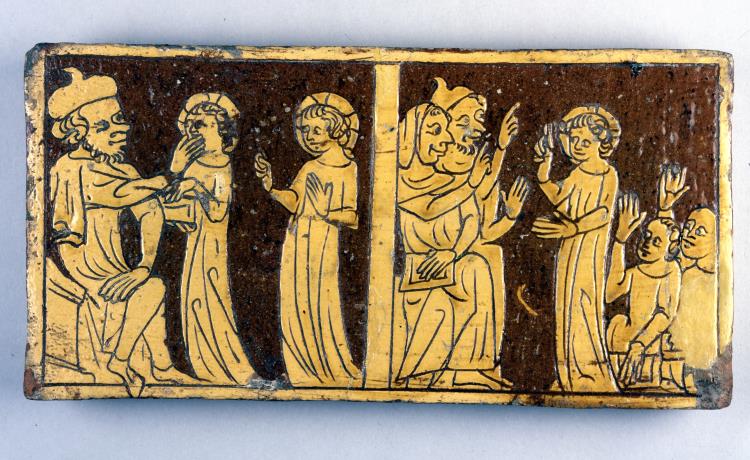
Today, you will discover this secret story of Jesus in the British Museum. The story is told on what is known as the “Tring Tiles” which date from the early 14th century and illustrates the scenes from Jesus’ alleged childhood that are said to be of English, or Norman manufacture. (Norman-Anglo-Saxon Old Guard) using a 14th-century art technique known as graffito.
The images on the tiles were said to be based on the Sacred Writings of the Apocrypha the New Testament which was originally translated by The Ante-Nicene Fathers and was very popular in the 14th century. These specific designs are thought to be derived from the Apocryphal Gospels via a French manuscript in the Bodleian Library in Oxford University.
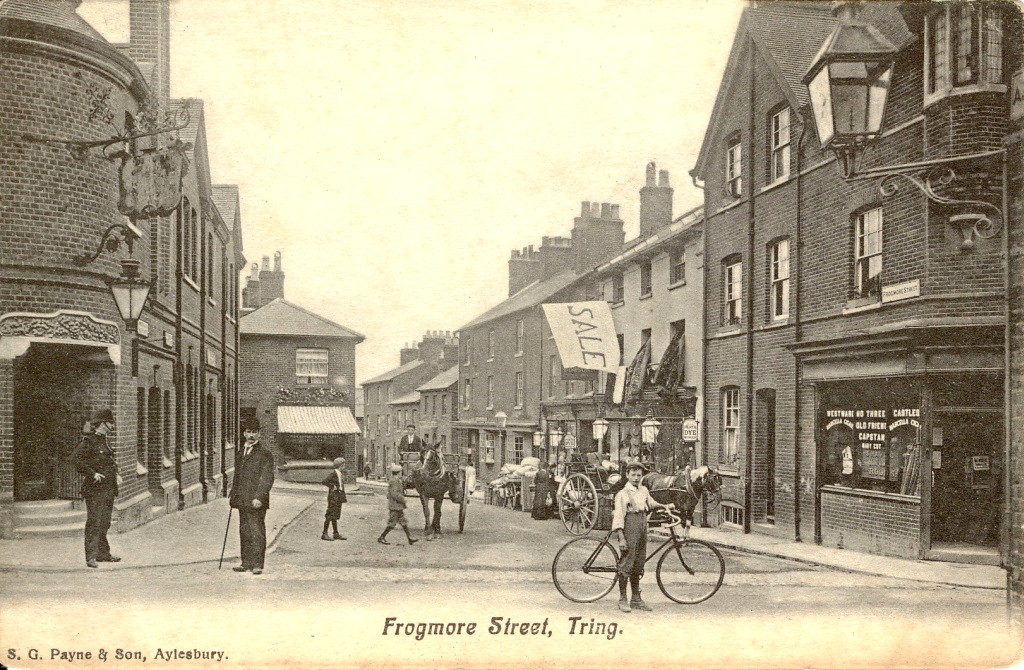
The tiles were presumably once wall-mounted at St. Peter and St. Paul’s Church at Tring near London and is also said to be called the “Tring Parish Church” located on “Frogmore Street.”
Nobody knows exactly how many tiles there are in existence, but there are currently eight tiles on display at The British Museum and two in the Victoria and Albert Museum.
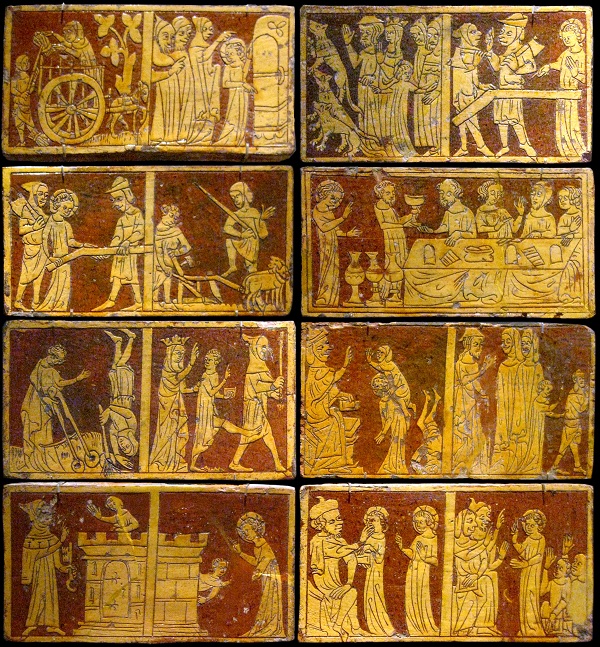
We can see in one image in the lower right on the tile shows Jesus entering school, on the right and in the next tile he is standing directly in front of his teacher who is named ‘Levi’ from whom he receives a slap on the face.
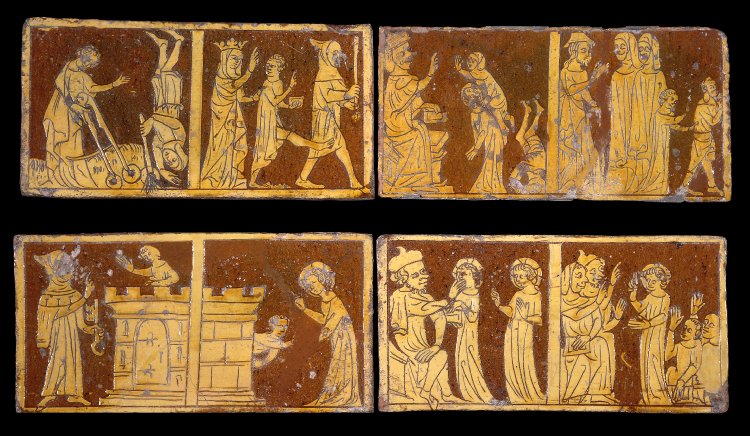
You may ask, “Why in the hell would anyone want to slap Jesus?” – I did not learn about that in Sunday school or in my newly edited 666th version of the New Testament Bible.
The reason is that these are the stories that became “banned and unlawful” by Rome and the Church through the Roman Curia to distribute so they did not make the cut in the editing process of the Old and New Testaments but were still considered “sacred” by the early Church Fathers. They are collectively known as the “Infancy Gospels,” written in Syriac, Arabic, and Greek which relates to us Jesus’ childhood acts or more appropriately – “magic acts.”
Even though many theologians and Christian researchers may have never heard of these writings, these books were still being taught and distributed in various parts of the world by what appears to be an Orthodox Greek and Russian conspiracy with the help of the English Anglican Church to keep these teachings for their descendants.
I believe the reason being is that they contain a treasure trove of the knowledge and Gnosis of the secret mysteries of the early church and also the fact that Jesus appears to be a superhero type of Gnostic – prodigal son who is portrayed as a magician with supernatural powers who heals and kills people with his magic.
The Jesus we find in these stories appears here not as the Prince of Peace who loves thy neighbor and turns the other cheek when slapped. No, Jesus is portrayed as a boy with supernatural knowledge (Gnosis) and magic whose abilities can easily debate and beat his elder schoolmasters and also kill his foes at will.
It is clear as day that Jesus is a warrior priest who can get just as angry as an “an eye for an eye” Old Testament or Greek God.
In one of the images on the Tiles, Mary and Joseph stand behind Jesus giving hand salutes with Joseph respectively with the Right Hand representing the Father and Mary the Left Hand -the Holy Spirit. We are shown a depiction of how even beasts like the Wolf had known Jesus, the Son but men knew him not.
He takes his Left Hand and touches the Left Hand of a man behind him, then Jesus proclaims;
“These beasts know me: but men know me not.”

To many people, the idea of the Lord Jesus being some type of “bad boy” who declares wolves as his friends and men as his foes and then practices magic and is feared by almost everyone in his community might seem totally reprehensible. But that is exactly what these stories of Jesus’ early childhood portray.
In fact, he absolutely amazed the learned elder teachers of his village with his knowledge and he copletely terrified the profane children and parents of his village with his magical abilities.
For example, we are told that Jesus kills a boy who bumped into him with his words and magic. In the gospels, a boy running down the street bumps into Jesus, knocking him down and in the Tring tile series, the event happens in a classroom. After the boy bumps into Jesus, he angrily condemns the boy to death when he declares:
“As thou has thrown me down, so shalt thou fall, nor ever rise. And that moment the boy fell down and died.”
News about Jesus began to spread around the village and the people truly began to fear him. The story goes that when a group of parents saw him coming up the street one day, they hid their children in a large oven.
Jesus asked the parents, “What was in the oven?”
They replied, “Little pigs.”
Jesus then said, “So be it.” And when the oven was opened, they found that the children were gone and only piglets remained.”
The facts are that the children were morphed into pigs by Jesus stating, “So be it.”
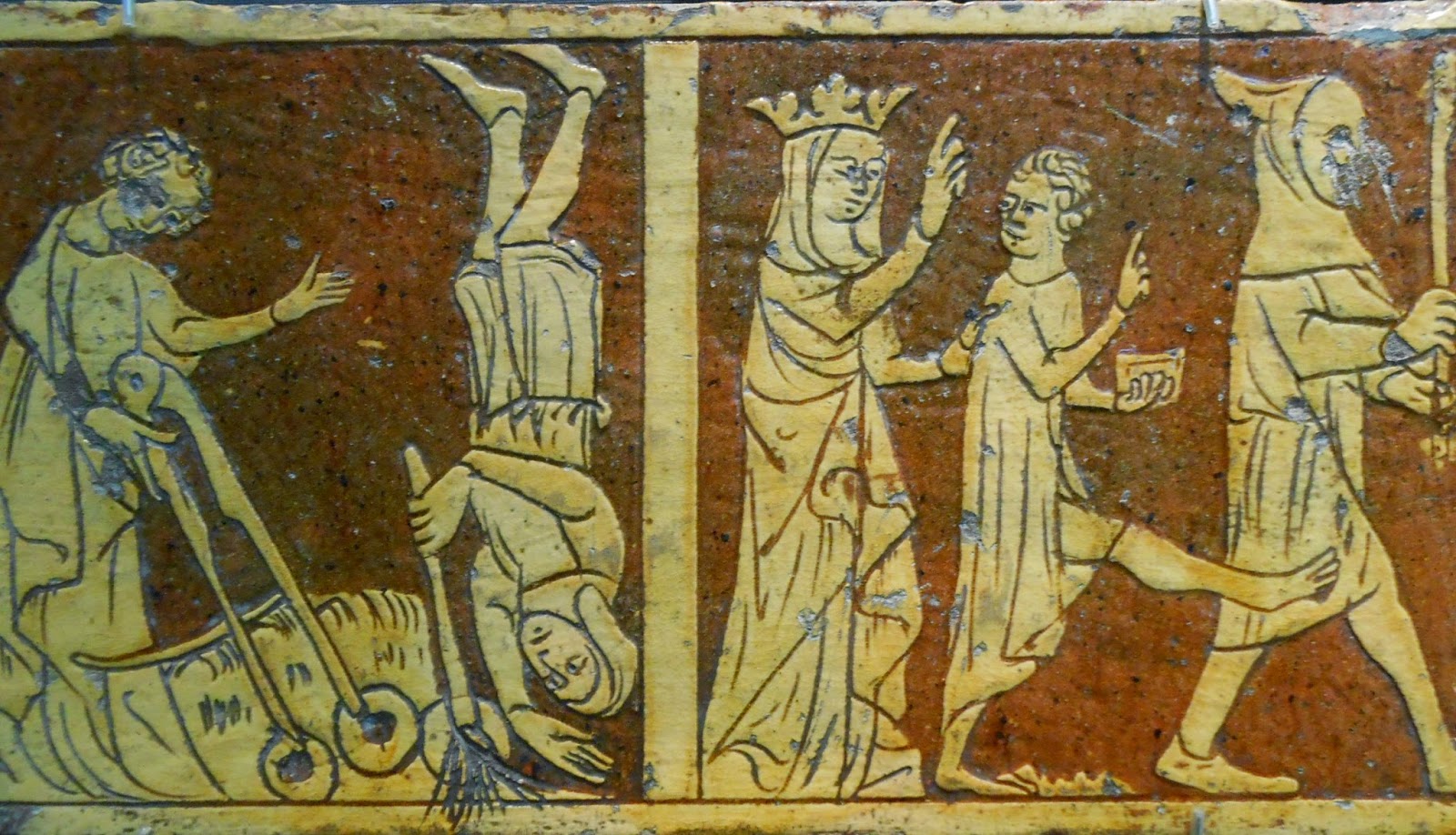
In another scene from the tiles, it shows how Jesus treats bullies with “zero tolerance.”
Here we clearly witness Jesus making some nice round circles which are said to be pools beside the river large with what looks like a large Masonic compass. More evidence for Freemasons and theologians that the family of Jesus were not only Priests and teachers but also Chaos magicians who were the original master builders ie: Freemasons.
Hence, “We started the Brotherhood.”
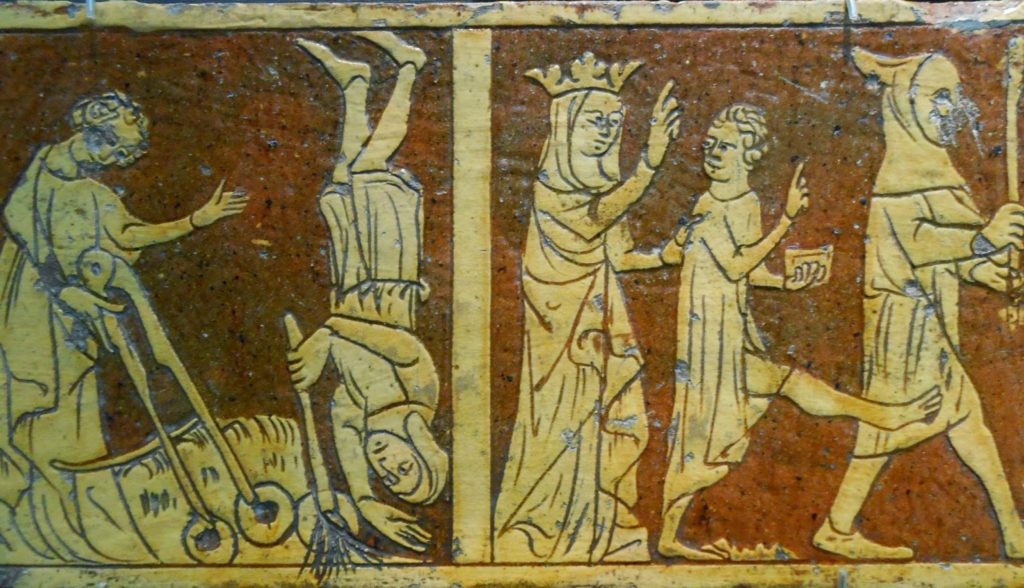
Jesus then proclaimed the death penalty on the boy who was the son of Annas the Scribe when he said, “In like manner as this water has vanished, so shall thy life vanish;” and the boy died.
This same “destructive boy” who dies is associated with Satan in the Gospel of Pseudo-Matthew where it is written;
“Then one of the children, the son of the Devil, and of an envious mind, shut up the channels which supplied water to the pools, and overthrew what Jesus had made. Then Jesus said unto him, Woe unto thee, son of death, Son of Satan. Does thou destroy the works which I have wrought? And straightway he who had done this died.”
It appears that the retribution dished out by Jesus seems to exceed the limits of moral justice where the offense did not warrant the death penalty even when compared to the Old Law of the slaves which allowed “an eye for an eye” and today we have the “Rule of Law” which only allows the state to administer justice.
In the next scene, it looks like his mother Mary instructs him to follow the light of the True God of the Most High with her Right Hand raised to the heavens as it shows Jesus with his right hand also raised with his left foot on the ground than restoring the boy back to life with magic using his right foot.
I believe the placing of the arms, hands, legs, and feet in these tiles play a huge role in the secret message they were trying to communicate to the initiates of their sacred bloodline via DNA Gnosis. Magic and Gnosis that the profane ie: uninitiated would not have understood and would have been absolutely terrified of Jesus’s supernatural abilities.
In one scene of the Tring tiles, a boy jumps on Infant Jesus’ shoulder. That angered the young Jesus so he kills him. The parents who are pictured on the right then come and complain to Joseph who has a talk with his son Jesus who then with his magic, revives the boy, who is next seen walking off to the right.
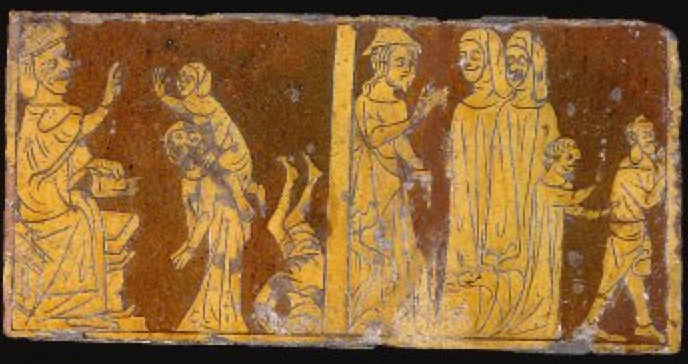
This may be the reason why the tiles show outraged village parents who came to Joseph complaining of Jesus’ atrocious acts. They demanded that something is done about the boy.
Joseph then attempted to admonish Jesus, but when Jesus discovered that the parents had complained about him, he used his magical powers to strike them blind.
In this story, it is obvious that although the knowledge (Gnosis) and intelligence of Jesus had easily exceeded that of the elders in his village, he lacked self-control which contributed to his rage and his unjust retribution against those who angered him. It was at this time that Joseph was persuaded by a schoolmaster named Zaccheus that the young Jesus should be sent to school where he might learn both discipline and literacy and more.
The secret story of the Bad Boy Jesus will be continued…
Moe is the founder of GnosticWarrior.com. He is a father, husband, author, martial arts black belt, and an expert in Gnosticism, the occult, and esotericism.

by Moe | Aug 17, 2018 | Demons, Health
For thousands of years before our present era, epilepsy was associated with evil demons and also ghosts that roam in the home at night.
As I mentioned in my article, The Babylonians Diagnosed Epilepsy As Demon Possession, the Ancient Babylonians were the first people in history to study and document the various human neurological and psychiatric disorders, including epilepsy. They believed that epilepsy was the cause of a supernatural disorder due to an invasion of the body by evil demons or spirits or the anger of personal gods.
The Babylonian demon of epilepsy was said to be called Lugalurra (bēl-urri/Lugal-urri/Lugal-ugri/Lugal-arri) which means “Lord of the Roof.”
For example, tow lines from the the text reads, “If a man approaches a woman on the roof, the Lugal-arra will seize him,” or “If a man approaches a woman on the roof, the (demon) Lurker (rabisu) will strike him with a stroke.”
Since the Babylonians play a large role in years leading up to the formation of Christianity, it should be no surprise to you that we find that the Lord of the Roof in the New Testament has a parallel in the Gospel of Matthew with the epileptic boy healed by Jesus is said to be possessed by “the Son of the Roof” (bar ˀeggārâ, Matthew 17:15).
The Ante-Nicene Christian Library: The Apostolic fathers (1870) says the Syriac word Peshitta translated in § 1, 79 as “The son-of-the-roof,” a Syriac phrase said to mean a demon of lunacy. A word used in Arabic of the devil producing insanity.
The lines read in transcription of the Babylonian tablets have been interpreted by researchers from the Institute of Epileptology from King’s College, London, United Kingdom, and †Faculty of Oriental Studies, University of Cambridge, Cambridge, United Kingdom.
summa am ˇ elu anta ¯ subb ˇ u b ˆ el¯ uri ¯ …qat etimmi q ¯ at m¯ am¯ ˆıti…
eli-su iba ˇ sˇsi al ˇ u lemnu ireddi- ˆ sˇu´…
They are translated as:
“If a man has been suffering from antasubb ˇ u, b ˆ el¯ uri ¯ , qat etimmi ¯ or qat m¯ am¯ ˆıti, and an alu lemnu ˆ then begins to inflict him with ideas of persecution…”
The researchers stated that the word antasubb ˇ u,ˆ is a understood to mean “the falling disease,” or what we call epilepsy characterized by major seizures. The term bel¯ uri – means literally “the lord of the roof.” It was this demon that supposedly caused epilepsy by lurking on the roof of a house.
The word qat etimmi ¯ means “the hand (power or influence) of a ghost.” The words alu lemnu ˆ translate, nonspecifically, to “evil demon.”
It is interesting that the Babylonians had said that epilepsy was caused by a demon and specifically, a demon called the Lord of the Roof who they thought actually “lurked on the roof of a house.”
Why the Lord of the Roof and why did they think this demon had resided on the roofs of their homes?
In my own experiences in dealing with the supernatural, modern science and “things that can possibly lurk on the rood on our modern homes,” I have met with a supernatural entity/organism that is intelligent, parasitical, and adversarial to humans to the point that it seeks to maim, eat and kill them.
Like the mythical Kronos, the real-life devourer of children…
This organism is the oldest living entity on earth. We know it as Mold in English and Fungus in Latin.
An evil demon like entity that lives on the roofs of houses and inside the walls and in the basement wreaking complete havoc and mayhem on the occupants of that same sid house unbeknownst to them until often, it is too late.
Here is some supporting evidence for my Babylonian theory on toxic parasitical molds being the true “Lord of the Roof.”
Mold makes Vancouver house uninhabitable – “Couple’s health, finances, wrecked by situation”

Craig and Shelly Johnson bought their Andresen neighborhood home 24 years ago. To the high school sweethearts, it was the perfect place to raise their kids and enjoy their future grandkids.
This summer, the Johnsons learned their dream home was poisoning them.
After a decade of unexplained chronic pain, fatigue, respiratory infections and debilitating headaches, Craig, 54, and Shelly, 50, learned the attic of their home was full of various varieties of black and white mold.
Read more @ Columbian.com
Mold forces Seminole County firefighters out of station, into trailer
Firefighters are not allowed inside the building during remediation and must sleep in the temporary trailer behind the building.
“The crews here knew there was likely going to be mold behind the cabinets, due to the leaks in the past,” Seminole County Fire Union President Jon Divita said.
9 Investigates obtained records that show concerns about leaks and mold were well-documented.
Spring 2015 maintenance notes stated, “There is a roof leak in the kitchen. It is above the cabinets to the left of the sink. Water is running down into the cabinets down the doors onto the counter.”
By December 2015, maintenance notes stated, “There is mold and wood rot that needs to be mitigated.”
Read more from WFTV 9 News
Milan family forced to flee home over toxic mold
MILAN, Illinois – A Milan homeowner says he and his family have been going through hell in a dispute with American Family insurance over toxic mold in their home and what caused it.
“They’ve been lying to us. They haven’t been up front and honest, they’ve been deceitful, just everything you would not expect from an insurance company,” said homeowner Jason Beeks.
He and his family have been forced to flee their home because of toxic levels of mold.
“Right now, the atmosphere inside the house is not live-able. It will kill you,” he said.
He says it started after a heavy wind and hail storm that hit the neighborhood on August 2, 2015. Several roofs were damaged, and Beeks filed claims on two vehicles and his 7-year-old roof.
Read more @ WQAD News
Moe is the founder of GnosticWarrior.com. He is a father, husband, author, martial arts black belt, and an expert in Gnosticism, the occult, and esotericism.
by Moe | Aug 15, 2018 | Demons, Health
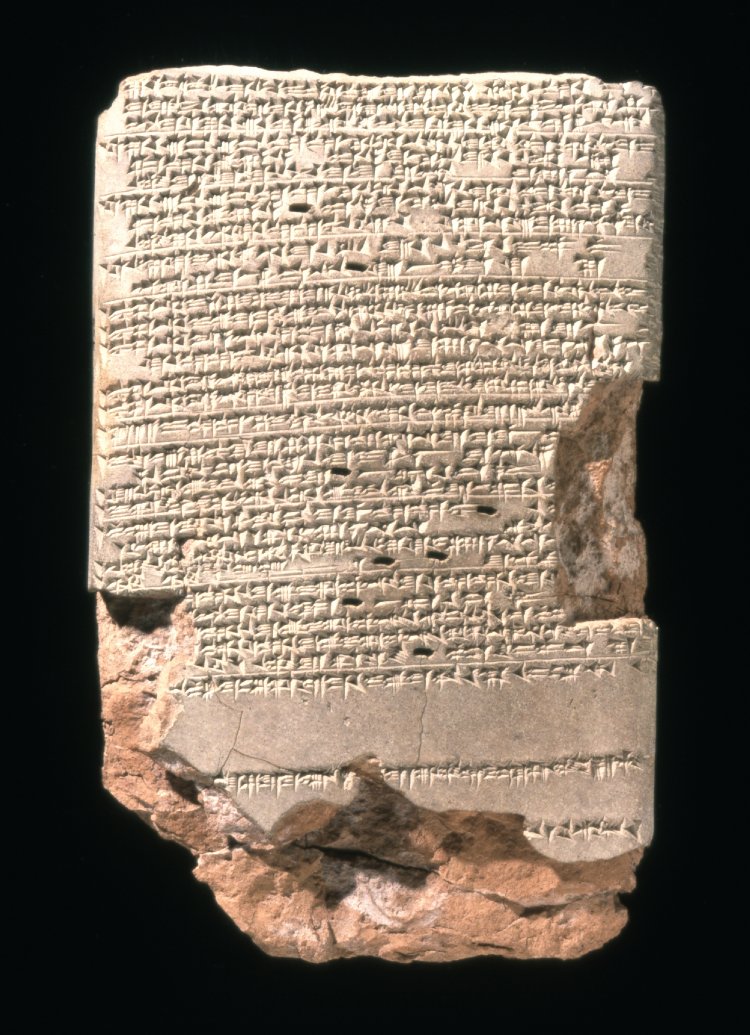
The first line (obverse) of the text of Tablet 26 from the Babylonian ‘Medical Diagnostic Series’ reads, “If epilepsy falls once upon a person [or falls many times] it is the result of possession by a demon or departed spirit.” (British Museum, London-See Kinnier Wilson and Reynolds, 1990)
This is known as the “epilepsy tablet” numbered 26 in a series of 40 tablets which comprise an early Babylonian treatise known as Sa-gig (Sumerian) or Sakikku (Babylonian), which is said to mean “all diseases”

The Ancient Babylonians were the first people in history to study and document the various human neurological and psychiatric disorders, including epilepsy. They believed that epilepsy was the cause of a supernatural disorder due to an invasion of the body by evil demons or spirits or the anger of personal gods, which like in Catholicism, required the intervention of the priest or ašipu.
The descriptions they left behind are very similar to our more modern clinical descriptions, minus the demons and spirits. The Babylonian medical text includes many of the classical symptoms of epilepsy such as paranoid delusions, hallucinations, mood and sleep disorders, as well as religiosity and hyposexuality.
Several different words for epilepsy are found in the medical texts, including bennu, miqit šamê (Sum. AN.TA.ŠUB.BA), and miqtu, as well as the Hands of several supernatural entities. They also describe the core symptoms by the words miqtu “fall”, ḫayyatu “fit”, and ṣibtu “seizure”.
Please keep in mind that the Babylonians were well aware of the multiple attacks that haunt epilepsy sufferers could be the attack of solitary or multiple demons who had seized upon the victim. They used priests to heal the victims and apparently knew the exact timing to intervene in order to drive the demon out of the person.
The following account of a unilateral focal motor seizure, which today we call ‘Jacksonian’, illustrates how a demon can be driven out only if the person is “consciously aware” and if “they are not so aware, the demon cannot be driven out.”
“If at the time of his possession, while he is sitting down, his (left) eye moves to the side, a lip puckers, saliva flows from his mouth, and his hand, leg and trunk on the left side jerk (or twitch) like a newly-slaughtered sheep it is miqtu. If at the time of the possession he is consciously aware, the demon can be driven out; if at the time of the possession he is not so aware, the demon cannot be driven out.” (BM 47753, reverse, lines 1–3).
The Babylonians had detailed the psychoses of epilepsy which we find from texts belonging to the British Museum and the Berlin National Museum (Reynolds and Kinnier Wilson, 2008).
‘If a man has been suffering from seizures, absence attacks, nocturnal epilepsy or automatisms, and an (or, possibly, the) evil demon then begins to inflict him with (ideas of) persecution so that he says—although no one will agree with him that it is so—that the finger of condemnation is being pointed at him behind his back and that god or goddess are angry with him; if he sees horrible, alarming, or immoral “visions” and is (consequently) in a constant state of fear; if he engages in periodic outbursts of anger against god or goddess, is obsessed with delusions of his own mind, evolves his own religion, and says—although (again) they will not allow it—that his family are hostile towards him and that god, king, his superiors and (city) elders treat him unjustly … and he has no desire for female relationships …’.
They were also aware of the serious potential consequence of epilepsy resulting in death:
‘If an epilepsy demon falls many times upon him and on a given day he seven times pursues and possesses him, his life will be spared. If he should fall upon him eight times his life may not be spared’ (BM 47753, obverse, line 6).
Moe is the founder of GnosticWarrior.com. He is a father, husband, author, martial arts black belt, and an expert in Gnosticism, the occult, and esotericism.

by Moe | Aug 15, 2018 | Gods & Goddesses, Mystical Christianity
In Mackey’s Revised History of Freemasonry, by Robert Ingham Clegg, et. al., we find the following: [Volume VII, pp. 2135 – 2137]
“Figures 3, 5, and 6 are different forms of Nergal. The word Ner-Gal divides into two parts: Ner signifies light, or luminary, etc., and gal signifies to roll, revolve, a revolution, a circuit, the two together implies the revolving or returning light. If this be truly descriptive of Nergal, there is nothing improbable in considering the rooster as allusive to it, since the vigilance of the rooster is well known, and that he gives due notice of the very earliest reappearance of light, morning after morning. There are different senses in which light may be taken, besides its reference to natural light:
1. Deliverance from any singular danger, or distress. Esther 8:6.
2. Posterity; a son, or successor. 1 Kings 11:36; 2 Chron. 21:7.
3. Resurrection or something very like it. Job 33:28, 30; Psalm 97:11.
In the figures 3, 5, and 6 there is no allusion to the first of these principles, but they have a strong reference to the second, Posterity, and the idea of fecundity or fertility is expressed in the adaptation of the figure of a rooster, which signifies the returning of light.
In Figure 5, which is taken from a gem in the Gallery of Florence, Italy, two roosters are yoked to the car of Cupid, and driven by one Cupid and led by another; and not merely as if harnessed to a common car, but as if they had been in a race and had come off victorious; as the driving Cupid carries a palm-branch, which is the reward of victory, obtained by these his emblematical figures.

In Figure 3 we have a car with a rooster standing in the attitude of crowing and flapping his wings; which is the custom of this bird on certain occasions. The star shown is the star of Venus, and distinguishes this equipage as the consecrated vehicle of that supreme goddess of love and beauty. [6] At a short distance in the background sits Hymen, the god of marriage and conjugality; his torch brightly blazing; at his feet is a rooster crowing, etc., in a manner and attitude very like the other; and with precisely the same allusions. The indication of this allegory is the influence of Venus and Hymen, the genial powers of vitality, on the renovation of life, in human posterity.
As the extinction of lamps, or torches, indicated utter desolation, loss of children and misery, so on the contrary we are led by the brightly blazing torch to imply the joy of connubial or marriage engagements.

The Figure 6 represents a rooster holding in his bill two ears of corn; he is attended by Mercury, having a Caduceus or wand in one hand, and a bag of money in the other. This gem has puzzled the learned. Montfaucon says, ‘To see Mercury with a rooster is common enough; but to see him walking before a rooster larger than himself, is what I have never noticed, except in this representation. It may denote that the greatest qualities of Mercury is vigilance. The rooster holding the corn in his bill, may, perhaps, mean that vigilance only can produce plenty of the productions necessary to the support of life.’ Ancient mythology adopted various representations of the human form.
Moe is the founder of GnosticWarrior.com. He is a father, husband, author, martial arts black belt, and an expert in Gnosticism, the occult, and esotericism.
by Moe | Aug 15, 2018 | Gods & Goddesses, Mystical Christianity
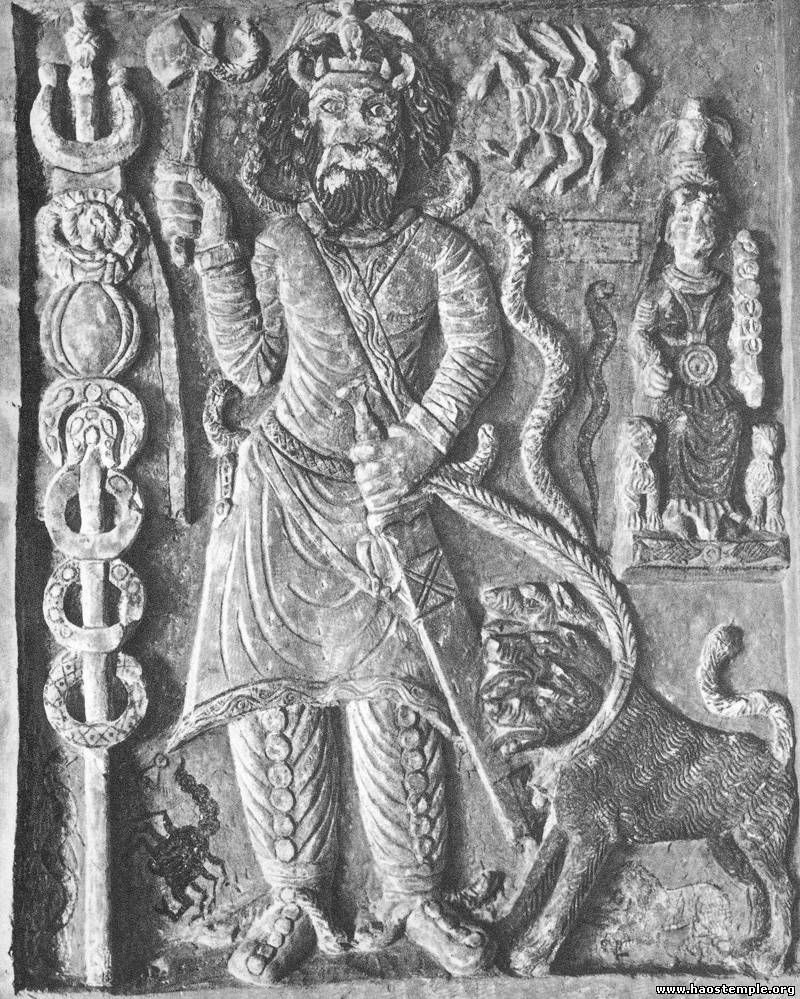
The “Cutha tablet” was found in the ancient city of Babylonia. The text on the tablet gives an account of “creation” and speaks of a “temple of Sittam, ” in the sanctuary of Nergal, the “giant king of war, lord of the city of Cutha.” He is frequently invoked in the hymns and his symbols and characteristics we find in the inscriptions and texts of Babylonian, Assyrian, and Samarian rulers.
As I explained in my article, Nergal: The Lion-Headed Cock God of Babylonian Hell (Earth), Nergal was the Cock-headed and Lion-headed Idol of the Samaritan Hebrews who we also know by many other names such as the Kush, Cush, Kish, Cuthah, Cuthites, Cushite, Cutheans, and Babylonians – to name a few. So when you read these different names you need to understand that they were the same people who purposely babbled history, scripture, and mythology because that has been their main job as the Scribes of Chaos for well over the last 2,000 years.
For those of you who have not read my past research on the Cush, I have found that they were also known as the Sons of Seth / Sethians who descended from Egyptian Pharaoh Seth I (Sesostris or Set I) and eventually became the founders of the Phoenician empire and at a later date – the Roman empire.

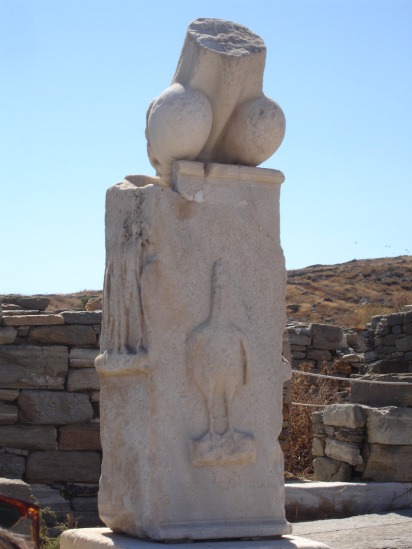
The Cush AKA Gnostic Sethians were the main progeny for the pillar (phallic/cock) cult that we see all around the world today and even here in the U.S. with the cock of Washington and Cleopatra. Herodotus tells us Seth defeated an army without much resistance and then erected a pillar in their capital with a vagina on it to symbolize the fact that the army fought like women which was most likely the same pillar that Josephus said survived in his time.
This is why we find Nergal, the Cush, Sethians and Romans were had carried and were associated with pillars (phallic/cock) in whatever lands they had conquered and ruled. Once a land and people were taken, their cocks were erected and sperm of their descendants was spread into the remaining concubine vaginas to establish their new hybrid/Hyksos empire.
As I mentioned earlier, Nergal was first mentioned as the god of the city known as Cuthah (Cuth/Kuth), and his association with this city is referred to in the Old Testament (II. Kings xvil. 30). He is mentioned in 2 Kings xvii, and the Babylonian Talmudic treatise Sanhedrin (fol. 63, p. 2) which states that the men of Cuthah made Nergal their god.
“And what was it? A cock.”
I find it interesting that they chose the cock which we call today a rooster and lion as their main symbols to represent Nergal and also aligned their souls with a God who they claimed was in charge of war and plagues. But when you really think about it, if you are trying to conquer the world, it makes perfect sense to get the God of war and plagues on your side so that you can use him to smite your foes and clear the land in a hurry.
I have found that there is probably a no better way to manage and rule the world than to use secret biological warfare via parasitical fungi/molds and their sovereign ruler – Nergal which have the ability to control, maim and kill your foes unbeknownst to them.
It was said that the Persians, Arabians, and Indians called the palm-tree – nergil, by of which they report strange things and we find that Nergal is in god lists, the god of the underworld named “King of the Palm Tree” (Lugal-gisimmar).
NERGAL IN BABYLONIAN HISTORY
In my opinion, the Babylonian texts reveal to us a treasure trove of hidden history, human biology, microbiology and spirituality that seems to prove that some of the stories in the Scripture are true and also these same people are the ancient Brotherhood of Magi that existed between Ancient Egypt and Crete for thousands of years.
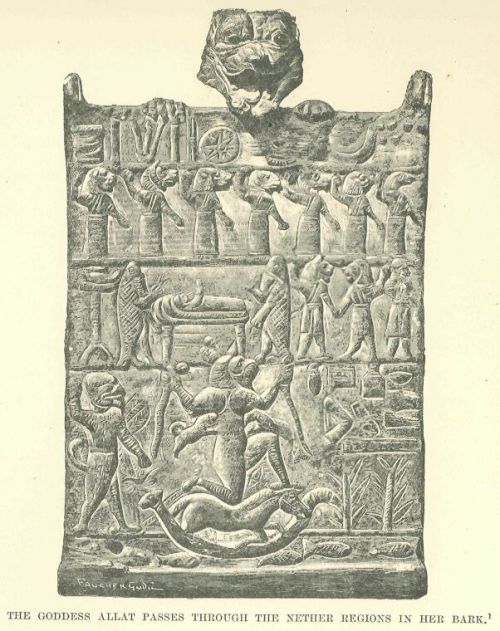
Assyrian documents of the 1st millennium BC describe Nergal as a benefactor of men, who hears prayers, restores the dead to life, and protects agriculture and flocks. Hymns depict him as a god of pestilence, hunger, and devastation. The other sphere of Nergal’s power was the underworld, of which he became king. According to one text, Nergal with his demon escorts descended to the underworld where the goddess Ereshkigal (or Allatum) was queen. He threatened to cut off her head, but she saved herself by becoming his wife, and Nergal obtained kingship over the underworld.”
According to the Babylonian theory of the manifestation of the divine power in cosmos and cycle, Nergal represents the Underworld, AKA Hell or lowest part of the cycle ie; Modernity as “King of the Beasts,” in which he is the “Lord of the great Dwelling-place,” that is, of the realm of Death. He is also most appropriately called the ” raging king,” the “furious one.”
In Christianity, Nergal later appears to take on the form of Simon Magus who is surnamed Saint Peter and Satan – the Father of the Galileans and King of Hell ie: The Modern World. This makes sense given the fact that the same Babylonian scribes who wrote about Nergal were the progenitors for the later Babylonian scribes of Rome.
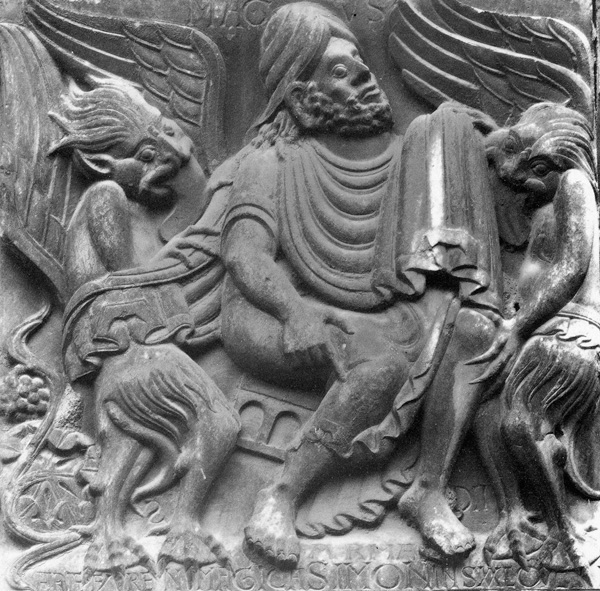
The same family. The same story. Just the names have been babbled to create a confusion of tongues which was always the goal as they tell us in Genesis;
And the LORD said, “If they have begun to do this as one people speaking the same language, then nothing they devise will be beyond them. Come, let Us go down and confuse their language so that they will not understand one another’s speech.” So the LORD scattered them from there over the face of the whole earth, and they stopped building the city.…”
We find Nergal in the Gilgamesh Epic (q.v.) where he opens the earth and brings up the spirit of Eabanland is listed as a god of plague and war Glr-ra with fourteen demons to assist him on his mission. He sends the plague-demon called Namtar to announce his arrival to Allatu who is obliged to admit him. Nergal then drags her from her throne intent on killing her, but when she bursts into tears and offers to become his wife and to place “the tablets of wisdom” in his hands, he spares her.
By doing so, he becomes the God of Knowledge (Gnosis) and protector of the “tablets of wisdom” and his descendants of chaos as the protectors of the king.
A role we see played today by national security apparatuses of the Deep State of the world such as the CIA and NSA in the U.S. and FSB in Russia. As the Mother of the CIA, James Jesus Angleton once said, “Deception is a state of mind and the mind of the State.”

Nergal is also associated with the god of the chase with his symbol of the lion and is often shown as a chimera type figure being that of man-lion and what we call today the Sphinx. The Semitic name for Nergal was Arin or Erin, a word which signifies “lion” in Hebrew and Syriac.
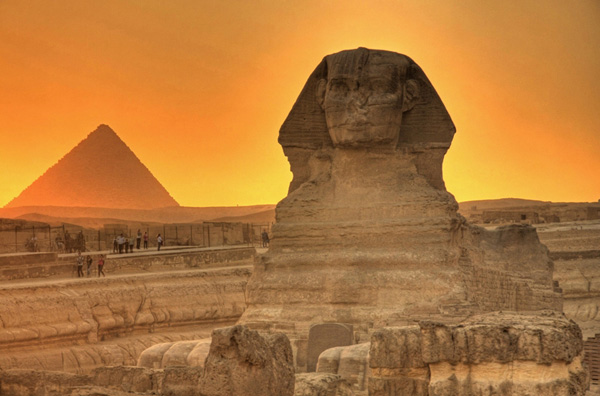
His descendants, The Cush – AKA Sons of Seth, AKA Samarians, AKA Babylonians, AKA the Aryan or Arian race who we find the Aryans all over the world such as in the names of the Island of Erin in Ireland which is named after their Aryan founders and the Arii of Germany, of the Ases of Scandinavia, and of the Island of Erin (Ireland).
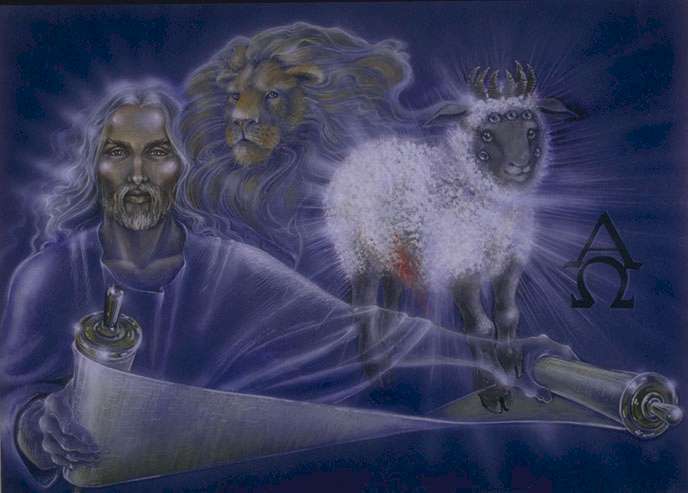
We also have the Lion of the Tribe of Judah and in Christianity refers to Jesus Christ, the Messiah. In Matthew 1:1–6 and Luke 3:31–34 of the New Testament, Jesus is described as a member of the tribe and Revelation 5:5 also mentions an apocalyptic vision of the Lion of the tribe of Judah.
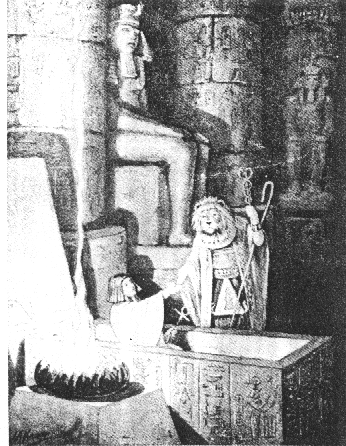
I have discovered the man-lion of the Cutha in the traditions of Gnosticism with the Yaldabaoth and the Demiurge who are depicted as a lion-faced figure or serpent and also the Lion-headed Chnoubis, The same symbol of lion we can now find in their Gnostic descendants, the Freemasons.
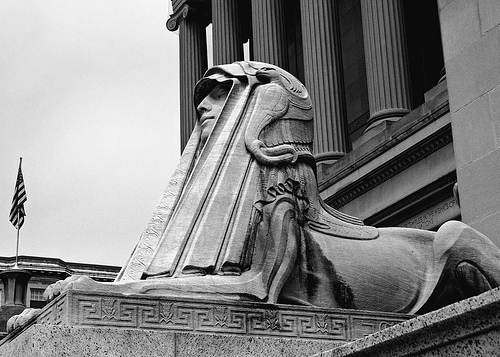
Who we find have the ritual of “The Lion of the Tribe of Judah” and the famous Lion’s Paw which is the most important message of the Third Degree.
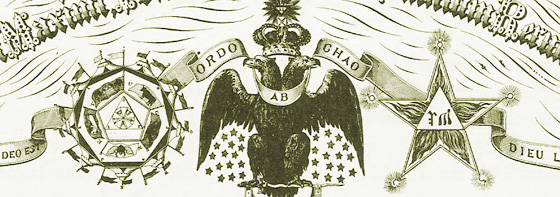
Let us not forget that the Masons are the masters of ORDO AB CHAO.
In the astral-theological system, Nergal is said to be associated with the planet Mars, while in the ecclesiastical art, we find his symbol of the great lion and on boundary-stone monuments surmounted by the head of a lion serving as guardians to the temples and palaces.
The Cutha tablet allegedly found at the library of Nineveh originally written for the great temple of Nergal at Cutha show Nergal the destroyer, who is represented as sending out the hosts of the ancient brood of chaos to their destruction.
The text also shows Nergal’s armies of chaos came into existence. The words are put into the mouth of Nergal and were written for his great temple at Cutha.
“On a tablet none wrote, none disclosed, and no bodies or brushwood were produced in the land; and there was none whom I approached.
Warriors with the body of a bird of the valley, men with the faces of ravens, did the great gods create.
In the ground did the gods create their city.
Tiamat (the dragon of chaos) suckled them. Their progeny (sasur) the mistress of the gods created.
In the midst of the mountains they grew up and became heroes and increased in number. Seven kings, brethren, appeared and begat children. Six thousand in number were their peoples. The god Banini their father was king; their mother was the queen Melili.”
To be continued…
Moe is the founder of GnosticWarrior.com. He is a father, husband, author, martial arts black belt, and an expert in Gnosticism, the occult, and esotericism.