Wisdom is better than weapons of war: but one sinner destroyeth much good. – King Solomon
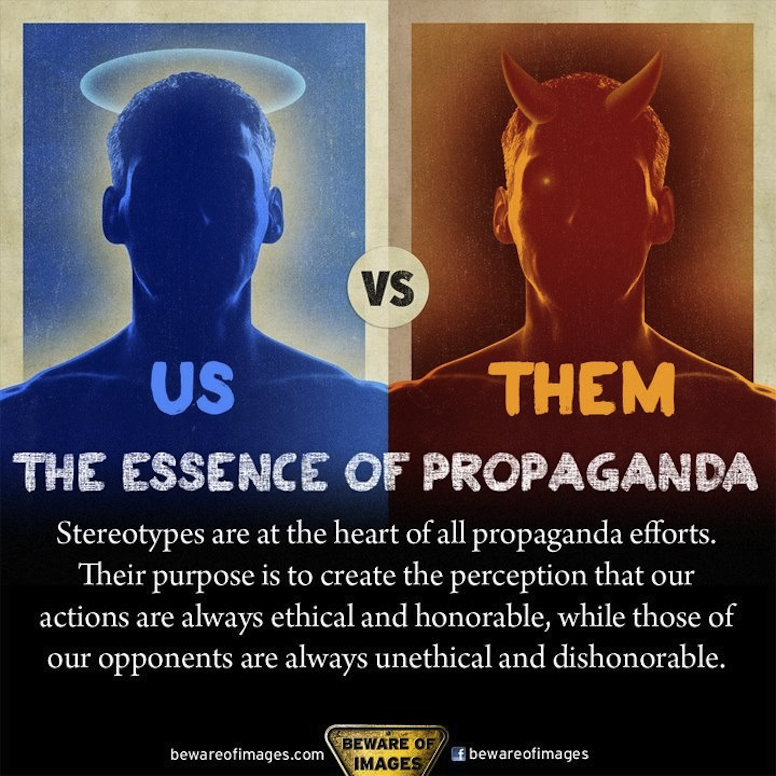
The world we see today is governed with the help of a method of communication and mind control that is called, ‘Propaganda’. Propaganda is a form of misleading communication that is artificially created by an organization or government to influence people, a community, or a whole nation. These statements may be partly false and partly true and are meant as “an appeal to emotion, not intellect.”
Most people today do not think for themselves. They let their teachers, media and government think for them. It is only when they are emotionally triggered, do they speak up or voice their opinions, which in reality are not their opinions, but ingrained propaganda that is based on half truths, lies and poisonous thoughts from others.
Very few people actually operate from the seat of intellect when analyzing such things as alleged facts, news or their education. This is why propaganda works so perfectly on the world’s citizens and why it is the preferred method of mental warfare employed by almost all the governments of the world. Hence, welcome to the magic of propaganda and mind control which go hand in hand. (more…)
Moe is the founder of GnosticWarrior.com. He is a father, husband, author, martial arts black belt, and an expert in Gnosticism, the occult, and esotericism.
The word mortgage essentially means “pledge till death.” The English word mortgage is derived from the Old French : mort, dead (from Vulgar Latin *mortus, from Latin mortuus, past participle of mor, to die; see mer- in Indo-European roots) + gage, pledge (of Germanic origin).
A mortgage is a contract specifying the terms you have to sign in order to get a loan; that which legally binds you by a pledge of property to a creditor as security for performance of an obligation or repayment. You don’t really own the home when you have a mortgage. It is more like a long-term lease with more flexibility and security than renting year to year.
If you don’t pay your home mortgage loan, this will amount to the death of your property; you will then go to a court where there is a referee called a judge who rules from the bench. This failure on your behalf to meet the terms of the agreement (legal contract) will more than likely cause the judge to rule for the other player, the bank or lender who will then foreclose on you, the losing party.
If you are lucky and pay off your mortgage in full, then you “sort of” own the property and won’t have to pay the bank anymore. The reason you don’t truly own the property out right is because you will have to keep Giving to Caesar what is Caesars by paying taxes for use of the land to the real property owner; and that my friends is the government.
The great jurist Sir Edward Coke, who lived from 1552 to 1634, has explained why the term mortgage comes from the Old French words mort, “dead,” and gage, “pledge.” It seemed to him that it had to do with the doubtfulness of whether or not the mortgagor will pay the debt. If the mortgagor does not, then the land pledged to the mortgagee as security for the debt “is taken from him for ever, and so dead to him upon condition, &c. And if he doth pay the money, then the pledge is dead as to the [mortgagee].” This etymology, as understood by 17th-century attorneys, of the Old French term morgage, which we adopted, may well be correct. The term has been in English much longer than the 17th century, being first recorded in Middle English with the form morgage and the figurative sense “pledge” in a work written before 1393.
Moe is the founder of GnosticWarrior.com. He is a father, husband, author, martial arts black belt, and an expert in Gnosticism, the occult, and esotericism.
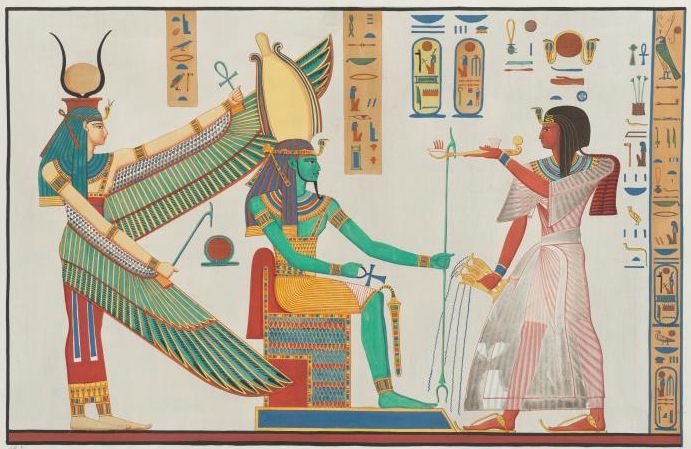
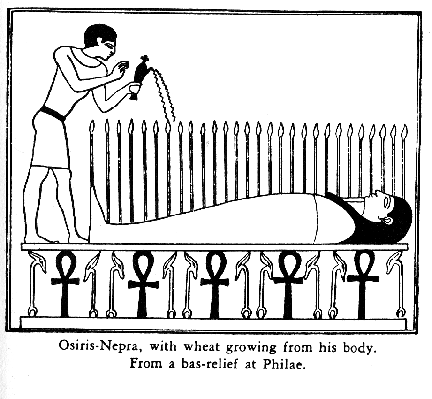
In Ancient Egyptian mythology, the god named Osiris is the SO BELOW (earth) representative of the AS ABOVE king of all the planets, Jupiter. The great Greek historian Herodotus confirms this fact, Osiris and Jupiter are one in the same. Osiris is not a real person, but a man-made title for the planet Jupiter who the Ancients had worshiped.
The god Osiris on earth through mythology represents the planet Jupiter in the heavens. Osiris is he who is permanently benign and youthful, the creator god, the lord of love, the lord of silence, god of the afterlife, the underworld and the dead. In Greek Mythology, they had assigned Jupiter to their god Zeus who they had also called the “Morning Star and Light Bringer.” Allegorical names that all represent the same planet.
Osiris is the mythological husband of the goddess Isis who represents the Moon, planet Venus, and the star Sirius. These names do not represent real people or Pharaohs, but were titles that were assigned to real people and Pharaohs. The style in which they governed the people through religion and commerce was indicative of their assigned titles, such as with Pharaoh Akhenaten of the Eighteenth dynasty of Egypt.
Akhenaten was forever made famous for abandoning ancient traditional Egyptian polytheism and abandonment of all other gods, especially the Gnostic religion of Amon (Amun or Amen). Jupiter equated with the Egyptian deity Amon. Akhenaten had introduced the religion centered on the Aten and thus causing much internal conflict amongst the elite of Egypt. The religion of Aten was based on sun and solar worship, symbolically represented by the disk of the sun. Later the worship of Aten was eradicated by Horemheb, who reinstituted the priesthood of Amon Ra and the Gnostic religion based on Amon.
Osiris is also the father of the god of truth and light, Horus. In Egyptian mythology, we find Osiris as the Creator, his son Horus the Preserver, and his brother Typhon the Destroyer. The name Typhon is assigned to Osiris’s brother whose name is Set (Set, Seth, Shaitan, or Molech), which is where we get the modern word for who Westerners call “Satan or the Devil.” Set is the SO BELOW of the planet on the AS ABOVE called Saturn. Hence, the gods Set, Satan, the Devil and Saturn are all one and the same. Just like Osiris of the Egyptians, Zeus of the Greeks, Yahweh of the Israelites, and Jove to the Romans are all just different allegorical names from different ancient cultures, which all represent the very same one planet we know of today as Jupiter.
Since most ancient times in mythology, these two planets have always fought with one another. It is in Ancient Egyptian mythology where we find Set kills his brother Osiris. Hence, darkness and chaos (Set who is Saturn) kills the light and order (Osiris who is Jupiter). These same planetary and earthly battles were carried on by the Greeks, with Jupiter being assigned to Zeus who battles his brother Cronus, and also banished his own son Prometheus to an island to have his liver fed on by eagles for teaching mortals the secret arts and teachings.
the victim being Bali, his murderer Sougriva; and the recital is so nearly identical with that archived in the sculptures and paintings of Uxmal and Chichen-Itza, and recorded in the second part of the Troano MS., that it is more than probable it was imported from Yucatan direct, perhaps by the colonists who, as Valmiki (the author of the “Ramayana”) tells us, settled in the Indio-Chinese peninsula (the Deccan) in remote ages, and who naturally would bring with them the language, customs, traditions, civilization, and folk-lore of their native land.
This same mythology was then interlaced into the Abrahamic religions, with Cain and Able who are both sons of Noah- who also represents the planet Jupiter. Cain slays his brother Able, just like in Egypt when Set had killed his brother Osiris.
In Freemasonry the story of Jupiter and Osiris is changed. We find Jupiter is represented by the Master Teacher, Hiram Abiff who is then killed by three ruffians who happened to be his students. 33rd Degree Freemason, Manly P. Hall confirms this fact that the story of Hiram Abiff is an adaptation of the mythology of Osiris;
“Preston, Gould, Mackey, Oliver, and Pike—in fact, nearly every great historian of Freemasonry-have all admitted the possibility of the modern society being connected, indirectly at least, with the ancient Mysteries, and their descriptions of the modern society are prefaced by excerpts from ancient writings descriptive of primitive ceremonials. These eminent Masonic scholars have all recognized in the legend of Hiram Abiff an adaptation of the Osiris myth; nor do they deny that the major part of the symbolism of the craft is derived from the pagan institutions of antiquity when the gods were venerated in secret places with strange figures and appropriate rituals.” (Manly P. Hall, “Rosicrucian and Masonic Origins”)
This is where it stands as of now in 2013. The god or this world is Satan (Set, Cain, Cronus, Saturn or The Masonic Three Ruffians), who we now know represents darkness and chaos, or what Masons would call CHAO (Latin for chaos). A power that has been in control of the earth’s energies for many centuries now.
Will Osiris ever return, or will we forever be under the Lordship of his brother Set, AKA Satan?
Something tells me that someday we may see Osiris again and these deals do not last forever……………………………
Matthew 13:30 – Let both grow together until the harvest. At that time I will tell the harvesters: First collect the weeds and tie them in bundles to be burned; then gather the wheat and bring it into my barn.'”
Moe is the founder of GnosticWarrior.com. He is a father, husband, author, martial arts black belt, and an expert in Gnosticism, the occult, and esotericism.
Satan (Set, Seth, Shaitan, Molech or Saturn) is the Lord of Hell and the very god who rules over money and wealth. The name Satan comes to us from Ancient Egypt from a deity named Set, (/sɛt/ or Seth, Sēth, Σήθ /sɛθ/; also spelled Setesh, Sutekh, Setekh, Suty or Sut).
Set represents the power of evil and is the Lord of Hell, who we simply call today Shaitan or Satan. He is the adversary, the accuser who is a god of the desert, storms, and foreigners, and in later myths, the god of darkness and chaos. (more…)
Moe is the founder of GnosticWarrior.com. He is a father, husband, author, martial arts black belt, and an expert in Gnosticism, the occult, and esotericism.
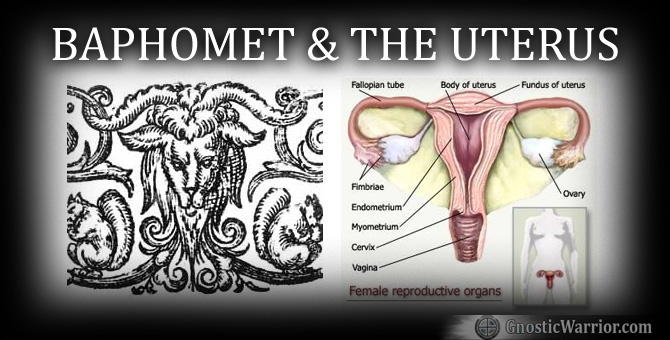
Please do not shoot the messenger ladies. I’m just talking about the female reproductive organ known as the uterus and its strong connection to the notorious head of Baphomet, whom many people mistakenly call “Satan or a demon.”
Here is an image below we created. I will let you all be the judge.
Many ancient cultures had fertility cults. The uterus was the center of a woman’s power and creativity. The place of creation that brings forth the light or dark. Numerous cultures had worshiped the goddess through the power of the uterus that gives birth to the world. Naturally, the uterus and phallus would be depicted in various art forms, from pictures to stone carvings.
In the occult, the uterus is called the lake of fire. The power of the fire of the solar logos is kindled here and this power can rise up from the sexual organ to the brain.
Could the image of Baphomet, that many people think is Satan or a demon, really be the image of the goddess in the form of the uterus?
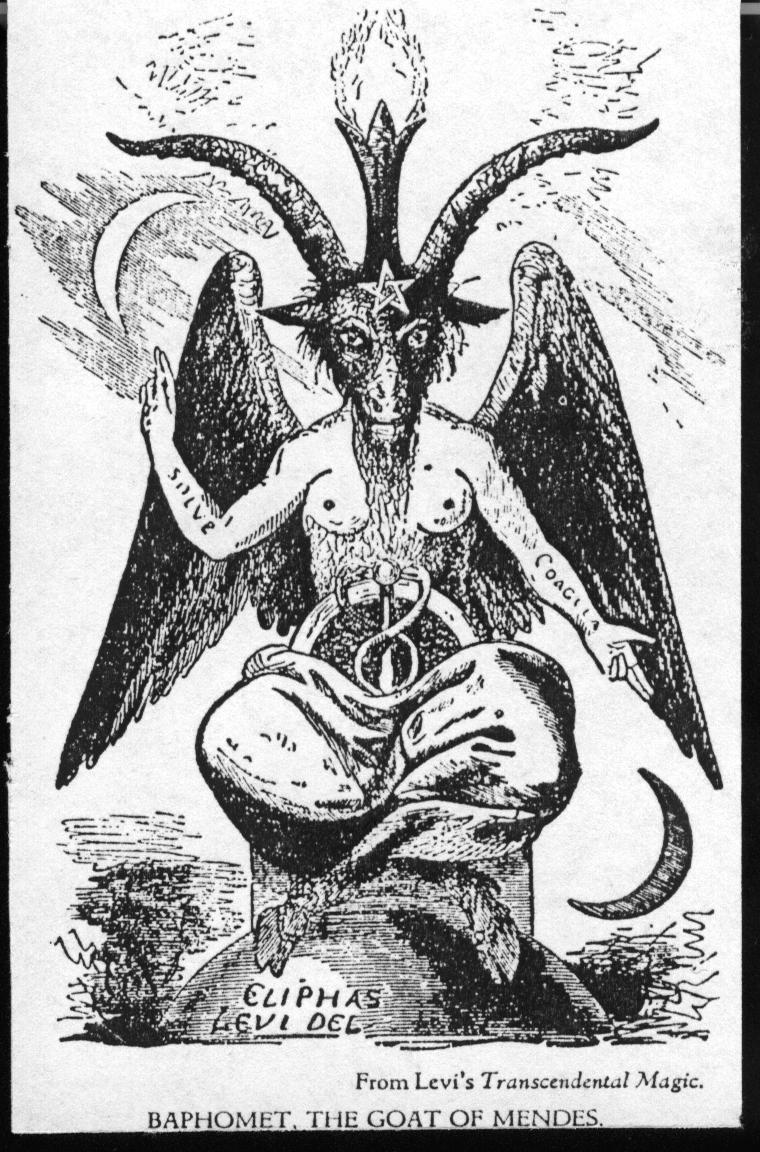
The original drawing of Baphomet below comes to us from a French-Jewish Freemason named Eliphas Levi, born Alphonse Louis Constant (February 8, 1810 – May 31, 1875).
Moe is the founder of GnosticWarrior.com. He is a father, husband, author, martial arts black belt, and an expert in Gnosticism, the occult, and esotericism.
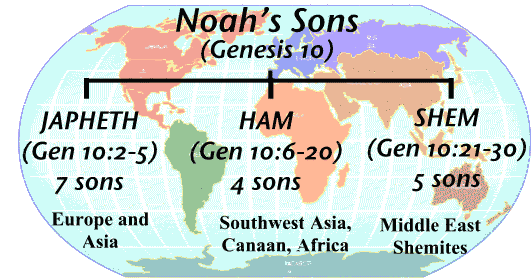
The three sons of Noah are Japheth, Ham, and Shem. Japheth is the eldest of the three sons, who are listed in the order “Shem, Ham, and Japheth” in Genesis 5:32 and 9:18. The current world at the present time is said to be divided amongst these three sons of Noah. According to that book, Japheth and his two brothers formed the three major races:
In Genesis 10:5, which states, “By these were the isles of the Gentiles divided in their lands.” Japheth’s descendants would inhabit the whole northern regions of the globe, having settled in Asia, Russia, Turkey, Greece, Europe, America and Israel, where Japheth is considered the father of the “Indo-Europeans or the Europeans” and “white people” (AKA the Caucasian race). The connection between Japheth and the Europeans, originates from Genesis 10:5, which states, “By these were the isles of the Gentiles divided in their lands.”
The name Japheth/ˈdʒeɪfɛθ/ (Hebrew: יָפֶֿתֿ, יֶפֶֿתֿ Yapheth , Modern Hebrew: Yefet ; Greek: Ἰάφεθ Iapheth ; Latin: Iafeth or Iapetus ; Arabic: يافث) is derived from Ja—God, or life, and Phatha, which means in Hebrew enlarged, and in other languages, father; thus, Japheth meant enlarged of God—God and father, or Deus pater. Various spellings of Japheth are Japheta, Japeta, Japhe, or Jophe, or, as the Latins “Iu-Pater” (yēu-pəter or Iuppiter, Iūpiter – Pater/Father or the nominative: *Dyēus-pətēr, meaning “O Father Sky-God”, or “O Father Day-God”); He was the ruler of the lower world whom the Latins had called “Father Jove”, and this is where we get the modern English spelling of Jupiter, who in Christianity is Saint Peter.
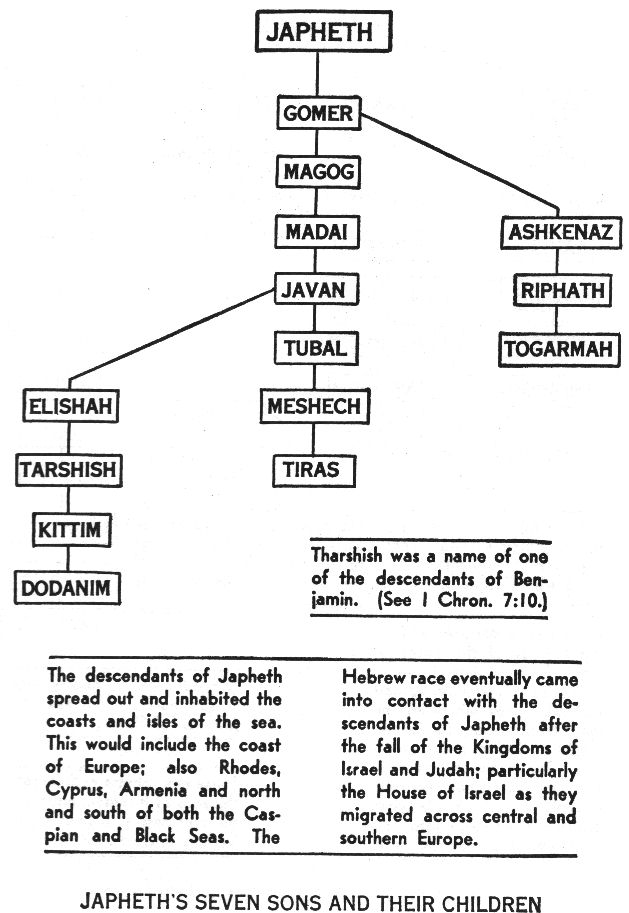
Japhet, the son of Noah, had seven sons: they inhabited so, that, beginning at the mountains Taurus and Amanus, they proceeded along Asia, as far as the river Tanais (Don), and along Europe to Cadiz; and settling themselves on the lands which they light upon, which none had inhabited before, they called the nations by their own names.
Japheth had seven sons: first, Gomer; second, Magog; third, Madai; fourth, Javan; fifth, Tubal; sixth, Meshech; seventh, Tiras. History of the Nations descended from the Eldest Son of Japheth, named Gomer (Gen. x. 2; I. Chron. i. 5; Ezekiel xxxviii. 6), viz.: Cimmerii, Italians, French, Sigambri, Gambrivi, Cimbri, Ancient Britons, Kumero or Welsh, Scotch, Irish, Comarians, Chomarians, Germans and various later writers (including Jerome and Isidore of Seville, as well as other traditional accounts) have assigned to them, are as follows:
Moe is the founder of GnosticWarrior.com. He is a father, husband, author, martial arts black belt, and an expert in Gnosticism, the occult, and esotericism.