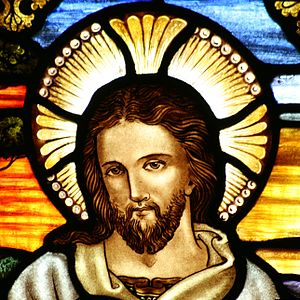
At the hour of Gautama-Buddha’s birth there were 32,000 wonders performed. The clouds stopped immovable in the sky, the waters of the rivers ceased to flow; the flowers ceased unbudding; the birds re-
Page 552
mained silent and full of wonder; all nature remained suspended in her course, and was full of expectation. “There was a preternatural light spread all over the world; animals suspended their eating; the blind saw; and the lame and dumb were cured,” etc.
We now quote from the Protevangelion:
“At the hour of the Nativity, as Joseph looked up into the air, ‘I saw,’ he says, ‘the clouds astonished, and the fowls of the air stopping in the midst of their flight. . . . And I beheld the sheep dispersed . . . and yet the sheep stood still; and I looked into a river, and saw the kids with their mouths close to the water, and touching it, but they did not drink.
“Then a bright cloud overshadowed the cave. But on a sudden the cloud became a great light in the cave, so that their eyes could not bear it. . . . The hand of Salome, which was withered, was straightway cured. . . . The blind saw; the lame and dumb were cured.”
When sent to school, the young Gautama, without having ever studied, completely worsted all his competitors; not only in writing, but in arithmetic, mathematics, metaphysics, wrestling, archery, astronomy, geometry, and finally vanquishes his own professors by giving the definition of sixty-four kinds of writings, which were unknown to the masters themselves.
And this is what is said again in the Gospel of the Infancy: “And when he (Jesus) was twelve years old . . . a certain principal Rabbi asked him, ‘Hast thou read books?’ and a certain astronomer asked the Lord Jesus whether he had studied astronomy. And Lord Jesus explained to him . . . about the spheres . . . about the physics and metaphysics. Also things that reason of man had never discovered. . . . The constitutions of the body, how the soul operated upon the body, . . . etc. And at this the master was so surprised that he said: ‘I believe this boy was born before Noah . . . he is more learned than any master.’ ”
The precepts of Hillel, who died forty years B. C., appear rather as quotations than original expressions in the Sermon on the Mount. Jesus taught the world nothing that had not been taught as earnestly before by other masters. He begins his sermon with certain purely Buddhistic
Page 553
precepts that had found acceptance among the Essenes, and were generally practiced by the Orphikoi, and the Neo-platonists. There were the Philhellenes, who, like Apollonius, had devoted their lives to moral and physical purity, and who practiced asceticism. He tries to imbue the hearts of his audience with a scorn for worldly wealth; a fakir-like unconcern for the morrow; love for humanity, poverty, and chastity. He blesses the poor in spirit, the meek, the hungering and the thirsting after righteousness, the merciful and the peace-makers, and, Buddha-like, leaves but a poor chance for the proud castes to enter into the kingdom of heaven. Every word of his sermon is an echo of the essential principles of monastic Buddhism. The ten commandments of Buddha, as found in an appendix to the Pratimoksha Sutra (Pali-Burman text), are elaborated to their full extent in Matthew. If we desire to acquaint ourselves with the historical Jesus we have to set the mythical Christ entirely aside, and learn all we can of the man in the first Gospel. His doctrines, religious views, and grandest aspirations will be found concentrated in his sermon.
This is the principal cause of the failure of missionaries to convert Brahmanists and Buddhists. These see that the little of really good that is offered in the new religion is paraded only in theory, while their own faith demands that those identical rules shall be applied in practice. Notwithstanding the impossibility for Christian missionaries to understand clearly the spirit of a religion wholly based on that doctrine of emanation which is so inimical to their own theology, the reasoning powers of some simple Buddhistical preachers are so high, that we see a scholar like Gutzlaff, utterly silenced and put to great straits by Buddhists. Judson, the famous Baptist missionary in Burmah, confesses, in his Journal, the difficulties to which he was often driven by them. Speaking of a certain Ooyan, he remarks that his strong mind was capable of grasping the most difficult subjects. “His words,” he remarks, “are as smooth as oil, as sweet as honey, and as sharp as razors; his mode of reasoning is soft, insinuating, and acute; and so adroitly does he act his part, that I with the strength of truth, was scarcely able to keep him down.” It appears though, that at a later period of his mission, Mr. Judson found that he had utterly mistaken the doctrine. “I begin to find,” he says, “that the semi-atheism, which I had sometimes mentioned, is nothing but a refined Buddhism, having its foundation in the Buddhistic Scriptures.” Thus he discovered at last that while there is in Buddhism “a generic term of most exalted perfection actually applied to numerous individuals, a Buddha superior to the whole host of subordinate deities,” there are also lurking in the
Moe is the founder of GnosticWarrior.com. He is a father, husband, author, martial arts black belt, and an expert in Gnosticism, the occult, and esotericism.