by Moe
The cross of life or the logos was used by the ancient Egyptians, Greeks and Jews. Their cross was modeled after the Egyptian Ankh or the Greek Tau. The letter Tau, Saint Bede had 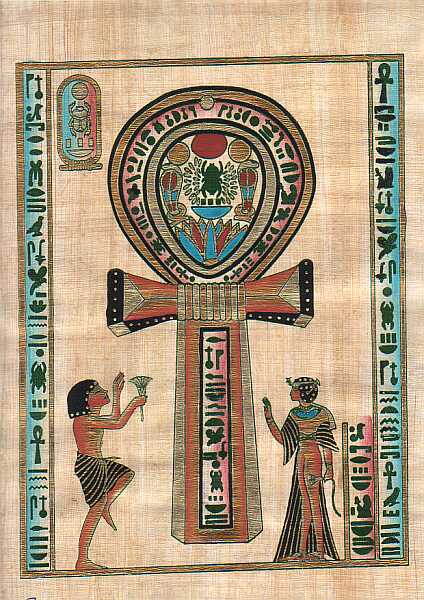 written was the sign of salvation and of the cross. The Tau is represented by an uppercase Τ and is the 19th letter of the Greek alphabet. The Greek alphabet is derived from the Phoenicians who had represented it with the Phoenician letter taw. The tau is considered a symbol of salvation due to the identification of the tau being the sign that which in Ezekiel 9:4 was marked on the forehead of the saved ones (וְהִתְוִיתָ תָּו עַל־מִצְחֹות הָאֲנָשִׁים “set a mark (tav; after the Phoenician cross-shape on the forehead of the men”).
St. Mark informs us, “With the form of a serpent, He kills the serpent, for the serpent made out of the rod swallowed up the other serpents.” Jesus was crucified on the Christian Cross of Warfare on Friday, April 3, AD 33. “The power of the serpent of Egypt was broken on the cross.” That quote about the symbol and power of the serpent being broken on the cross was from the 1st century A.D. Christian apologist Justin Martyr, also known as Saint Justin ( c. 100 – 165 AD). St. Augustine tells us, that the image of Christ and his Cross was the new ensign of Christian Warfare that the Romans had carried before them; being the Ensign or Profession of their Warfare.
Many Christians are unaware of the fact that the Christian Cross is a symbol of Christian warfare. The cross is a symbol and war standard, and should not be worshipped or adored like an idol. The 7th-8th century Doctor of the Church and Father of English History, Saint Bede had explained, “A Cross of Silver, and the Image of our Saviour in a Picture. They bore a Cross for their Banner, Pro Vexillo: hon pro Adoratione, not for Adoration.” A Latin phrase meaning, “As standards: no honors for Adoration.”
Before the advent of Christianity, the Gnostic religion and brotherhood of the serpent (wisdom and health) had ruled the world for thousands of years. The religion of the serpent had originally come from the East in Ancient Greece, Crete and Egypt. It then moved West with the mass migrations of these tribes of the serpent into places such as America and England. It was here at this time, where the priesthood of the Druids, Saxon, Angles, Picts and various pagan Celtic tribes were dying for control of this land. It wasn’t until approximately in the 7th century A.D., when the cross had made its way into ancient England.
It was a time of war, bloodshed and lawlessness. Loyalty and peace were simply non-existent.
In order to bring peace to the region, a group of powerful ex-Druids of Italy, Gaul, Ireland, Britain, Scotland and Iona who were also known as Culdee Monks had made the decision to become Christians by joining the Celtic Druid Church with the Roman to create what we know today as the Catholic Church. The meaning of the name Catholic is universal and these monks were some of the true Doctors and Fathers of the Catholic Religion. (more…)
Moe is the founder of GnosticWarrior.com. He is a father, husband, author, martial arts black belt, and an expert in Gnosticism, the occult, and esotericism.
by Moe
The Bull stated that any land not inhabited by Christians was available to be “discovered,” claimed, and exploited by Christian rulers and declared that “the Catholic faith and the Christian religion be exalted and be everywhere increased and spread, that the health of souls be cared for and that barbarous nations be overthrown and brought to the faith itself.” This “Doctrine of Discovery” became the basis of all European claims in the Americas as well as the foundation for the United States’ western expansion.
Nuns to pope: Revoke 15th-century doctrine that allows Christians to seize native land
(Source: Washington Post) – In November, Sister Maureen Fiedler hand-delivered a letter to Pope Francis’ ambassador in Washington, D.C., urging the pontiff to renounce a series of 15th-century church documents that justify the colonization and oppression of indigenous peoples.
She doesn’t know if the letter made it to the Vatican. But she’s hopeful a recent resolution by the Leadership Conference of Women Religious will spur the pope to repudiate the centuries-old concept known as the “Doctrine of Discovery.”
“When I learned about it, I was horrified,” said Fiedler. As a member of the Loretto Community, a congregation of religious women and lay people, Fiedler first heard of the doctrine when her order marked its 200th anniversary by challenging “the papal sanctioning of Christian enslavement and power over non-Christians.”
Read more from the Washington Post
The Doctrine of Discovery, 1493
The Papal Bull “Inter Caetera,” issued by Pope Alexander VI on May 4, 1493, played a central role in the Spanish conquest of the New World. The document supported Spain’s strategy to ensure its exclusive right to the lands discovered by Columbus the previous year. It established a demarcation line one hundred leagues west of the Azores and Cape Verde Islands and assigned Spain the exclusive right to acquire territorial possessions and to trade in all lands west of that line. All others were forbidden to approach the lands west of the line without special license from the rulers of Spain. This effectively gave Spain a monopoly on the lands in the New World.
The Bull stated that any land not inhabited by Christians was available to be “discovered,” claimed, and exploited by Christian rulers and declared that “the Catholic faith and the Christian religion be exalted and be everywhere increased and spread, that the health of souls be cared for and that barbarous nations be overthrown and brought to the faith itself.” This “Doctrine of Discovery” became the basis of all European claims in the Americas as well as the foundation for the United States’ western expansion. In the US Supreme Court in the 1823 case Johnson v. McIntosh, Chief Justice John Marshall’s opinion in the unanimous decision held “that the principle of discovery gave European nations an absolute right to New World lands.” In essence, American Indians had only a right of occupancy, which could be abolished.
The Bull Inter Caetera made headlines again throughout the 1990s and in 2000, when many Catholics petitioned Pope John Paul II to formally revoke it and recognize the human rights of indigenous “non-Christian peoples.”
Read More
Moe is the founder of GnosticWarrior.com. He is a father, husband, author, martial arts black belt, and an expert in Gnosticism, the occult, and esotericism.
by Moe
For the first time since possibly the first crusade, Pope Francis has called for what may amount to a modern-day military crusade to protect persecuted Christians from brutal Islamic jihadists such as the the Islamic State of Iraq and Syria (ISIS).
This news also comes out after an alleged plot this week by ISIS to kill the Pope.
Here are some quotes from an Associated Press article who broke the news:
The Vatican is increasingly indicating support for military action in Iraq to protect Christians and other religious minorities from persecution by brutal Islamic jihadists.
As the world grapples with how to combat the Islamic State of Iraq and Al-Sham (ISIS), the Vatican released a letter Wednesday in which Pope Francis urges the international community “to take action to end the humanitarian tragedy now underway.”
The Pope’s comments followed stronger words from the Vatican’s ambassador to the United Nations in Geneva on Sunday. “Maybe military action is necessary at this moment,” Archbishop Silvano Tomasi said in an interview with Vatican Radio.
The plan for the first holy war was formed at the twilight of the 11th century by pope Sylvester II. It was later confirmed when the Christian Byzantine emperor, Alexius in the East had written a letter to then Pope Urban II asking for help from the attacking Muslim Turks in the Holy Land.
Shortly thereafter Pope Urban II called for the first “holy war” or Crusade to gain control of the Holy Land.
The First Crusade was known as Gesta Francorum. This was when the Knights Templar were formed and who were originally founded to protect Christian pilgrims to the Holy Land. In 1139 Pope Innocent II placed the Templars directly under papal authority.
Read more from the AP
Moe is the founder of GnosticWarrior.com. He is a father, husband, author, martial arts black belt, and an expert in Gnosticism, the occult, and esotericism.
by Moe
The ancient symbology of the serpent that can be witnessed for the last three thousand years all over the world in places 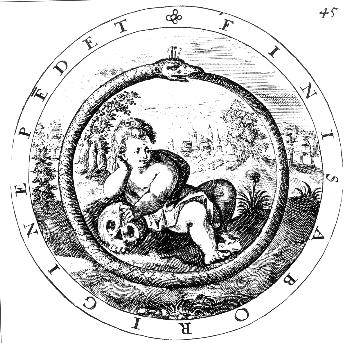 such as Egypt, Crete, Greece and also the serpent in the Garden of Eden is really just a wise worm, and the little king of earth. This fact was somewhat of a surprise to me, and I know it will be to many of my readers. However, if you understand that the worm is one of the most ancient and strongest creatures on earth that is now being verified by science as fact, and that we humans are just descendants of the worm via the sperm, you will then start to comprehend these worm revelations that I have been revealing to you over the last couple of years. After all, this is the Apocalypse. (unveiling)
The current English and Germanic languages, and modern adaptations of the bible are much different from the ancient Hebrew, Greek and Latin versions. The words we speak and see today are different from those of yesteryear. In order to find the secrets of the past, we must search this ancient history and these older languages to find the truth hidden right before our very eyes. As in the case on the symbol of the serpent found all over the world, which I have found is really the symbolic exoteric representation of the worm. (more…)
Moe is the founder of GnosticWarrior.com. He is a father, husband, author, martial arts black belt, and an expert in Gnosticism, the occult, and esotericism.
by Moe
You will find that the actual name “antichrist” is only spoken about by the Apostle John a few times in the bible via the verses John  2:18, 2:22, 4:3, and 2 John 7. He tells us that there are “many antichrists” who will appear between the time of Christ’s first and Second Coming, but there will be one great antichrist who will rise to power during the end times, or “last hour,” as 1 John phrases it. He will deny that Jesus is the Christ. He will deny both God the Father and God the Son. He will be a liar and a deceiver.
The antichrist is mentioned in 1 John 4:1-3 and says, “Beloved, do not believe every spirit, but test the spirits, whether they are of God; because many false prophets have gone out into the world. By this you know the Spirit of God: Every spirit that confesses that Jesus Christ has come in the flesh is of God, and every spirit that does not confess that Jesus Christ has come in the flesh is not of God. And this is the spirit of the Antichrist, which you have heard was coming, and is now already in the world.” (NKJV) (more…)
Moe is the founder of GnosticWarrior.com. He is a father, husband, author, martial arts black belt, and an expert in Gnosticism, the occult, and esotericism.
by Moe
The family of the Juli who were also known by the given name of the Caesars in ancient Rome had produced some of the most powerful people of the 6th Age. In fact, they were esteemed as Gods and had changed time, calendars and they in which the people under the rule of the Roman Empire would be ruled for generations to come. A family that would help build Rome into a world-wide Empire, and also conquer much of the world.
The history surrounding the family of the Caesars has been written about by many of the world’s best historians, and scholars over the last 2,000 years. But in all these books, articles and movies that tell of their history, they still do not indicate the city or cities where the first family of the Caesars had come from. In the course of my own research into the history of this family, I have found an ancient connection to a couple of cities that were once called Caere (Cere). It was in the cities of Caere where a people called the Cereithes had lived, and whose name may have also helped form the English word we know of today as Christian.
The original home and birthplace of the name of the Caesars I have found to be composed of two cities bearing the same name of Caere (Cere). This name of Caere is derived from the Greek word ‘Ares’ who the Romans identified this god as their God of war, Mars. He is represented as the son of Zeus (Jupiter) and Hera (Venus). (Homer Illiad v. 893, &c.; Hes. 921; Apollod. i. 3. § 1.) The God of the Roman Empire was Jove (Jupiter) who was known as Zeus in Greece and the Emperor became a son of Zeus who ruled by religion and war with the Roman Emperor as the God of War and Pontifex Maximus of religion.
Virgil had written this poem about Augustus and his family of the Caesars:
Turn, turn thine eyesIsee here thy race divine,
Behold thy own imperial Roman line:
Caesar, with all the Julian name survey;
See where the glorious ranks ascend to-day !—
This—this is he!—the chief so long foretold
To bless the land where Saturn ruled of old,
And give the Lernean realms a second age of gold!
The promised prince, Augustus the divine,
Of Caesar’s race, and Jove’s immortal line.
It was Augustus Caesar who was the race of Jupiter who had addressed to the gods Mars and Venus, progenitors of the Roman people (and patrons of Ovid’s poetry).
WHERE WAS THE HOMELAND AND CITIES OF THE CAESARS?
The city of Caere that may be the first original homeland which would be in ancient Greece on the island of Crete, and the other would be the second sister city that had come later to Italy. The original first city of Caere (Cere or Caeratus) was in ancient Greece on the Holy Island of Crete. A city we know of today as Knossus (Cnossus, Gnossus). A city I like to call the first true home to Gnosis and the Gnostics because after all, this is where we get the word we today call Gnosis. In historical times, this was the most powerful city in the world. The ancient city of Caere had got its name from a small river that had flowed beneath its walls called “Caeratus.” This river had run along side another river named Triton which took its name from the Son of Neptune. Mythological gods who all were born on Crete. An island known by many names.
This connection I have made between the Caesars and Crete makes more sense when you research Augustus Caesar’s grandfather, Atius Balbus who I believe was originally from Crete or it was simply his ancesteral homeland. Atius was said to be born in 100 BC in Roma, Italy, and later died along with his many ancestors who are buried on the Sacred Mountain of the Stone on the Holy Island of Crete.
The great 1st century geographer and historian, Strabo had written this about the city of Caere and river on the island of Crete;
There are several cities in Crete, but the greatest and most famous are three: Cnossus, Gortyna and Cydonia. The praises of Cnossus are p129hymned above the rest both by Homer, who calls it “great” and “the kingdom of Minos,”and by the later poets.
In earlier times Cnossus was called Caeratus, bearing the same name as the river which flows past it. According to history, Minos was an excellent law‑giver, and also the first to gain the mastery of the sea; and he divided the island into three parts and founded a city in each part, Cnossus in the opposite the Peloponnesus. And it, too lies to the north. As Ephorus p131states, Minos was an emulator of a certain Rhadamanthys of early times, a man most just and bearing the same name as Minos’s brother, who is reputed to have been the first to civilise the island by establishing laws and by uniting cities under one city as metropolis by setting up constitutions, alleging that he brought from Zeus the several decrees which he promulgated.
Strabo goes on to allude to his ancestral bonds to Crete and the city of Gnossus by saying he himself was not an alien to these lands, but how by fate and war, he ultimately had to sever his connections to the island. A law that still stands to this day. Strabo had said; “The Caerites were held in much repute among the Hellenes for their bravery and integrity, and because, powerful though they were, they abstained from robbery.”
An interesting note about me is that I had my DNA tested a few years ago revealing I’m a Greek Hellene (Phoenician) on my father’s side, and I also feel connected to the family of the Caesars. An internal Gnosis of past knowledge that I have been verifying for several years now. Hence, as Plato had said, “All learning is remembering.”
According to Dionysius, the Romans were first engaged in hostilities with Caere under the reign of Tarquin the Elder, and subsequently under Servius Tullius, by whom a treaty was concluded between the two states. (III. 28.) Long after, when Rome had been taken by the Gauls, the Caerites rendered that city an important service by receiving their priests and vestals, and defeating the Gauls on their return through the Sabine country; on which occasion they recovered the gold with which Rome is said to have purchased its liberation n. In return for this assistance, the Romans requested the Caerites inadequately, as Strabo seems to hint, by declaring them the public guests of Rome, and admitting them, though not in full, to the rights enjoyed .by her citizens0. (Cf. Liv. V. 40. and 50. Val. Max. I.1. Aul. Gell. XVI. 13.)
Virgil, one of Rome’s greatest poets in the time of Julius Caesar had written this poem that I believe connects the Caesars to this town and also shows the nature of their roles as shepherds to their people;
“Not far from hence there stands a hilly town,
Of ancient building and of high renown,
Torn from the Tuscans by the Lydian race,
Who gave the name of Care to the place,
Once Agyllina called.”
“A greenwood shade, for long religion known,
Stands by the streams, that wash the Tuscan town,
Encompassed round with gloomy hills above,
Which add a holy horror to the grove:
The first inhabitants, of Grecian blood,
That sacred forest to Sylvanus vowed,
The guardian of their flocks and fields,—they pay
Their due devotions on his annual day.”
THE CAESARS FROM CAERE IN ITALY
In Italy, there was a city also called Caerite cera Digni,’] Caere (Cer- vetri) was a very ancient town of Etruria, about twenty-seven miles north of Rome. was a very ancient town of Etruria, about twenty-seven miles north of Rome. The remains of Caere are still to be traced about four miles from the sea, on a spot known to the people of the country by the name of Cerveteri. Aisium. It was called by the Greeks ‘AyuXXa. About A.u.c. 400, the people of Tarquinii having taken up arms against the Romans, the Caerites were accused of aiding them, and were threatened with punishment, but having asked pardon they obtained it at the expense of half their territory. The Romans, out of gratitude, are said to have conferred upon the Caerites the Roman franchise without the suffragium. The Caerites appear to have been the first body of Roman citizens who did not enjoy the sufferage. ; or on the retirement of the Gauls before the destruction of Rome, on which occasion they rendered important service.(3) According to Dionysins, the Caerites were engaged in war against the Romans under the elder Tarquin, who defeated them in a battle and laid waste their territory;
As it is said in John 19:15; “But they shouted, “Take him away! Take him away! Crucify him!” “Shall I crucify your king?” Pilate asked. “We have no king but Caesar,” the chief priests answered.” “They elected Caesar to be their king; by Caesar they were destroyed” (Lampe). Their theocracy fell by their mad rage against the perfect embodiment of the highest righteousness and purest love. “The kingdom of God, by the confession of its rulers, has become the kingdom of this world.”
SOURCES:
2. Cambro-Briton and General Celtic Repository, Volume 2
3. Quinti Horatii Flacci opera omnia, with a comm. by A.J. Macleane By Quintus Horatius Flaccus
Moe is the founder of GnosticWarrior.com. He is a father, husband, author, martial arts black belt, and an expert in Gnosticism, the occult, and esotericism.