by Moe | Aug 1, 2022 | Breaking News, Propaganda
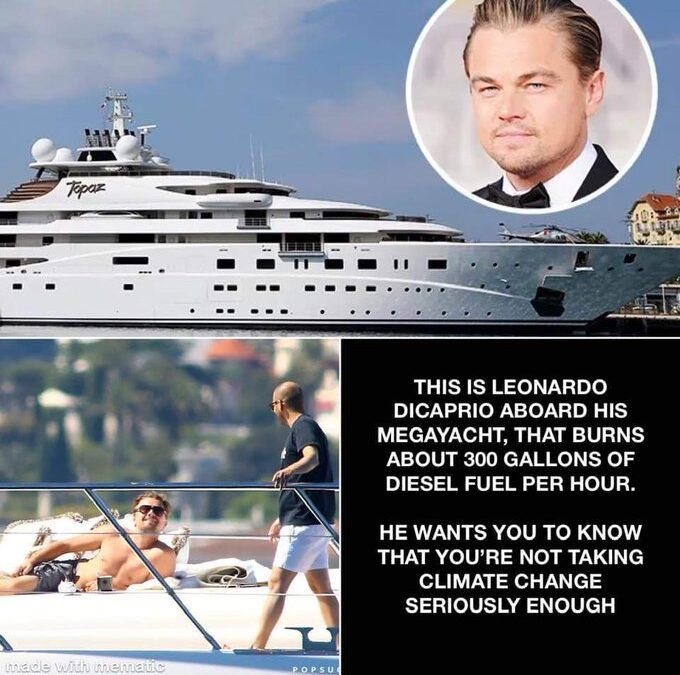
Leonardo DiCaprio is vocal about Climate Change and urges his fans to take action time and time again, but he doesn’t follow his own advice.
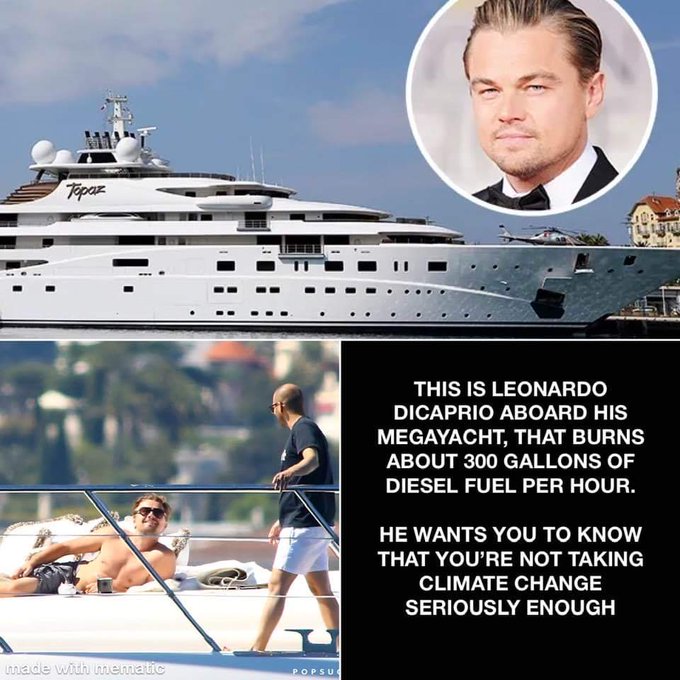
In an epic Twitter thread this past week, Brazilian President Bolsonaro gave American actor and climate activist, Leonardo DiCaprio a stern lecture on being an eco-hypocrite and spreading misinformation, saying that he should “give up his yacht before lecturing the world about the environment” and stop trying to change the world, but not himself:
He is one of the world’s most famous faces, and he has used his fame to draw attention to environmental issues like climate change, deforestation, and the decline in the ocean’s fish stocks.
In 2016, DiCaprio said that “the planet is dying” and he has called for humans to become “carbon neutral” by 2048. But now we have proof that he isn’t really committed to saving the planet when it comes down to it.
DiCaprio has been making headlines lately for being a hypocrite for his own extreme carbon footprint by using tons of CO2 emissions from his travels. He can be regularly seen floating around on his 110 million dollar yacht that takes $339,712 in diesel fuel to fill its tank or jet setting around the globe in planes promoting his films.
Bolsonaro was responding to DiCaprio, who was virtue signaling on Twitter about the Amazon rainforest, saying that it has “faced an onslaught of illegal deforestation at the hands of extractive industry over the last 3 years.”
“You again, Leo?” Tweeted Bolsonaro. “I could tell you, again, to give up your yacht before lecturing the world, but I know progressives: you want to change the entire world but never yourselves, so I will let you off the hook.”
Bolsinaro continues;
“Between us, it’s weird to see a dude who pretends to love the Planet paying more attention to Brazil than to the fires harming Europe and his own country.
But don’t worry, Leo, unlike the places you are pretending not to see by brilliantly playing the role of a blind man, Brazil is and will carry on being the nation that most preserves. You can carry on playing with your Hollywood star toys as we do our job.
Actually, in my government average deforestation is way lower than it was in the past, when the crook turned candidate that your Brazilian buddy supports was in power.
It’s clear that everyone who attacks Brazil and its sovereignty for the sake of virtue signaling doesn’t have a clue about the matter. They don’t know, for instance, that we preserve more than 80% of our native vegetation or that we have the cleanest energy among G20 nations.
It’s also clear that you don’t know that my government announced a new commitment to eradicate illegal deforestation by 2028, and not by 2030 as most countries. Or maybe you do know that, but for some reason pretend to be ignorant. I hope you not getting too much for this role.
If its within your reach, we would love to see you stop spreading missinformation. In the recent past, you used a 2003 image to talk about the Amazon wildfires allegedly happening in 2019 and was exposed, but I have forgiven you. So please go and sin no more.
By the way, what do you think about the hitting coal market in Europe? And what about Greta Timberlake, do you know what she has been up to lately and what she has to say about it? If I was hosting a barbecue in my house, I’m sure she would be yelling “How dare you?”.
This is not the first time that the two have clashed with each other.
Earlier this year, Bolisinaro slammed the actor DiCaprio after posting a tweet encouraging Brazilian youth to vote, “Brazil is home to the Amazon and other ecosystems critical to climate change. What happens there matters to us all, and youth voting is key in driving change for a healthy planet”.
The Brazilian President replied, “Our people will decide if they want to keep our sovereignty on the Amazon or to be ruled by crooks who serve foreign special interest”.
Moe is the founder of GnosticWarrior.com. He is a father, husband, author, martial arts black belt, and an expert in Gnosticism, the occult, and esotericism.
by Moe | Jul 15, 2022 | Alchemy, Meaning of Words, Mind Control Research
“O thou invisible spirit of wine, if thou hast no name to be known by, let us call thee Devil.” – Shakespeare
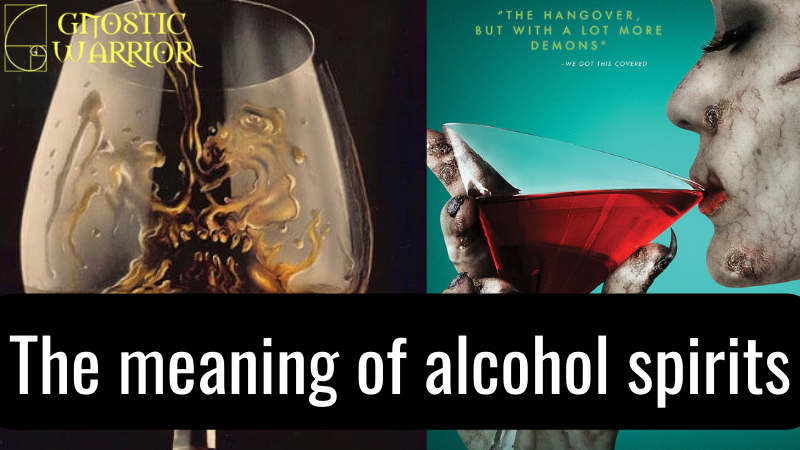
The secret history of spirits and alcohol is a long and fascinating one.
Many ancient cultures were very well acquainted with alcohol. The use of it has been linked to religious ceremonies as well as being used as an offering to gods or spirits so that they would provide good harvests or protection for crops from pests and disease.
Another reason why alcohol was used in many religious ceremonies and held to be sacred when used appropriately. It was used in ceremonies because it allowed the person to have communion with the spirit world. Hence, the name spirits when referring to alcohol.
Paracelsus (1493-1541) used the word spirit to refer to a fine powder but also a volatile liquid. By the 1670s it was being used in English for “any sublimated substance, the pure spirit of anything,” including liquids.
For example, when an ancient alchemist made wine, it was the “spirit of the grape” being extracted and served as a drink. Beer would be the “spirit of barley or hops.” They believed that through alchemy, the transmutation of a substance to its original state was its spirit, just like the human spirit.
It was called a spirit of the original material because it contained the essence or nature of the material it was distilled from. In much the same way that humans were thought to have a spiritual essence because of their souls.
It has been said that the use of the word “spirit” in connection with the distillation process first came about in the Middle East;
“The term “spirit” in reference to alcohol stems from Middle Eastern alchemy. These alchemists were more concerned with medical elixirs than with transmuting lead into gold. The vapor given off and collected during an alchemical process (as with the distillation of alcohol) was called a spirit of the original material.” (Wikipedia)
This is why the word spirits can be used interchangeably with alcohol.
Ancient alchemists generally believed in three kinds of spirits: natural spirits (responsible for growth and nutrition), animal spirits (responsible for sensation and movement), and vital spirits (responsible for life itself). Through this supposed spirit, the realm of air passed into oceans of liquid.
In our modern era, we sometimes call various alcoholic drinks such as wine, “spirits of wine” or other alcoholic beverages are simply called “distilled spirits.”
This is described in the 18th century book; “The pure Substance of anything separated from the more Gross. It is more especially taken for a most subtil and highly refined Powder, and sometimes for a very pure Spirit: Thus the highest rectified Spirit of Wine is called Alcohol Vini.” (1706, Phillips, Alcahol or Alcool)
In the 17th century book of Philsophy, it was also called the essence or quintessence;
“By extension to fluids of the idea of sublimation: An essence, quintessence, or spirit, obtained by distillation or rectification; as alcohol of wine, essence or spirit of wine.” (1672, Philosophy Translation)
All alcoholic spirits go through at least two procedures – fermentation and distillation.
Fermentation is where all alcohol is created and it requires two simple ingredients: a raw material such as grapes in liquid form that contains sugar, followed by the addition of fungi/molds/yeast. Fungi are a living organism that feeds on sugar and it poops out the bi-product of this consumption, which is ethanol, AKA alcohol and carbon dioxide (CO2).
The simple formula for fermentation is:
YEAST + SUGAR = ALCOHOL + C02
Wine and beer is a creation of humankind that is made from growing molds/fungi on grapes and or barley and wheat. Then through the fermentation process, which simply means to artificially create the ideal conditions to grow mold on these same commodities, to then be distilled in order to extract the spirits of the mold for human consumption, drunkenness, illness, disease, and death.
The molds/fungi convert these substances to sugars, and the sugars are consumed by added yeasts through distillation to produce a volatile substance – alcohol or what we should simply call “mold spirits” because that is what exactly they are.
It is from ancient alchemy that we get the notion of a “volatile substance”, in which the vapor given off from the fungi/molds is ethanol and collected during the alchemical process (as with the fermentation and distillation of alcohol) was called a spirit of the original material – fungi/molds.
Distillation is the process of separating alcohol from water via evaporation and condensation. The base alcohol is heated, and certain parts of it are captured. This process purifies and concentrates the remaining alcohol, which will ultimately be the final spirit produced.
These spirit drinks contain a poisonous substance that is released by the molds/fungi through the distillation process known as ethyl alcohol, which is the same chemical element that is present in all beers, wines, and other alcoholic drinks.
Meaning that molds/fungi are the ONLY living organism and common ingredient that produces the ethyl alcohol among all these various drinks.
In the early 19th century, Winfield Scott Hall, former Chairman of the American Medical Association (1905) and President of the American Academy of Medicine (1902-1910) had said the biology of ethyl alcohol may be thus summed up, “Ethyl alcohol is the excretion of a fungus.” (Bulletin of the American Medical Temperance Association)
The alcohol that we know and love (found in beer, wine, hard liquor, etc.). also called ethanol, it is actually the waste (poop and pee) produced by unicellular fungi called yeast. Yeast loves to eat/react with sugar, and when that happens ethanol and carbon dioxide are expelled.
Just like when people expell gas (fart).
Humans LOVE and make use of both of these products. When you bake a loaf of bread, it is the carbon dioxide bubbles that make it rise as the alcohol is evaporated away.
It is commonly known today that to alchemically extract the essence of a plant will give you what we call its “essential oil.” For example, the essence extracted from a grape will give you what is called “grape extract or grape oil” and to extract the oil from a grape seed will give you “grape seed extract” or “grape seed oil.”
This is is a reflection of its essence and what is sometimes called the plant’s unique spirit.
The word spirit is much less used today than in times past, but is still commonly found when describing various alcoholic drinks. However, I have found that how we describe this essence or oil from the fermentation of various fruits, grains, and or barley, is actually a misnomer.
The origins of the word spirit come to us from the Latin spiritus “breath, spirit,” from spirare “breathe.”
It was an ancient belief for thousands of years that supernatural beings or things fly and float in the air and they could enter a person’s body simply by breathing in these beings or things.
These spirits have been known over the last few thousand years by various names through various cultures such as “elementals, demons, devils, succubi, incubi, ghosts, specters, phantoms, unclean and impure spirits” to name a few.
As it relates to alcohol, we can examine the ingredients to find that the only living organisms used in its creation are fungi or molds that are also referred to as yeasts.
Alcoholic beverages are made by fermenting sugar or starch-based materials, such as fruit like grapes and grains such as barley. The sugars are converted by spirits, i.e., fungi/molds/yeasts into ethanol (the type of alcohol found in alcoholic beverages and your vehicles gasoline) and other chemicals that give the beverage its flavor and aroma.
During the process of distillation, the alcohol concentration is increased through the evaporation of water and then the alcohol is condensed down, leaving only the base liquid produced by the fungi/molds.
So we’re drinking the spirit of fermented liquid, which is the essence or quintessence of the fungi/molds and not the fruits or grains, which are only associated with forming the flavor of the specific alcoholic beverage.
This is what the word spirit is referring to when it is associated with alcoholic beverages.
It is the fungi that feed on fruits and grains that then expels their waste, i.e., urine and feces that gives the alcoholic drink its particular aroma and taste.
THE MEANING OF ALCOHOL
In the etymology of the word alcohol, we find the secret meaning of what happens when you drink fungi/mold spirits. Alcohol is a compound word comprised of the words al, co, and hol.
The first word al describes how the action is performed or when and where something is done.
The next compound word co means “together, mutually, in common,” as used in words like co-exist, co-worker, and co-pilot.
The meaning of the last word hol is “whole or entire.”
When you drink alcohol, which we know is the essence or spirit of fungi/molds, you are performing the action to come together to live mutually in common within your body with the spirits of the fungi/molds and you now become one of whole.
An unholy communion.
Think about this for a moment.
When you or someone drinks enough alcohol to become drunk to the point that they are just wasted and out of their mind, we find that true nature and essence of how we humans become one or whole with the very fungi/mold spirits in our behavior and actions.
Drinking alcohol reduces your inhibitions and impairs judgment, so it is easy to say or do things that you wouldn’t normally do when sober.
Drunkenness is the state of being intoxicated by alcohol and often leads to risky behavior and bad decisions, such as becoming violent, aggressive, sexual promiscuity, and driving while intoxicated.
Alcohol also affects cognitive processes such as memory, attention span and reasoning ability. This means that you may forget what happened while you were drunk or not remember someone else’s actions very well.
People who are drunk are more likely to forget where they’re going and get lost. They can also become disorientated in crowds or unfamiliar places.
It’s as if when people consume alcohol or spirits they perform the very action that allows fungi/mold spirits to coexist or become one/whole with their body.
As a result of communing with the unseen spirit world and not knowing the true implication, these fungal spirits may be able to high jack our neuro systems and brains to become a type of co-pilot within our bodies.
But it is not us who are truly in control.
Quite the contrary.
It is the spirit of the very fungi/molds we just consumed, who are in control of our minds and bodies and who are hell-bent upon our destruction, and everyone around us from transgressing against these natural laws in which they are God’s legislators working within our very blood.
For Saint Peter hath said, “Be sober-minded and alert. Your adversary the devil prowls around like a roaring lion, seeking someone to devour.”
The word devour means to consume or eat up, and that is exactly what molds/fungi do to humans who are not sober-minded and alert.
SOURCES:
1. Bulletin of the American Medical Temperance Association
Moe is the founder of GnosticWarrior.com. He is a father, husband, author, martial arts black belt, and an expert in Gnosticism, the occult, and esotericism.
by Moe | Jul 13, 2022 | Neoliberalism, Political Metaphysics, Traditionalism
Several studies on mental and physical health in relation to political ideologies have identified a significant gap between those people on the right, who are often called conservatives, versus the left who are associated with liberals.
Over two decades of supporting research has shown overwhelmingly that left-wingers or liberals tend to more often suffer from mental illness than right-wingers or conservatives.
This may surprise some people, but it shouldn’t because there is a lot of research showing that conservatives tend to be more grounded than liberals. They are less likely to be neurotic or psychotic, healthier, and happier than their counterparts on the left.
Liberalism has been found to be associated with higher levels of neuroticism (anxiety and emotional instability), social desirability, and self-esteem. Conservatives were more likely to be conscientious (high levels of self-discipline), whereas liberals were more likely to be open-minded, curious and creative.
The American Psychiatric Association’s Diagnostic and Statistical Manual of Mental Disorders (DSM) defines psychotic individuals as having “distorted thinking” and “grossly disorganized behavior.” In other words, their thought processes are irrational and disordered.
A person with psychosis may experience delusions (false beliefs) or hallucinations (seeing something that is not there). Psychotic disorders include schizophrenia, bipolar disorder, major depression with psychotic features, schizoaffective disorder and schizophreniform disorder.
According to Pew Research Center survey published in March 2020, white liberals/Democrats are much more likely to have been diagnosed with a mental health condition compared with their moderate and conservatives peers. This poll showed that mental health conditions varied considerably by race, even in the “very liberal” category.
The studie’s author, Zach Goldberg, had published study’s info in a set of visuals and posted them to a thread on Twitter.
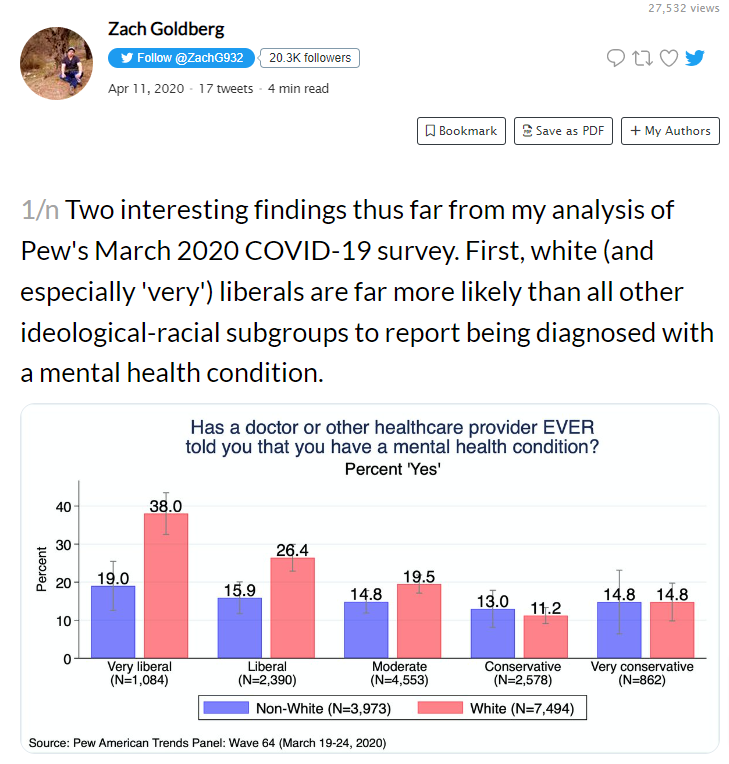
The difference is much more pronounced in the younger female aged category of 18 to 29-year-olds, with the highest percentage at a whopping 56%.
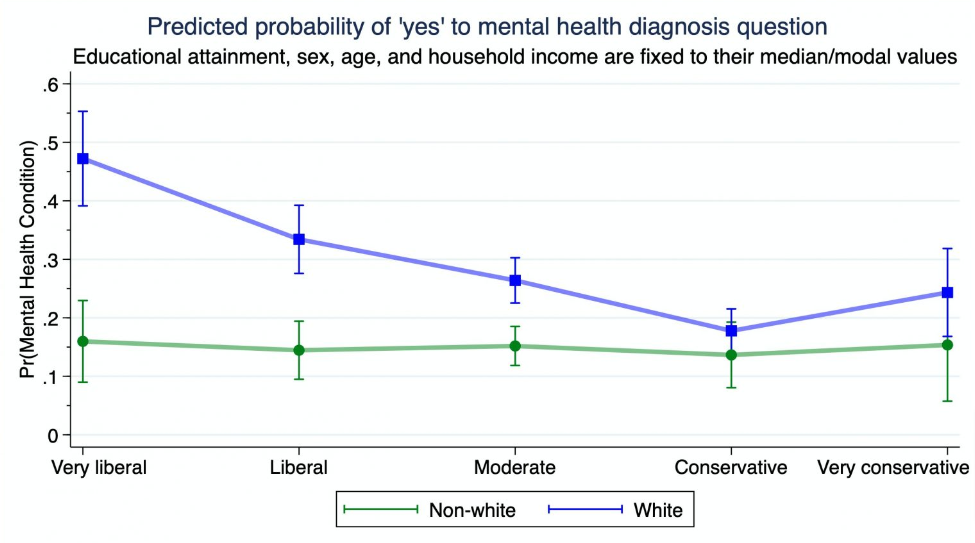
Here is an example of Pew Research statistics of young women diagnosed with a mental condition:
56% of young white liberals
28% of young white moderates
27% of young white conservatives
Here are the statistics of young men diagnosed with a mental condition:
34% of liberal/Democrat men
22% of moderate men
16% of conservative men
A recent study from the University of Pennsylvania found that conservatives were more likely to be happier and satisfied with their lives compared to liberals. The study also found that conservatives were more likely to have higher levels of well-being than liberals.
The study concluded that the difference in well-being was due to political ideology rather than demographics such as income or education level. It also found that this difference was most prominent in younger adults who were still forming their political ideologies.
Another study conducted by Duke University showed that liberals were more likely to experience depression than conservatives, and that they also had higher rates of suicide attempts as well.
Also, political conservatives are happier, healthier, and stronger than liberals. A 2012 study found conservatives score higher than liberals on personality and attitude measures that are traditionally associated with positive adjustment and mental health, including personal agency, positive outlook, transcendent moral beliefs, and generalized beliefs in fairness.
Several studies show conservatives believe more in cultural traditions of a developed society along with individual freedom combined with individual responsibility, a limited government, economic opportunity, strong national defense (and in-group preservation), and belief in a transcendent moral order.
In contrast, liberalism is based upon beliefs in progress, equality, tolerance, and pluralism in matters of morals, religion, and politics, and see government as a vital instrument for solving social injustice (Brooks, 2010; Chambers, Baron, & Inman, 2006; Hunter, 1992; Lakoff, 2002).
A 2019 political psychology study found that people with conservative political attitudes tend to have better physical health than their liberal counterparts (Chan, 2019).
In 2020, a study found that political ideology may also be relevant to mental health, as people who are more liberal, especially those identifying as “extremely liberal,” are more likely to have mental health problems.
The researchers found that these mental health issues on the Left were not just compared to conservatives, but also with those identifying as “liberal” or “slightly liberal.” This tendency for mental illness was more pronounced for people who identified as “extremely liberal,” who were reported to be worse off on several metrics.
However, the study found that those who identified as “extremely conservative” had comparable levels of mental health to those identifying as “conservative” and “slightly conservative.” Conservatives also reported being happier than liberal groups.
Another 2020 study investigated a large pool of adult Americans to see whether there was a relationship between political ideology and mental health. The researchers found a strongly elevated risk for mental illness among the extreme liberals (+150%), a small increase among the liberals and slightly liberals (+29 to 32%), and somewhat lower rates among conservatives and extreme conservatives (-17 to 24%).
Researchers in Brittain found people with clinical symptoms of anxiety disorders tend to express higher concerns about economic inequality and the environment, according to new research published in the International Journal of Psychology. The findings indicate that anxiety symptoms are slightly more common among those with a leftist worldview in Great Britain.
“It’s no wonder that researchers have been interested in the underpinnings of political orientation for so long,” said study author Vilja Helminen (@vilja_h), a doctoral candidate at the University of Helsinki.
“But a lot of the studies have focused on how individuals self-identify on a liberal-conservative continuum. So, we were interested in what goes on behind those labels, how threat sensitivity in the form of anxiety disorder symptoms is related to a wider range of political attitudes.”
Other studies have shown that while both conservatives and liberals experience stress, conservatives are better able to cope with stress than liberals, who tend to become depressed or anxious when facing difficult situations.
GNOSTIC WARRIOR CONCLUSION
It doesn’t take a psychiatrist to understand that some people in American culture suffer from mental illness. In fact, it is very common with nearly one in five U.S. adults living with a mental illness, which equates to 52.9 million people in 2020. This number must be much higher in 2022.
What that means is that when you walk down the street, 1 in 5 people you encounter are mentally ill. Now, we know that these people tend to be attracted to the left and liberalism.
There are several reasons why this may be so:
Conservatives tend to have stronger religious beliefs than liberals do, which gives them a sense of meaning in life and a sense of belonging that helps them cope with difficult situations.
Liberals often lack these things because they reject traditional religious beliefs and lack the support networks provided by church members who help one another through difficult times.
Conservatives are more likely to marry and stay married than leftists are, which provides them with another source of support during difficult times as well as social support for their ideas and beliefs from their spouse or partner. This is particularly true for men since men tend to be more active in politics than women do (although women have been getting more active recently).
I also believe that a major part of this problem is at U.S. universities because it is well-known that academics lean extremely to the left (especially in the softer fields), and show high rates of mental illness (Duarte et al., 2015; Kinman & Wray, 2013; Langbert, 2018).
Studies have also reported higher rates of mental illness among college students and PhD students in particular with a higher suicide rate (Levecque et al., 2017; Puthran et al., 2016; Rotenstein et al., 2016; Twenge et al., 2010).
This would help exacerbate the problem of mental health in younger liberal adults who are being influenced through the education system.
These findings above prove that there is a link between liberal political ideologies and mental health problems.
In recent years, there has been a rise in the number of people identifying themselves as liberals or leftists and also culture wars between the left and the right.
This can be attributed to a number of factors, including the increased acceptance of LGBTQ+ people, women and minorities in society; however, it is also mainly due to a growing prevalence of mental illness among this group and it is only getting worse by the year.
SOURCES:
Barry R. Schlenker a, John R. Chambers a, Bonnie M. Le b (2011) Department of Psychology, University of Florida, Gainesville, Florida, United States Department of Psychology, University of Toronto, Ontario, Canada
Chan, E. Y. (2019). Political orientation and physical health: The role of personal responsibility. Personality and Individual Differences, 141, 117–122. https://doi.org/10.1016/j.paid.2019.01.005
EOW Kirkegaard · 2020 MENTAL ILLNESS AND THE LEFT
Clinical symptoms of anxiety disorders as predictors of political attitudes: A prospective cohort study Vilja Helminen,Marko Elovainio,Markus Jokela First published: 13 August 2021 https://onlinelibrary.wiley.com/doi/full/10.1002/ijop.12796
Other sources listed above or linked to
Moe is the founder of GnosticWarrior.com. He is a father, husband, author, martial arts black belt, and an expert in Gnosticism, the occult, and esotericism.

by Moe | Jul 6, 2022 | Conspiracy, New World Order News
The world-famous Georgia Guidestones were damaged in a bomb attack early this morning.
According to the Georgia Bureau of Investigation (GBI), security cameras captured the moment the Guidestones were hit with an explosive device at around 4 am on Wednesday morning.
The GBI released surveillance video showing a car leaving the scene shortly after the explosion.
Later on Wednesday, Elbert County officials made the decision to take down the remainder of the granite monument at approximately 4:40 p.m. Wednesday.
The Guidestones received national attention on Last Week Tonight with John Oliver during Georgia’s May 24 gubernatorial primary when Republican candidate Kandiss Taylor said the Guidestones were satanic and made demolishing them part of her platform.
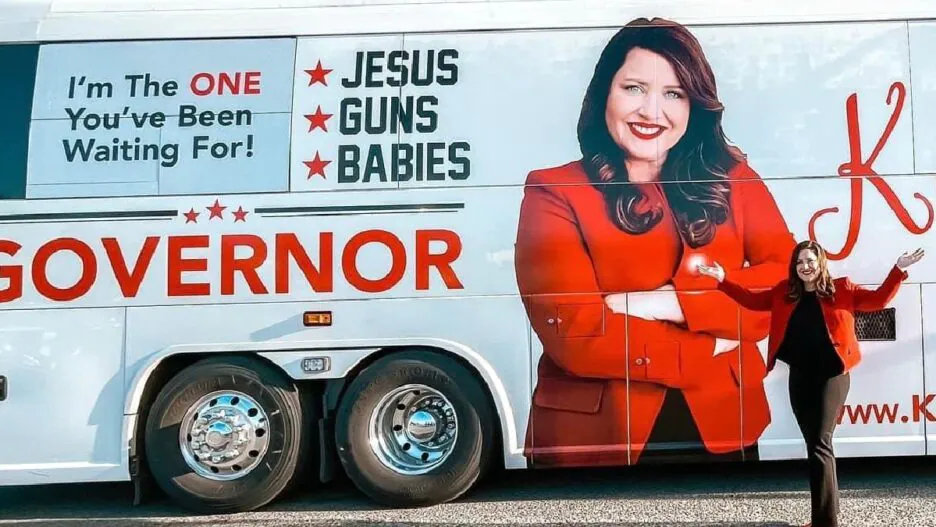
“God is God all by Himself. He can do ANYTHING He wants to do. That includes striking down Satanic Guidestones,” Taylor tweeted Wednesday morning.
In a campaign video, Ms. Tatlor talks about demonic human sacrifice and the new world order.
“Human sacrifice was a form of demonic worship, we’re still doing it in present day by killing our unborn,” she says, while a graphic about the number of abortions performed worldwide splashes across the screen. “It’s the same demons, the same sacrifice, the same sin, it’s just a different time.”
“The new world order is here and they told us it was coming,” she says.
The Georgia Guidestones were created by a man and a secret group who remains shrouded in mystery and intrigue. The only name we know for the author is R.C. Christian, which is said to be a pseudonym.
They are located at the top of a hill on the north-western brow of the Elberton Granite Finishing Company, about 5 miles (8.0 km) northeast of Elberton, Georgia, United States.
This is the third time the monument has been attacked. The first was in 2008, when graffiti was painted on the stones with slogans such as “Death to the new world order”. Then again, in September 2014, the stones were vandalized with paint stating, “I Am Isis, goddess of love”.
The massive stones have been at the center of a conspiracy for what is written on them.
The Georgia Guidestones: What the 10 guidelines say and the plan for depopulation
The Geogia Guidestones 10 Guidelines Read:
1) Maintain humanity under 500,000,000 in perpetual balance with nature.
2) Guide reproduction wisely — improving fitness and diversity.
3) Unite humanity with a living new language.
4) Rule passion — faith — tradition — and all things with tempered reason.
5) Protect people and nations with fair laws and just courts.
6) Let all nations rule internally resolving external disputes in a world court.
7) Avoid petty laws and useless officials.
8) Balance personal rights with social duties.
9) Prize truth — beauty — love — seeking harmony with the infinite.
10) Be not a cancer on the earth — Leave room for nature — Leave room for nature
Moe is the founder of GnosticWarrior.com. He is a father, husband, author, martial arts black belt, and an expert in Gnosticism, the occult, and esotericism.
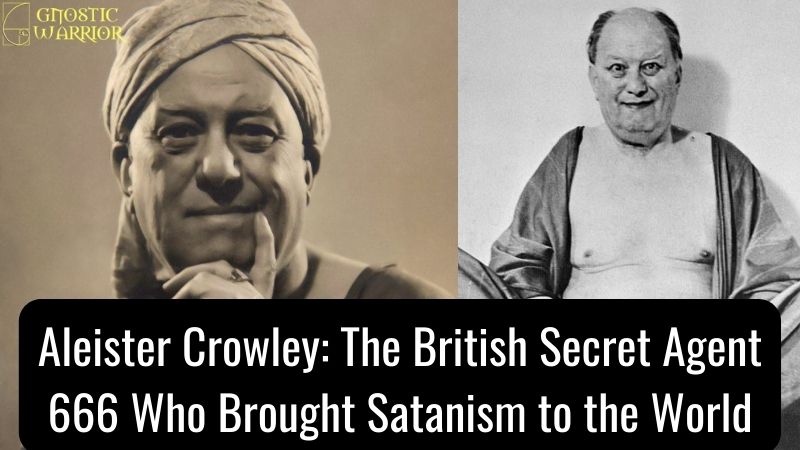
by Moe | Jul 6, 2022 | Mind Control Research, Neoliberalism, Propaganda, Satanism
It was determined that Aleister Crowley was an employee of the British Government but at present in this country on official business of which the British Counsel, New York City, has full cognizance.” – U.S. Military at West Point 1918
The world of the occult is full of mysteries and secrets, but there are some that are more intriguing than the rest. One such mystery is the life story of Aleister Crowley, who was one of the most influential and possibly dangerous Satanists of all time.
A lot has been written about that man – both good and bad. But what many people don’t know about Crowley is that declassified documents from the archives of the United States Army’s Military Intelligence Division (MID) have revealed he was actually a secret British intelligence agency spy. Crowley also admitted to being a spy in some of his writings, but many people did not take his word for face value.
For example, in his 1929 book, The Confessions of Aleister Crowley, and elsewhere, Crowley made vague references to his intelligence work, such as his 1914-19 mission in the U.S.A. as an anti-British propagandist, masked secret service on behalf of His Majesty.
According to the American historian and Professor of History at the University of Idaho, Author Richard B. Spence, Crowley used his role as The Great Beast and his ventures into the occult and Satanism to mask his role as a secret agent for British Intelligence.
Spence had studied many of these declassified documents from the U.S. Army’s Military Intelligence Division (MID) and first detailed this information in an essay he published titled: Secret Agent 666: Aleister Crowley and British Intelligence in America, 1914-1918, that later turned into a book, Secret Agent 666.
“He was such a disreputable and even evil character in the public mind that arguably no responsible intelligence official would think of employing him,” said Spence. “But the very fact that he seemed such an improbable spy was perhaps the best recommendation for using him.”
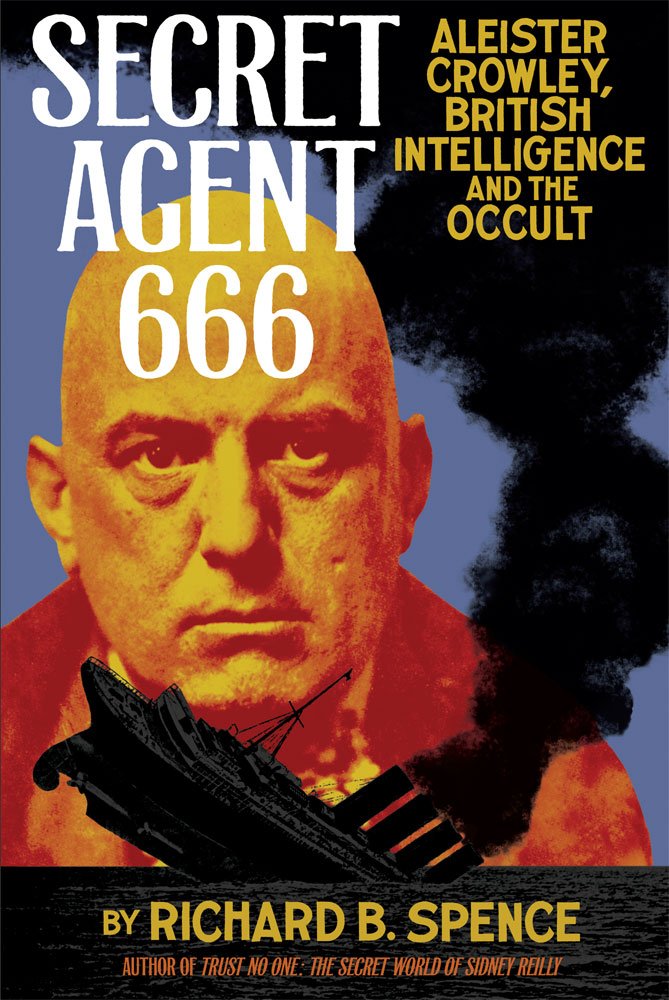
Richard Spence specializes in Russian intelligence and military history, and also the history of secret societies and the occult. There is no doubt that Spence is a seasoned academician, and a great historian who put an immense effort into researching and gathering documents in relation to the Crowley’s involvemnet as a paid asset for British Intelligence.
Spence studied government documents gleaned from British, American, French and Italian archives to reveal that Crowley played a major role in several international incidents in Germany, Moscow, and Ireland. He was even involved in a plot to overthrow the government of Spain, and the 1941 flight of one of Germany’s most famous Nazi’s, Rudolf Hess, who was obsessed with the occult.
Spence details Crowley’s travels, referencing his own work, the writings of others, interviews, official records, and so on, linking him to various schemes, and several of his acquaintances were involved in intelligence operations.
Spence had said;
In 1999, I was deep into researching the complicated and perplexing career of the “Ace of Spies,” Sidney Reilly. Intriguing synchronicities kept appearing between the movements of Reilly and Crowley. Most intriguing was the men’s overlapping presence in World War I in New York City, where Reilly was working, in his own devious way, for Britain’s “secret service.”
Crowley later claimed to have been doing the same, despite the blatant anti-British propaganda he had been writing for pro-German magazines during much of that time. Not surprisingly, Crowley’s subsequent protestations of loyal secret service to England mostly were dismissed as face-saving fantasy.
Still, the question seemed interesting enough to merit a look at whatever American security agencies’ records might hold on the subject. Eventually the files of the U.S. Army’s old Military Intelligence Division yielded a thin dossier on Crowley’s WWI activities.
This handful of documents contained one critical piece of information: during the war, American investigators, while probing the activities of suspected German spies, discovered that “Aleister Crowley was an employee of the British Government . . . in this country on official business of which the British Consul, New York City has full cognizance.”
Thus Crowley’s claim to have been His Majesty’s servant was true after all, at least to some degree.
Of course, this leads to the harder questions:what he did and with whom, and why. My preliminary exploration of those and related issues, “Secret Agent 666: Aleister Crowley and British Intelligence in America, 1914–1918,” appeared in the International Journal of Intelligence and Counter-Intelligence in the fall of 2000. Still immersed in the Reilly book and with other research projects in the pipeline, I did not intend to dig any deeper into Crowley’s intrigues.”
As Spence notes in his book, Crowley was well connected to not only prominent occultists, but he also had powerful friends in high places all around the world. People such as the famous senior British Army officer and military historian, Col. J.F.C. Fuller, who would be a guest at Adolf Hitler’s fiftieth birthday celebration.
Another friend, the American journalist and Moscow bureau chief of The New York Times, Walter Duranty, who became Stalin’s favorite and apologist. Crowley also had links to Winston Churchill, such as the writer Frank Harris, a guest at Churchill’s nuptials.
Much is Spences research investigates the Beast’s exploits in the U.S. from October 1914 to mid-December 1919, when Crowley specialized and was paid for feeding disinfo under the guise of a pro-German propagandist for a man named George Sylvester Viereck. It was rumored that he was the son of Kaiser William I, but later he was instead acknowledged as the son of Prince Augustus of Prussia.
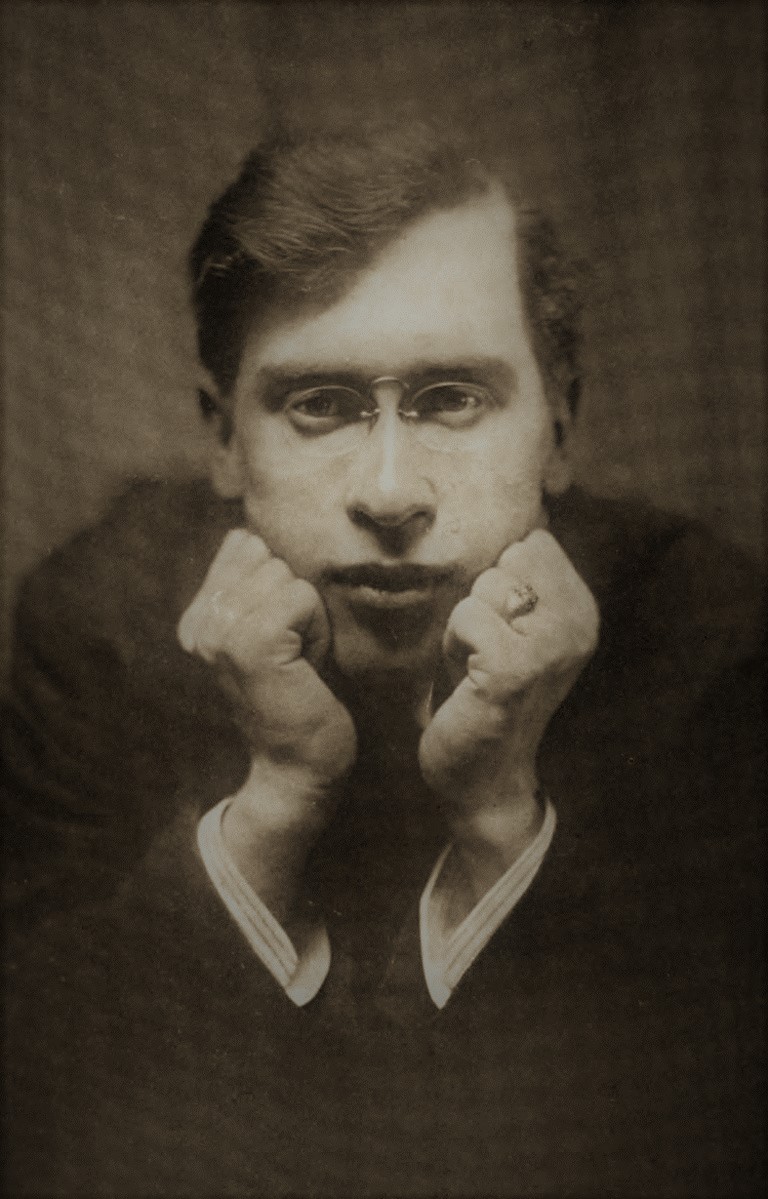
Viereck was a well-known member and supporter of the Nazi party who had hired Crowley to write anti-British articles for his two magazines, The International and The Fatherland, which argued for the German cause during World War I. He was also an aspiring occultist and a member of various secret societies who had a fondness for drugs, sex, and orgies.
Through Viereck, Crowley gained the attention of the “Propaganda Kabinett,” which was a secret group that included German-American journalists and academics, as well as German officials like the Kaiser’s military attaché in Washington, Franz von Papen, and Ambassador von Bernstorff.
Von Papen would be one of the men who would later help make Adolf Hitler the chancellor of Germany. After the war, Viereck was convicted in 1942 for this failure to register with the U. S. Department of State as a Nazi agent and was sent to prison from 1942 to 1947.
Crowley claimed that he was able to influence the Propaganda Kabinett during a March 1915 meeting to believe that “arrogance and violence were the best policy”, which led to a German U-boat torpedoing the British Ocean Liner RMS Lusitania off the coast of Ireland on May 7, 1915, and killing over 1,000 people.
The Americans, he explained, were like children; easily frightened and responsive to firmness.
As Spence notes, Crowleys columns for the weekly newspapers as “The Fatherland”, spying on Indian seditionists and militant Irish republicans, thwarting German-inspired sabotage and subversion on the West Coast (p. 102), rubbing elbows with anarchists like Emma Goldman and her lover and comrade-in-arms Alexander Berkman, etc.; all the while the Mage’s seasonal magickal retreats could serve as a cover for surveillance missions.
At the time, it was the perfect cover for Crowley.
It gave him carte blanche access to enter various countries like the U.S. and to interact with the country’s elite, such as George Sylvester Viereck, who most of them never suspected him of being a spy. As if Crowley’s public persona was a cover for his intelligence activity, and some, if not all of his “magickal workings” were simply diversions, deceptions, or covers for his real missions.
Crowley was also friends with Freemason, Theodor Reuss, the Grand Master of the German Ordo Templi Orientis, also known as the O.T.O. It is alleged that Reuss also worked for the Prussian Secret Police and later in the German secret service.
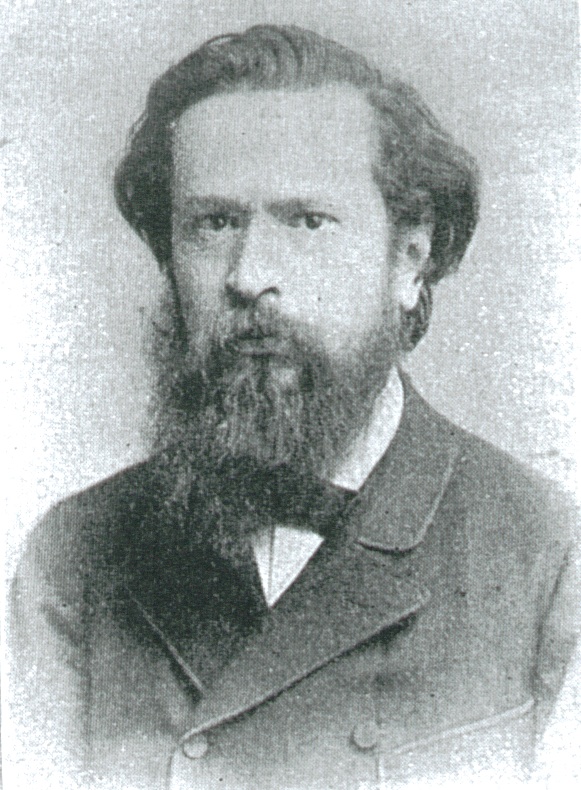
The O.T.O. is a magical group practicing tantric sex magic, kabbalistic rituals and drug experimentation. In 1910, while living in London, Reuss made Crowley a VII° of O.T.O., and in 1912, he appointed him National Grand Master General X° for the O.T.O. in the United Kingdom of Great Britain and Ireland. Crowley wrote Liber XV, the Gnostic Mass, which became incorporated into the Ordo Templi Orientis’ Gnostic Catholic Church.
Whether Reuss connection to Crowley tied him to German intelligence is another question. Regardless, they both remained in constant contact while Crowley secretly worked for Britain in America and Reuss served as the German Kaiser’s agent in Holland and Switzerland.
Spence notes in his book that intelligent assets like Crowley were ideal for this type of work because they had a level of unrepredicatability in their character (mental health) and that although they cannot be 100% trusted, they certainly can be useful.
“The occult angle might explain why the Germans have found this phony Irishman and affected fruitcake credible, For the Germans, as for the British, the crucial question about Crowley was not whether he could be trusted, but whether he could be useful” (p. 206).
The idea is for the intelligence agency to create a “Satanic Master or Guru” who bamboozles ignorant people with his woo-woo magic to mesmerize his victims into following his orders, offering up their cash, and revealing secrets as his unwitting puppets. These same people could be easily led into compromising and criminal situations that would be used to blackmail just about anyone they targeted.
Meaning, Crowley was most likely a grand faker and his antics were all a scam. A stage magician who used words, props and people’s ignorance to bamboozle and even mind control his targets – the elite and influential people of whatever country his propaganda was aimed.
Spence had said that Crowley’s ego was perfect for the job of a spy. He wrote;
“It might seem that someone so obsessively self-centered and disdainful of common decency as Aleister Crowley would make a poor spy. On the contrary, those very qualities helped to qualify him for the job. A strong, even ruthless, ego is essential for motivation and self-preservation; the only person the spy ultimately can rely on is himself. Espionage, street-level spying anyway, is at best morally suspect.
One British intelligence veteran, Bickham Sweet-Escott, recalled being told at his recruitment, “All I can say is that if you join us, you mustn’t be afraid of forgery, and you mustn’t be afraid of murder.” A 1950s contract agent for the CIA, George Hunter White, revealed this mindset with brutal candor when he recollected, “I toiled wholeheartedly in the vineyard because it was fun, fun, fun.
Where else could a red-blooded American boy lie, cheat, steal, rape and pillage with the sanction and blessing of the all-highest?”15 Crowley, the proponent of “Do What Thou Wilt,” would have found such an environment both convivial and rewarding on many levels,” Spence had said.
If Crowley’s mission were exposed, he would be simply labeled crazy, a Satanist, a liar, and a drug addict with ample supporting evidence to prove it. In addition, the fact that all intelligence records of his activities were always controlled by the very people who wished to keep this information secret and confidential in order to conceal his true mission.
That way London’s hands were clean. As Richard Spence notes, it’s called plausible deniability.
In his book, Spence claims Crowley used his magic and especially drugs to experiment with various mind control techniques. He wrote;
“The other thing he made good use of was drugs. In New York, he carried out very detailed studies on the effects of mescaline (peyote). He would invite various friends over for dinner, fix them curry and dose the food with mescaline. Then he observed and took notes on their behavior.”
Mescaline, Spence noted, was later used by intelligence agencies for experiments in behavior modification and mind control. Measuring the degree to which his occultism was a calculated cover “gets tricky,” said Spence. “From my perspective, it ultimately isn’t all that important whether he was sincere or a grand faker. He was certainly a person who could seem one thing while actually being something quite the opposite.”
Though extremely unconventional in his behavior, “when push came to shove, Crowley had a visceral loyalty to England,” said Spence. “Because he did things that could not be publicly discussed, he could never really defend himself against these charges, though he did make attempts to redeem his reputation.”
Spence details that Crowley wrote: “I did not feel that I was advancing in the confidence of the Germans,” he later wrote, and as a result he had been getting “no secrets worth reporting to London.” Sounds rather spy-ish behavior to me. Crowley the independent British Spy? (inside joke).
The rest of the book (ch. 13-4) focuses, among other things, on Crowley’s connections to people of importance in the Weimar Republic and the Third Reich. Chief among them were Karl Germer of OTO, Luftwaffe General Erich Ludendorff, old pals like Kurt Jahnke and George Viereck.
Jahnke worked under Deputy Führer and Hitler’s fraternal lover Rudolf Hess in a special intelligence bureau called ‘Abteilung Pfeffer’, whose mission was “the strengthening of Anglo-German relations by a mutual, unfettered exchange of views” (p. 245)
Recently, another researcher, Mike McClaughry, obtained one of these 100-year-old documents through the Freedom of Information Act (FOIA) showing that Crowley was in fact on a watchlist while in America. It also proves that the U.S. military knew that he was a secret agent working for the British government and that he may have also been a German spy.
The full title of the document is;
USNA MID 9140-815/1, extract of British ‘Watch List’, p106, entry #340, from c1916, concluded after US probe for German spies: ‘Aleister Crowley was an employee of the British Government […] in this country on official business of which the British Consul, New York City has full cognizance.
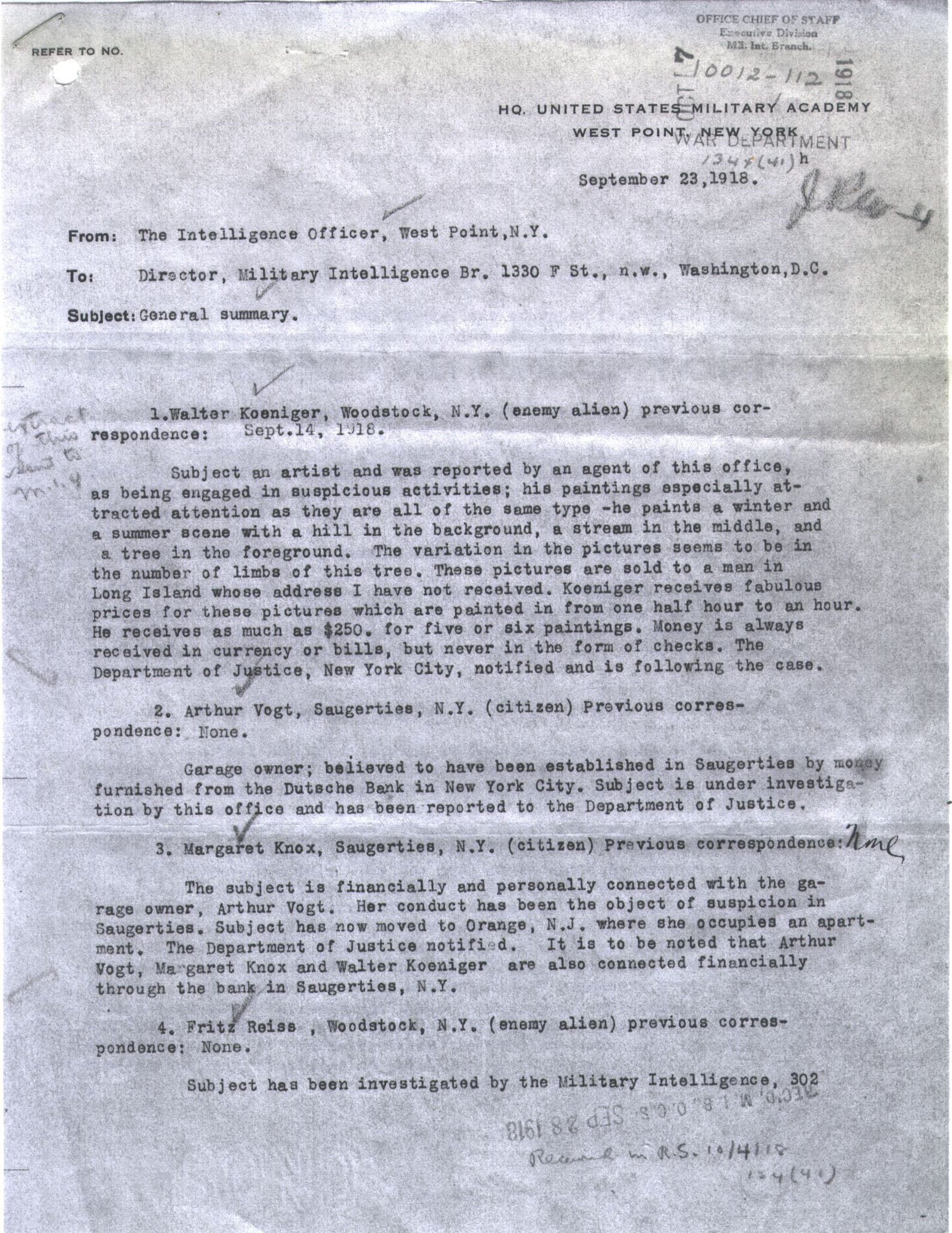
Here is the actual photo copy of the document – Intelligence Off Westpoint to MID Dir Re: Crowley Sept 23 1918
Page 2
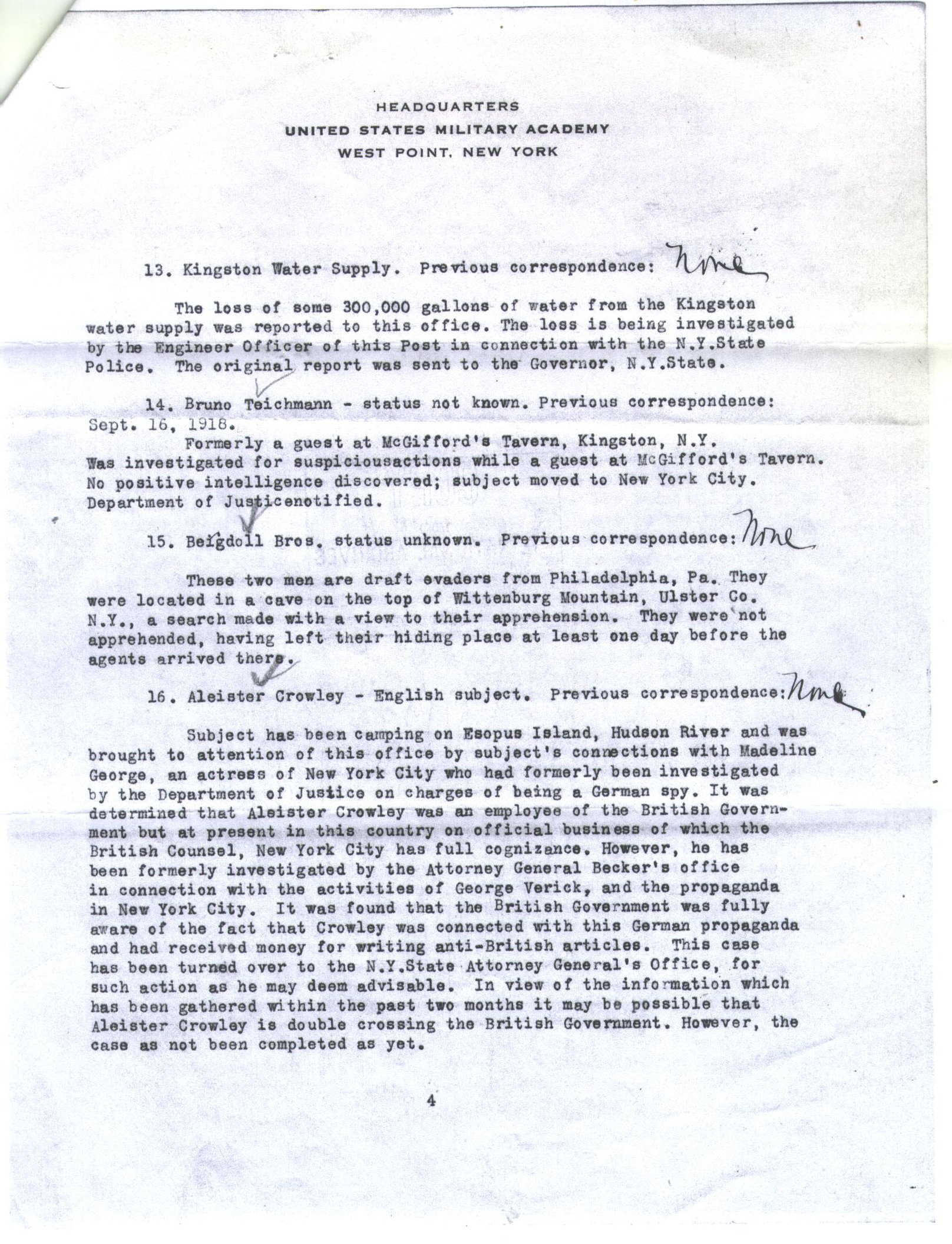
PDF version of Aleister Crowley British Agent 666
Here is the full text from the section that mentions Crowley;
16. Aleister Crowley – English subject. Previous correspondence: Subject has been camping on Esopus Island, Hudeon River and was brought to attention of this office by subject’s connections with Madeline George, an actress of New York City who had formerly been investigated by the Department of Justice on charges of being a German spy.
It was determined that Aleister Crowley was an employee of the British Government. but at present in this country on official business, of which the British Counsel, New York City, has full cognizance. However, he has been formerly investigated by the Attorney General Becker’s office in connection with the activities of George Verick, and the propaganda in New York City.
It was found that the British Government was fully aware of the tact, that Crowley was connected with this German propaganda and had received money for writing anti-British articles. This case has been turned over to the N.Y. State Attorney General’s Office, for such action as he may deem advisable.
In view of the information which has been gathered within the past two months, it may be possible that Aleister Crowley is double-crossing the British Government. However, the case has not been completed as yet.”
When you look at the evidence that Spence puts forth and the life of Crowley, you discover that he was an undercover British spy whose stage antics and teachings of Thelema may have really been meant to infiltrate, propagandize, and mind control his followers.
After all, true Gnosis (spiritual knowledge) is very powerful for the self will and also our true histories. Corrupt and control the Gnosis (spiritual knowledge) and its history, you not only control the people who venture into this world of the occult – you destroy them.
Crowley espionage opportunities for British intelligence provided him with the perfect cover to “Do Thou Wilt” in order to infiltrate, corrupt, and form various NeoGnostic and Satanic organizations for his handlers.
The evidence makes it pretty clear that British intelligence and possibly other intelligence agencies had used Crowley as an asset who was involved not only in pre-WWI Germany and Russia, but he was also deeply imbedded in these United States, gathering information on famous people while also helping influence American opinion.
All the while, he was spreading his dangerous doctrines around the globe. Infecting, indoctrinating, and initiating an entire generation of people in the West into his Satanic ideologies.
A secret Satanic cryptocracy controlling and manipulating the populace, all the while chipping away at the cultural Judeo-Christian values that once defined Western civilization to lead us to the End Times.
This is why author, Craig Heimbichner portrays Crowley in his book, Blood on the Altar as the propagator of “the world’s most dangerous secret society.”
The Satanists are in control and most people don’t even know it.
Moe is the founder of GnosticWarrior.com. He is a father, husband, author, martial arts black belt, and an expert in Gnosticism, the occult, and esotericism.